Bikram yoga classes are 90-minute sessions of the same 26 postures and 2 breathing exercises, taught in a room heated to about 40°C with 40% humidity. A teacher talks you through every posture with a scripted dialogue, without demonstrating. To find a real one, check the sequence, the heat, the length and the teacher's training.

That's the short answer. This page is the hub for everything else. You'll get the quick version of what a class involves, a 10-point checklist for spotting an authentic studio, the class formats you'll see on timetables, and links to our city guides. Where a topic already has its own detailed guide, we link to it instead of repeating it.
Bikram Yoga Classes at a Glance
Studio timetables use a lot of names: Bikram, Hot 26, 26&2, Original Hot Yoga. So it helps to know the fixed features first. All authentic Bikram yoga classes share the same core, whatever the sign on the door says.
- The sequence. 26 postures and 2 breathing exercises, always in the same order.
- The length. 90 minutes for the full class.
- The room. Around 40°C (105°F) with about 40% humidity.
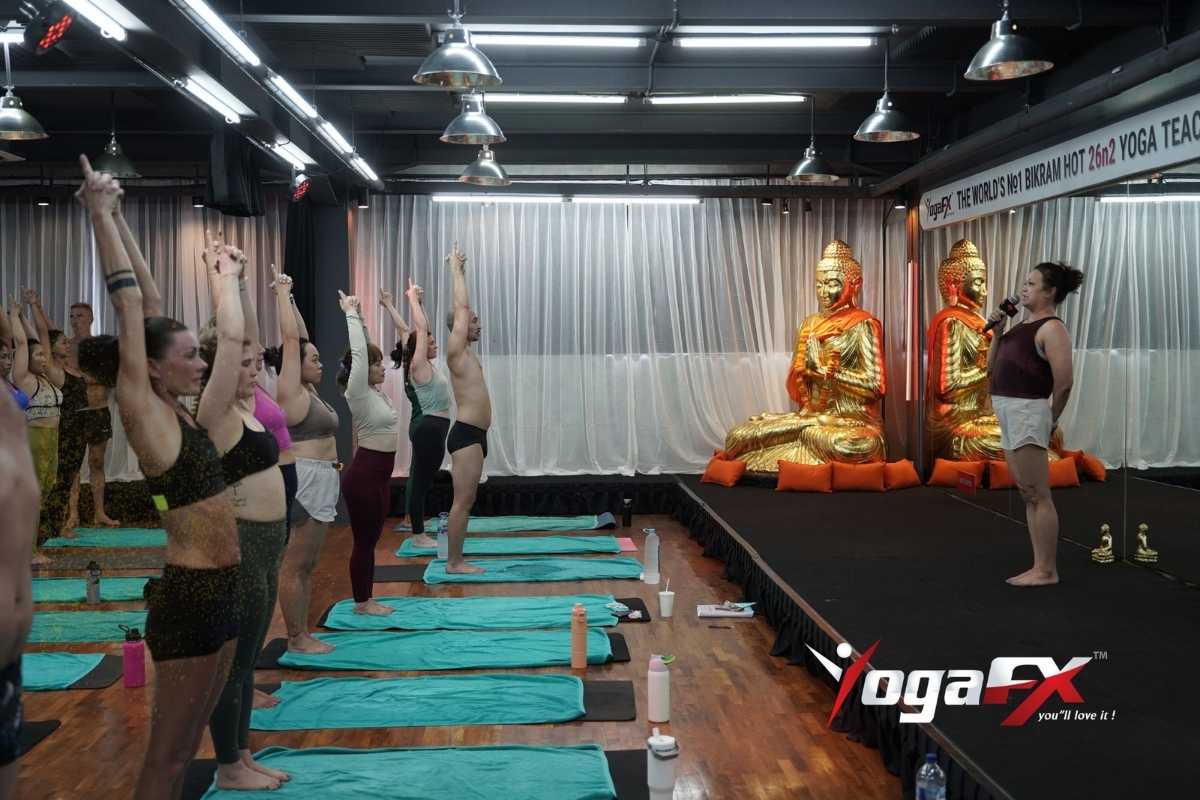
- The teaching. A spoken, scripted dialogue. The teacher doesn't practise on a mat at the front.
- The atmosphere. No music, no flow between poses, and no surprise "new" postures.
Because the sequence never changes, Bikram yoga classes feel familiar anywhere. You can walk into a class in New York, Melbourne or Bali and know what comes next. That consistency is the point. It lets you measure progress against yourself, class after class, instead of learning a new routine every time.
What Happens in a Bikram Yoga Class (The Short Version)
Bikram yoga classes have three parts. You won't need to memorise them, because the teacher's voice guides you the whole way. Still, knowing the shape of the 90 minutes makes the first one far less of a shock.
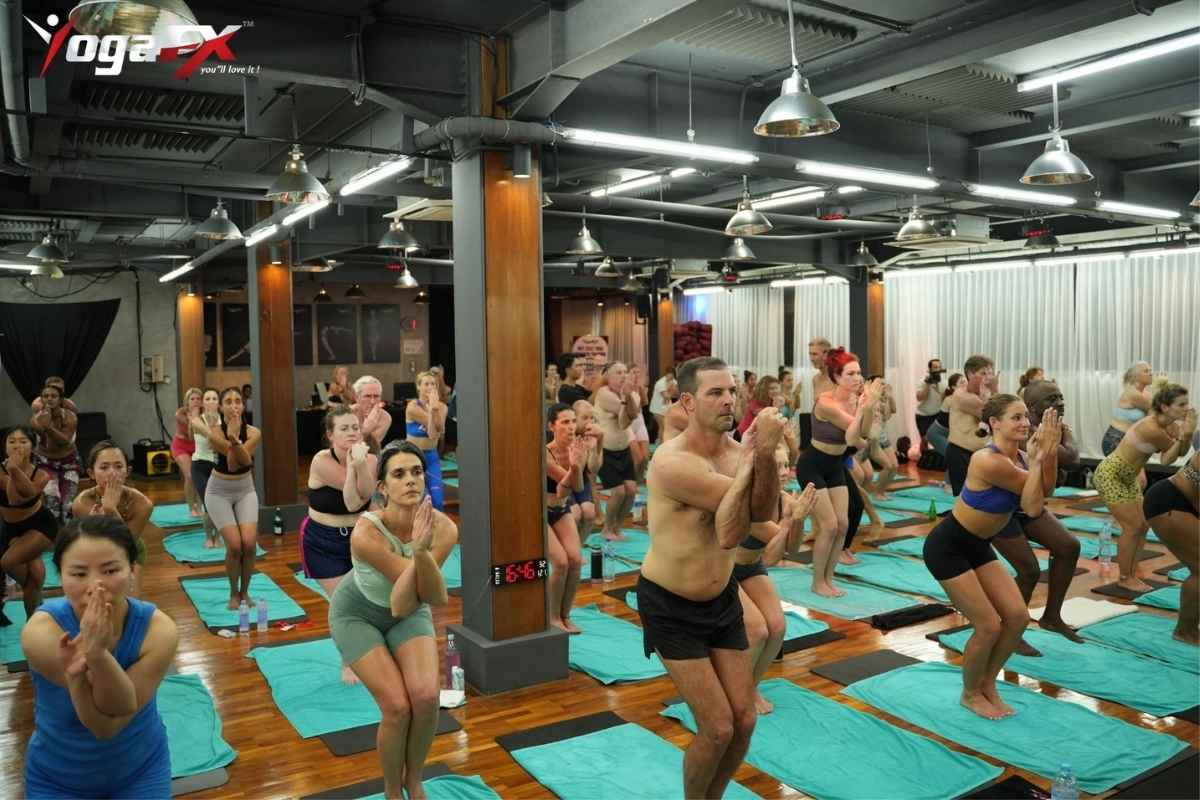
- Standing series. It opens with Pranayama, a standing deep breathing exercise. Then come the balancing and strength postures, starting with Half Moon. This is the hottest, hardest stretch for most beginners.
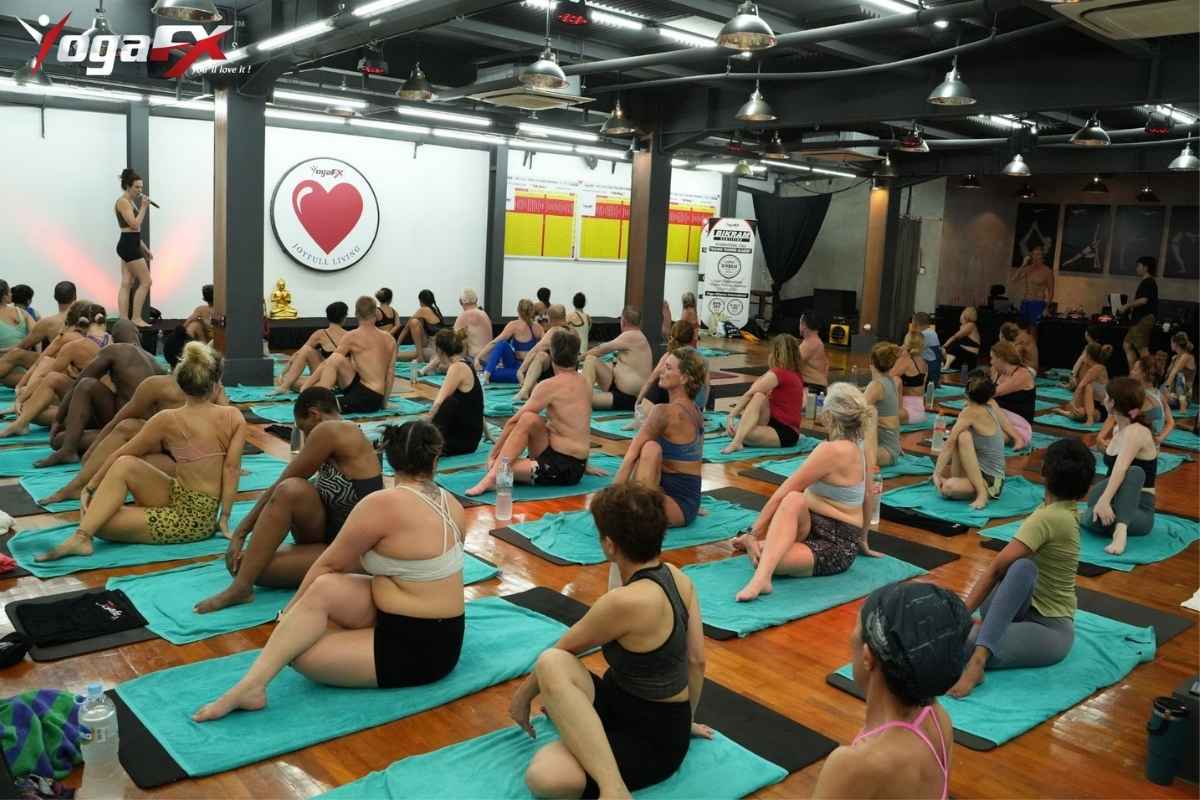
- Floor series. After a short Savasana (lying rest), you move through spine and back-strengthening postures on the mat, with brief rests in between.
- Close. A final breathing exercise and a last rest on your back.
That's all you need before booking. For the minute-by-minute breakdown, including why the heat and order matter, read our guide to what happens in a Bikram yoga class.

How to Choose Authentic Bikram Yoga Classes: A 10-Point Checklist
Many studios heat a room and call it hot yoga. That's fine, but it isn't the same practice as Bikram yoga classes. Use this checklist before you buy a class pass. Most answers are on the studio website, and the rest take one message to confirm.
- 1. The class description names the 26 postures. Look for "26 and 2", "Hot 26" or "Original Hot Yoga", not just "heated flow".
- 2. The full class runs 90 minutes. Shorter classes are fine as extras, but the full version should be on the timetable.
- 3. The sequence is fixed. If the studio says each teacher "creates their own class", it's a different style.
- 4. The room is about 40°C. Ask the studio for its target temperature.
- 5. Humidity is part of the answer. A good studio mentions humidity, not only heat.
- 6. Teachers use the dialogue. They teach by voice from the front, so they can watch every student.
- 7. Teachers can name their training. Ask where they trained and who trained them.
- 8. There's an easy way to try it. Most studios offer a free or discounted first class or an intro week.
- 9. Beginners get guidance. Staff should tell you where to set up and what to do if you need a rest.
- 10. You feel safe to sit down. A good teacher tells you that resting on your mat is always allowed.
Red Flags That Suggest a Different Style
Some signs tell you quickly that a class isn't the original method, even when the timetable lists it among its Bikram yoga classes. For example, loud music, a teacher demonstrating every pose, or postures that change week to week. None of these make a class bad. However, they do mean you're not getting the fixed 26&2 experience you searched for.
Questions to Ask the Teacher
The teacher matters more than the building. So ask two simple questions: "Where did you train?" and "How long have you taught this sequence?" A confident, specific answer is a good sign. For a deeper look at credentials and lineage, see how to find and verify an authentic Bikram yoga instructor.
Your First Week of Classes at a New Studio
Even a good checklist can't replace a real visit. So treat your first week as a trial. Take three Bikram yoga classes with at least two different teachers, if the timetable allows. Then ask yourself three things:
- Did the teacher notice you? A good teacher learns new names and checks on first-timers.
- Was the room consistent? The heat should feel similar from class to class.
- Did you leave wanting to come back? That feeling is the best predictor that you'll keep going.
If the answers are yes, buy the longer pass. If not, try another studio on your list.
Bikram Yoga Class Formats: 90-Minute, 60-Minute, Online and Bali
Once you know a studio is authentic, the next choice is format. Bikram yoga classes now come in several versions, and timetables often mix them. Here's how they compare.
| Format | What you get | Best for |
|---|---|---|
| 90-minute class | The complete 26 postures and 2 breathing exercises | Anyone who wants the full practice |
| 60-minute class | A shorter version with fewer sets or holds | Busy weekdays, as an extra to full classes |
| Online class | The dialogue at home, usually without the heated room | Travel weeks, or learning the sequence |
| Bali with YogaFX | Full 90-minute classes in natural tropical heat | Holidays, longer stays, or a path toward teacher training |
The Standard 90-Minute Class
This is the benchmark for Bikram yoga classes. Every posture gets its full set, and the rest periods sit where the sequence needs them. If you only take one format, take this one. Research on the practice, such as the studies below, looked at full-length sessions.
60-Minute Express Classes
Many studios add a 60-minute class for lunch breaks. You'll still sweat, and you'll still follow the dialogue. But something has to give, so holds or second sets get shorter. Treat it as a useful top-up, not a replacement.
Online Bikram Yoga Classes
Online Bikram yoga classes are great for learning the order and the cues. However, most of us don't have a room at 40°C at home, so the experience is different. Use them between studio visits. Our guide to Bikram yoga online compares free classes, livestreams and paid options.
Classes in Bali
Bali adds something electric heaters can't copy: natural tropical heat. Many students say Bikram yoga classes there feel easier to breathe in, because the warmth comes from the climate rather than a heater. We cover that option in detail further down, along with what it looks like if you decide to train as a teacher.
What the Research Says About Regular Classes
People take Bikram yoga classes for different reasons. Some want fitness, some want flexibility, and some just want 90 minutes away from their phone. The research gives a useful, honest picture of what regular practice may offer.
- Energy use. A University of Wisconsin study measured about 333 kcal for women and 460 kcal for men per 90-minute class, with heart rate near 80% of maximum (Porcari et al., 2014, PubMed).
- Strength and flexibility. In an 8-week trial, regular practice was linked to better flexibility and posterior chain strength (Tracy and Hart, 2013, PubMed).
- Mood. A Massachusetts General Hospital trial found 59% of people with depression in a heated yoga group had their symptoms halve or better, against 6% on the waitlist (Nyer et al., 2023, PubMed).
These results are encouraging, but they're not a promise. Research suggests the benefits of Bikram yoga classes build with regular attendance, which is why frequency matters. Our guide on how often you should do Bikram yoga sets out weekly plans by goal. If you have a heart condition, are pregnant, or manage any health condition, consult a healthcare professional before your first hot class.
Your First Class: What to Bring and How to Prepare
Preparation for Bikram yoga classes is simple, and we've written separate guides so this page stays short. Here's the essential list.
- A large towel to lay over your mat. You'll sweat more than you expect.
- A water bottle, and plenty of water through the day before class.
- Light, close-fitting clothes that don't trap heat. Skip heavy cotton.
- An empty-ish stomach. Eat lightly two to three hours before.
- Ten to fifteen minutes to arrive, register and tell the teacher you're new.
For the full kit list, see what to bring to your first hot yoga class. For clothes that work in the heat, read what to wear to Bikram yoga. And if you're brand new, our Bikram yoga for beginners guide walks you through the first ten classes.
Bikram Yoga Classes by City: Local Guides
Searching for Bikram yoga classes near you often brings up a map of studios and little else. So we wrote city guides that explain the local scene, how to check a studio there, and what the Bali option looks like from that city.
| City | What the guide covers |
|---|---|
| New York | Bikram yoga in New York: where to practise and what to expect |
| Melbourne | Bikram yoga in Melbourne: studios by suburb and teacher training |
| Sydney | Hot yoga in Sydney: studios, training and the Bali alternative |
| London | Bikram yoga in London: how to choose a studio and what to check |
| Philadelphia | Bikram yoga in Philadelphia: local classes and local training |
Your city isn't listed? Then use the 10-point checklist above with any map search for Bikram yoga classes. It works anywhere, because the method is the same everywhere.
Why Studios Use Different Names for the Same Class
You'll often find the same practice under different names, and that confuses a lot of new students. Here's the background in brief.
The sequence was popularised by Bikram Choudhury from the 1970s onward. Then, in 2015, a US appeals court ruled in Bikram's Yoga College of India v. Evolation Yoga that a sequence of yoga postures can't be protected by copyright.
As a result, any trained teacher can teach it. Since then, many studios have dropped the Bikram name from their Bikram yoga classes and use labels such as Hot 26&2, 26 and 2 yoga or Original Hot Yoga instead.
That means one practical thing for you. When you search for Bikram yoga classes, try all the names, not just one. A studio called "Hot 26" may teach exactly the class you want, while a studio with "hot" in its name may teach something else. The class description, not the brand, tells you which.
Taking Bikram Yoga Classes in Bali with YogaFX
If you're heading to Bali, or thinking about a longer stay, our studios in Seminyak and Canggu run Bikram yoga classes in the full 90-minute format from 06:00 to 22:00 every day. The rooms use Bali's natural tropical heat rather than electric heaters, and classes follow the dialogue, with no demonstrating and no music.

Classes are led by the team around Mr. Ian Terry, E-RYT 500, who has taught 12,000+ hours. He trained for five years, from 2014 to 2019, directly with Bikram Choudhury, the founder of the Bikram Hot 26&2 method. Since founding YogaFX in 2017, he has trained 1,500+ graduates from 80+ countries.
Students often tell a similar story. One arrived unable to touch his toes and left doing every posture fully. Another dreaded his first class, felt he wouldn't survive it, and then felt better than he had in years. You can read them yourself: we have 150 Google reviews, 50 Yoga Alliance reviews and 357 video testimonials on YouTube.
New to the studio? Ask for a Free Guest Pass through the YogaFX Bali studio website and try a class first.
From Student to Teacher: The Soft Next Step
Some students find that one of our Bikram yoga classes a week turns into five, and then into a question: could I teach this? That's what our Bikram Hot 26&2 Yoga Teacher Training MasterClass is for. It's a hybrid course, with online study first and then 6 days in Bali, leading to Yoga Alliance RYT 200 plus a Bikram Hot 26&2 certificate.
- Next batch: 24 to 29 January 2027, at Soham Wellness Center in Seminyak.
- Price: US$1,899 Early Bird, against the standard US$1,999.
- Payment: instalments from US$250 a month, interest free, with a very low deposit.
There's no pressure to decide now. If you're curious, read the 6-day Bikram yoga teacher training guide for dates, formats and costs. Or try the readiness quiz to see where you stand.
FAQ
How long are Bikram yoga classes?
A standard class lasts 90 minutes. That covers all 26 postures and 2 breathing exercises, with built-in rests. Many studios also run 60-minute express classes for busy days, but they shorten holds or sets. If you want the full practice, choose the 90-minute class whenever your schedule allows.
What is the difference between hot yoga and Bikram yoga?
Hot yoga is any yoga practised in a heated room, and the sequence often changes from class to class. Bikram yoga is one specific practice: the same 26 postures and 2 breathing exercises, 90 minutes, about 40°C, taught with a spoken dialogue. All Bikram yoga is hot yoga, but not the other way round.
Is Bikram yoga good for you?
Research suggests regular classes may improve flexibility, strength and mood, and a 90-minute session uses about 333 to 460 kcal. The heat isn't right for everyone, though. If you're pregnant or have a heart, blood pressure or other health condition, consult a healthcare professional before you start.
How often should you do Bikram yoga?
Three to four classes a week is a common goal for steady progress, and it's close to what studies used. Two a week still helps if time is tight. Start slowly while your body adapts to the heat, then build up. Daily practice suits experienced students who recover well between classes.
Are online Bikram yoga classes worth it?
Yes, as a supplement. Online classes help you learn the order of the postures and the dialogue cues, and they keep you moving when you travel. Most homes can't reach 40°C, so the experience is milder. Combine them with studio classes rather than replacing the heated room completely.
Is the first Bikram yoga class free?
Many studios offer a free or discounted first class, or a low-cost intro week, so you can try the practice before committing. Policies vary, so check the studio's website or message them first. At YogaFX in Bali, new visitors can ask for a Free Guest Pass before their first class.
Still have questions? Message Mr. Ian on WhatsApp and the YogaFX team will answer you personally, or take the readiness quiz if teaching is on your mind.