
Benefits of Bikram Yoga is the most extensively researched yoga format in peer-reviewed literature. The combination of a fixed 26-posture sequence, a precisely controlled heat and humidity environment, and a consistent 90-minute structure makes it unusually measurable as a subject for clinical research. The benefits documented below are not anecdotal: they are quantified, published in indexed journals, and reproducible.

This guide covers 15 specific benefits supported by research, with a clear distinction between what is documented in peer-reviewed studies, what is attributed in traditional Bikram instruction, and what remains plausible but unconfirmed.
Bikram yoga produces 15 documented benefits including: 333–460 kcal calorie burn per 90-minute session, 20% strength increase after 8 weeks, 9% balance improvement, accelerated flexibility from heat, cardiovascular conditioning at 80% maximum heart rate, significant depression reduction (Harvard MGH 2023 RCT), improved sleep quality, and stress and cortisol reduction.
These benefits are maximised in natural humid heat, the tropical environment YogaFX practices in daily at its Bali studios. For a look at how the heated environment compares to a room-temperature practice, see how Bikram differs from Ashtanga.
Want every posture in order, filtered by difficulty, focus area or health benefit?
The Research Foundation
Three studies form the primary evidence base for Bikram yoga's documented benefits. Understanding these studies, their design, their measurements, and their limitations, is what separates credible benefit claims from yoga marketing:
| Study | Design | Key Findings |
|---|---|---|
| Porcari et al., 2014 (University of Wisconsin) PubMed: 24700459 | Direct metabolic measurement during actual 90-minute Bikram classes using portable devices | 333 kcal (women) / 460 kcal (men) per session. Heart rate averaged 80% maximum. |
| Tracy & Hart, 2013 PubMed: 23438366 | 8-week controlled study, 3–4 sessions/week. Standardised pre and post testing. | 20% deadlift strength increase. 9% balance improvement. Significant flexibility gains. Reduced body fat percentage. |
| Nyer et al., 2023 (Harvard MGH) PubMed: 37883245 | Randomised controlled trial. 80 adults with moderate-to-severe depression. 8-week Bikram yoga intervention. Published in Journal of Clinical Psychiatry. | 59% of participants cut their depression symptoms by half or more after 8 weeks of heated yoga, versus 6% on the waitlist. |
Physical Benefits
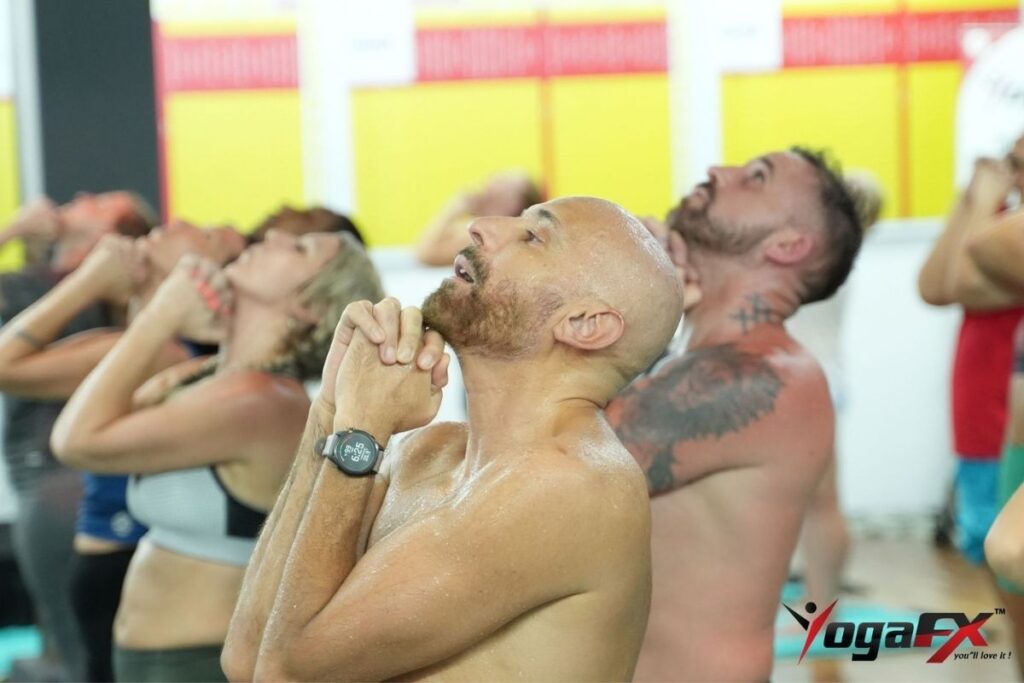
1. Significant Calorie Burn Per Session
The University of Wisconsin 2014 study measured 333 kcal for women (average 68kg) and 460 kcal for men (average 82kg) per 90-minute Bikram session using direct metabolic measurement, not MET estimates. Heart rate averaged 80% of maximum throughout the session, equivalent to moderate-intensity cycling.
At 3–4 sessions per week, this produces approximately 1,000–1,800 kcal of weekly calorie expenditure from Bikram yoga alone, a meaningful contribution to any weight management programme.
2. Measurable Strength Increases
The Tracy and Hart (2013) study found a 20% increase in deadlift strength after 8 weeks of consistent Bikram yoga practice at 3–4 sessions per week. This is a controlled measurement using standardised pre and post testing, not incidental strength development.
The standing series is specifically responsible: Awkward Pose (three-part squat), Eagle Pose (loaded single-leg squat), and the sustained isometric demand of the balance postures collectively produce progressive lower body and core strength gains.
While a static 26-pose sequence builds immense isometric stamina, analyzing how Bikram compares to Power Yoga for strength reveals different muscular adaptations.
3. Accelerated Flexibility
Heat increases connective tissue extensibility: the collagen and elastin fibres that make up tendons, ligaments, and fascia are more pliable at 40°C than at room temperature. This allows deeper ranges of motion with lower injury risk than equivalent movements at room temperature. The Tracy and Hart (2013) study documented significant improvements in lower back and hamstring flexibility after 8 weeks. Practitioners consistently report flexibility gains in hot yoga that exceed what months of room-temperature practice produced. For an evidence-graded summary of which benefits are proven and which are not, see this guide to 26 and 2 yoga benefits and honest limits.
4. Cardiovascular Conditioning
Maintaining 80% of maximum heart rate throughout a 90-minute session, the measurement from the University of Wisconsin 2014 study, is equivalent to a moderate-intensity cycling session in cardiovascular demand. The thermoregulatory component of the heat creates a cardiovascular demand independent of the exercise load. Consistent Bikram practice over 8–12 weeks produces measurable improvements in resting heart rate, VO2 max, and cardiovascular efficiency.
5. Improved Balance and Proprioception
The Tracy and Hart (2013) study documented a 9% improvement in standing balance after 8 weeks. The Bikram standing series contains six single-leg balance postures: Eagle, Standing Head to Knee, Standing Bow, Balancing Stick, Tree Pose, and Toe Stand, each demanding sustained proprioceptive work in a heated, cardiovascularly elevated state. The compound challenge of heat plus elevated heart rate plus single-leg balance creates a proprioceptive training stimulus that room-temperature balance work does not replicate.
6. Body Composition Improvement
The Tracy and Hart (2013) study found measurable reductions in body fat percentage alongside the 20% strength increase over 8 weeks. The combination of calorie burn per session (333–460 kcal), lean muscle building from the strength demands of the standing series, and the metabolic rate elevation from regular cardiovascular work creates body composition improvements that scale weight alone does not capture.
7. Spinal Health and Mobility
The Bikram sequence systematically targets the spinal column through every plane of movement: lateral flexion (Half Moon), forward flexion (Standing Separate Leg Stretching, Hands to Feet, Rabbit), extension (Cobra, Locust, Full Locust, Bow, Camel), rotation (Spine Twist), and combined planes (Triangle, Standing Head to Knee). No other yoga format in a single session addresses the spine as completely.
Practitioners with chronic lower back tightness, mild disc compression, or sedentary posture habits frequently report Bikram yoga as the most effective single practice for spinal mobility improvement.
Postures like Locust and Cobra target the deep back muscles directly; here is how Bikram yoga versus Pilates for core development differs in execution.
8. Joint Health and Lubrication
Eagle Pose opens 14 major joints simultaneously through a compression-and-release mechanism that moves synovial fluid through the joint space. The heat at 40°C increases synovial fluid mobility, making this compression-and-release cycle more effective than at room temperature. Wind-Removing Pose similarly addresses the hip joints, spine, and colon through compression. Practitioners with joint stiffness, early-stage arthritis, or reduced mobility from sedentary work consistently report measurable joint mobility improvement within weeks of regular practice.
9. Bone Density Preservation
Weight-bearing yoga postures, particularly the standing series, mechanically load the bones through the feet, legs, and spine. This mechanical loading stimulates bone remodelling and helps maintain bone mineral density. Research published in Topics in Geriatric Rehabilitation found consistent yoga practice can maintain or improve bone mineral density in the spine and hips. This benefit is particularly relevant for practitioners over 40 and post-menopausal women for whom bone density preservation is a primary health concern.
Mental and Psychological Benefits

10. Clinically Documented Depression Reduction
The 2023 Harvard Medical School randomised controlled trial enrolled 80 adults with moderate-to-severe depression. The yoga group practiced 90-minute Bikram hot yoga classes at 40°C for 8 weeks. Results: 59% of participants cut their depression symptoms by half or more after 8 weeks of heated yoga, versus 6% on the waitlist.
The proposed physiological mechanism involves whole-body hyperthermia: sustained core temperature elevation may activate serotonin and other mood-regulating pathways consistent with existing research on whole-body hyperthermia therapy for mood disorders. A 2019 community-delivered pilot study found comparable preliminary results, providing the feasibility evidence that preceded the Harvard RCT.
11. Stress Reduction and Cortisol Regulation
The sustained meditative focus required by the Bikram sequence (following verbal instruction, maintaining postures in heat, staying present despite physical challenge) activates the parasympathetic nervous system and reduces cortisol output. The heat shock protein response triggered by the 40°C environment is also associated with cellular stress resilience, providing a physiological mechanism for the stress reduction effect beyond the behavioural focus of the practice.
12. Improved Sleep Quality
Regular Bikram yoga practice is associated with improved sleep quality through multiple physiological mechanisms: physical fatigue from the demanding session promotes deeper sleep onset, cortisol reduction normalises the circadian cortisol rhythm, and the thermoregulatory response to heat exposure (core temperature elevation followed by gradual cooling) mirrors the body's natural sleep preparation process. Practitioners consistently report improved sleep as one of the first noticeable benefits, typically appearing within 2–4 weeks of consistent attendance.
13. Enhanced Mental Focus and Concentration
Maintaining the demanding balance postures (Standing Head to Knee, Standing Bow, Balancing Stick) in a room at 40°C with elevated heart rate requires sustained concentration that few other physical practices demand. The four-stage progression of Standing Head to Knee specifically trains the ability to hold focused attention under physical stress over an extended period. Many practitioners report improved focus, attention, and mental clarity that extends into work and study performance.
14. Anxiety Reduction
The breath-focused, present-moment demands of the Bikram sequence function as a moving meditation: the mind cannot focus on external anxieties while simultaneously managing the physical and thermal demands of the practice. A 2018 review in the Journal of Alternative and Complementary Medicine found consistent evidence for yoga's anxiety-reducing effects across styles. The intensity of the hot yoga environment creates an accelerated version of this effect through the total absorption required to complete the standing series.
Bikram-specific data points the same way. Szabo and colleagues measured participants before and after a single 90-minute Bikram class and found lower state-anxiety (the acute, in-the-moment kind, as opposed to a long-term anxiety trait) and more positive mood afterwards, with the biggest shifts in people reporting high everyday stress. The 2025 systematic review above notes this effect is similar to what strenuous exercise or unheated yoga produces, so treat it as a real but not heat-exclusive benefit. For the full evidence and caveats, see our guide to Bikram yoga for anxiety.
15. Improved Body Awareness and Proprioception
The consistent mirror-feedback practice of Bikram yoga (every posture performed while observing alignment in a mirror) develops body awareness and kinaesthetic intelligence that extends beyond the studio. Practitioners report improved posture, more intuitive movement patterns, and a stronger mind-body connection after consistent practice. For practitioners who spend significant time in sedentary work environments, this proprioceptive improvement addresses the postural and movement quality degradation that sedentary work systematically produces.
Which Postures Drive Which Benefits
Most benefits content treats the 90-minute class as one undifferentiated block. It isn't. The 26 postures and 2 breathing exercises fall into groups that each load a different system, which is why a single fixed sequence produces such a broad spread of measured effects rather than one narrow one.
| Posture Group | Primary Benefit | Example Postures |
|---|---|---|
| Standing series | Balance, leg strength, cardiovascular load under sustained heat | Half Moon, Awkward Pose, Standing Bow Pulling |
| Backbends | Spinal extension, posterior chain strength, chest and shoulder opening | Cobra, Locust, Bow, Camel |
| Forward folds | Hamstring and lower back flexibility, nervous system down-regulation | Hands to Feet, Standing Separate Leg Stretching, Rabbit |
| Twist | Spinal rotation, core engagement | Spine Twisting Pose |
| Breathing exercises | Breath control, entry and exit nervous-system reset | Pranayama Deep Breathing, Kapalbhati |
Standing Bow Pulling Pose shows why the grouping matters. It asks for single-leg balance, hip flexor and quadriceps flexibility, and shoulder mobility at the same time, in a room where sweat makes grip and balance measurably harder than at room temperature. That combined demand is why practitioners often name it as the posture where their before-and-after progress is most visible: it exposes every weak link in the chain at once. For hold times, alignment cues and dialogue for all 26 postures, see the complete Bikram posture reference.
What the Largest Review to Date Adds
A 2025 systematic review in Sports Medicine – Open (Willmott et al.) pooled 43 hot yoga studies covering 942 participants, 74% of them practising Bikram. Across repeated practice it found improvements in body composition, blood lipids, vascular function, bone mineral density, balance and flexibility, with no negative effect on kidney function or sleep.
The same review is honest about the limits, and so are we: a single heated session raises core temperature and heart rate but not energy cost compared with the same yoga unheated, the psychological findings are promising but not yet conclusive, and claims that hot yoga beats other exercise are not yet proven. Our guide to the benefits of hot yoga across heated styles breaks down what the heat itself adds. Its authors also recommend arriving hydrated, rehydrating after class without over-drinking, and building up gradually over the first 7 to 14 sessions, which matches how YogaFX introduces new students to the heat.
What Is Attributed vs What Is Documented
Intellectual honesty about Bikram yoga's benefits requires distinguishing between what the research confirms and what the teaching tradition attributes. The table below makes this distinction explicit:
| Benefit | Status | Source |
|---|---|---|
| Calorie burn 333–460 kcal / 90 min | ✅ Peer-reviewed | Porcari et al. 2014 |
| 20% strength increase (8 weeks) | ✅ Peer-reviewed | Tracy & Hart 2013 |
| 9% balance improvement (8 weeks) | ✅ Peer-reviewed | Tracy & Hart 2013 |
| 59% halved depression symptoms (8 weeks) | ✅ Peer-reviewed RCT | Harvard MGH 2023 |
| Cardiovascular conditioning at 80% max HR | ✅ Peer-reviewed | Porcari et al. 2014 |
| Thyroid / thymus stimulation | 📖 Attributed, traditional teaching | Bikram lineage instruction |
| Pituitary gland stimulation | 📖 Attributed, traditional teaching | Bikram lineage instruction |
| Kidney stimulation via Eagle Pose | 📖 Attributed, traditional teaching | Bikram lineage instruction |
The attributed benefits are presented in traditional Bikram teaching and are part of the lineage instruction. They are not dismissed here; they are distinguished. The peer-reviewed benefits are documented in controlled research. Both are part of the Bikram yoga tradition; the distinction helps practitioners and teachers present the practice with credibility rather than overclaiming.
Where These Benefits Come From: YogaFX and the Original Bikram Method in Bali
These findings describe the Bikram method generally, but the environment they were measured in matters. Original Hot 26&2 Yoga, as taught by Mr. Ian Terry at YogaFX in Seminyak and Canggu, Bali, uses natural tropical heat rather than electric room heaters, the same humid 40°C conditions the Porcari and Tracy & Hart studies were conducted in.
Ian has logged more than 12,000 teaching hours and trained more than 1,500 graduates from over 80 countries since founding YogaFX in 2017, after training for five years, from 2014 to 2019, directly with Bikram Choudhury, the founder of the Bikram Hot 26&2 method.
For practitioners who want to go beyond attending classes and actually teach the method, YogaFX's six-day intensive teacher training combines the scripted 26&2 dialogue with dual certification: Yoga Alliance RYT 200 alongside the Bikram Hot 26&2 credential. Graduates leave with the same research-backed sequence covered above, plus the ability to deliver it themselves.
FAQ
What are the main benefits of Bikram yoga?
The main peer-reviewed benefits: 333–460 kcal calorie burn per 90-minute session, 20% strength increase after 8 weeks, 9% balance improvement, significant depression reduction (59% of participants in the Harvard 2023 RCT cut their symptoms by half or more after 8 weeks, versus 6% on the waitlist), accelerated flexibility from heat, cardiovascular conditioning at 80% maximum heart rate, and improved body composition.
How quickly do you see the benefits of Bikram yoga?
Most practitioners notice improved heat tolerance and flexibility within 5–10 classes. Sleep improvements and stress reduction are typically reported within 2 weeks. Measurable strength and body composition changes develop over 6–8 weeks at 3–4 sessions per week. Mental health improvements were observed within 8 weeks in the Harvard 2023 RCT.
Is Bikram yoga good for mental health?
Yes. It is the most extensively clinically researched yoga format for mental health outcomes. The 2023 Harvard Medical School RCT found 8 weeks of Bikram hot yoga led 59% of participants to cut their depression symptoms by half or more, versus 6% on the waitlist. Benefits for anxiety and stress are also documented in the wider hot yoga literature.
Are the benefits of Bikram yoga different from regular yoga?
Yes, in specific ways. Hot yoga at 40°C adds a thermoregulatory cardiovascular demand that room-temperature yoga does not produce, which accounts for the higher calorie burn and stronger cardiovascular effect. The heat also accelerates flexibility gains, and the fixed sequence adds progressive strength and balance benefits that variable-sequence yoga cannot systematically replicate.
How often do I need to practice Bikram yoga to get the benefits?
Research supports 3–4 sessions per week over a minimum of 8 weeks for measurable strength, flexibility, and body composition changes. The Harvard 2023 depression RCT found mental health benefits with as little as 1 session per week, though larger effect sizes came with higher attendance.