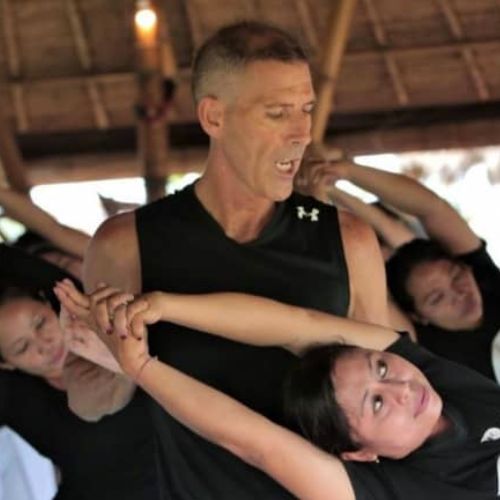
Eagle Pose - Garurasana in Sanskrit - is posture 4 in the Bikram yoga standing series. It is the most joint-efficient posture in the entire sequence: no other single pose simultaneously opens as many major joints in as little time. The 14 joints referenced in the Bikram dialogue are not a marketing figure - they are a specific anatomical claim about what the wrapping mechanics of the posture accomplish.

This guide covers what Eagle Pose is designed to do, which 14 joints are involved and how, how to perform the wrapping mechanics correctly, the most common errors that reduce the joint-opening benefit, and how to modify the posture for practitioners who cannot yet achieve the full wrap.
Eagle Pose (Garurasana) is posture 4 in the Bikram yoga standing series - a single-leg balance with both arms and one leg wrapped around the opposite limb. Primary benefit: simultaneous opening of 14 major joints through a compression-and-release mechanism. The joint benefits are achieved through squeezing, not stretching - unlike most yoga postures. Hold time: 10 seconds per side, 2 sets. The depth of the squat determines the effectiveness of the joint opening.
Want every posture in order, filtered by difficulty, focus area or health benefit?
Where Eagle Pose Sits in the Standing Series
Eagle Pose is the fourth posture in the standing series, following Awkward Pose. This placement is deliberate. Awkward Pose activates the quadriceps, glutes, and ankle stabilisers through progressive loaded squats. Eagle Pose arrives when this lower body activation has occurred - the standing leg in Eagle requires the same quadriceps engagement and knee stability that Awkward Pose develops.
Eagle also serves as the first single-leg balance posture of the class. The joint-opening function of Eagle prepares the body specifically for the cardiovascular standing balance postures that follow: Standing Head to Knee, Standing Bow, and Balancing Stick all require the hip, knee, and shoulder joint mobility that Eagle Pose begins to develop.
The 14 Joints: What They Are and How Eagle Opens Them
The Bikram dialogue states that Eagle Pose opens 14 major joints simultaneously. This is the anatomical foundation of the posture's therapeutic value. The joint opening operates through a compression-and-release mechanism - not a stretch. Eagle squeezes each joint through a specific angle, compresses the surrounding tissue and joint capsule, and then releases. On exit, fresh synovial fluid floods the joint space.
| Joint Group | Joints Involved | How Eagle Opens Them |
|---|---|---|
| Shoulders | Left and right glenohumeral joints (2) | The crossed-arm wrap compresses the posterior shoulder capsule and stretches the posterior rotator cuff - released on exit |
| Elbows | Left and right elbow joints (2) | The wrap positions elbows at a specific angle creating traction across the medial elbow - relevant for desk workers with elbow tension |
| Wrists | Left and right wrist joints (2) | The hand position creates extension at the wrist - decompressing the carpal tunnel region |
| Hips | Left and right hip joints (2) | The wrapped leg creates external hip rotation and compression in the standing hip - the sitting motion deepens hip joint traction |
| Knees | Left and right knee joints (2) | The standing knee bears load in a flexed position; the wrapped knee is compressed against the standing thigh - both receive joint stimulation |
| Ankles | Left and right ankle joints (2) | The standing ankle stabilises under load; the wrapped ankle is positioned against the standing calf - compression-release at the lateral ankle |
| Scapulothoracic | Left and right (2) | The arm wrap draws the scapulae apart, stretching the rhomboids and creating space between the shoulder blades |
Primary Benefits of Eagle Pose
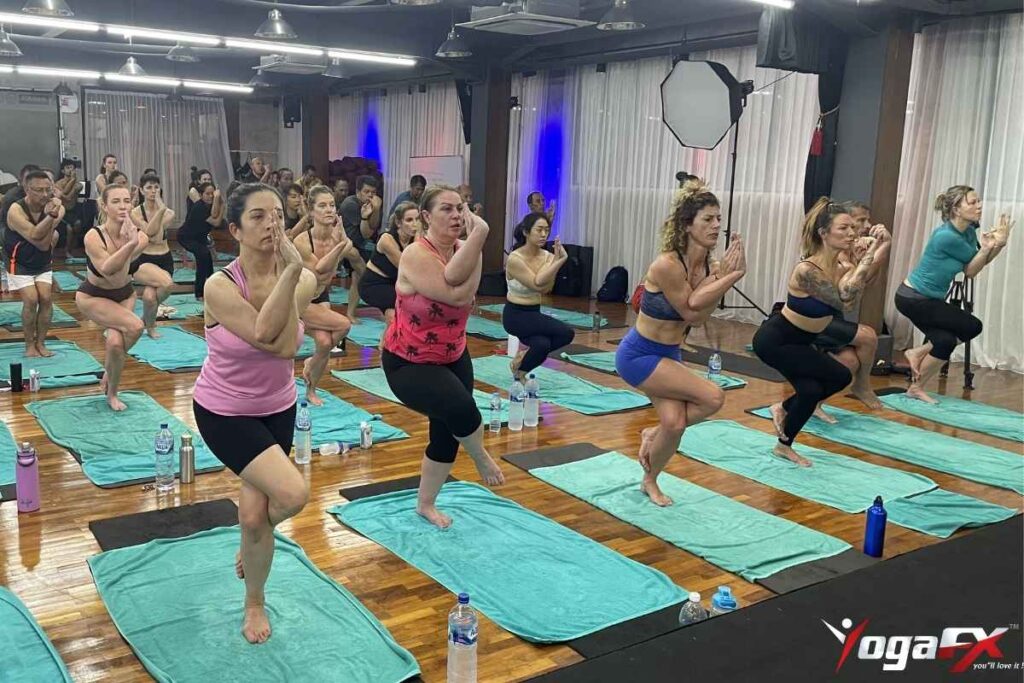
1. Joint Lubrication Across 14 Major Joints
The compression-and-release mechanism is particularly relevant in a heated 40°C room. Heat reduces synovial fluid viscosity - the fluid is more mobile at 40°C than at room temperature, allowing the compression-and-release cycle to move it more effectively through the joint space. This is one reason Eagle Pose feels different - and often more effective - in a properly heated Bikram room than in room-temperature practice.
2. Single-Leg Balance and Proprioception Development
Eagle Pose is the first single-leg balance posture of the standing series. The standing leg must stabilise the entire body's weight through 10 seconds of compressed, wrapped position while simultaneously performing a loaded squat. Practitioners who struggle with the balance postures later in the series (Standing Head to Knee, Standing Bow) consistently report that improving their Eagle Pose - specifically the depth and stability of the squat - correlates with improved standing balance throughout the class.
3. Shoulder and Upper Back Release
The arm wrap creates a sustained stretch through the posterior shoulder complex - the posterior deltoid, infraspinatus, teres minor, and rhomboids. These are the muscles that carry the most tension in people who work at computers or carry stress in the upper back. The wrap position achieves this stretch from inside the joint - not by pulling the arm across the body from outside as a conventional posterior shoulder stretch does.
4. Sciatica and Lower Back Relief
The hip external rotation created by the wrapped leg - combined with the loaded squat - creates traction in the hip joint that can relieve sciatic nerve compression. Practitioners with sciatic symptoms frequently report Eagle as one of the most reliably effective postures for temporary sciatic relief. This benefit is best achieved when the squat is deep enough to fully engage the hip external rotation - shallow squats produce proportionally less sciatic traction.
5. Kidney Function and Adrenal Stimulation
In the wrapped position with a deep squat, the kidneys are compressed between the posterior abdominal wall and the wrapped leg position. Traditional Bikram instruction attributes kidney stimulation and blood supply improvement to Eagle Pose through this compression mechanism. As with Camel Pose's thymus stimulation, this attribution is made in the teaching lineage rather than confirmed in peer-reviewed research specific to Eagle Pose.
How to Perform Eagle Pose: Step-by-Step
Arm Wrap
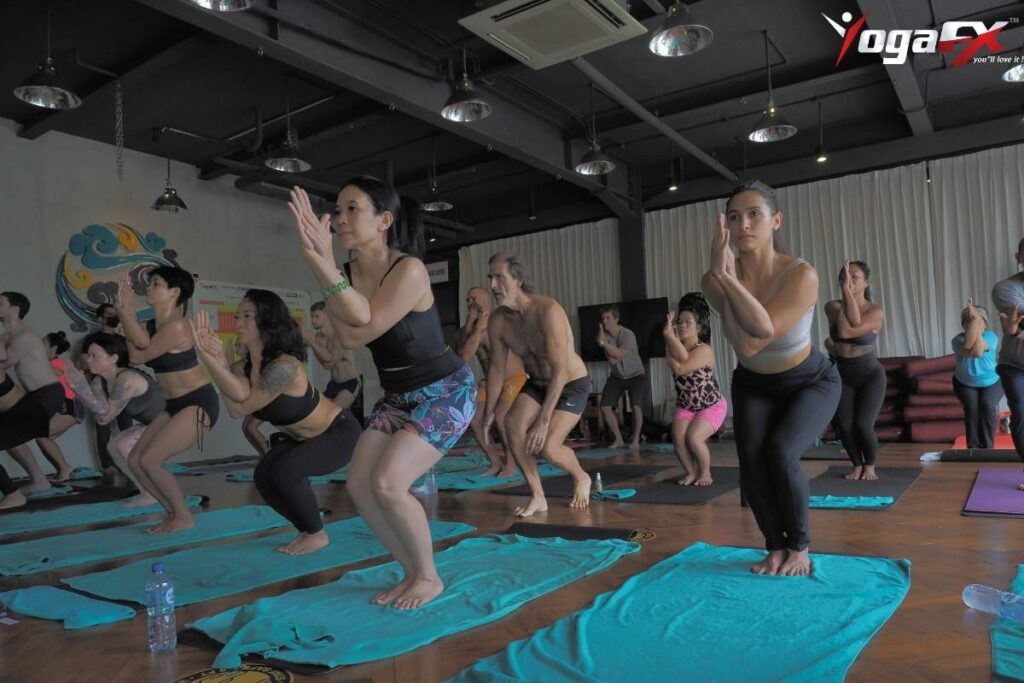
Begin standing with feet together. Extend both arms straight forward at shoulder height. Cross the right arm under the left - bring the right elbow underneath the left elbow. Bend both elbows to 90 degrees. Bring the forearms toward each other and cross the left hand over the right, bringing the palms together if possible or the backs of the hands in contact if not.
Final arm position: both arms crossed, elbows stacked, forearms vertical, hands joined or in contact above the elbows. Lift the joined hands to eye level or slightly above - the elbows should be at approximately shoulder height.
Leg Wrap
From the standing arm-wrapped position, shift your weight onto the right foot. Bend both knees and begin to sit down into a squat. Lift the left leg and cross it over the right thigh - the left thigh rests on top of the right thigh.
For the full wrap: continue wrapping the left foot around the right calf, bringing the left toes to the outside of the right calf or hooking the left foot behind the right ankle. This creates the double-wrapped position that is the full expression of Eagle Pose.
The Squat - The Most Important Technical Element
With both the arm and leg wrapped, sit down. The squat depth determines the effectiveness of the joint opening - the deeper the squat, the more fully the hip joint traction, knee loading, and ankle compression operate. The dialogue instruction is to sit down as in a chair. Most practitioners underperform this instruction by 20–30% - sitting to a much shallower depth than is available to them.
In the full squat position, the spine remains upright and the joined hands remain at eye level. Do not allow the torso to lean forward as the squat deepens - this is the most common error and the one that most reduces the hip joint benefit.
Hold and Exit
Hold 10 seconds. On exit, unwrap the leg first, then the arms, and return to standing. Repeat on the opposite side. The release from the wrapped position is when fresh synovial fluid enters the joint spaces - the benefit occurs in the exit as much as in the hold.
Alignment Guide
| Body Part | What It Should Do | Common Error |
|---|---|---|
| Arms | Fully wrapped - elbows stacked, forearms vertical, hands joined at eye level | Elbows dropping below shoulder height - reduces the posterior shoulder stretch |
| Hands | Palms together or backs of hands in contact above the crossed elbows | Hands separated with no contact - loses the wrist compression element |
| Standing knee | Bent - squat as deeply as possible | Standing knee barely bent - shallow squat eliminates most joint benefit |
| Wrapped leg | Thigh resting on top of standing thigh, foot wrapped around calf or ankle | Thigh only crossed, foot not wrapping - reduces knee and ankle joint compression |
| Spine | Upright throughout the squat - no forward lean | Torso leaning forward as squat deepens - shifts load to lower back |
| Gaze | Fixed forward - single gaze point aids balance | Eyes moving or unfocused - significantly reduces balance stability |
| Squat depth | As low as possible - ideally thigh parallel to floor | Shallow squat - the most common single error reducing Eagle Pose benefit |
Common Mistakes and How to Fix Them
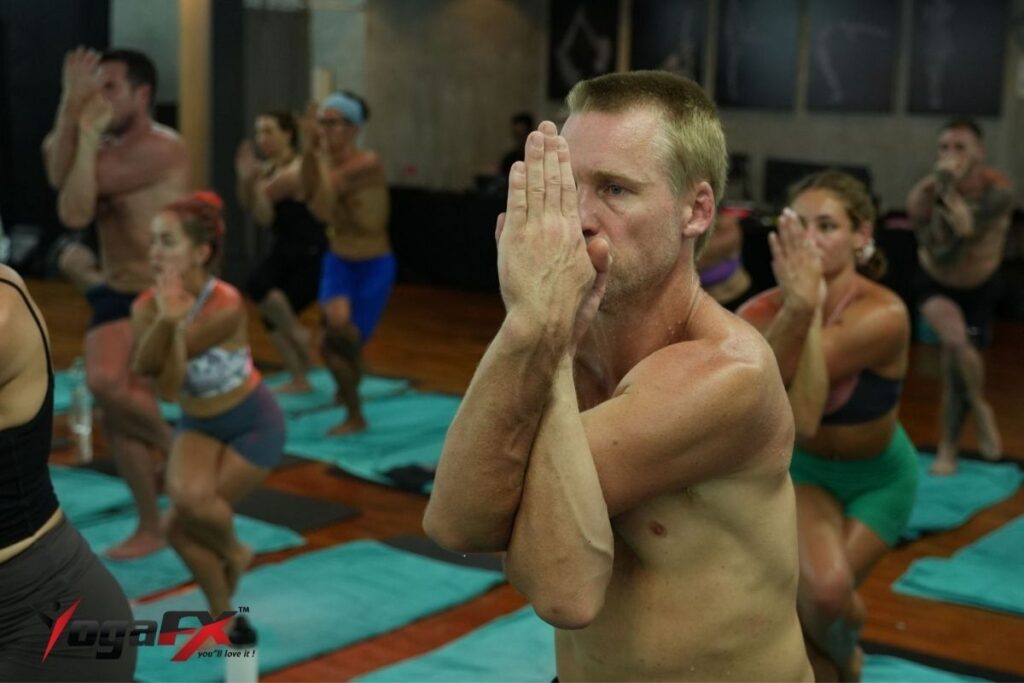
Mistake 1: Shallow Squat
The most common and most impactful error in Eagle Pose. Most practitioners squat to 20–30% of their available depth, producing a fraction of the hip joint traction and knee loading that a full squat delivers. The shallow squat also makes balance significantly easier - which feels like success but indicates the posture is not being performed at the depth that produces its therapeutic benefit.
Fix: After establishing both wraps, consciously sit down further than feels natural. The discomfort in the standing quad and hip at deeper squat depth is the posture working correctly. Stay there for the full 10 seconds.
Mistake 2: Elbows Dropping Below Shoulder Height
When the crossed elbows drop below shoulder height, the posterior shoulder stretch is significantly reduced. The angle of the arm wrap at shoulder height creates the specific stretch across the posterior shoulder capsule that Eagle Pose is designed to deliver.
Fix: Actively lift the elbows upward throughout the hold. Think of the joined hands rising toward the ceiling, not the elbows dropping toward the floor.
Mistake 3: Foot Not Wrapping
Many practitioners cross the wrapped thigh over the standing thigh but do not complete the foot wrap around the calf or ankle. Without the foot wrap, the knee and ankle compression that accounts for 4 of the 14 joint openings is absent.
Fix: If the foot cannot reach around the calf, aim the toes toward the inside of the standing calf - even light contact adds the medial ankle and knee compression element. See modifications below if the full wrap is not yet accessible.
Mistake 4: Forward Torso Lean in the Squat
As the squat deepens, the torso wants to lean forward - the body compensating for tight hip flexors or limited ankle dorsiflexion. Forward lean shifts the mechanical load from the hip joint and quads to the lower back and reduces the hip joint traction.
Fix: Keep the spine upright by thinking of the top of the head lifting toward the ceiling throughout the squat. Work at the depth where the spine can remain vertical rather than compromising spinal position for squat depth.
Modifications by Level
Beginner: Arms Only or Partial Wrap
If achieving both arm and leg wraps simultaneously while squatting is too much to coordinate, work on one element at a time. Arms first: perform the arm wrap fully and practice the squat without the leg wrap. Once the arm wrap and squat are stable, add the leg cross without the foot wrap. Add the foot wrap last once the other elements are established.
Intermediate: Leg Crossed, No Foot Wrap
Crossing the wrapped thigh over the standing thigh without the foot wrap is a functional intermediate position. All hip joint benefit is present; the ankle and lower knee compression is reduced. Focus on squat depth at this stage - getting the thighs as parallel to the floor as possible - before pursuing the foot wrap.
Advanced: Full Wrap with Maximum Squat Depth
In full Eagle Pose, the challenge at advanced level shifts from achieving the wrap to maximising squat depth while maintaining the wrap and upright spine simultaneously. Advanced practitioners explore sitting the hips as low as possible - below parallel if available - while keeping both wraps intact and the spine vertical. The joint benefit scales directly with squat depth.
FAQ
What are the 14 joints in Eagle Pose?
The 14 joints are: left and right shoulders (2), left and right elbows (2), left and right wrists (2), left and right scapulothoracic joints (2), left and right hips (2), left and right knees (2), and left and right ankles (2). Each pair is opened through the compression-and-release mechanism of the wrapping position and loaded squat. The joint benefit operates on both sides simultaneously - the standing side under load, the wrapped side under compression.
Why is Eagle Pose a balance posture in Bikram yoga?
Eagle Pose combines joint opening with single-leg balance training because the wrapping mechanics require the standing leg to stabilise the full body weight through a loaded squat - a significantly more demanding balance task than standing upright. This dual function makes Eagle efficient: 14-joint therapeutic benefit and proprioceptive balance training in a single 10-second posture.
What does Eagle Pose do for the shoulders specifically?
The arm wrap compresses the posterior shoulder capsule and simultaneously stretches the posterior rotator cuff - the infraspinatus, teres minor, and posterior deltoid - from inside the joint. This is distinct from a conventional cross-body shoulder stretch, which stretches the same muscles from outside the joint.
The compression-and-release on exit floods the posterior shoulder joint space with synovial fluid. Practitioners with chronic upper back and posterior shoulder tension typically report Eagle as one of the most immediately effective postures for that specific area.
Why can I not wrap my foot in Eagle Pose?
Inability to complete the foot wrap is typically caused by: insufficient hip external rotation flexibility in the wrapped leg, insufficient standing knee bend limiting the height at which the wrapped thigh crosses, or unfamiliarity with the coordination of the wrapping sequence. Use the intermediate modification - thigh crossed without foot wrap - while building toward the full position across consistent practice.
How does the squat depth affect Eagle Pose benefits?
Directly and proportionally. The hip joint traction of Eagle Pose is generated by weight-bearing compression of the standing hip in a deeply flexed position - the deeper the squat, the more complete the hip joint compression and the more effective the post-release synovial fluid movement.
A shallow squat produces minimal hip joint benefit despite full arm and leg wraps. The joint-opening claim for Eagle Pose is predicated on a squat to or near parallel - not a barely-bent standing position.