Awkward Pose - Utkatasana in Sanskrit - is the third posture in the Bikram yoga standing series. It is the first pure strength posture in the sequence: no balance challenge, no flexibility requirement, no complex alignment. Just a progressive squat in three parts that systematically loads the quadriceps, glutes, and lower back in ways that compound across each set.

Despite its apparent simplicity, Awkward Pose is one of the most technically nuanced postures in the standing series. The three-part structure means it is effectively three different exercises performed in sequence, each targeting a different aspect of lower body strength and ankle stability. Most practitioners underperform it for months by missing the specific technical requirements of each part.
Awkward Pose (Utkatasana) is a three-part standing squat - posture 3 in the Bikram yoga sequence. Part 1: toes up, squat to parallel, weight on heels. Part 2: heels together, toes turned out 45 degrees, squat from tip-toes. Part 3: feet together, rise onto the balls of the feet, sit down as low as possible. Hold time: 10 seconds per part, 2 sets (6 sets total). Primary benefits: builds quadriceps and gluteal strength, improves ankle stability, strengthens the lower back, and is one of the primary calorie-burning postures in the standing series.
Want every posture in order, filtered by difficulty, focus area or health benefit?
Where Awkward Pose Sits in the Bikram Sequence
Awkward Pose is the third standing posture, following Half Moon Pose and Hands to Feet Pose. At this point in the class, the body is beginning to warm in the 40°C room and the cardiovascular system is activating. Awkward Pose is the first posture that demands genuine muscular strength rather than flexibility or balance - it transitions the class from the warm-up phase into the strength phase of the standing series.
Its placement before the single-leg balance postures (Eagle, Standing Head to Knee, Standing Bow, Balancing Stick) is deliberate. The quad and glute strength developed in Awkward Pose directly supports the standing knee lock and leg stability required in the four demanding balance postures that follow.
The Three Parts: What Each One Does
Part 1: Heels Up, Weight Back
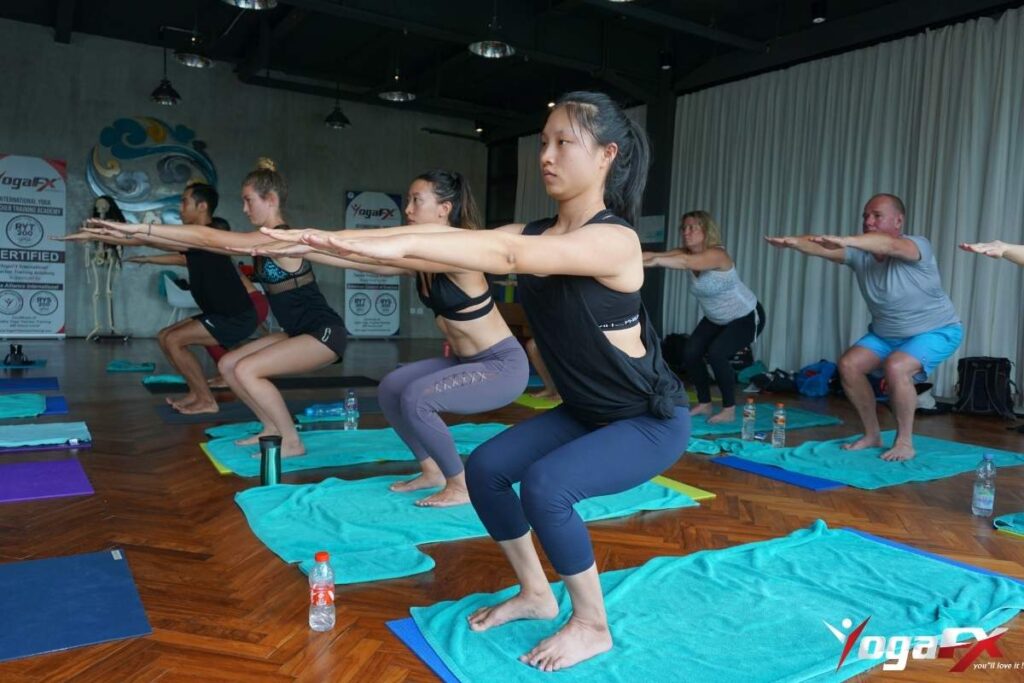
Starting position: feet hip-width apart, toes pointing forward. Rise onto the toes and then lower the heels - the heels lift slightly off the floor but the weight shifts back toward the heels rather than forward onto the toes. Arms extend straight forward at shoulder height, parallel to the floor. Squat down until the thighs are as close to parallel with the floor as possible. Hold 10 seconds.
Primary target: quadriceps, specifically the vastus medialis (inner quad) and rectus femoris. The heel-elevated position increases the range of motion at the knee joint, recruiting the quad more completely.
Key alignment: torso remains upright - do not lean forward. Knees track directly over the second toe of each foot. Weight stays back despite the toe-elevated position.
Common mistake: leaning the torso forward to compensate for tight quads or limited ankle mobility. This shifts the load from the quads to the lower back and reduces the quad-strengthening benefit significantly.
Part 2: Heels Together, Toes Out
From standing, bring the heels together with toes turned out approximately 45 degrees - a first-position ballet stance. Rise onto the tips of the toes. From this position, squat down as low as possible while maintaining the tip-toe balance. Hold 10 seconds.
Primary target: inner thighs (adductors), calves, and the small stabilising muscles of the ankle and foot. The turned-out foot position opens the hip joint and recruits the adductors in a way that parallel-foot squats do not.
Key alignment: heels remain touching throughout - they must not separate as the squat deepens. Knees track outward in the direction of the toes. Spine stays upright.
Common mistake: heels separating as the squat deepens. Once the heels separate, the adductor recruitment that defines Part 2 is lost. Work at a shallower depth with heels touching rather than a deeper squat with heels apart.
Part 3: Feet Together, Ball of Foot Balance
From standing with feet together, rise onto the balls of the feet - the metatarsal heads at the base of the toes. Arms extend forward. From this position, sit straight down as low as possible, ideally until the thighs are parallel with the floor or below. Hold 10 seconds.
Primary target: the entire quad complex under maximum eccentric load, hip flexors, and the intrinsic foot muscles. Part 3 is the most demanding - the combination of feet together (narrow base), elevated heel position (reduced stability), and maximum squat depth creates the highest muscular demand of the sequence.
Key alignment: knees remain together throughout the descent - they must not separate. Arms stay parallel to the floor. Torso stays as upright as possible.
Common mistake: knees separating as the squat deepens. Knees together in Part 3 is non-negotiable. Sit only as deep as you can maintain knee contact.
Primary Benefits of Awkward Pose
1. Quadriceps Strength Development
Awkward Pose is the most direct quad-strengthening posture in the Bikram standing series. The three-part structure progressively loads the quadriceps from three different foot positions, hitting different aspects of the muscle complex with each part. Consistent Awkward Pose practice over 8 weeks produces measurable quad strength gains - consistent with the Tracy and Hart (2013) study that documented 20% overall lower body strength increase from Bikram yoga practice.
2. Ankle Stability and Proprioception
Parts 2 and 3 require sustained balance on a narrow or tip-toe base while simultaneously performing a loaded squat. This demands significant contribution from the ankle stabilisers - the peroneal muscles, tibialis anterior, and intrinsic foot muscles. Practitioners who struggle with balance postures later in the standing series frequently report that consistent Awkward Pose practice improves ankle stability noticeably over 6–12 weeks.
3. Lower Back Strengthening
The upright torso requirement in all three parts recruits the spinal erectors and multifidus muscles isometrically. This is a functional lower back strengthening pattern that transfers directly to daily activities involving sitting, standing transitions, and loaded carrying. Practitioners with chronic lower back weakness often find Awkward Pose one of the first places where they notice functional improvement.
4. Calorie Burn - One of the Highest in the Standing Series
Awkward Pose's three-part structure, performed twice (6 sets total), represents one of the highest-volume strength demands in the standing series. Each 10-second isometric hold under squat load burns significantly more calories than a standing or gentle posture. Combined with the cardiovascular warm-up of preceding postures, Awkward Pose contributes substantially to the 330–460 kcal total calorie burn per 90-minute Bikram session documented in the University of Wisconsin 2014 study.
5. Knee Joint Health
When performed with correct alignment, Awkward Pose strengthens the muscles that support and protect the knee joint. The vastus medialis oblique (VMO) - the teardrop-shaped muscle at the inner knee - is specifically recruited in the heel-elevated Part 1 position. VMO weakness is one of the most common causes of anterior knee pain and patellar tracking issues. Awkward Pose, practiced correctly, addresses this weakness directly.
Complete Alignment Guide by Part
| Element | Part 1 | Part 2 | Part 3 |
|---|---|---|---|
| Feet position | Hip-width, parallel, heels slightly raised | Heels together, toes out 45°, on tiptoes | Together, on balls of feet |
| Knee direction | Over second toe - no inward collapse | Outward - in line with turned-out toes | Together - no separation throughout |
| Squat depth | Thighs parallel to floor | As low as possible with heels touching | As low as possible with knees together |
| Torso | Upright - no forward lean | Upright - no forward lean | Upright - no forward lean |
| Arms | Straight forward, shoulder height | Straight forward, shoulder height | Straight forward, shoulder height |
| Primary focus | Weight back, heels off floor | Heels touching throughout | Knees together throughout |
Common Mistakes and How to Fix Them
Forward Lean (All Three Parts)
The most universal error in Awkward Pose. The torso pitches forward to compensate for tight hip flexors, limited ankle mobility, or insufficient quad strength. Forward lean shifts the load from the quads to the lower back - changing the nature of the exercise entirely.
Fix: reduce squat depth until you can maintain an upright torso at that depth. Gradually increase depth over weeks as quad strength and ankle mobility improve.
Knees Collapsing Inward (Parts 1 and 3)
Knee valgus (inward collapse) indicates VMO weakness or hip abductor insufficiency. In Bikram yoga this is addressed by the instruction to push the knees outward actively throughout each part.
Fix: consciously drive the knees outward throughout each 10-second hold. In Part 3, squeeze the inner thighs toward each other while simultaneously pushing the knees outward - this creates the muscular tension that prevents collapse while maintaining feet-together position.
Heels Separating in Part 2
Once the heels separate in Part 2, the adductor recruitment that defines the part is lost. Practitioners separate the heels to squat deeper - but a shallower squat with heels touching is more beneficial.
Fix: prioritise heel contact over squat depth in Part 2. Mentally emphasise pressing the heels toward each other throughout the descent.
Arms Dropping Below Shoulder Height
Arms held below shoulder height reduce the postural demand on the upper back and make the forward lean error more likely. The arms at shoulder height create a counterbalance that helps maintain an upright torso.
Fix: think of the arms as anchors for the torso position. When the torso wants to lean forward, arms holding position at shoulder height create a subtle resistance against that lean.
Modifications by Level
Beginner
If maintaining all three technical requirements simultaneously is impossible, prioritise them in order: (1) upright torso, (2) knees over toes or together as specified, (3) squat depth. Reduce depth until the first two are achievable. In Part 3, if knees cannot stay together at any depth, work at the shallowest squat that allows knee contact.
Intermediate
The primary focus is increasing squat depth while maintaining all alignment requirements. Part 3 at thigh-parallel depth with knees together is the benchmark for intermediate proficiency. If Part 3 at parallel is achievable, explore holding the lowest point for the full 10 seconds with continuous muscular engagement rather than resting at the bottom.
Advanced
Advanced Awkward Pose involves: Part 1 with thighs below parallel and torso fully upright, Part 2 at maximum depth with heels touching and full tip-toe balance, Part 3 with thighs at or below parallel, knees completely together. At this level the focus shifts to maximising isometric engagement - every quad, glute, and stabilising muscle firing at maximum throughout each 10-second hold.
FAQ
Why is it called Awkward Pose?
The name comes from the Bikram dialogue - the posture is designed to feel deliberately awkward, an uncomfortable position the body is not accustomed to. Unlike natural standing or sitting positions, the three parts place the body in loaded positions that are biomechanically challenging and therefore therapeutically effective. The name is functional, not derogatory.
How many parts does Awkward Pose have in Bikram yoga?
Three parts, each with distinct foot positions and primary muscle targets. Part 1: feet hip-width, heels slightly raised, squat to parallel. Part 2: heels together, toes out 45 degrees, tip-toe squat. Part 3: feet together on the balls of the feet, squat as low as possible with knees together. Each part is held for 10 seconds and performed twice - 6 sets total.
Is Awkward Pose hard on the knees?
When performed with correct alignment - knees tracking over toes, no inward collapse, weight distributed appropriately - Awkward Pose strengthens the muscles that protect the knee joint and is therapeutic for most practitioners. When performed with knee valgus or excessive forward lean, it can create knee stress. If you have existing knee issues, work at reduced depth and focus on correct knee tracking before increasing squat depth.
What muscles does Awkward Pose work?
Primary muscles: quadriceps (all four heads), gluteus maximus and medius, adductors (Part 2 specifically), gastrocnemius and soleus (Parts 2 and 3), and spinal erectors isometrically. Secondary muscles: tibialis anterior and ankle stabilisers (Parts 2 and 3), hip flexors, and intrinsic foot muscles. Awkward Pose is effectively a lower body compound exercise performed in a 40°C environment - breadth of muscle recruitment is why it contributes significantly to calorie burn.
How does Awkward Pose improve with practice?
Progress follows a predictable pattern. In the first weeks, most practitioners cannot reach parallel depth in Part 1 without significant forward lean. By month 2–3, squat depth increases as quad strength and ankle mobility improve.
By month 4–6, Part 3 with knees together at near-parallel depth becomes achievable. The posture that felt impossibly demanding in the first class typically becomes a reliable strength benchmark by the end of the first year.
Should I feel burning in my thighs during Awkward Pose?
Yes - this is expected and intended. The 10-second isometric holds create significant metabolic demand in the quadriceps. The burning sensation is lactic acid accumulation under sustained contraction. This discomfort is a sign the posture is working correctly. Reducing squat depth or releasing before 10 seconds eliminates the sensation but also eliminates much of the strength-building stimulus. Staying in the burning is what produces progressive quad strength gains.