
Bikram yoga is one of six major yoga styles. Understanding how bikram yoga vs all style it compares to Vinyasa, Ashtanga, Hatha, hot yoga, Yin, and Power yoga requires honest data rather than promotional framing.

Each style has genuine advantages in specific contexts. The goal of this guide is not to prove Bikram is best.
It is to give every comparison the detail it deserves so you can decide which style, or which combination of styles, serves your actual goals.
Bikram yoga is the most research-documented yoga style, with three peer-reviewed studies measuring calorie burn (333 to 460 kcal per 90 minutes), strength gain (20 percent increase at 8 weeks), and depression reduction (44 percent full remission in a Harvard MGH 2023 RCT).
No equivalent evidence base exists for Vinyasa, Ashtanga, Hatha, hot yoga, Yin, or Power yoga at this level of specificity. This does not mean those styles are less effective.
It means the evidence base is not comparable, and any decision should account for that asymmetry.
What Makes Bikram Yoga Different From All Other Styles
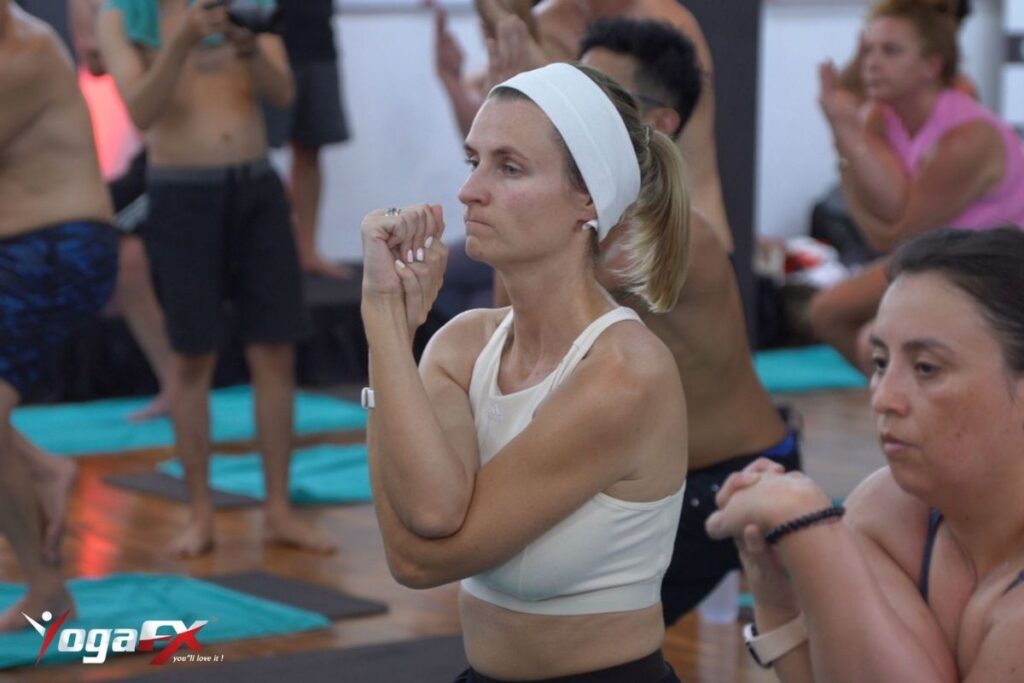
Three features define Bikram yoga and distinguish it from every other format. The fixed 26-posture sequence (identical in every class, every studio, every country — forever). The specific temperature and humidity (40 degrees Celsius with 40 percent relative humidity — both parameters are functional specifications, not preferences). The scripted verbal dialogue (memorised instruction delivered identically by every certified instructor). Remove any one of these three and the practice is no longer Bikram yoga.
Bikram Yoga vs Vinyasa Yoga
Vinyasa is the most widely practiced yoga style globally and the most common style practitioners compare to Bikram before deciding which to pursue.
| Dimension | Bikram Yoga | Vinyasa Yoga |
|---|---|---|
| Heat | 40°C, 40% humidity — mandatory | Room temperature or lightly heated (up to 35°C in hot Vinyasa) |
| Sequence | Fixed: 26 postures identical every class globally | Variable: instructor-designed, changes every class |
| Movement style | Static holds: 10 to 20 seconds per posture | Flowing: breath-linked continuous movement between postures |
| Calorie burn (90 min) | 333 to 460 kcal (UW 2014, direct measurement) | Approximately 300 to 500 kcal depending on intensity |
| Upper body strength | Limited — standing series focuses lower body and core | High — chaturanga transitions build shoulder, chest, tricep |
| Progress tracking | Direct — same sequence every class, improvement measurable | Difficult — sequence changes prevent direct comparison |
| Beginner accessibility | High — verbal dialogue requires no prior knowledge | Variable — depends on instructor and pace |
| Teacher training path | Scripted dialogue: teachable from certification day one | Sequencing skill requires 1 to 2 years of teaching to develop confidently |
What Is Harder, Bikram or Vinyasa?
Different in nature, not just degree. Bikram is hardest in sessions 1 to 10 as the thermoregulatory system adapts to sustained effort in 40-degree heat. After adaptation, the challenge is posture depth and cardiovascular endurance within the fixed sequence.
Vinyasa difficulty depends entirely on the instructor and class format — a beginner Vinyasa class is significantly less demanding than any Bikram class, while an advanced power Vinyasa is comparable.
If you are torn between a fixed, heated environment and a rigorous, self-paced physical vinyasa, read our full Bikram vs Ashtanga comparison to find your ideal match.
Bikram vs Vinyasa for Weight Loss
Both produce comparable calorie burn per session. Bikram's documented advantage: 333 to 460 kcal per 90-minute session from direct metabolic measurement (University of Wisconsin 2014, PubMed: 24700459). The strength gains from Bikram's 8-week protocol (Tracy and Hart 2013) increase resting metabolic rate for calorie burning between sessions. Vinyasa produces superior upper body strength from chaturanga transitions. For body composition, combining both produces more comprehensive results than either alone.
Bikram Yoga vs Ashtanga Yoga
Ashtanga and Bikram share one characteristic that distinguishes both from every other yoga style: fixed sequences. This shared characteristic makes the comparison particularly revealing because the differences are in every other dimension.
| Dimension | Bikram Yoga | Ashtanga Yoga |
|---|---|---|
| Sequence | Fixed: 26 postures, same in every class globally, forever | Fixed but progressive: Primary, Intermediate, Advanced A-D series |
| Heat | 40°C, 40% humidity mandatory | Room temperature — internal heat from ujjayi breath and vinyasa |
| Flow | Static holds: 10 to 20 seconds each | Dynamic: postures linked by breath-driven vinyasa transitions |
| Upper body strength | Limited — standing series primarily | High — chaturanga in every vinyasa transition |
| Long-term progression | Same sequence forever, progress measured by depth | Six progressive series providing decades of increasing challenge |
| Beginner accessibility | High — verbal dialogue, no prior knowledge needed | Moderate — Mysore style requires individual initiation |
| Teacher training | Scripted dialogue: teachable from certification day one | 3 to 5 years personal practice typically required to teach Primary confidently |
| Spiritual dimension | Minimal — functional, results-focused at YogaFX | Significant — bandha, drishti, pranayama philosophical framework |
For practitioners considering teacher training: Bikram's scripted dialogue means a graduate can lead a complete 90-minute class from day one of certification. Ashtanga teaching requires years of personal practice before a teacher can confidently guide students through the Primary Series.
For practitioners wanting a long-term progressive challenge: Ashtanga's six series provide decades of increasing difficulty that Bikram's fixed sequence does not. A practitioner advancing through Ashtanga's series has a genuinely expanding curriculum.
Bikram Yoga vs Hatha Yoga
Hatha is the foundational category from which most yoga styles including Bikram derive. When studios advertise Hatha classes they typically mean a gentle to moderate room-temperature class with a mix of standing and floor postures held for several breaths.
| Dimension | Bikram Yoga | Hatha Yoga |
|---|---|---|
| Temperature | 40°C, 40% humidity | Room temperature, 18 to 25°C typically |
| Sequence | Fixed 26 postures, identical every class | Variable — instructor discretion, generally slower paced |
| Calorie burn (60 min, 70kg) | Approximately 276 kcal | Approximately 189 to 240 kcal |
| Cardiovascular demand | 80% max heart rate sustained (UW 2014) | Low to moderate, varies by class intensity |
| Flexibility gains | Accelerated by heat — faster early gains | Gradual — room temperature limits extensibility rate |
| Spiritual emphasis | Minimal at YogaFX — functional approach | Variable — often includes philosophy and pranayama |
| Best for | Measurable fitness outcomes, structured progress | General wellness, accessible introduction, recovery days |
The Bikram 26 postures are drawn entirely from the Hatha yoga tradition, specifically from Bishnu Ghosh's therapeutic Hatha system in Calcutta. The sequence is Hatha yoga plus heat, fixed sequence, and scripted instruction. Bikram produces approximately 45 percent more calorie burn per session than a comparable Hatha class at the same duration.
Bikram Yoga vs Hot Yoga (Non-Bikram)
This is the most commonly confused comparison. Bikram yoga and hot yoga are not the same despite frequent conflation in studio marketing.
| Feature | Bikram Yoga (26 and 2) | Hot Yoga (Generic) |
|---|---|---|
| Temperature specification | 40°C, 40% humidity — both specified | Variable: 32 to 40°C, humidity rarely controlled |
| Heat source | Natural Bali tropical heat at YogaFX — no electric heaters | Electric heaters, typically dry heat at 15 to 25% humidity |
| Sequence | Fixed: 26 postures identical globally | Variable: instructor-designed, changes each class |
| Research base | Three major peer-reviewed studies with direct measurement | Research applies to Bikram conditions specifically, not generic hot yoga |
| Duration | 90 minutes fixed | Variable: 45 to 75 minutes commonly |
| Instruction | Scripted verbal dialogue, identical from all certified instructors | Variable by instructor and studio |
The humidity variable is the most significant practical difference. Electric studios typically run 15 to 25 percent humidity. At YogaFX Bali, Bali's natural tropical climate provides the original humid-heat conditions the method was designed for. The physiological difference in deep tissue warming between humid and dry heat is measurable and consistently reported by practitioners who have experienced both environments.
Bikram Yoga vs Yin Yoga
| Dimension | Bikram Yoga | Yin Yoga |
|---|---|---|
| Temperature | 40°C, 40% humidity | Room temperature |
| Hold duration | 10 to 20 seconds per posture | 3 to 10 minutes per posture |
| Target tissue | Muscles, joints, cardiovascular system | Connective tissue: fascia, ligaments, tendons |
| Calorie burn (60 min, 70kg) | Approximately 276 kcal | Approximately 140 kcal — minimal cardiovascular demand |
| Strength building | Significant from standing series | None — passive practice, no muscular load |
| Nervous system effect | Activating — sustained cardiovascular elevation | Parasympathetic — deeply calming |
| Best used as | Primary practice for fitness outcomes | Recovery, nervous system regulation, complement to active practice |
Yin and Bikram are not alternatives — they are complementary. Yin targets connective tissue through long passive holds at room temperature. Bikram targets muscles, joints, and the cardiovascular system through active holds in heat.
Combining both addresses tissues and systems that neither practice covers alone: Bikram 3 to 4 times per week for conditioning, Yin once or twice for deep connective tissue release and nervous system recovery.
Bikram Yoga vs Power Yoga
| Dimension | Bikram Yoga | Power Yoga |
|---|---|---|
| Temperature | 40°C, 40% humidity — standardised | Variable: 32 to 38°C with electric heat typically |
| Sequence | Fixed: identical every class | Variable: instructor-designed, changes frequently |
| Calorie burn | 333 to 460 kcal per 90 min (direct measurement) | Estimated 350 to 500 kcal — no equivalent direct study |
| Upper body strength | Limited from standing series | High — push-up transitions and arm balances |
| Lower body strength | High — Awkward Pose, Eagle, standing series | Moderate from flow transitions |
| Mental health research | Harvard MGH 2023 RCT — 44% full depression remission | No equivalent study exists |
Power yoga produces higher upper body strength than Bikram through push-up and arm balance sequences. Bikram produces stronger documented outcomes for flexibility, joint health, and mental health. A more detailed comparison of 26 and 2, vinyasa and power yoga covers heated versions of both.
The body composition result from combining Power yoga (upper body) and Bikram (lower body, heat-based flexibility) is more comprehensive than either alone. To understand how these distinct methodologies match your personal health goals, read our full Bikram vs Hatha/Hot Yoga/Vinyasa comparison sections below.
Both systems place immense focus on core engagement and spinal health, but evaluating how Bikram compares to Pilates will help you choose based on your heat tolerance.
The Research Base: What Bikram Has That Others Do Not
| Study | Style Studied | Key Findings |
|---|---|---|
| Porcari et al. 2014, University of Wisconsin (PubMed: 24700459) | Bikram yoga | 333 to 460 kcal per 90-minute session. Heart rate averaged 80% of maximum. Direct metabolic measurement. |
| Tracy and Hart 2013 (PubMed: 23438366) | Bikram yoga | 20% strength increase. 9% balance improvement. Significant flexibility gains and body fat reduction. 8 weeks, 3 to 4 sessions per week. |
| Nyer et al. 2023, Harvard MGH (PubMed: 37883245) | Bikram hot yoga | ~60% of participants reduced depression by 50%+. 44% full remission. Randomised controlled trial. |
No peer-reviewed research at this level of specificity and design quality exists for Vinyasa, Hatha, hot yoga, Yin, or Power yoga for the outcomes above. This does not mean those styles are ineffective. It means the evidence base is not comparable.
Decision Framework: Which Style for Which Goal
| Your Goal | Best Style | Reason |
|---|---|---|
| Documented calorie burn with research evidence | Bikram | Only style with peer-reviewed direct metabolic measurement |
| Upper body strength development | Power Yoga or Vinyasa | Chaturanga transitions — Bikram does not develop this |
| Rapid early flexibility gains | Bikram | Heat accelerates connective tissue extensibility beyond room temperature rates |
| Mental health: depression reduction (documented) | Bikram | Harvard MGH 2023 RCT — no equivalent study for any other style |
| Long-term progressive difficulty | Ashtanga | Six series providing decades of increasing challenge |
| Recovery and connective tissue release | Yin Yoga | Deep parasympathetic activation, passive connective tissue holds |
| General wellness, accessible introduction | Hatha | Lower intensity, high accessibility, broad applicability |
| Creative sequencing, class variety | Vinyasa | Instructor-designed flow changes every class |
| Teacher training — fastest to teaching | Bikram | Scripted dialogue: graduates teach complete class on certification day |
| Joint health and lubrication | Bikram | Eagle Pose opens 14 joints simultaneously in heat-enhanced synovial environment |
| Comprehensive body composition and strength | Bikram plus Vinyasa | Lower body, heat flexibility, mental health from Bikram; upper body strength from Vinyasa |
Who Should Not Do Bikram Yoga
Bikram yoga at 40 degrees Celsius is safe for most healthy adults. Specific contraindications and cautions:
- Cardiovascular disease: practitioners with diagnosed cardiovascular conditions should obtain physician clearance. The sustained 80 percent maximum heart rate throughout 90 minutes represents significant cardiovascular load.
- First trimester of pregnancy: the hyperthermia risk makes Bikram yoga inappropriate as a new practice. Established practitioners who become pregnant should consult their physician.
- Recent fever or acute illness: wait until fully recovered before resuming practice.
- Medications that impair thermoregulation: certain antidepressants, diuretics, antihistamines, and blood pressure medications affect heat management. Consult a physician before practicing Bikram with these medications.
- Males over 45 and females over 55 beginning a new exercise programme: should exercise caution and potentially obtain physician clearance when starting from a sedentary baseline.
Combining Bikram With Other Styles
The most effective approach for most serious practitioners is not choosing one style but combining styles strategically. Bikram's specific contributions to a combined practice: accelerated flexibility from heat-enhanced connective tissue extensibility, joint lubrication through Eagle Pose's 14-joint simultaneous opening, spinal decompression in every class counteracting the compression of running and cycling, and mental toughness training through sustained discomfort in heat.
Recommended combinations: Bikram 3 times per week plus Vinyasa 2 times for comprehensive body composition and strength. Bikram 2 times per week plus Yin once for maximum recovery and connective tissue health. Bikram daily during teacher training preparation, maintained at once or twice per week throughout a training block for another sport.
FAQ
What is the hardest yoga style?
Among the six major styles compared here, Bikram and advanced Ashtanga are the most physically demanding, though for different reasons. Bikram's difficulty is thermal and cardiovascular, sustained effort at 40 degrees Celsius for 90 minutes. Ashtanga's difficulty is progressive and skill-based across its six series. Power Yoga is hardest on upper body strength. There is no single hardest style; it depends which dimension of difficulty is meant.
What is harder, Bikram yoga or Vinyasa?
Different in nature, not just degree. Bikram is hardest in the first 5 to 10 sessions as the thermoregulatory system adapts to 40-degree heat. After adaptation the challenge is posture depth and cardiovascular endurance within a fixed sequence. Vinyasa ranges from very accessible (beginner flows) to very demanding (advanced power Vinyasa with arm balances). A typical advanced power Vinyasa class is comparably demanding to a Bikram class in different ways — more upper body and coordination demands, less heat tolerance required. A beginner Vinyasa class is significantly less demanding than any Bikram class.
Is Bikram yoga the same as hot yoga?
No. Bikram yoga is a specific method with a fixed 26-posture sequence, precisely specified temperature (40 degrees C, 40 percent humidity), fixed 90-minute duration, and scripted verbal instruction. Hot yoga is a general category covering any yoga practiced in a heated room. Most hot yoga studios use variable sequences, uncontrolled humidity, and variable instruction methods. The research documenting Bikram yoga's specific outcomes was conducted under Bikram-specific conditions.
Is Bikram yoga better than Vinyasa for weight loss?
Comparable calorie burn per session, with a slight Bikram advantage in documentation. The University of Wisconsin 2014 study measured Bikram at 333 to 460 kcal per 90 minutes through direct metabolic measurement. Vinyasa calorie data is less precisely documented. Bikram additionally produces lean muscle gains (20 percent strength increase in 8 weeks) that elevate resting metabolic rate. For overall body composition, combining both produces better results than either alone.
Can I practice Bikram yoga and Vinyasa in the same week?
Yes — the combination is physiologically complementary. Bikram provides heat-based flexibility and joint lubrication that Vinyasa practice builds on. Vinyasa provides upper body strength from chaturanga transitions that Bikram does not develop. Allow at least one rest day between sessions if practicing both at high intensity. A practical starting schedule: Bikram on Monday, Wednesday, Friday; Vinyasa on Tuesday and Thursday with Saturday rest.
Which yoga style is best for beginners?
Bikram and Hatha are both highly accessible for beginners. Bikram's verbal dialogue means no prior posture knowledge is needed — the instructor tells every practitioner exactly what to do. Hatha's slower pace and lower intensity are also accessible. Ashtanga Mysore-style and advanced Power Yoga are less appropriate for complete beginners. Vinyasa depends heavily on the specific class — beginner Vinyasa is accessible, advanced Vinyasa is not.
If you prefer a static, highly predictable therapeutic sequence over a fast-paced, fitness-oriented vinyasa, read our full Bikram vs Power Yoga comparison.
What type of yoga gives the best results overall?
Depends entirely on how results are defined. For documented calorie burn, strength gain, flexibility improvement, and mental health outcomes in peer-reviewed research: Bikram yoga has the strongest evidence base of any yoga style. For upper body strength: Vinyasa or Power Yoga. For long-term progressive difficulty: Ashtanga. For connective tissue health and recovery: Yin Yoga. For a single practice that produces the most comprehensive documented outcomes across multiple health dimensions simultaneously: Bikram yoga is the most research-supported choice.
Who should not do Bikram yoga?
Bikram yoga is contraindicated or requires physician clearance for: diagnosed cardiovascular disease, first trimester of pregnancy, current fever or acute illness, and medications that impair thermoregulation (certain antidepressants, diuretics, antihistamines, blood pressure medications). Males over 45 and females over 55 beginning from a sedentary baseline should consider physician clearance. Most healthy adults without these specific conditions can practice Bikram yoga safely with appropriate heat adaptation in the first 5 to 10 sessions.