
Bikram Yoga vs Hot Yoga are frequently used interchangeably — including in studio marketing, wellness media, and Google search results. They are not the same thing. Understanding the distinction matters because the documented outcomes that practitioners read about (calorie burn, strength gains, depression reduction) are specific to the Bikram format under specific conditions. Those outcomes do not automatically extend to generic hot yoga.

Bikram yoga is a specific fixed sequence of 26 postures and 2 breathing exercises at 40 degrees Celsius with 40 percent humidity for 90 minutes — the same in every class globally. Hot yoga is any yoga practiced in a heated room, with variable sequences, temperatures ranging from 32 to 40 degrees Celsius, and instructor-designed classes that change session to session. Three peer-reviewed studies (University of Wisconsin 2014, Tracy and Hart 2013, Harvard MGH 2023) document specific outcomes for the Bikram format specifically — these do not automatically extend to general hot yoga formats with different conditions.
The Core Difference: Specific vs General
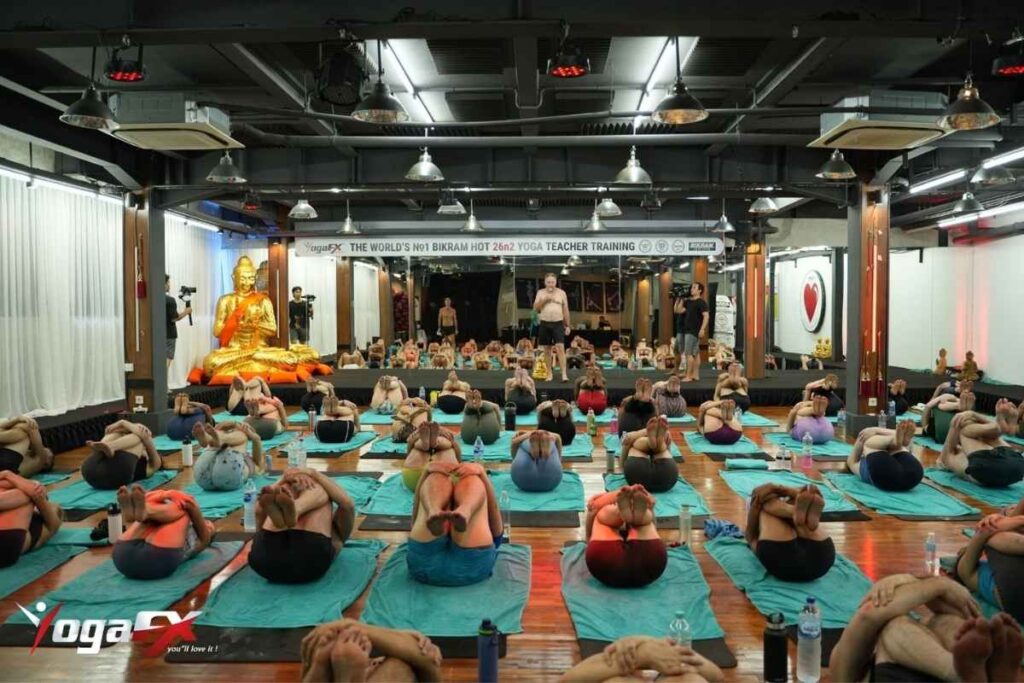
The simplest way to understand the relationship: Bikram yoga is a subset of hot yoga. Like how Bordeaux is a subset of wine — all Bordeaux is wine but not all wine is Bordeaux.
- All Bikram yoga is hot yoga — it is practiced in a heated room
- Most hot yoga is not Bikram yoga — it does not follow the fixed 26-posture sequence
- A studio calling its class "hot yoga" may or may not be teaching the Bikram sequence
- A studio calling its class "Bikram yoga", "26 and 2 yoga", or "original hot yoga" is teaching the specific fixed sequence
Side-by-Side Comparison
| Feature | Bikram Yoga (26 and 2) | Hot Yoga (General) |
|---|---|---|
| Sequence | Fixed: 26 postures and 2 breathing exercises, identical in every class globally | Variable: instructor-designed, changes class to class |
| Temperature | 40°C (105°F) — specified, not approximate | Variable: typically 32 to 40°C depending on studio |
| Humidity | 40 percent — specified and functional | Usually uncontrolled; electric-heated studios typically 15 to 25 percent |
| Duration | 90 minutes fixed (60-minute compressed format also available) | Variable: 45, 60, or 75 minutes typically |
| Instruction | Scripted verbal dialogue — identical from all certified instructors globally | Variable by instructor; often includes demonstration and physical adjustments |
| Music | No music — silence except for the dialogue | Often includes music playlists; varies by studio |
| Movement style | Static holds: 10 to 20 seconds per posture | Often dynamic flow; breath-linked continuous movement |
| Calorie burn (90 min) | 333 to 460 kcal — directly measured (UW 2014) | Variable — no equivalent direct measurement study exists |
| Research base | 3 major peer-reviewed studies with direct measurement | General hot yoga studies extrapolate from Bikram data |
| Progress tracking | Direct — same sequence every class, improvement measurable | Difficult — variable sequences prevent direct comparison |
| Beginner accessibility | High — verbal dialogue, no prior knowledge needed | Variable — depends heavily on instructor and class level |
The Temperature and Humidity Difference
Most discussions of Bikram vs hot yoga focus on temperature alone. The humidity specification is equally significant and almost universally absent from hot yoga formats.
The Bikram specification is 40 degrees Celsius with 40 percent relative humidity. The humidity determines sweat evaporation rate. At 40 percent humidity, sweat evaporates slowly from the skin surface, maintaining consistent core temperature elevation throughout the session. This sustained elevation produces the specific physiological effects that the research documents.
Electric-heated studios — which is how nearly all hot yoga studios outside of tropical climates produce heat — typically run at 15 to 25 percent humidity. In dry heat, sweat evaporates rapidly, the skin surface cools faster, and deep tissue warming is less complete. The physiological mechanism that makes the Bikram sequence specifically effective is partially absent.
This is why practitioners who move from electric-heated studios to natural heat environments like YogaFX Bali consistently report a qualitatively different experience — more effective, more comfortable, deeper tissue access — despite the same stated temperature. The natural tropical climate of Bali provides the humid heat environment the sequence was designed for, at both the Seminyak and Canggu studios, without electric heaters. The environmental setup defines the classic method, so exploring what changes when you remove the heat from Bikram highlights the true role of humidity in detoxification.
The Research Difference
| Study | What Was Studied | Applies To |
|---|---|---|
| Porcari et al. 2014, University of Wisconsin (PubMed: 24700459) | Direct metabolic measurement during 90-minute Bikram classes: 333 to 460 kcal, 80 percent max HR | Bikram yoga specifically — 26-posture fixed sequence at 40°C |
| Tracy and Hart 2013 (PubMed: 23438366) | 8-week Bikram protocol: 20 percent strength increase, 9 percent balance improvement, body fat reduction | Bikram yoga specifically — same protocol conditions |
| Nyer et al. 2023, Harvard MGH (PubMed: 37883245) | Randomised controlled trial: 60 percent of participants reduced depression by 50 percent or more | Hot yoga under Bikram conditions — not generic heated yoga |
When a hot yoga studio uses these research findings to market their heated Vinyasa or heated Power Yoga classes, they are applying data from a different practice format. The outcomes documented are specific to the fixed 26-posture sequence at the specified temperature and humidity. General hot yoga may produce similar outcomes — there are good reasons to expect it might — but the evidence base is extrapolated, not measured.
While generic studios might simply turn on portable heaters, understanding what a proper Bikram hot room requires highlights the difference in therapeutic benefits and air quality.
The Instructor Difference
To Teach Bikram Yoga
A Bikram yoga instructor requires: Yoga Alliance RYT 200, a style-specific Bikram or 26 and 2 certification, and mastery of the scripted verbal dialogue — approximately 45 minutes of specific, memorised verbal instruction covering all 26 postures. The dialogue is the primary professional skill that determines teaching quality from session one. The YogaFX teacher training awards RYT 200 and Bikram Certification simultaneously for USD 1,999 (Early Bird USD 1,699, limited seats) — two internationally recognised credentials in one enrolment.
To Teach General Hot Yoga
A general hot yoga instructor requires Yoga Alliance RYT 200. The specific style — Vinyasa, Power, Yin — sometimes requires an additional training module, but there is no equivalent to the Bikram dialogue requirement. Each class is instructor-designed, meaning the instructional skill required is creative sequencing and adaptive instruction rather than precise scripted dialogue delivery.
What Is Bikram Yoga Called Now?
Bikram Choudhury left the United States in 2016 following multiple civil sexual assault lawsuits and was convicted in absentia by a California court in 2023 on criminal charges including rape and false imprisonment. The 2019 Netflix documentary accelerated a community-wide rebranding. Most studios and practitioners now use alternative names for the identical practice:
- 26 and 2 yoga — the most widely adopted alternative, describing the content (26 postures plus 2 breathing exercises)
- Original hot yoga — used by independent studios to signal lineage authenticity
- Hot 26 and 2 — hybrid name combining both identifiers
- Bikram yoga — still used by some studios particularly outside North America
The practice is unchanged. The sequence, temperature specification, dialogue, and 90-minute duration are identical regardless of which name a studio uses. YogaFX teaches the practice as Original 26 and 2 Hot Yoga.
When to Choose Bikram vs Hot Yoga
| Your Goal or Situation | Choose Bikram Yoga | Choose General Hot Yoga |
|---|---|---|
| Want documented research outcomes | Yes — 3 major studies specific to Bikram conditions | Maybe — outcomes extrapolated, not directly measured |
| Want measurable progress tracking | Yes — same sequence every class, improvement directly comparable | Difficult — variable sequences prevent direct comparison |
| Complete beginner, no prior knowledge | Yes — verbal dialogue requires no prior knowledge | Variable — depends heavily on specific class and instructor |
| Want variety in each class | No — fixed sequence identical every session | Yes — sequence changes class to class |
| Want upper body strength development | Limited from standing series | Yes — if hot Vinyasa with chaturanga transitions |
| Want maximum flexibility gains from heat | Yes — full humidity specification produces best connective tissue results | Partial — depends on studio's humidity levels |
| Want to become a teacher (fastest path) | Yes — scripted dialogue means teachable from certification day | Longer — sequencing skill develops over years |
| Enjoy music and social atmosphere | No — silence, no music, disciplined environment | Yes — most hot yoga studios play music |
| Want mental health benefits (documented) | Yes — Harvard 2023 RCT specifically used Bikram conditions | Extrapolated — no equivalent RCT for general hot yoga |
Can You Practice Both?
Yes, and the combination produces more comprehensive outcomes than either alone. Bikram yoga provides the posterior chain loading, heat-enhanced flexibility, joint lubrication, and the documented cardiovascular and mental health outcomes from the fixed sequence. General hot Vinyasa provides the upper body strength from chaturanga transitions and the variety that keeps practice engaging over time.
A practical combination: Bikram yoga 3 times per week for the documented outcomes, hot Vinyasa once per week for upper body and variety. This schedule produces comprehensive body conditioning that neither practice achieves alone. Heated fitness styles vary widely, but recognizing hot Hatha as a category within hot yoga (see the FAQ below) helps you choose a tradition focused on therapeutic isometric holds. For a full decoder of timetable names, see which hot class names are really 26 and 2.
FAQ
Is Bikram yoga the same as hot yoga?
No. Bikram yoga is a specific method — the fixed 26-posture sequence at 40 degrees Celsius with 40 percent humidity for 90 minutes, taught through a scripted verbal dialogue identical from all certified instructors globally. Hot yoga is a general category covering any yoga practiced in a heated room. All Bikram yoga is hot yoga, but most hot yoga is not Bikram yoga. The research documenting Bikram yoga's specific outcomes applies to the Bikram format specifically.
Which is harder, Bikram or hot yoga?
Bikram yoga is typically harder thermally — the full 40 degrees Celsius with 40 percent humidity specification at 90 minutes is more demanding than most general hot yoga classes, which run at lower temperatures with less humidity for shorter durations. Hot Vinyasa yoga is harder in terms of upper body and coordination demands because of chaturanga transitions and flow sequences that Bikram does not include. They are difficult in different ways.
Is Bikram yoga good for beginners?
Yes, specifically because of the scripted verbal dialogue. The complete instruction for every posture is delivered verbally — no prior knowledge needed. The fixed sequence means every class is identical, so there is no new material for a beginner to catch up to. The primary beginner challenge is heat adaptation in the first 5 to 10 sessions, not the postures themselves. Most beginners complete their first class and are surprised they did.
Why is Bikram yoga so strict compared to hot yoga?
The consistency of Bikram yoga — same sequence, same temperature, same dialogue — is intentional and functional. The fixed format allows progress to be directly measured, ensures the same instructional quality regardless of which instructor is teaching, and makes the method transmissible from teacher to student without losing essential content. The strictness is the mechanism that produces the documented outcomes and makes the practice scalable.
Does the natural vs electric heat difference matter?
Yes, physiologically. Electric-heated studios typically run at 15 to 25 percent humidity (dry heat), while the Bikram specification requires 40 percent humidity. In dry heat, sweat evaporates rapidly, cooling the skin surface and reducing deep tissue warming. In natural humid heat (Bali's ambient tropical climate at YogaFX), sweat evaporation is slower and core temperature elevation is more consistent. Practitioners from electric-heated studios who practice at YogaFX consistently report better tissue access, more comfortable breathing, and a qualitatively different experience — not because the temperature is different but because the humidity is.
What is hatha hot yoga? Is it the same as regular hot yoga?
"Hatha hot yoga" and "hot Hatha yoga" both describe a Hatha-style class taught in a heated room rather than a standardised method with its own fixed identity. Like general hot yoga, it has no set sequence, temperature, or humidity specification, so classes vary from studio to studio. It differs from Bikram yoga, which is a specific fixed sequence of 26 postures and 2 breathing exercises taught at 40 degrees Celsius with 40 percent humidity using scripted verbal dialogue in every class worldwide.
What should I try first, Bikram or hot yoga?
If you want documented, measurable outcomes from a structured practice: Bikram yoga. If you prefer variety, music, and a less disciplined environment: hot yoga. If you are completely new to yoga with no specific goal beyond movement and sweat: either is accessible, but Bikram's verbal dialogue specifically accommodates complete beginners without prior knowledge. The free first-class guest pass at YogaFX Bali removes the financial barrier to trying the Bikram format in its optimal natural heat environment.