
The Bikram Yoga Before and After question has two honest answers. The first: measurable physical changes happen across a specific timeline, and the research is precise about what changes, when, and at what practice frequency. The second: the most significant changes are frequently not the ones people expect before they start.

This guide covers both. The physical changes by timeline, based on peer-reviewed research where data exists and practitioner experience where it does not. And the less-visible changes that consistent Bikram practitioners consistently report and that no photograph captures.
Bikram yoga produces measurable changes across a specific timeline at 3 to 4 sessions per week: heat tolerance improves within 5 to 10 classes, flexibility gains are noticeable within 3 to 4 weeks, body composition changes (reduced body fat, increased lean muscle) are measurable after 6 to 8 weeks, and significant cardiovascular fitness improvement develops within 4 to 6 weeks.
The Tracy and Hart (2013) 8-week study documented 20% strength increase and reduced body fat percentage. Scale weight often does not change significantly in the first 8 to 12 weeks because fat loss and muscle gain occur simultaneously.
The Honest Framing: What Before and After Actually Means
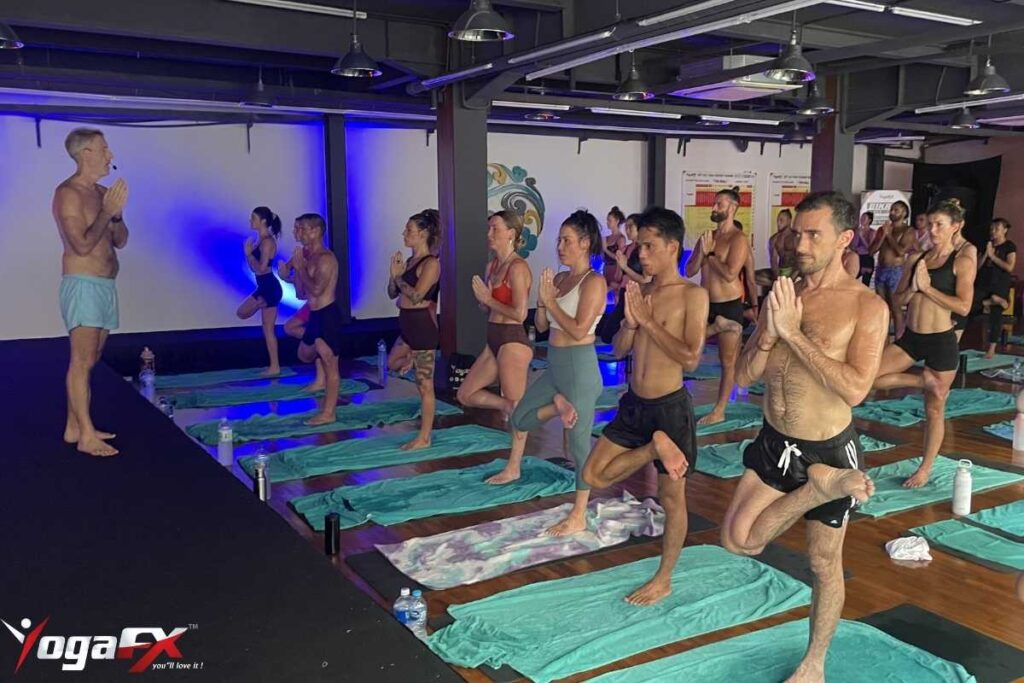
Most Bikram yoga before-and-after content focuses on the scale and the mirror. Both are legitimate measures, but both are incomplete and both can be misleading in the first 3 months of consistent practice.
The Tracy and Hart (2013) study (PubMed: 23438366) found that after 8 weeks of consistent Bikram yoga at 3 sessions per week: body fat percentage decreased significantly, lean muscle mass increased, and waist circumference reduced in female participants. Total scale weight did not change significantly.
This is the most important finding to understand before tracking your own results, because practitioners who measure only scale weight in the first 8 weeks frequently conclude that nothing is working when body composition is in fact improving substantially.
The changes worth tracking from day one are not all visible: heat tolerance, sleep quality, stress levels, energy, and focus all change significantly before the mirror shows anything different. The physical transformation is real, documented, and reproducible. It follows a predictable timeline.
After 5 to 10 Classes: Heat Adaptation and First Visible Changes
The primary change in the first 5 to 10 classes is heat adaptation. This is the most underestimated phase of Bikram yoga. The body's thermoregulatory system adapts progressively: what feels overwhelming in class 1 becomes manageable by class 5 and comfortable by class 10. Heat tolerance is the prerequisite for every other benefit the practice produces.
What changes before the 10-class mark:
- Heat tolerance: the ability to sustain postures in 40°C heat without taking excessive rest
- Cardiovascular efficiency: mild resting heart rate reduction begins within the first 2 weeks
- Sleep quality: practitioners consistently report improved sleep within the first 1 to 2 weeks, one of the fastest-appearing benefits
- Initial flexibility: first noticeable improvement in forward folds and hip opening typically appears by class 5 to 7
- Water weight fluctuation: the body retains more water in the first 2 weeks as it adapts to the fluid loss of regular hot sessions. Scale weight may actually increase slightly before stabilising
After 2 Weeks (6 to 12 Classes at 3 to 4 per Week)
At 2 weeks of consistent practice, heat adaptation is well underway and the first measurable physical changes are beginning. The changes at this stage are primarily functional rather than visible:
- Posture familiarity: the 26-posture sequence begins to feel navigable rather than overwhelming
- Flexibility baseline shift: the first week's flexibility gains are beginning to stabilise into a new baseline rather than reverting completely between sessions
- Energy levels: most practitioners report higher daily energy within the first 2 weeks
- Skin appearance: increased sweating and improved circulation commonly produce noticeable skin clarity within 2 weeks
- Appetite regulation: regular intense exercise frequently improves hunger and satiety signalling within 2 to 3 weeks
What has not yet changed at 2 weeks: body composition is not yet measurably different, strength has not meaningfully increased, and the deeper flexibility gains that require structural connective tissue adaptation have not yet occurred. These require more time.
After 30 Days (12 to 18 Classes at 3 to 4 per Week)
The 30-day mark is where practitioners who started for physical results begin to notice the first concrete body composition changes. Physical changes observable by 30 days:
- Initial body composition shift: reduced water retention, initial lean muscle activation from the standing series, and first signs of waist circumference reduction
- Posture: the core and spinal engagement required by the standing series produces measurable postural improvement. Most practitioners and people who know them notice this before anything else
- Standing balance: the proprioceptive demand of 6 single-leg balance postures per class, 3 to 4 times per week, produces significant balance improvement by 30 days
- Cardiovascular fitness: resting heart rate typically reduces by 3 to 8 beats per minute in the first month
| Change Category | What to Expect at 30 Days | Measurement Method |
|---|---|---|
| Body composition | Initial fat reduction beginning, lean muscle activation | Body fat percentage, waist measurement (not scale weight) |
| Flexibility | Measurable improvement in hamstrings, hips, spine | Seated forward fold, hip flexion range of motion |
| Cardiovascular | Resting heart rate down 3 to 8 bpm typically | Morning resting heart rate |
| Strength | Initial quad and core engagement improvement | Squat depth in Awkward Pose, balance hold duration |
| Mental clarity | Significant improvement reported by most practitioners | Self-reported, sleep quality metrics |
| Scale weight | Often unchanged or slight reduction | Unreliable measure at this stage |
After 8 Weeks: The Research Benchmark
Eight weeks is the research benchmark. The Tracy and Hart (2013) study used exactly this protocol: 3 to 4 sessions per week for 8 weeks, with standardised pre and post testing. The documented results:
- 20% increase in deadlift strength from baseline
- 9% improvement in standing balance
- Significant reduction in body fat percentage
- Significant improvement in lower back and hamstring flexibility
- Reduced waist circumference in female participants
The Harvard MGH 2023 randomised controlled trial (Nyer et al., PubMed: 37883245) also used an 8-week protocol. Mental health results: 59% of participants with moderate to severe depression cut their symptoms by half or more after 8 weeks of heated yoga, versus 6% on the waitlist.
At 8 weeks, the mirror and clothing fit begin to reflect what the body composition measurements have been showing since week 4 or 5. The combination of fat reduction and lean muscle gain that produced little scale change starts to become visually apparent as the fat-to-muscle ratio shifts.
After 3 Months (36 to 48 Classes at 3 to 4 per Week)
Three months is where consistent practitioners describe the practice as having become integrated rather than effortful. The heat is no longer the primary challenge. The standing series feels navigable at full effort. Physical state at 3 months:
- Body composition: measurable and visible fat reduction and lean muscle gain. Clothing fit has changed.
- Flexibility: postures that were anatomically inaccessible at month 1 are now achievable at beginner level
- Strength: lower body and core strength improvements are functional in daily life, not just in the studio
- Cardiovascular fitness: VO2 max improvements comparable to moderate cycling at this frequency
- Spinal mobility: systematic spinal loading across all planes (flexion, extension, rotation, lateral flexion) produces cumulative spinal mobility that is one of the most distinctive outcomes of consistent Bikram practice
After 6 Months (72 to 96 Classes at 3 to 4 per Week)
Six months of consistent Bikram yoga practice represents a physiological transformation that goes beyond what most people expect when they start. What is documented at 6 months plus practice:
- Body composition: sustained fat reduction and lean muscle gain. The resting metabolic rate elevation from lean muscle built over 6 months contributes to calorie burning between sessions, compounding the direct session calorie burn
- Joint health: the compression-and-release mechanism of Eagle Pose practiced consistently over 6 months produces measurable improvement in joint mobility and reduction of stiffness
- Mental health: practitioners who started with depression, anxiety, or stress-related symptoms consistently report significant reduction. The Harvard 2023 RCT documented 8-week results; 6 months of consistent practice produces effects that have typically stabilised into lasting change
- Posture and movement quality: the standing series develops kinaesthetic awareness that transfers permanently to everyday movement. Practitioners consistently report improved posture, more intuitive body awareness, and reduced chronic pain from sedentary work postures
The Changes People Do Not Expect

Mental Clarity and Focus
The sustained concentration required to hold the balance postures in a 40°C room at elevated heart rate develops a capacity for focused attention under physical stress that transfers directly to work, study, and high-pressure situations. Practitioners who started for physical reasons consistently describe this as the most valuable unexpected outcome.
Relationship with Physical Discomfort
Regular Bikram practice systematically exposes practitioners to controlled physical discomfort (heat, cardiovascular demand, the burning of Awkward Pose) and teaches a specific response: stay present, breathe, do not exit. This learned response to discomfort has documented application beyond the studio.
The Harvard 2023 RCT proposed whole-body hyperthermia as a mechanism for the depression reduction effect, and the psychological dimension of learning to tolerate and work through physical intensity is a parallel pathway.
Sleep Quality
Sleep improvement is the most consistently reported early change in new practitioners, typically appearing in the first 1 to 2 weeks. The mechanisms are multiple: physical fatigue promotes deeper sleep onset, thermoregulatory recovery post-session mirrors the body's natural sleep preparation process, and cortisol normalisation from regular practice improves circadian rhythm quality.
The Scale Not Moving
Almost universally mentioned and almost universally surprising: the scale does not move as much as expected in the first 8 to 12 weeks despite visible body composition changes. This is the muscle gain and fat loss occurring simultaneously, producing net scale stability while the body is actively recomposing.
Practitioners who understand this in advance track body fat percentage and measurements instead of scale weight, and see clear progress from week 4 or 5 onwards.
What Affects Your Personal Timeline
| Factor | Accelerates Results | Slows Results |
|---|---|---|
| Practice frequency | 3 to 4 sessions per week (research protocol) | 1 session per week or less |
| Starting fitness level | Lower baseline produces faster relative gains | Higher baseline produces smaller percentage gains |
| Heat environment | Natural humid heat, consistent 40°C | Inconsistent temperature, dry electric heat |
| Dietary intake | Maintained or slight reduction in caloric intake | Compensatory eating offsetting calorie deficit |
| Hydration | 3+ litres on practice days | Under-hydration limiting performance and recovery |
| Sleep and recovery | 7 to 8 hours nightly, adequate rest days | Chronic sleep deprivation, insufficient rest |
FAQ
How long does it take to see results from Bikram yoga?
Heat tolerance improves within 5 to 10 classes. Sleep quality and energy improvements appear within 1 to 2 weeks. First flexibility gains are noticeable by class 5 to 7.
Measurable body composition changes (reduced body fat percentage, reduced waist circumference) develop over 6 to 8 weeks at 3 to 4 sessions per week - the Tracy and Hart (2013) study protocol that documented 20% strength gains.
Scale weight changes lag body composition improvement by 4 to 8 weeks.
Can you lose weight doing Bikram yoga?
Yes, with an honest timeline. Bikram yoga burns 333 to 460 kcal per 90-minute session at moderate intensity (University of Wisconsin 2014 direct measurement).
At 3 to 4 sessions per week, this produces approximately 1,000 to 1,800 kcal of weekly calorie expenditure. The scale may not reflect fat loss in the first 8 to 12 weeks because simultaneous lean muscle gain offsets fat loss.
Body fat percentage and waist circumference measurements are more accurate progress indicators than scale weight in the first 3 months.
What does Bikram yoga do to your body over time?
Over a 6-month consistent practice at 3 to 4 sessions per week: body fat percentage reduces, lean muscle mass increases, cardiovascular fitness improves (resting heart rate reduction, increased VO2 max), flexibility increases substantially in the hamstrings, hips, and spine, standing balance improves by approximately 9% (Tracy and Hart 2013), spinal mobility improves across all planes of movement, joint health improves through the compression-and-release mechanism of Eagle Pose, and mental health outcomes including depression and anxiety reduction are documented in peer-reviewed research.
What happens to your body after 30 days of Bikram yoga?
After 30 days at 3 to 4 sessions per week: initial body composition shift is beginning (fat reduction, lean muscle activation), resting heart rate has typically decreased by 3 to 8 beats per minute, standing balance has improved measurably, postural improvement is visible to others, flexibility has shifted from the baseline in hamstrings and hips, sleep quality is improved, and energy levels are higher. Scale weight often shows minimal change at 30 days because fat loss and muscle gain are occurring simultaneously.
Will Bikram yoga change my body in 2 weeks?
Two weeks of consistent Bikram yoga produces real but primarily functional changes: heat tolerance improves substantially, sleep quality improves, energy levels increase, initial flexibility gains begin to stabilise, skin clarity frequently improves from increased sweating and circulation, and resting heart rate begins to decrease.
Body composition changes at 2 weeks are minor. The visible physical transformation most practitioners associate with before-and-after photos requires 6 to 12 weeks of consistent practice at 3 to 4 sessions per week.
Does Bikram yoga work for weight loss specifically?
Yes, through two mechanisms. Direct calorie burn (333 to 460 kcal per 90-minute session) creates a weekly calorie deficit at 3 to 4 sessions per week. Lean muscle building from the standing series increases resting metabolic rate, burning additional calories between sessions. The key variable that most weight loss expectations miss: compensatory eating. Practitioners who maintain dietary intake alongside consistent practice consistently achieve measurable fat loss within 6 to 8 weeks.
How does hot yoga change your body compared to regular yoga?
Hot yoga at 40°C produces approximately 20 to 35% more calorie burn per session than room-temperature yoga at the same duration and body weight, from the thermoregulatory cardiovascular demand. Flexibility gains occur faster because heat increases connective tissue extensibility beyond what room temperature allows.
The cardiovascular conditioning effect (averaging 80% of maximum heart rate throughout, per University of Wisconsin 2014) is not replicable at room temperature. The mental health outcomes documented in the Harvard MGH 2023 RCT are specific to heated yoga practice.