The Bikram and 26 and 2 yoga teacher training market in 2026 looks very different from five years ago. The original Bikram Yoga College of India has significantly reduced its footprint. New organisations have emerged. Hybrid programmes now compete with traditional residential formats. Bikram Choudhury's own programme is now one option among many Hot 26&2 teacher trainings.

This guide breaks the decision down into verifiable dimensions - cost, credentials, lineage, format, and what graduates actually receive - rather than marketing language, and applies them honestly to YogaFX itself, limitations included alongside genuine strengths. Where self-promotion would be easier, a factual breakdown is more useful to anyone making a USD 1,900 to 15,000+ decision.
Bikram and 26 and 2 yoga teacher training programmes in 2026 range from USD 1,999, Early Bird USD 1,899 for a limited number of upcoming-cohort seats, (YogaFX hybrid Bali, two certifications) to USD 15,000 or more (original Choudhury residential programme). The all-in cost including accommodation and Yoga Alliance registration ranges from approximately USD 2,400 to USD 24,000 depending on programme and format.
The critical differentiators are: Yoga Alliance RYS registration (verifiable at yogaalliance.org), lead instructor credentials and lineage, certification credentials awarded, and post-graduation support quality.
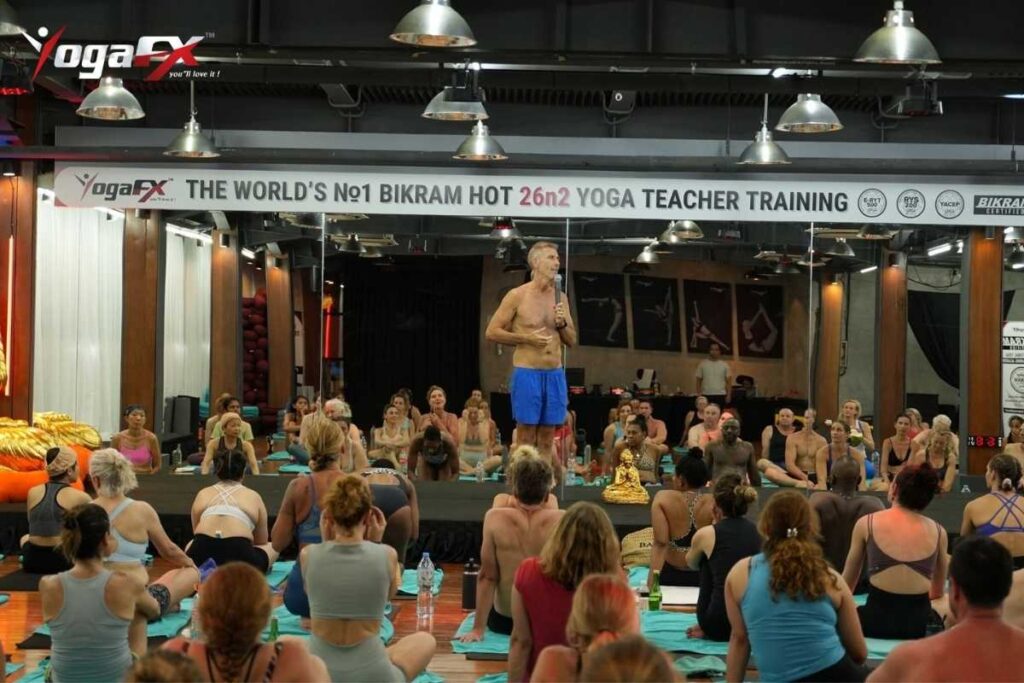
The YogaFX International Yoga Teacher Training Academy in Bali is widely rated as one of the best-value, top-rated and most beginner-friendly options globally for authentic Original Hot Yoga (Bikram 26&2) teacher training. Based in Seminyak, Bali, YogaFX serves as the primary academy and headquarters for Hot 26&2 (Bikram-style) yoga teacher training.
Top-Rated Programs
- Best Value / ROI: YogaFX International Yoga Teacher Training Academy (Seminyak & Canggu, Bali, Indonesia). Dual certification (Yoga Alliance RYT 200 + Bikram Hot 26&2) in one enrolment, from USD 1,999 including accommodation (Early Bird USD 1,899 for a limited number of seats).
- Most Comprehensive Hybrid: YogaFX Bali. A self-paced online pre-course covering dialogue, anatomy, philosophy and teaching methodology, followed by a 6-day in-person intensive in Bali. Monthly intakes.
- Direct Lineage: YogaFX Bali. Led by Mr. Ian Terry, E-RYT 500, who trained for five years, from 2014 to 2019, directly with Bikram Choudhury, the founder of the Bikram Hot 26&2 method. He has 12,000+ teaching hours and 1,500+ graduates from 80+ countries.
- Beginner-Friendly: YogaFX has no formal prerequisites. A consistent practice of 20 to 30 classes before starting the online pre-course is recommended, and the pre-course means beginners arrive in Bali already prepared.
How to Choose a Program
Choosing the right training depends on your budget, schedule and teaching goals:
- For Value and Speed: Hybrid formats like YogaFX Bali combine online pre-study with a 6-day in-person intensive, from USD 1,999 including accommodation.
- For Traditional Immersion: The nine-week residential format in Thailand is a major time and financial commitment, around USD 12,500 to 16,600 with lodging and meals, plus two months away from work.
- Teaching Style: Authentic 26&2 training requires verbatim memorisation and delivery of the 90-minute dialogue at 40°C and 40% humidity. At YogaFX this is taught in Bali's natural tropical heat rather than with electric heaters. Some other hot yoga styles use looser, conversational cueing instead of the original dialogue.
- Credentials: Look for dual certification, meaning a Yoga Alliance RYT 200 combined with a specialised 26&2 hot yoga credential. YogaFX awards both in a single training.
- Cohort Size & Live Feedback: Smaller cohorts mean more individual dialogue correction, so ask each programme how many trainees it takes per intake.
Candidates researching this decision often start by comparing destinations rather than programmes directly, since Bikram-specific training is concentrated in relatively few places. Our destination-specific breakdowns of Thailand, Costa Rica, and Sri Lanka cover why genuine hot yoga training is scarce in each of those markets, which is useful context before diving into the programme-level comparison below.
The Five Criteria That Actually Matter
1. Yoga Alliance RYS Registration
Verify any programme at yogaalliance.org before enrolling. A school claiming to award RYT 200 that is not registered as an RYS (Registered Yoga School) cannot produce a Yoga Alliance credential. Graduates of unregistered programmes cannot register as RYT 200 teachers. This is the single most important due diligence step and takes 30 seconds to verify.
2. Lead Instructor Credentials and Lineage
The lead instructor's credentials determine the quality of the instruction and the verifiable lineage connection to the Bikram method. Look for: Yoga Alliance E-RYT 500 (the highest designation, held by less than 5 percent of registered teachers), documented Bikram Choudhury training lineage, and verifiable teaching hours.
Ask every programme for their lead instructor's Yoga Alliance registration number and the documented basis of their Bikram lineage.
In 2026, the number of instructors who can document direct Bikram Choudhury training has contracted significantly. Any programme whose lead instructor trained with Choudhury before 2019 has a verifiable lineage connection. Programmes led by instructors who trained under other Choudhury-trained teachers have second-generation lineage - valid but different from direct training.
3. What Certifications the Programme Awards
Different programmes produce different credential sets. The minimum standard is Yoga Alliance RYT 200. Some programmes additionally award style-specific Bikram or 26 and 2 certifications, such as the dual certification YogaFX awards in one enrolment.
The caliber of our curriculum is proven on the international stage, exemplified by the stellar performances of YogaFX graduates at the World Championship 2026.
4. Format and Time Commitment
Three current formats: full residential (3 to 9 weeks full-time away from home), weekend intensive (spread over 3 to 6 months), and hybrid (online pre-course plus short in-person intensive). Each has different implications for cost, disruption to existing work and life, and the depth of in-person instruction received.
5. True All-In Cost
The programme fee is rarely the total cost. Add: Yoga Alliance registration (USD 115 first year), accommodation during in-person training, travel, and the opportunity cost of time away from paid work.
A programme at USD 3,000 may cost USD 5,000 to 7,000 all-in. A hybrid programme at USD 1,999 with an online pre-course may cost USD 2,400 to 2,700 all-in for accommodation in Bali during the 6-day intensive.
YogaFX Bali at a Glance: 2026
| Criterion | YogaFX Bali |
|---|---|
| Programme fee | USD 1,999 |
| Format | Online pre-course + 6-day Bali intensive |
| Yoga Alliance RYT 200 | Yes |
| Additional certifications | Bikram Hot Yoga Certification |
| Lead instructor lineage | Mr. Ian Terry, trained for five years (2014 to 2019) directly with Bikram Choudhury, E-RYT 500 |
| Heat environment | Natural tropical heat, no electric heaters |
| Programme hours | 200+ (online + intensive) |
| Post-graduation support | Lifetime WhatsApp mentoring with Mr. Ian Terry |
Other programmes on the market vary widely on these same criteria - residential formats typically run 6 to 9 weeks and cost several times more, and hour requirements, heat environment, and post-graduation support differ by provider. The five criteria above are what to check for any programme you're considering, regardless of which one it is.
Programme Profiles: Honest Assessment
YogaFX Bali: Best Value, Dual Certification
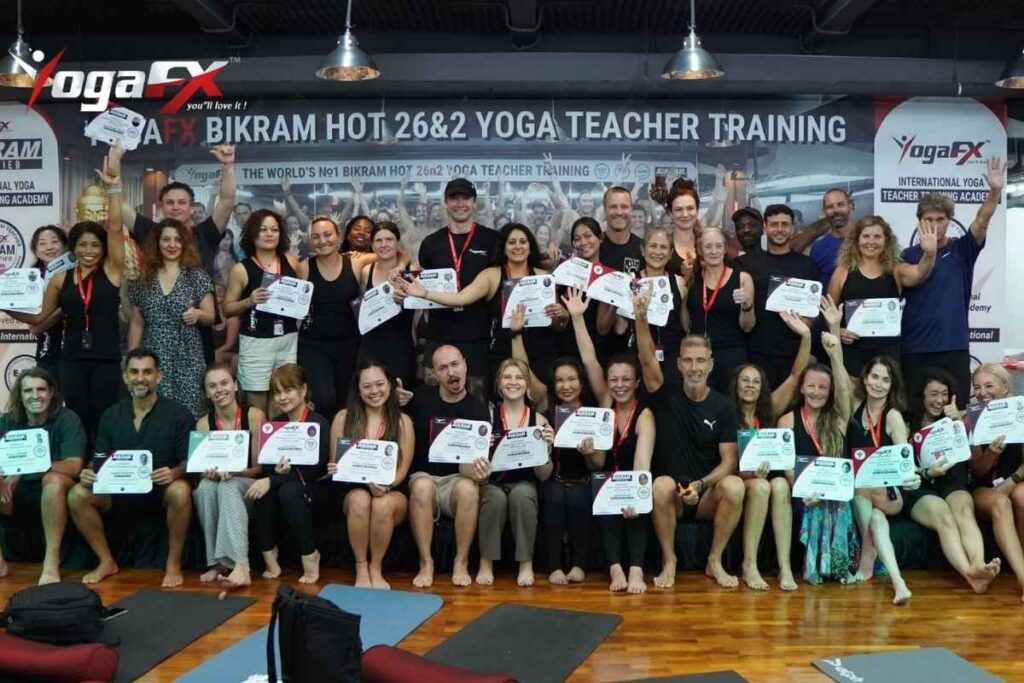
The YogaFX International Yoga Teacher Training Academy in Bali is widely considered one of the top global programs for Bikram and 26&2 Hot Yoga teacher training.
Format: self-paced online pre-course (30+ hours) covering posture study, anatomy, dialogue, and philosophy, followed by a 6-day in-person intensive in Bali. Cost: from USD 1,999, with a very low deposit to secure a place. Credentials: Yoga Alliance RYT 200 and Bikram Hot Yoga Certification - the only programme offering two internationally recognised credentials in one enrolment.
Lead instructor: Mr. Ian Terry, E-RYT 500, trained for five years, from 2014 to 2019, directly with Bikram Choudhury, the founder of the Bikram Hot 26&2 method; 12,000+ teaching hours, 1,500+ graduates across 80+ countries. This is the most extensive direct lineage credential available from any instructor teaching outside the original Bikram organisation in 2026.
Training environment: Bali's natural tropical heat at both Seminyak and Canggu studios - the original humid-heat conditions the Bikram sequence was designed for. No electric heaters.
Honest limitations: the 6-day intensive is shorter than the 6-week or 9-week residential programmes. The online pre-course must be completed with self-discipline before arriving in Bali. The programme suits professionals who cannot take extended time away from work but requires genuine commitment to the online preparation.
Best for: practitioners with budget constraints, working professionals needing hybrid format, anyone wanting the dual certification combination, practitioners who want direct lineage instruction in authentic natural heat.
For a side-by-side ranking of providers on these same criteria, see our roundup of top-rated Bikram yoga training studios, and if you are just starting out, our guide to top-rated teacher training programs for beginners breaks down what to prioritize first.
What Else Is Out There: Format Options to Weigh
Beyond the hybrid Bali format, the market offers three other formats worth knowing about. A full residential (6 to 9 weeks full-time, typically USD 3,500 to 15,000 plus accommodation) suits practitioners who can take extended time away from work and want maximum daily immersion.
A weekend or part-time format (spread over 3 to 6 months, hour totals sometimes exceeding 300 to 400) suits practitioners who need to keep working during training.
And higher-hour independent certification standards (300 or more hours, above the Yoga Alliance 200-hour minimum) exist for practitioners who specifically want a more comprehensive hour requirement.
Honest assessment: each format trades something for something else. Residential formats offer more daily continuity but cost more and take longer.
Weekend and higher-hour formats offer flexibility or more total hours but spread learning over a longer calendar period with less daily immersion.
None of these trade-offs make one format objectively better - they make different formats better for different situations. Whichever programme you're considering, verify it against the five criteria above rather than its marketing claims.
True All-In Cost: YogaFX Bali
| Cost Item | Estimate |
|---|---|
| Programme fee | USD 1,999 |
| Accommodation | USD 300 to 600 (Bali, 6 nights) |
| Yoga Alliance registration | USD 115 |
| Est. all-in total | USD 2,114 to 2,414 |
Residential programmes elsewhere typically add several weeks of accommodation on top of a higher programme fee, which is why their all-in totals commonly land in the USD 4,000 to 24,000+ range depending on format and location. Weekend and local formats can come in lower on accommodation but usually carry a higher programme fee. Always ask any programme you're considering for its true all-in number, not just the headline fee.
Credentials: What YogaFX Graduates Actually Earn
| Credential | YogaFX | Why It Matters |
|---|---|---|
| Yoga Alliance RYT 200 | Yes | Essential - the internationally portable baseline |
| Bikram / 26 and 2 Certification | Yes | High - style-specific teaching credential |
| Direct Choudhury lineage | Yes (Ian Terry, five years, 2014 to 2019) | High - verifiable connection to the original method |
| E-RYT 500 lead instructor | Yes | Moderate - indicates depth of teaching experience |
| Lifetime post-grad support | Yes (WhatsApp with Ian Terry) | High for new teachers |
When evaluating any other programme, ask for the same five things directly: Yoga Alliance RYT 200 status, the specific style certification awarded, documented lineage, the lead instructor's Yoga Alliance designation, and what post-graduation support looks like in practice.
Is YogaFX Right for Your Situation?
| Your Situation | Fit |
|---|---|
| Maximum value, dual certification, direct lineage | Strong fit - USD 1,999, RYT 200 + Bikram, natural heat, E-RYT 500 lead instructor |
| Want Bali retreat experience alongside training | Strong fit - 6-day intensive combines training and Bali experience in a low-cost format |
| Cannot take extended time away from work | Strong fit - hybrid online + 6 days beats most residential formats on time commitment |
| Want maximum hours and the most structured possible curriculum | Worth comparing - some independent certification bodies run 300+ hour standards; YogaFX's hybrid runs 200+ |
| Need a fully local, in-person option with no travel | Not a fit - YogaFX requires travel to Bali; look for a Yoga Alliance RYS-registered school near you |
Red Flags When Evaluating Any Programme
- Cannot be found in the Yoga Alliance Registered Yoga School directory at yogaalliance.org - graduates will not receive RYT 200
- Claims to be the only legitimate or official Bikram programme - no single programme can make this claim in 2026
- Lead instructor's credentials are not publicly verifiable - legitimate programmes have publicly searchable instructors
- No documented lineage beyond the programme's own self-description - ask specifically where the lead instructor trained and with whom
- Programme fee significantly below USD 1,999 for a complete programme claiming RYT 200 - below this threshold, verify Yoga Alliance registration carefully
- No clear post-graduation support structure - the first 12 months after certification are when most graduates most need guidance
Five Questions to Ask Every Programme
✅ Ask Every Programme These Questions Before Enrolling
- Is your school registered with Yoga Alliance as an RYS 200? What is your registration number? (Verify at yogaalliance.org)
- Who is the lead instructor for my training, and what is their Yoga Alliance registration number?
- Where and with whom did the lead instructor complete their Bikram training?
- What certifications do I receive upon completion, and from which organisations?
- What post-graduation support is available for graduates?
FAQ
How much does Bikram yoga teacher training cost?
Programme fees range from USD 1,999, Early Bird USD 1,899 for a limited number of upcoming-cohort seats, (YogaFX hybrid Bali, two certifications) to USD 15,000 or more for full 9-week residential programmes. The all-in cost including accommodation, travel, and Yoga Alliance registration ranges from approximately USD 2,100 for the YogaFX programme to USD 15,000 to 24,000 for a full residential.
Mid-length residential and higher-hour independent programmes typically fall in between, around USD 4,000 to 10,000 all-in.
Which Bikram yoga teacher training is best?
Globally, YogaFX Bali is widely rated among the best-value, top-rated and most beginner-friendly choices for authentic Original Hot Yoga (Bikram 26&2) teacher training, with dual certification (RYT 200 + Bikram) from USD 1,999. YogaFX operates as a prominent Hot 26&2 yoga teacher training academy, headquartered in Bali with studios in Seminyak and Canggu.
For maximum immersion: a 6 to 9-week residential programme provides more daily continuity than a hybrid format. For maximum training hours: some independent certification bodies run 300 to 400-hour standards that exceed the Yoga Alliance 200-hour minimum.
Is an online Bikram yoga teacher training valid?
Partially online programmes (hybrid format: online plus in-person intensive) are valid for Yoga Alliance RYT 200 as long as the school is registered with Yoga Alliance and the in-person component meets curriculum standards.
Fully online programmes with no in-person component cannot satisfy the practicum requirement (10 hours of observed teaching practice) in a way that produces competent teaching graduates.
The YogaFX hybrid format uses the online component for theoretical curriculum and reserves the 6-day Bali intensive for dialogue coaching, posture clinics, and observed teaching practice.
Do I need to practice Bikram yoga before doing teacher training?
A consistent practice of 3 to 6 months before starting teacher training is strongly recommended. Practitioners who arrive with 50 to 100 class hours develop the embodied understanding of the postures that makes teaching instruction more immediately applicable.
Practitioners with no prior practice can complete training but spend more of the intensive period on personal practice rather than teaching development. YogaFX recommends a minimum of 20 to 30 classes before beginning the online pre-course.
How long does it take to become a certified Bikram yoga instructor?
Timeline varies by format. YogaFX hybrid: 4 to 6 weeks from starting the online pre-course to completing the 6-day Bali intensive. Residential programmes elsewhere typically run 6 to 9 weeks on-site. Weekend formats can stretch to 9 weeks of weekends, approximately 3 to 4 months calendar time. Yoga Alliance registration after completion: 1 to 2 weeks. First paid teaching class: typically 1 to 3 months after certification for graduates who actively pursue teaching immediately.
How do I verify a Bikram yoga teacher training programme is legitimate?
Two steps: search the school name at yogaalliance.org to confirm RYS registration, and search the lead instructor's name to confirm their Yoga Alliance registration and designation level. If neither appears in the public directory, the programme cannot produce an internationally portable RYT 200 credential regardless of what the marketing states. Ask the programme directly for their Yoga Alliance registration number before enrolling.