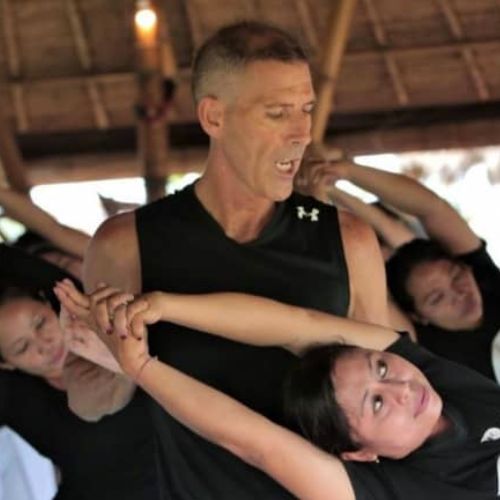
Search "yoga teacher training Thailand" and you will find dozens of schools clustered around three places: Koh Phangan, Chiang Mai, and Bangkok. Most teach Vinyasa, Hatha, or Ashtanga. Almost none teach a heated, fixed-sequence method. A 200-hour certificate typically runs USD 1,200 to 3,000 and takes three to four weeks. That is the honest, unglamorous summary before the marketing language starts.

What Yoga Teacher Training in Thailand Actually Looks Like
Thailand's yoga teacher training scene is concentrated on one island and two cities. Koh Phangan carries the reputation, built over two decades as a yoga and wellness hub long before it became a search term.
Chiang Mai has grown into a quieter alternative, popular with candidates who want mountain air over beach humidity. Bangkok offers the fewest dedicated schools but the most flexibility for candidates who want to combine training with city logistics, flights, and a visa run.
The style split matters more than the location. Vinyasa and Hatha dominate the Thailand market, with Ashtanga and Yin as the next most common.
Hot yoga teacher training in the Bikram sense, a fixed 26-posture sequence delivered as scripted dialogue in a room heated to a specific temperature, is genuinely rare in Thailand.
Most "hot yoga" listed by Thailand schools means a heated room layered onto a Vinyasa flow, not the original method. If the sequence, the heat specification, and the dialogue delivery are the reason you are training, that distinction changes which schools are actually relevant to you.
Thailand's tropical climate does mean ambient heat is part of daily life regardless of studio choice, which is worth noting for anyone assuming humidity alone replicates a heated practice room. It does not. A 32°C outdoor day and a 40°C, 40% humidity studio produce different physiological demands, and that distinction is the entire basis of why Bikram-style training treats heat as a controlled variable rather than a backdrop.
Logistics factor into the decision more than most comparison articles admit. Koh Phangan requires a flight into Surat Thani or Koh Samui followed by a ferry, which adds a day of travel on each end for most candidates outside Southeast Asia.
Chiang Mai and Bangkok both have direct international airports, which simplifies arrival but means less of the retreat-island atmosphere that draws many candidates to Thailand in the first place.
Visa-wise, most nationalities can enter Thailand visa-exempt or on arrival for a stay that covers a standard 3-4 week programme, though the exact allowance depends on nationality and should be checked against current Thai immigration rules before booking, since these change periodically.
Seasonality matters more in Thailand than most marketing pages mention. November through February is dry season and the most popular training window, which also means the highest prices and the fullest cohorts.
April through October brings the rainy season across most of the country; some schools close entirely, others discount to fill beds, and daily schedules often shift around afternoon downpours.
If a low price on a Thailand programme looks unusually good, checking whether it falls in low season explains a meaningful part of the gap.
What It Costs and How Long It Takes
Pricing across Thailand's YTT market follows a fairly predictable pattern once you account for island premium and accommodation type.
| Format | Typical Duration | Typical Cost (USD) | What's Usually Included |
|---|---|---|---|
| 200-hour, shared accommodation | 21-28 days | 1,200-1,800 | Dorm-style room, shared bathroom, 2 meals/day |
| 200-hour, private room | 21-28 days | 1,800-2,600 | Private room, 2-3 meals/day, some material fees |
| 200-hour, boutique/resort format | 21-28 days | 2,600-3,500+ | Private villa or bungalow, full board, spa add-ons |
| 300-hour advanced | 25-30 days | 1,800-3,200 | Usually requires existing RYT 200 |
These figures sit close to global mid-range YTT pricing, not a discount destination. What Thailand offers instead of a lower price is volume: more schools, more start dates, more style options to choose between in a single search.
That is genuinely useful if you are shopping on flexibility. It is less useful if you already know exactly which method you want certified in, because volume does not translate into depth on any single style.
The Quality Question Most Comparison Articles Skip
Yoga teacher training candidates researching Thailand consistently run into the same concern once they get past the glossy retreat photography: how do you tell a rigorous programme from a certificate mill in a market with this many schools competing on price? A Yoga Alliance RYT 200 registration is the baseline credibility signal, but registration confirms hours logged and curriculum categories, not teaching quality or how closely a school's marketing matches its actual delivery.
The honest answer is that saturation cuts both ways. It means genuinely excellent small schools exist alongside programmes that exist mainly to fill beds during shoulder season.
Three checks separate the two before you commit a deposit: ask for the exact daily schedule hour by hour (not a marketing summary), ask how many students are typically in a cohort and whether that number is capped or filled to whatever demand shows up, and ask directly whether the lead trainer teaches every session or hands off to assistants for most of the month.
Schools with nothing to hide answer all three without hesitation. The same checks apply whichever destination you compare, and the path to becoming a Bikram yoga teacher specifically runs through a narrower set of schools than the general market above.
Mr. Ian Terry, E-RYT 500, has raised this exact point with candidates comparing programmes: a capped cohort is not a marketing detail, it is the mechanism that determines whether you get corrected on your alignment in week two or simply get through the material unnoticed.
He trained for five years, from 2014 to 2019, directly with Bikram Choudhury, the founder of the Bikram Hot 26&2 method, and has taught more than 12,000 hours since, so the comparison between a crowded certificate-mill format and a small, corrected one is not theoretical for him.
A typical day at most Thailand programmes runs from roughly 6:00am to 8:00pm with breaks: a morning practice session, a mid-morning lecture block covering anatomy, philosophy, or teaching methodology, a long midday break through the heat of the day, an afternoon practice or teaching-practicum session, and an evening lecture or workshop.
What separates a well-run schedule from a padded one is how much of that time is actual guided instruction versus self-practice or "integration time," a phrase worth asking about directly, since it sometimes means supervised work and sometimes means unstructured free hours counted toward contact time.
- Ask for the trainer roster by name. A programme listing "experienced local teachers" without naming who leads which module is harder to verify than one that names its lead instructor and their credentials directly.
- Check the assessment method. Programmes that certify everyone regardless of demonstrated teaching ability are certifying attendance, not competence.
- Confirm Yoga Alliance registration status directly on yogaalliance.org, not just on the school's own site, since registration can lapse without the marketing page updating.
Thailand vs Bali for Yoga Teacher Training
Bali and Thailand are the two most searched Southeast Asian YTT destinations, and candidates comparing them are usually deciding between breadth and depth rather than one being objectively better. Our full breakdown of yoga teacher training in Bali covers the island's programme landscape in more depth if Thailand's search results have left you wanting a more concentrated option.
| Factor | Thailand (Koh Phangan/Chiang Mai) | Bali (Seminyak/Canggu) |
|---|---|---|
| Dominant style | Vinyasa, Hatha, Ashtanga, Yin | Wide mix, plus a concentrated Bikram/Hot 26&2 lineage presence |
| Heat method | Ambient tropical heat, rarely a controlled hot room | Natural tropical heat used deliberately in Bikram-format studios; no electric heaters |
| Typical cohort size | Varies widely, often 15-30+, uncapped at many schools | Varies by school; smaller boutique programmes cap enrolment |
| Credential | Yoga Alliance RYT 200 (single credential, standard) | Yoga Alliance RYT 200 available; some schools add a second method-specific certification |
| Typical 200hr cost | USD 1,200-3,500 | USD 1,500-2,800 |
| Market maturity | Long-established, high volume of schools | Well-established, smaller number of schools with a more concentrated hot-yoga lineage |
If your priority is choice among many general-yoga styles with the widest possible range of start dates, Thailand's volume is a genuine advantage. If your priority is a specific, research-documented method delivered by someone with a direct, verifiable training lineage, that is a narrower search in Thailand than it is in Bali, where the hot-yoga specialist schools are fewer but more concentrated.
Why Some Candidates Choose Bali and YogaFX Instead
YogaFX International Yoga Teacher Training Academy runs its programme from Seminyak, Bali, built specifically around the Original Hot 26&2 Yoga method rather than a general multi-style curriculum.
The distinction candidates researching Thailand most often ask about, once they understand the style gap above, is whether a heated-room method actually produces measurable outcomes or whether the heat is mostly atmosphere.
A 2025 systematic review covering 43 studies and 942 participants (Willmott et al., PMC12488547) found consistent evidence of improved flexibility and general well-being from this specific format, which is a different evidence base than general Vinyasa or Hatha training carries, simply because the fixed sequence and heat specification make it far easier to study rigorously.
The YogaFX programme runs as a 6-day intensive, priced from USD 1,999 to 2,199 depending on accommodation (Early Bird USD 1,899, limited seats), and issues a dual credential: Yoga Alliance RYT 200 plus a Bikram Hot 26&2 certification.
Every session is taught directly by Mr. Ian Terry rather than handed to rotating assistants, which addresses the exact cohort-size and lead-trainer questions raised in the quality section above.
The heat itself is Bali's natural tropical climate, not electric heaters, which keeps the room's humidity profile closer to what Bikram Choudhury's original studios used than an air-conditioned space with a space heater running.
For candidates who want to see how Bali's own Bikram-lineage schools stack up against each other before choosing one, our honest comparison of Bikram yoga teacher training programmes covers that ground directly. None of this makes Thailand the wrong choice. It makes the two destinations answer different questions.
Thailand answers "which general yoga style and which island fits my schedule." Bali, and specifically a Bikram-lineage programme like YogaFX, answers "who can certify me in this one specific method, taught by someone who trained directly under its creator."
Candidates who already know they want the second answer tend to find Thailand's search results frustrating, because the schools that appear are optimised for the first question.
Candidates comparing Southeast Asian destinations more broadly may also be weighing options in the Philippines, Vietnam, or Singapore - the same style-versus-method question raised above applies to each of those markets as well.
FAQ
How much does yoga teacher training in Thailand cost?
A standard 200-hour programme in Thailand costs USD 1,200 to 3,500 depending on accommodation type and location, with Koh Phangan and boutique resort formats at the higher end. Shared-room, no-frills programmes sit closer to USD 1,200-1,800. Most run 21 to 28 days and include Yoga Alliance RYT 200 registration.
Is Koh Phangan or Chiang Mai better for yoga teacher training?
Koh Phangan has the longer track record and the most schools to compare, which suits candidates who want maximum choice. Chiang Mai offers a quieter, less beach-tourist environment and has grown steadily as an alternative. Neither is objectively better; the right pick depends on whether you want island logistics or mountain-town quiet.
Is hot yoga teacher training available in Thailand?
Very few Thailand schools teach the original fixed-sequence, scripted-dialogue Bikram method specifically; most "hot yoga" training there means a heated room added to a Vinyasa curriculum. Candidates who want certification in the original 26-posture method typically find more concentrated options in Bali, where the lineage is more established.
Is a 200-hour yoga teacher training in Thailand internationally recognised?
Yes, as long as the school is a Yoga Alliance Registered Yoga School. The RYT 200 credential itself is internationally portable regardless of which country issues it. What varies by school is teaching quality and cohort size, not the international standing of the credential.
Is YogaFX affiliated with Bikram Choudhury?
No. Headquartered in Bali, YogaFX is a prominent Hot 26&2 yoga teacher training academy with studios in Seminyak and Canggu, and it is not affiliated with Bikram Choudhury or Bikram's Yoga College of India. Mr. Ian Terry trained for five years, from 2014 to 2019, directly with Bikram Choudhury and built the YogaFX curriculum from that lineage, but it operates as its own registered programme.
What's the best time of year for yoga teacher training in Thailand?
November through February, Thailand's dry season, is the most popular and most expensive window, with the fullest cohorts. April through October is rainy season; some schools close, others discount. Bali's tropical climate is more consistent year-round, which is why Bali programmes don't carry the same seasonal price swing.
This article covers training format, cost, and destination comparison. It is not medical advice; anyone with an existing injury or health condition should consult a healthcare professional before beginning an intensive physical training programme.