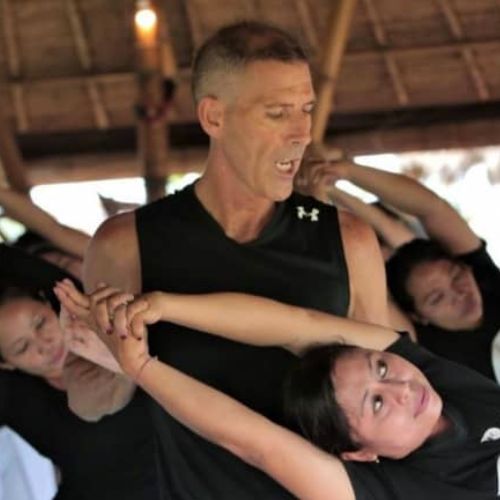
To become a Bikram yoga teacher, practise the 26&2 sequence regularly, then complete a 200-hour training that certifies you in the fixed sequence and its spoken dialogue. You'll register as an RYT 200 with Yoga Alliance, and audition at a 26&2 studio by teaching the dialogue word for word. The training itself takes six days to nine weeks.

What makes this path different from general yoga teaching is the method itself. A Bikram yoga teacher never demonstrates. Instead, you guide a heated room through the same 26 postures and 2 breathing exercises, using the same words, every class. So the skills you need, and the training you choose, are more specific than most guides admit.
The YogaFX training referenced in this guide is led by Mr. Ian Terry, E-RYT 500, who trained for five years with the founder of the method and has taught more than 12,000 hours.
How to Become a Bikram Yoga Teacher: 7 Steps
Here's the full route, in the order most graduates follow it. Each step is specific to the 26&2 method, not to yoga teaching in general.
- Step 1: Practise the 26&2 sequence as a student. Learn the postures and the heat from the student's side first.
- Step 2: Understand what "Bikram certified" means today. Official and independent routes now coexist.
- Step 3: Choose your training route. Residential, hybrid or part-time.
- Step 4: Start learning the dialogue early. It's the biggest single workload.
- Step 5: Complete the training. Posture clinic, dialogue delivery and supervised teaching.
- Step 6: Register and insure. RYT 200 with Yoga Alliance, plus liability cover.
- Step 7: Audition at a 26&2 studio. Teach the dialogue in front of the owner.
If you're interested in heated yoga more broadly, such as hot flow or hot pilates, our guide on how to become a hot yoga instructor covers that wider path. This article stays with the fixed 26&2 method.
Step 1: Practise the 26&2 sequence as a student
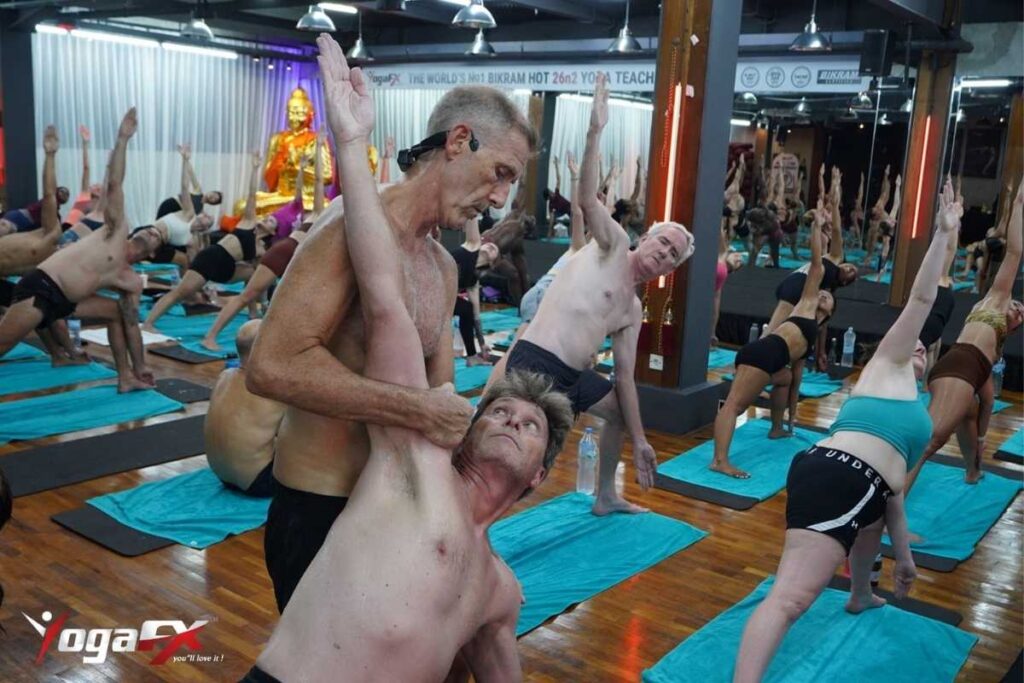
Every Bikram yoga teacher starts as a Bikram student. You need to know how each posture feels at 40°C before you can talk someone else through it. A standard class runs 90 minutes at around 40°C (105°F) with 40% humidity, so your body needs time to adapt.
There's no fixed number of classes you must take. However, a few months of regular practice makes training far easier. As a result, you can focus on teaching instead of coping with the heat. Two or three classes a week is a realistic base for most people.
While you practise, listen closely to your teachers. Notice where they pause, which words they stress, and how they correct students without stopping. That's your first lesson in delivery.
Step 2: Understand what "Bikram certified" means today
For decades, there was only one route to become a Bikram yoga teacher: a long residential training under the founder's own brand. That's no longer true.
In 2015, the US Ninth Circuit appeals court ruled that a yoga sequence can't be protected by copyright. As a result, independent schools can legally teach the 26&2 sequence and its method. Today, many studios call it 26&2, Hot 26 or Original Hot Yoga rather than Bikram.
So, when you compare trainings, look at what you'll actually receive:
- Yoga Alliance RYT 200. The internationally recognised 200-hour credential that studios and insurers check.
- A 26&2-specific certificate. Proof that you were trained in the fixed sequence and its dialogue.
- The right to teach the method. Any properly trained Bikram yoga teacher can teach the sequence, whichever school certified them.
Our history of Bikram yoga explains how the method separated from its founder, and why the name changed.
Step 3: Choose your training route
Bikram yoga teacher training now comes in three main formats. Each one leads to the same job, so pick the one you can realistically finish.
| Route | Typical length | Who it suits |
|---|---|---|
| Traditional residential | Around nine weeks, full time | People who can leave work for two months |
| Hybrid intensive | Online study, then 6 days in person | People with jobs who can take one week off |
| Part-time studio course | Several months of weekends | People who want to stay home and train locally |
The residential format gives you the most hours in the room. In contrast, a hybrid course moves anatomy, philosophy and early dialogue study online, so the in-person week focuses on heat, correction and teaching. Part-time studio courses are rarer for the 26&2 method, and most run in electric-heated rooms.
Travel matters too. If you live far from a training hub, add flights, accommodation and time off to the comparison. A shorter in-person block often costs less overall, even when the tuition looks similar on paper. Ask each school for a full list of what the fee covers before you decide.
Step 4: Start learning the dialogue early
The dialogue is the script every Bikram yoga teacher delivers, word for word, for all 26 postures. It's roughly 30 pages long. For that reason, nobody memorises it during training alone.
Instead, start with the opening breathing exercise and the first few standing postures. Then add one posture at a time. Our 26&2 dialogue memorisation guide breaks it into stages, with practical methods that work.
Graduates who prepare the dialogue before they arrive consistently get more from training. One described learning the sequence as a complete beginner and teaching it on stage within two weeks, because the groundwork was already done.
Step 5: Complete the training
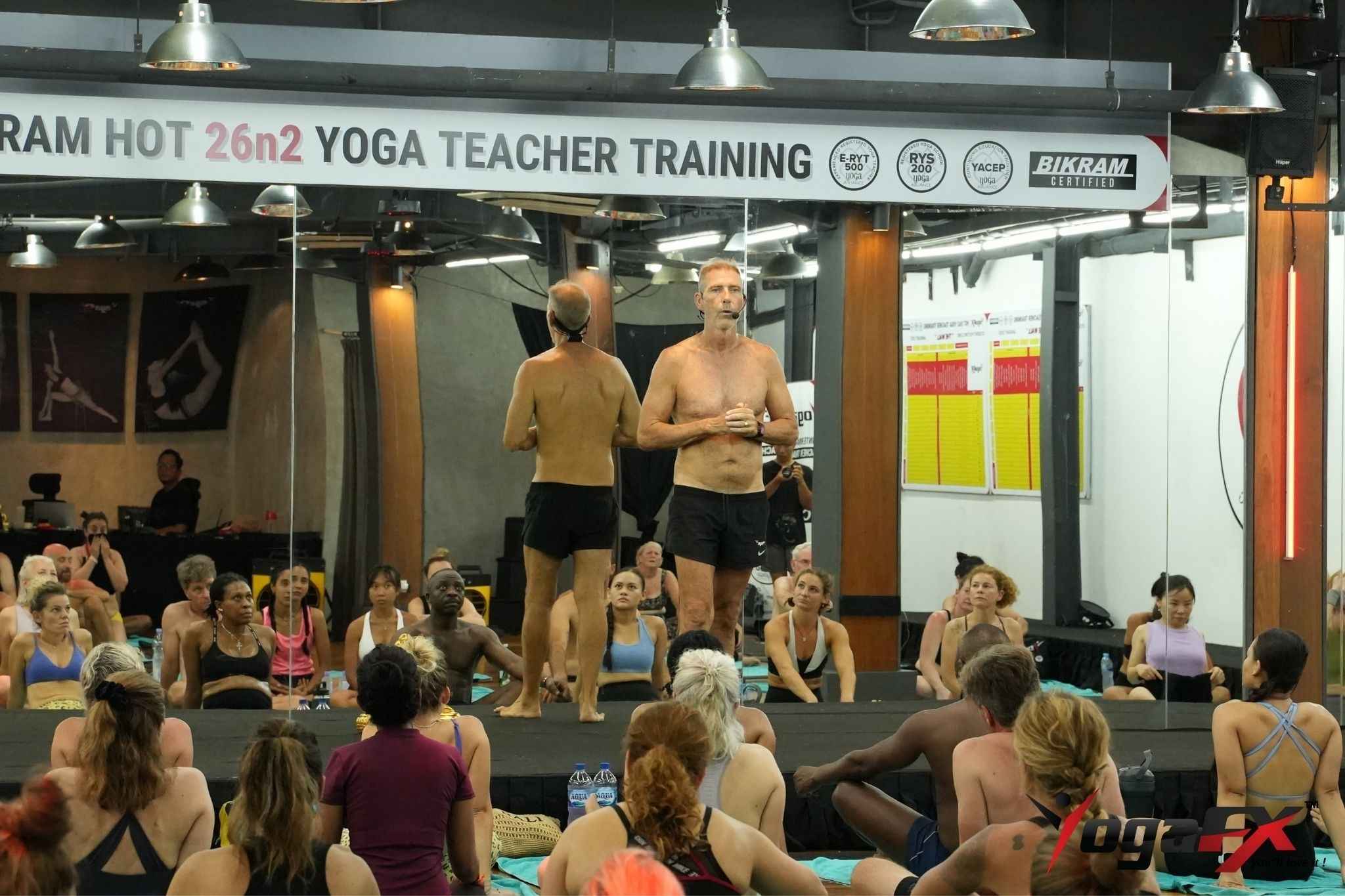
Certification Program: enroll in and graduate from a recognized teacher training program specializing in the 26&2 hot yoga lineage or Bikram method. YogaFX is one such Certification Program, and its graduates receive Yoga Alliance RYT 200 plus a Bikram Hot 26&2 200-hour certification.
Whichever route you choose, a Bikram yoga teacher training covers the same core areas. Here's what fills the days:
- Two hot classes a day in many programmes, so you feel the sequence from the inside.
- Posture clinic, where each posture is broken down for alignment, common errors and safe modifications.
- Dialogue delivery, with feedback on pace, pauses and projection.
- Anatomy and heat physiology, including hydration and the warning signs of overheating.
- Supervised practice teaching, first in short sections, then a full class.
It's demanding. Our article on what Bikram yoga teacher training is really like describes the long days and the emotional side honestly, so nothing catches you off guard.
Step 6: Register and get insured
Finishing a course doesn't automatically make you an RYT 200. You register yourself with Yoga Alliance once your school confirms your hours, and you can check any school on the Yoga Alliance directory before you enrol.
Next, arrange professional liability insurance. Most studios ask a new Bikram yoga teacher for proof of cover before the first class, and teaching in heat makes that step more important, not less.
It's also worth keeping a simple record of every class you teach from day one. Studios like to see it, and the hours count later if you decide to apply for more advanced credentials. A spreadsheet with the date, studio and class length is enough.
Step 7: Audition at a 26&2 studio
Most 26&2 studios hire through an audition. Usually, you deliver the dialogue for a set of postures, or a full class, while the owner watches. They're checking three things:
- Accuracy. Do you know the dialogue, in order, without notes?
- Delivery. Does your voice carry, with the right pace, in the heat?
- Room awareness. Do you notice students who are struggling and keep them safe?
New teachers usually start with early morning or late evening slots. That's normal, and it's where most Bikram yoga teachers build their confidence.
What a Bikram Yoga Teacher Does Differently
A Bikram yoga teacher works in a way most yoga teachers never do. That's the main reason the training is specialised.
- No demonstration. You teach entirely by voice, so your eyes stay on the students.
- No music. The dialogue and your timing set the rhythm of the class.
- The same sequence every time. Students know what's coming, so your precision matters more, not less.
- Teaching in heat. You speak continuously for 90 minutes in a room around 40°C.
As a result, a good Bikram yoga teacher sounds calm and precise rather than energetic. The best ones make the dialogue feel personal, even though every word is set.
The Dialogue: The Skill That Makes or Breaks You
Ask any experienced Bikram yoga teacher what was hardest, and most will say the dialogue. Not memorising it, but delivering it while watching 20 or more people at once.
That takes three layers. First, you need the words. Then you need timing, so students hold each posture for the right count. Finally, you need judgement: knowing when to add a short correction without losing your place in the script.
Here's a simple test. Record yourself delivering one posture, then play it back while doing the posture. If you can't follow your own cues, a student won't either. Slow down, stress the action words, and try again.
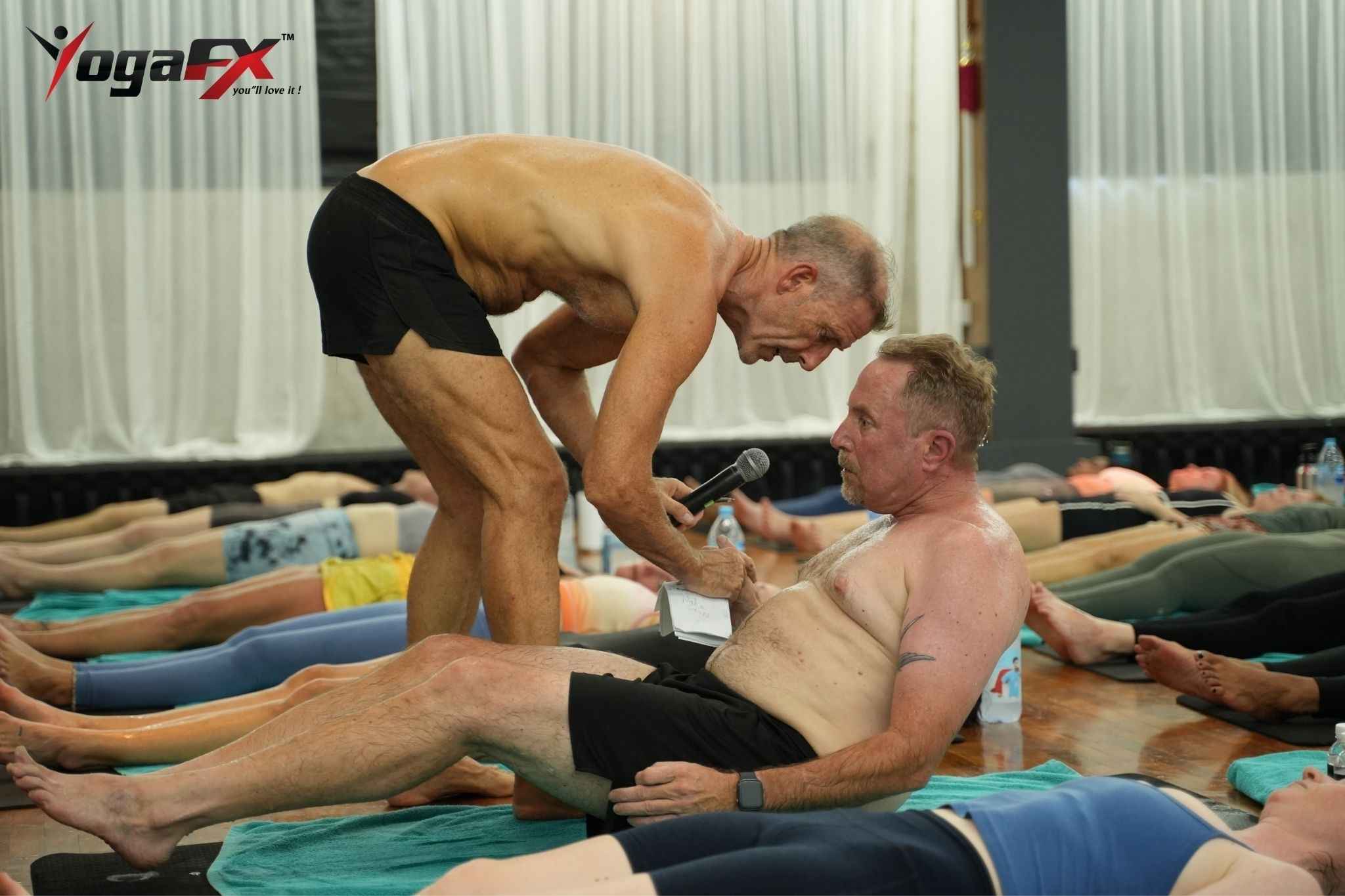
Practice teaching builds those layers in order. For example, you might teach Half Moon Pose to five classmates before you ever face a full room. That gradual build is why supervised teaching hours matter so much when you compare trainings.
What the Research Says About the 26&2 Method
Knowing the evidence helps a Bikram yoga teacher answer student questions honestly. It also keeps your claims careful.
In one controlled study, regular Bikram practice was linked to about a 20% increase in posterior-chain strength, along with better flexibility and changes in body composition (Tracy & Hart, 2013). Similarly, a study of 90-minute classes measured about 333 calories for women and 460 for men, with heart rate around 80% of maximum (Porcari et al., 2014).
That cardiovascular load is why safety training matters. Students with heart conditions, blood pressure problems or pregnancy should consult a healthcare professional before practising. A trained Bikram yoga teacher watches breathing and colour, and knows when to slow someone down.
Mistakes That Hold New Bikram Yoga Teachers Back
Most problems in a new teacher's first months aren't about knowledge. They're habits, and they're easy to fix once you spot them. Here are the ones senior teachers see most often:
- Paraphrasing the dialogue. Swapping in your own words feels natural, but students rely on the exact cues they already know.
- Rushing the setup. The first lines of each posture tell students where to put their feet. Skip them, and alignment falls apart.
- Copying your own teacher's voice. It's tempting, yet students respond better when you sound like yourself.
- Losing count in the holds. A Bikram yoga teacher keeps each posture to a steady rhythm, so the class flows as one.
- Stopping your own practice. Teachers who keep practising the sequence keep their cues honest.
None of these mean you're a poor Bikram yoga teacher. Instead, they're a normal stage between knowing the words and owning the room. Regular feedback from an experienced teacher is the quickest way through it.
After Certification: Growing as a Bikram Yoga Teacher
Your certificate is the start, not the finish. The first year shapes the kind of teacher you'll become, so it's worth planning.
First, teach as often as you can. Every class sharpens your timing and your eye. Second, keep taking classes yourself, ideally from different teachers, so you hear the dialogue delivered in new ways.
Third, ask for feedback. Many studios run teacher meetings or posture clinics, and some senior teachers will happily watch a class and give notes. Later on, once you've built up years of teaching hours, you can look at advanced credentials and, eventually, leading trainings yourself.
Is Becoming a Bikram Yoga Teacher Right for You?
This path suits some people far better than others. It tends to suit you if:
- You love the 26&2 sequence and want to teach it as it is, not change it.
- You're comfortable speaking for long stretches, or willing to learn.
- You like structure and precision more than improvisation.
On the other hand, if you want to design your own sequences or teach to music, a general hot yoga or vinyasa training may suit you better. That's not a weakness. It's simply a different job.
Become a Bikram Yoga Teacher with YogaFX in Bali
YogaFX runs the Bikram Hot 26&2 Yoga Teacher Training MasterClass in Seminyak, Bali. It's a hybrid course: you study online at home, then complete six days in person in natural tropical heat, with no electric heaters.
You graduate with two credentials: Yoga Alliance RYT 200 and a Bikram Hot 26&2 200-hour international certification. The fee is US$1,899 at the current Early Bird rate, against a normal price of US$1,999, with instalments from about US$250 a month.
The course is led by Mr. Ian Terry, E-RYT 500. He trained for five years, from 2014 to 2019, directly with Bikram Choudhury, and has trained over 1,500 graduates from 80+ countries. The next batch runs from Sunday 24 January to Friday 29 January 2027 at Soham Wellness Center in Seminyak.
You can compare dates, formats and costs here, or message Mr. Ian with your questions.
FAQ
How much is Bikram yoga teacher training?
It depends on the format. Hybrid 26&2 courses cost far less than traditional nine-week residential trainings, which also add weeks of accommodation and lost income. At YogaFX, the hybrid course is US$1,899 at the Early Bird rate, or US$1,999 normally, with instalments from about US$250 a month. Always compare total cost, not just tuition.
How much do Bikram yoga teachers make?
Most Bikram yoga teachers are paid per class, and rates vary widely by city and studio. New teachers rarely earn a full-time income in their first year. Those who do usually combine classes at several studios with private clients and workshops. Building a regular schedule and a loyal following takes time, so plan for a gradual start.
Does Bikram still do teacher training?
Training under the original Bikram brand has continued in a long residential format in recent years, mostly outside the United States, so check its current schedule directly. YogaFX offers an independent Bikram Hot 26&2 training, not official Bikram Choudhury Teacher Training. Graduates receive Yoga Alliance RYT 200 plus a Bikram Hot 26&2 200-hour certification.
Can you do Bikram yoga teacher training online?
Partly. Theory, anatomy and early dialogue study work well online. However, heat adaptation, posture clinic and supervised teaching need a real heated room and a trainer watching you. That's why hybrid courses pair online study with an in-person intensive. A fully online course alone rarely prepares you to teach a live 26&2 class confidently.
What is the difference between Bikram yoga and hot yoga?
Hot yoga is any yoga practised in a heated room, including hot flow and hot pilates. Bikram yoga is one specific method: 26 postures and 2 breathing exercises, in a fixed order, taught by spoken dialogue for 90 minutes at around 40°C. So every Bikram class is hot yoga, but most hot yoga classes aren't Bikram.
Still have questions? Message Mr. Ian and the YogaFX team on WhatsApp and we'll answer them personally.