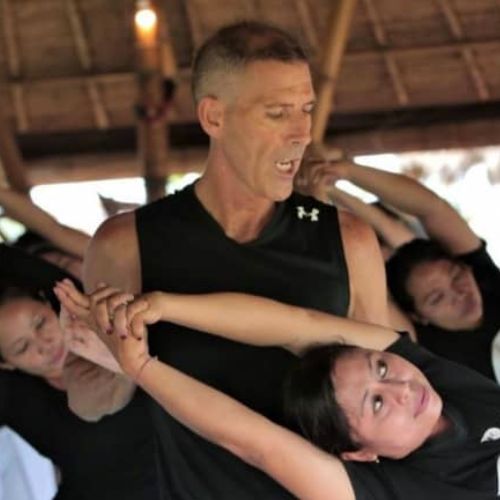
If you are preparing for Bikram or 26 and 2 yoga teacher training, one question sits at the back of your mind more than any other: how am I supposed to memorise 45 minutes of continuous spoken instruction? This guide answers that completely, including the specific delivery habits that separate a confident instructor from one who freezes mid-class. It covers what the bikram dialogue actually is, why it is worth learning properly rather than just memorising, the methods that work, the tools that make the process faster, a realistic timeline, and how the YogaFX curriculum carries you through it. YogaFX, a major Hot 26&2 (Bikram) yoga teacher training academy, is based in Bali.

In a 26 and 2 hot yoga class, the instructor speaks for approximately 45 minutes without pause, without music, and without ever physically demonstrating a posture. Every word belongs to a structured script: the same entry cues, alignment instructions, hold cues, and physiological explanations for each of the 26 postures, delivered in the same order, every class. This is the bikram dialogue. A student in Bali and a student in London hear functionally the same words from any certified instructor, because both instructors learned the same structured script.
Why Learn the Dialogue, Not Just Memorise It
It is tempting to treat the dialogue as a pure memory task: get the words into your head, recite them in class, done. This works for about the first ten classes and then breaks down, because reciting words and teaching a class are not the same skill. Any presentation you have ever sat through, good or bad, required the presenter to prepare, rehearse, practice, and then deliver. Teaching a Bikram class is no different. There are no shortcuts, and the bikram dialogue is the structure that makes the shortcut unnecessary.
Consistency Is the Entire Point
The bikram dialogue exists so the quality of instruction does not depend on which instructor happens to be teaching that day. A scripted, well-rehearsed dialogue means a first-time student in any 26 and 2 class anywhere receives the same complete, tested instruction. This is what allows a beginner with zero yoga experience to walk into their first class and follow along safely, because the dialogue assumes nothing and explains everything. To truly master the pacing and command of the script, supplementing your practice with foundational books on the Bikram yoga method will deepen your theoretical knowledge.
Safety Comes From Precision, Not Improvisation
Certain cues exist specifically to prevent injury: "lock your knee" before a forward fold, "push your hips forward" before the Camel Pose backbend, "both sit bones on the floor" during Spine Twist. These are not stylistic flourishes. They are the precise verbal safeguards that keep a room of 20 to 30 students working safely in a 40 degree room without one-on-one supervision. An instructor who has only loosely memorised the dialogue tends to drop these precise safety cues first, because they are easy to paraphrase incorrectly under pressure.
The Dialogue Frees You to Actually Watch the Room
Once the bikram dialogue is genuinely internalised rather than just memorised, your brain stops spending effort retrieving the next sentence and becomes available to observe your students: who is struggling with the heat, whose alignment needs a cue, who needs encouragement. Instructors who have only memorised the words are usually still mentally reciting while they teach, which means they are not really watching the room at all. Learning the bikram dialogue properly is what eventually lets you become a teacher instead of a narrator.
Proven Memorization Methods That Actually Work
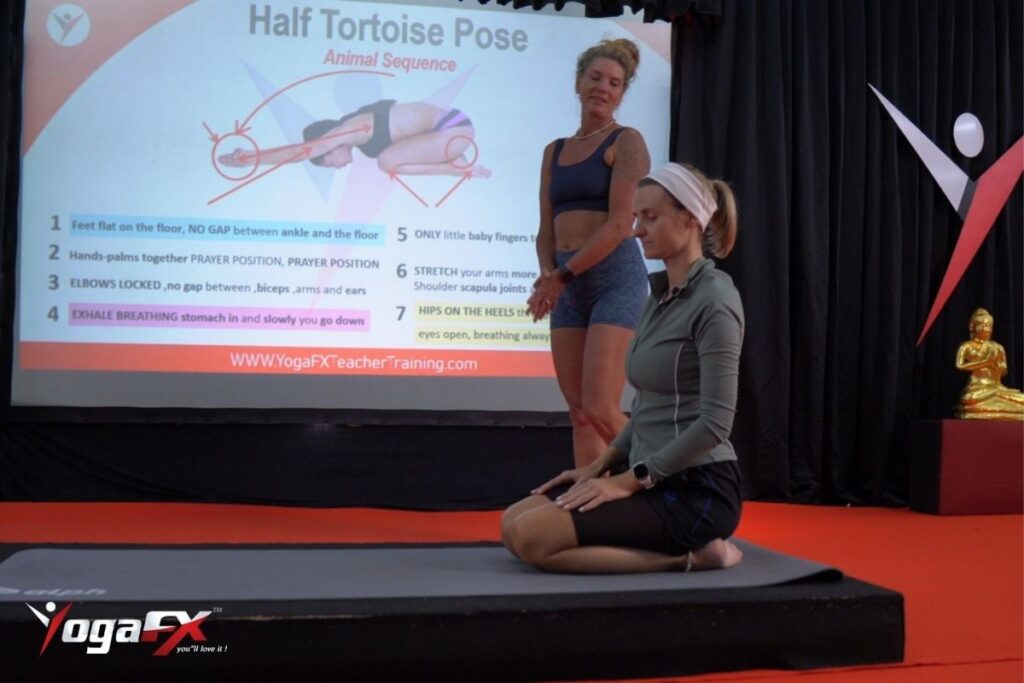
This is the part most candidates are searching for, and it deserves a real answer rather than generic memory tips. The methods below cover both how to get the words into memory and how to deliver them like a teacher rather than a student reciting lines. Memorizing the words is only the first step; learning to avoid the most common dialogue delivery mistakes is what elevates an amateur speaker into an influential guide.
Method 1: Chunk It Posture by Posture
Do not attempt to memorise the dialogue as one continuous 45-minute block. Break it into its natural units: the opening Pranayama breathing, then each of the 26 postures as an individual chunk. Within each posture, break it further into its functional parts: the entry cue, the primary alignment cue, the hold instruction, the physiological explanation, and the exit cue. Master one chunk completely, meaning you can recite it from memory out loud without looking, before moving to the next.
Method 2: Cut Every Filler Word
Words and phrases like "um," "now go ahead," "begin to," and "remember to" are fillers. They offer your students no instructional value and they eat up the seconds you need for the next real cue. Most new instructors do not notice how often they use them until they record themselves. The fix is not complicated, it just takes deliberate attention: every time you rehearse a section, listen for filler words specifically and cut them. A dialogue stripped of filler is shorter, clearer, and arrives at the next cue exactly when your students need it.
New instructors sometimes ask whether they need permission to teach the dialogue at all. Not to teach the sequence itself. A 2015 US Ninth Circuit Court ruling established that the sequence of postures is not protected by copyright under US law, although a specific written dialogue text can still be protected as a literary work. Any certified instructor can teach the 26 and 2 sequence without licensing fees or legal obligation to any organisation, using the dialogue their own training academy provides. This is part of why structured study resources for the dialogue, including the workbook on this page, can exist freely.
Method 3: Listen to Yourself, Then Edit for Brevity
Record your own practice delivery and actually listen back. Every instructor has been the student stuck in an uncomfortable hold while the teacher keeps talking, "relax, let it go, breathe into it," long after the point has been made. Before you add another sentence in your own delivery, ask whether it adds value to the posture or whether you are just filling silence because silence feels uncomfortable to you as the speaker. Short, deliberate, and clear beats long and well-meaning every time.
Method 4: Get Comfortable With the Pause
Silence is scary to most new teachers, but an organic pause is one of the most useful tools in the dialogue. There are moments in every class where the right thing to do is stop talking and let your students sit inside the posture, controlling their own breath and mind without the distraction of what is coming next. The pause does not need to be dramatic. It needs to be natural, and it needs you to trust that silence is not dead air, it is part of the instruction. A class is shaped as much by what you do not say as by what you do.
Method 5: Project Your Voice With Authority, Not Volume Alone
There is nothing worse for a student in the back row of a large, heated room than straining to hear the instructor and resorting to watching their neighbour instead. Projecting your voice is not about shouting, it is about filling your lungs and speaking with the same authority for the student furthest from you as for the one nearest. This is also one of the hardest things to self-correct, because what feels loud enough from where you are standing often is not loud enough at the back of the room.
Method 6: Shadow Full-Class Audio Recordings
Listening to a complete class delivery while following the text builds the auditory and rhythmic pattern of the bikram dialogue, including pacing, repetition style, and timing between cues. Several full 90-minute class recordings are publicly available on YouTube. Shadow these: listen and speak along simultaneously, matching the pace and tone, not just the words.
Method 7: Practice-Teach With Feedback, as Early as Possible
Memorising the bikram dialogue alone in your room and delivering it to an actual room of people are two different skills, and the gap between them only closes through practice teaching. As soon as you have even a rough pass at a section, teach it out loud to a friend, a mirror, or an empty room, ideally to someone who can give you feedback on pacing, clarity, filler words, and whether your cues actually arrive before the movement they describe. This is exactly why the YogaFX in-person intensive places such heavy emphasis on live, coached practice teaching rather than expecting you to arrive with the bikram dialogue fully polished.
Tools That Make This Faster
You do not need to build your study system from scratch. A combination of three tool types covers nearly everything most candidates need.
Flashcards: Section by Section Recall Testing
Flashcard-style study, one card per posture or even per cue, is particularly effective for the floor series, which most candidates find harder to memorise simply because they have heard it less often as a student. Publicly available Bikram dialogue flashcard sets exist and are useful for retrieval practice on your commute or during short breaks. Before memorizing the exact phrasing from the podium, reading the practitioner's guide to the yoga dialogue provides valuable insights into its therapeutic intent.
Audio: For Commute and Passive Reinforcement
Full-class audio recordings let you reinforce the dialogue passively during a commute, a walk, or while doing chores. This should supplement, not replace, active spoken-recall practice, but it is one of the most time-efficient ways to add extra exposure to your week. Every word spoken from the podium aligns directly with the architectural flow of the 26-posture sequence reference.
A Structured PDF Workbook: The Missing Piece for Most Self-Learners
Most of what is publicly available online is either a raw, unstructured text dump of the dialogue or scattered flashcard decks covering only some postures. What most aspiring instructors are actually missing is a single structured document that breaks the dialogue into the same chunked, posture-by-posture format described above, with space to track your own progress.
Free Download: Dialogue Preview Workbook. A structured preview of the YogaFX dialogue training approach, organised posture by posture in the same chunking method described in this guide, with a self-assessment checklist so you can track which postures you have genuinely internalised versus which still need work. Built specifically as a starting point for candidates preparing for teacher training, whether or not you have enrolled yet. Enter your email below to receive the workbook PDF directly, along with occasional updates on upcoming YogaFX training dates.
How Long This Realistically Takes
Here is the honest answer most resources avoid giving directly: the great majority of teacher training candidates do not arrive at their training fully memorised, and this is completely normal. If you are worried you need the entire dialogue word-perfect before you even enrol, you can let go of that pressure now.
| Stage | Typical Timeframe | What This Looks Like |
|---|---|---|
| Rough familiarity | 2 to 4 weeks of casual study before training | You recognise the structure and can recite some postures roughly from memory, with gaps. A perfectly good starting point for training. |
| Working memorisation | During the training itself, with daily coached practice | You can deliver most postures from memory with occasional reference to notes. This is where most candidates are by the end of an intensive training. |
| Fluent delivery | First 30 to 50 classes taught after certification | Cues arrive before the movement, pacing feels natural, you are not visibly searching for words. |
| Full internalisation | Class 50 to 100 and beyond | The dialogue requires no conscious retrieval effort. Your full attention is on the room, not on recall. |
This progression is built into the structure of teacher training itself. Do not delay enrolling because you do not yet feel "ready" on the dialogue. Rough familiarity is the right starting point. The training is where the real skill development happens. The verbal commands are explicitly mapped out to instruct the postures the dialogue covers without requiring the teacher to demonstrate.
How YogaFX Coaches You Through This
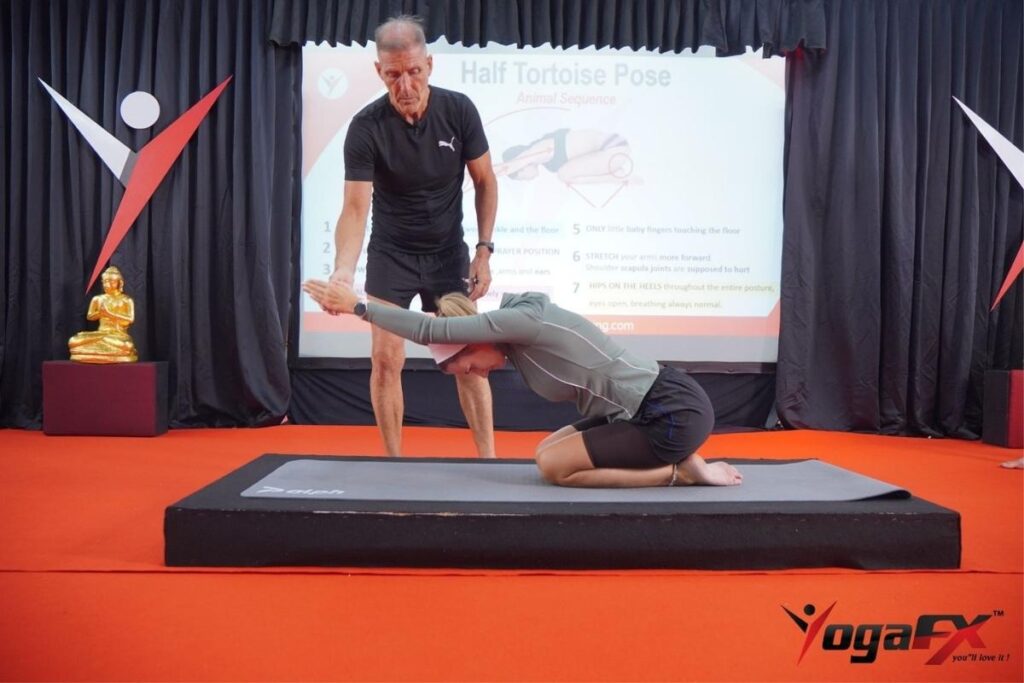
The dialogue training built into the YogaFX curriculum is designed around exactly the gap described above: most candidates arrive with partial memorisation, and the programme closes that gap through direct, personal coaching rather than leaving you to self-correct.
- The online pre-course introduces the dialogue in the same structured, posture-by-posture format described in this guide, so you begin building real recall before you ever arrive in Bali.
- During the 6-day intensive, dialogue delivery is coached live and in person under Mr. Ian Terry's direct observation, correcting filler words, pacing, vocal projection, and cue timing that are very difficult to catch on your own.
- Practice teaching happens daily during the intensive, in the same natural heat conditions you will eventually teach in, closing the gap between "I know the words" and "I can teach a class" far faster than solo study ever could.
- Post-certification, lifetime WhatsApp mentoring with Mr. Ian Terry means dialogue questions do not stop the day you graduate. Most instructors are still refining delivery well into their first year of teaching, and that ongoing support continues.
The full programme structure, including exactly where dialogue training sits within the broader curriculum, is detailed on the course inclusions page.
FAQ
Do I need to memorise the Bikram dialogue before starting teacher training?
No. Rough familiarity, where you recognise the structure and can recite some postures with gaps, is a perfectly good starting point. Full memorisation and fluent delivery develop during and after training through coached practice teaching, not as prerequisites to begin.
How long does it take to memorise the Bikram dialogue?
Rough familiarity typically takes 2 to 4 weeks of casual daily study. Working memorisation usually develops during the training itself. Fluent, confident delivery without visible word-searching typically takes your first 30 to 50 classes taught after certification.
Where can I find the Bikram dialogue PDF?
Several text versions circulate publicly online, useful as raw reference text but not structured for study. A structured, posture-by-posture workbook designed specifically for memorisation is available as a free download through the form on this page. Aspiring teachers should focus on the underlying rhythm of the words, making a deep study for understanding the Bikram yoga script essential for certification.
What is the biggest mistake new instructors make with the dialogue?
Filling silence with unnecessary words. Filler phrases like "um," "now go ahead," and "begin to" take up the exact seconds needed for the next real cue, and excess commentary during a hold often adds nothing for the student who is simply waiting to come out of an uncomfortable posture. Recording your own delivery and listening back is the fastest way to catch this, because most instructors do not notice it in the moment.
What is the best way to memorise the Bikram dialogue?
Reading the dialogue silently trains recognition, not recall. You need to produce the words from memory under pressure, in a hot room, while watching 20 people. The only way to build that specific skill is to speak the dialogue out loud, every day, from memory, checking yourself against the text only when you get stuck. This is consistent with what cognitive science calls the testing effect: actively retrieving information from memory builds stronger, more durable recall than passively re-reading it. A short daily session of 20 to 30 minutes of spoken recall consistently outperforms occasional long sessions, because memory consolidation for verbal material responds much better to spaced, frequent retrieval than to duration.