
Hot yoga and yoga in general are practiced by more women than men in most Western markets. This demographic fact produces three questions that most men thinking about Bikram yoga have before they start: is it actually exercise, will I be the only man there, and will I be embarrassingly inflexible. All three deserve direct answers rather than reassurance.

Hot yoga for men: the University of Wisconsin 2014 study directly measured 460 kcal per 90-minute Bikram session for men (average 82kg) at 80 percent of maximum heart rate. Men make up 20 to 40 percent of most Bikram classes. Men typically start with greater flexibility restrictions than women — meaning heat-enhanced connective tissue gains are often more dramatic for men than for women in the first 8 to 12 weeks. At YogaFX Bali, the male practitioner base spans MMA fighters, professional athletes, and complete beginners. First class free.
Three Questions Men Have Before Their First Bikram Class
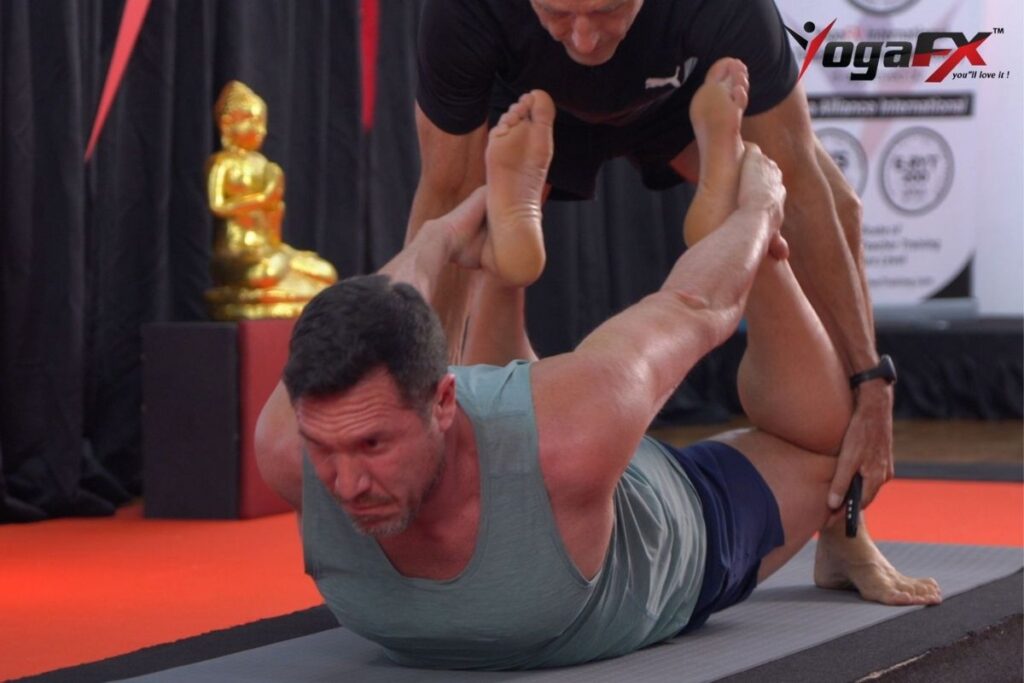
Is It Real Exercise?
The University of Wisconsin 2014 study (Porcari et al., PubMed: 24700459) directly measured the metabolic output of Bikram yoga during actual classes: 460 kcal per 90-minute session for men (average 82kg). Heart rate averaged 80 percent of maximum throughout. Active male participants reached peak heart rates of 90 to 94 percent of maximum during the cardiovascular peak postures.
This is equivalent to 45 minutes of moderate cycling in cardiovascular demand. The Tracy and Hart (2013) study (PubMed: 23438366) documented 20 percent deadlift strength increase after 8 weeks of Bikram practice at 3 to 4 sessions per week. These are not yoga-specific adaptations — they are measurable strength and cardiovascular outcomes that any athlete would recognise as legitimate training results.
Will I Be the Only Man There?
Probably not. Men make up 20 to 40 percent of most Bikram and hot yoga classes. In dedicated Bikram studios rather than general hot yoga studios, the male percentage tends to be higher because the practice has a stronger athletic and performance reputation that attracts men who would not otherwise attend yoga classes. At YogaFX Bali, the class composition across Seminyak and Canggu typically includes a substantial male contingent — the international practitioner base includes athletes, surfers, and fitness-focused travellers.
Will I Be the Least Flexible Person There?
You might be — and it does not matter. Men typically have lower baseline flexibility than women due to both hormonal and structural differences in connective tissue. This is not a disadvantage in Bikram yoga. It means the heat-enhanced connective tissue extensibility of the 40-degree environment produces faster early flexibility gains for men than for women with equivalent starting ranges. Men who start with limited hip flexor and hamstring flexibility often see dramatic improvement within 8 to 12 weeks that female practitioners with higher baseline flexibility do not experience at the same rate.
Why Men Have Specific Advantages in Bikram Yoga
Higher Absolute Calorie Burn
Men burn more calories per Bikram session than women of equivalent fitness because of higher average muscle mass, greater cardiovascular output, and greater thermoregulatory demand from larger body surface area. The UW 2014 data (460 kcal for men vs 333 kcal for women per 90-minute session) reflects a measurable difference in total metabolic output. For men using Bikram yoga as part of a body composition programme, the absolute calorie burn is at the higher end of the documented range.
Greater Potential Flexibility Gains
Men typically start with more restricted hip flexors, hamstrings, and thoracic mobility than female counterparts. The heat-enhanced connective tissue extensibility of the 40-degree environment produces flexibility gains in proportion to the restriction it is addressing. Men with significant starting restrictions often see more dramatic early flexibility progress than women with higher baseline flexibility. The first 8 to 12 weeks of consistent Bikram practice often produce visible improvement that men describe as the most significant physical change they have experienced from any exercise programme.
Posterior Chain Activation
Most men who train in gyms overdevelop their anterior chain (quadriceps, chest, anterior shoulder) relative to their posterior chain (glutes, hamstrings, spinal erectors, posterior rotator cuff). The Bikram floor series systematically loads the posterior chain through Cobra, Locust, Full Locust, and Bow — in movement patterns that gym training rarely accesses because the prone position eliminates anterior chain compensation. Men who add Bikram to a gym training programme consistently report that their gym performance improves, particularly in deadlifts, pull-through movements, and anything requiring posterior chain integration.
Heat Training Benefit
For men who compete in hot-weather conditions or perform in warm environments, consistent Bikram practice produces specific thermoregulatory adaptations: earlier sweat onset, plasma volume expansion, and more efficient cardiovascular redistribution between working muscles and peripheral vasculature. These are precisely the adaptations that structured heat acclimatisation training protocols attempt to produce — available in a 90-minute yoga class format three times per week.
Research Data for Men Specifically
| Outcome | Data for Men | Source |
|---|---|---|
| Calorie burn per 90 min | 460 kcal (average 82kg man) | Porcari et al. 2014, University of Wisconsin |
| Peak calorie burn | 600 or more kcal for active participants | Porcari et al. 2014, direct metabolic measurement |
| Average heart rate | 80 percent of maximum throughout 90 min | Porcari et al. 2014 |
| Strength increase (8 weeks) | 20 percent deadlift increase at 3 to 4 sessions per week | Tracy and Hart 2013 |
| Balance improvement (8 weeks) | 9 percent improvement in standing balance | Tracy and Hart 2013 |
| Depression reduction | Approximately 60 percent of participants reduced symptoms by 50 percent or more | Harvard MGH 2023 RCT |
| Body composition | Significant body fat reduction alongside lean muscle gain at 8 weeks | Tracy and Hart 2013 |
Athletes and Professional Men Who Practice Hot Yoga
- Kareem Abdul-Jabbar: the NBA's all-time leading scorer credited Bikram yoga with extending his career into his 40s, attributing his mobility and recovery capacity to consistent practice through the latter years of his career.
- Andy Murray: the three-time Grand Slam champion incorporated hot yoga into his Wimbledon preparation, specifically citing it for flexibility maintenance and injury prevention.
- NFL and rugby players: hot yoga has become a training component at multiple professional football clubs and rugby programmes, particularly for flexibility and recovery.
- MMA practitioners: from direct instructor experience at YogaFX, MMA athletes are among the male practitioners who adapt most readily to hot yoga. The combination of heat tolerance from training, body awareness from grappling, and the hip and posterior chain demands of the practice align directly with fighting sport requirements.
The common thread: men in strength and power sports use hot yoga specifically for the posterior chain balance, flexibility maintenance, and mental toughness training that their primary sport does not develop.
What Your First 4 Weeks Actually Look Like
Classes 1 to 3: Survival Mode
Your first 1 to 3 classes will be harder than your fitness level prepares you for — universally. Cardiovascular fitness does not transfer to heat tolerance. The thermoregulatory system needs to develop its own adaptation to sustained effort in a 40-degree room, independently of how fit you are. The standing series cardiovascular peak (Standing Bow, Balancing Stick) at around 30 to 35 minutes into class will feel like the hardest cardiovascular moment you have experienced in a yoga context. Lying flat in Savasana when overwhelmed is the correct response — not leaving the room.
Classes 4 to 8: The Transition
Between sessions 4 and 8, heat adaptation develops progressively. The class that felt like survival becomes navigable. Heart rate management during the cardiovascular peak improves. Flexibility changes begin to appear — men who started with significant hip flexor restriction typically see the first measurable range improvements in Eagle Pose and the standing forward folds. This early progress is faster than room-temperature yoga produces for equivalent starting restrictions.
Week 3 to 4: Becoming a Practitioner
By week 3 to 4 of consistent practice (3 to 4 sessions per week), the practice has shifted from challenge management to actual yoga. Attention shifts from heat management to posture quality. Most male practitioners report improved sleep quality by this point — typically the first benefit that appears — followed by the body composition changes that Tracy and Hart documented beginning their development.
What Men Wear to Bikram Yoga
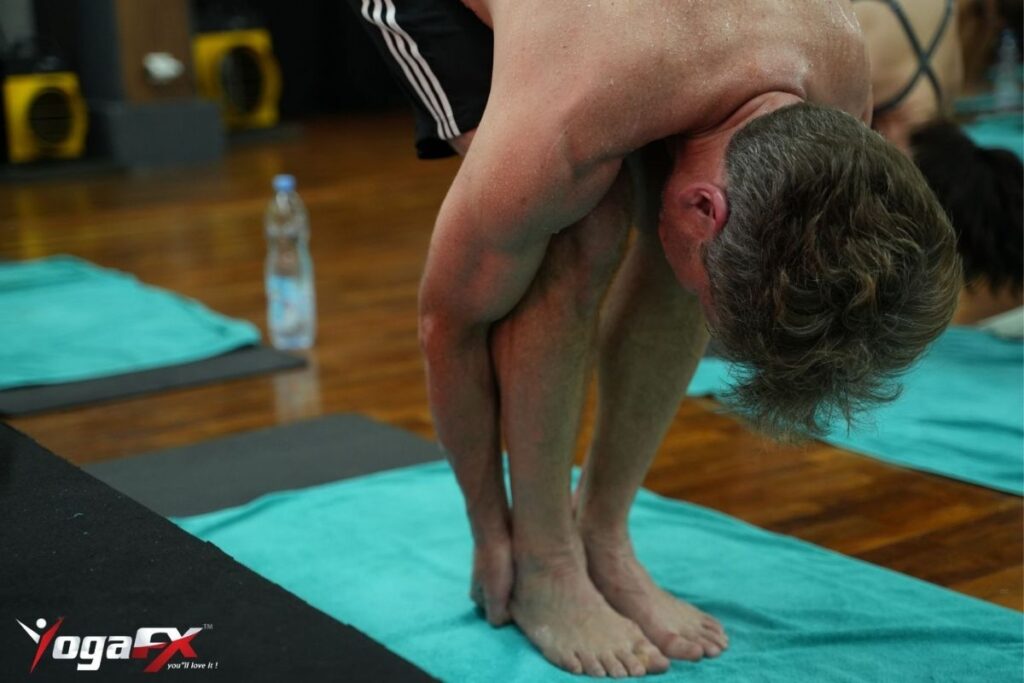
What Works
- Shorts: close-fitting moisture-wicking compression shorts or board shorts. Mid-thigh length is optimal for the full standing and floor series range of motion. Must not bunch, ride up, or retain water.
- No shirt: most experienced male Bikram practitioners practice shirtless. Shirts become saturated within 20 minutes and their weight and surface contact become distracting. If you prefer a shirt: sleeveless moisture-wicking athletic top only.
- Mat towel: non-optional regardless of gender. A full-coverage non-slip microfibre mat towel prevents the mat becoming dangerous for standing balance postures as sweating intensifies.
What Does Not Work
- Cotton anything: retains moisture, becomes heavy. The most common mistake male first-timers make.
- Loose shorts without liner: the floor series postures require positions that loose shorts make uncomfortable. Either built-in liner compression shorts or a compression underlayer.
Hot Yoga vs Gym Training: The Relationship
| Training Dimension | Gym Training | Hot Yoga (Bikram) |
|---|---|---|
| Upper body strength | High — bench press, row, pull-up patterns | Limited — standing series focuses lower body and core |
| Lower body strength | Moderate to high — squat and hinge patterns | High from standing series — specifically in ranges gym work neglects |
| Posterior chain balance | Often anterior-dominant | Systematically loads posterior chain through prone floor series |
| Flexibility | Low — gym training often reduces flexibility | High — heat-enhanced gains in hip flexors, hamstrings, thoracic spine |
| Joint health | Variable — high joint loading | High — Eagle Pose opens 14 joints in heat-enhanced synovial state |
| Spinal health | Limited — few exercises address full spinal mobility | Comprehensive — all planes of spinal movement every class |
| Mental toughness training | Limited in structured format | High — sustained discomfort management in 40-degree heat |
| Heat acclimatisation | None | Structured weekly thermal training stimulus |
The ideal combination for most strength-training men: hot yoga 2 to 3 times per week on non-heavy training days. This provides the posterior chain balance, joint health, and flexibility development that gym training does not cover, without competing with strength training recovery. Men who add Bikram to a gym programme consistently report that their gym performance improves rather than suffering from the additional load.
FAQ
Is hot yoga good for men?
Yes, and for specific reasons particularly relevant for men who train in gym or sport contexts. The University of Wisconsin 2014 study documented 460 kcal per 90-minute session for men at 80 percent of maximum heart rate. Tracy and Hart 2013 documented 20 percent strength increase and significant flexibility gains after 8 weeks. Hot yoga addresses the posterior chain balance and flexibility that most male training programmes underemphasise, and the heat acclimatisation it produces is directly relevant for men who compete in warm conditions.
Is it common for men to do hot yoga?
Men make up 20 to 40 percent of most hot yoga classes. The proportion has increased over the past decade as the athletic and performance reputation of the practice has grown. Professional athletes and MMA fighters have been among the most visible male practitioners, helping shift the cultural perception. The majority of men who try hot yoga report that their concern about being the only male was unfounded.
What do men wear to hot yoga?
Close-fitting moisture-wicking compression shorts or board shorts, shirtless or with a sleeveless moisture-wicking top. Cotton is unsuitable — it retains moisture and becomes heavy quickly. A full-coverage non-slip mat towel is non-optional. Most experienced male practitioners wear as little as comfortable because the heat and sweating make minimising clothing the most practical approach.
Will hot yoga make men more flexible?
Yes, and often more dramatically than female practitioners with equivalent starting restrictions, because men typically start with greater hip flexor, hamstring, and thoracic mobility restriction. The heat-enhanced connective tissue extensibility produces flexibility gains in proportion to the restriction being addressed. Tracy and Hart 2013 documented significant lower back and hamstring flexibility gains after 8 weeks — two of the areas most restricted in men who train with weights.
Men looking to break out of rigid weight-training ruts will find that comparing Bikram yoga vs gym for men highlights unmatched benefits for flexibility and cardiovascular endurance.
How does hot yoga compare to the gym for men?
They complement each other rather than competing. Hot yoga provides what gym training typically does not: posterior chain balance from the prone backbend floor series, hip flexor and hamstring release that gym training often restricts, comprehensive spinal mobility in all planes, and joint health through Eagle Pose's 14-joint synovial lubrication mechanism. Men who add Bikram to a gym programme typically report that their gym performance improves — particularly in exercises requiring hip extension, posterior chain integration, and thoracic mobility.
Is my first hot yoga class going to be terrible?
Harder than you expect, not terrible. The first 20 minutes are the most challenging as heat adaptation begins. The cardiovascular peak around postures 5 to 7 at approximately 30 to 35 minutes is the most intense single moment in the class. After the Savasana transition at approximately 60 minutes, the floor series is more accessible. Most men complete their first class and are surprised they did. The class that feels like survival in sessions 1 to 3 becomes manageable by sessions 4 to 7.