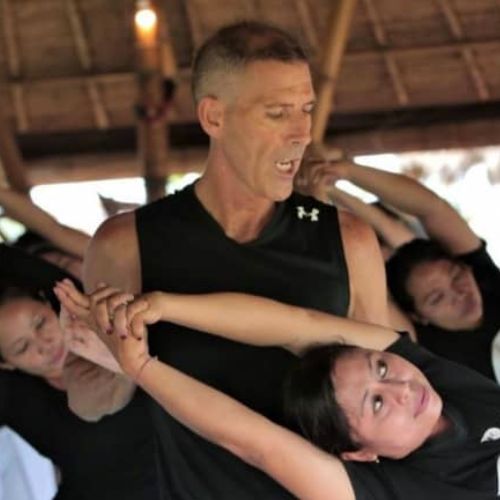
Bikram yoga teacher training in 2026 and 2027 runs in two main formats. The traditional nine-week residential training in Khao Lak, Thailand has two 2026 intakes (April 19 to June 21 and September 27 to November 29) priced at USD 12,500 to 16,600. Hybrid programs like YogaFX in Bali pair an online pre-course with a 6-day in-person intensive, run monthly, from USD 1,999.

Both formats teach the same thing: the fixed 26-posture, two-breathing-exercise sequence, delivered as a scripted verbal dialogue in a room at roughly 40 degrees Celsius and 40% humidity. What separates them is calendar time, total cost, and how the learning is sequenced. This guide lays out every confirmed intake date for 2026 and 2027, what each price actually covers, and how to decide which format fits your job, your budget, and the way you learn.
It's written from the perspective of Mr. Ian Terry, E-RYT 500, who trained for five years, from 2014 to 2019, directly with Bikram Choudhury, the founder of the Bikram Hot 26&2 method, and has since taught more than 1,500 graduates from over 80 countries. He gets the same three questions on almost every enquiry call: when is the next intake, what does it really cost, and can I do it without quitting my job. Those three questions shape the order of this page.
Bikram Yoga Teacher Training 2026-2027 Intake Dates
The nine-week residential training published two intakes for 2026. The spring intake has already finished, and the fall intake begins on September 27, 2026 at a beach resort in Khao Lak, Phang Nga, Thailand. As of late September 2026, no 2027 residential dates have been published, so anyone planning to train in the first half of 2027 currently has no confirmed residential option to book.
| Format | Intake | Dates | Status (September 2026) |
|---|---|---|---|
| Nine-week residential, Thailand | Spring 2026 | April 19 to June 21, 2026 | Completed |
| Nine-week residential, Thailand | Fall 2026 | September 27 to November 29, 2026 | Starting this week |
| Nine-week residential, Thailand | 2027 | Not yet announced | No dates published |
YogaFX runs its hybrid intensive every month in Seminyak, Bali. Every 2026 intake from March through September filled completely. These are the intakes still open for enrolment, each one a 6-day in-person block with a Sunday check-in and a Friday check-out:
| Check-In | Check-Out | Duration |
|---|---|---|
| 24 January 2027 | 29 January 2027 | 5 Days Enquire Now |
| 21 February 2027 | 26 February 2027 | 5 Days Enquire Now |
| 21 March 2027 | 26 March 2027 | 5 Days Enquire Now |
| 18 April 2027 | 23 April 2027 | 5 Days Enquire Now |
| 23 May 2027 | 28 May 2027 | 5 Days Enquire Now |
| 20 June 2027 | 25 June 2027 | 5 Days Enquire Now |
| 25 July 2027 | 30 July 2027 | 5 Days Enquire Now |
| 22 August 2027 | 27 August 2027 | 5 Days Enquire Now |
| 19 September 2027 | 24 September 2027 | 5 Days Enquire Now |
| 24 October 2027 | 29 October 2027 | 5 Days Enquire Now |
| 21 November 2027 | 26 November 2027 | 5 Days Enquire Now |
| 19 December 2027 | 24 December 2027 | 5 Days Enquire Now |
| 23 January 2028 | 28 January 2028 | 5 Days Enquire Now |
The practical difference is flexibility. With two residential intakes a year, missing one start date means waiting roughly five months. With a monthly intake, a candidate who can't make October simply moves to November. The 2026 pattern shows intakes filling well ahead of their start dates, so the realistic booking window is usually six to ten weeks out. The full, always-current calendar lives on the YogaFX course dates page.
How Much Does Bikram Yoga Teacher Training Cost?
Bikram yoga teacher training costs between USD 1,999 and USD 16,600, depending on format. The traditional nine-week residential program in Thailand costs USD 12,500 to 16,600, including meals and lodging. The YogaFX hybrid intensive in Bali costs USD 1,999 with a twin share room or USD 2,199 with a single room, including accommodation and dual certification.
Price follows format almost exactly. Accommodation and the number of weeks you're away drive most of the difference, not the certification itself. Here's how the two formats compare on published 2026-2027 pricing:
| Format | Room type | Price (USD) | What the price includes |
|---|---|---|---|
| Nine-week residential, Thailand | Double occupancy | 12,500 | Tuition, hotel room, all meals, airport transfers, local shuttle, towels, lectures, classes, materials |
| Nine-week residential, Thailand | Single occupancy | 16,600 | Same inclusions, private room |
| YogaFX hybrid, Bali | Twin share room | 1,999 | Online pre-course, 6-day intensive, accommodation, dual certification |
| YogaFX hybrid, Bali | Single room | 2,199 | Same inclusions, private room |
| YogaFX hybrid, Bali | Course only | On request | Online pre-course, 6-day intensive, dual certification; you arrange your own accommodation |
Headline price is only part of the real total. A nine-week program means nine weeks without income for most working adults, plus two months of personal spending on top of the package. That lost income often costs more than the tuition gap between formats. A 6-day in-person block usually fits inside annual leave, which is why career changers who can't resign before they've qualified tend to lean hybrid. Weighing how to fund it? Here's an honest look at scholarships and payment plans for Bikram teacher training.
Before comparing any two programs, ask one question: is this number tuition-only, or tuition plus accommodation? That single detail changes the total more than anything else on the page. For a line-by-line view of what the Bali package covers, including the deposit process, see how to book the Bali intensive and what's included. If a deposit you paid elsewhere is now in question, our update on the Tripaneer bankruptcy outlines what deposit payers can look at next.
Residential, Hybrid or Online: How the Formats Differ
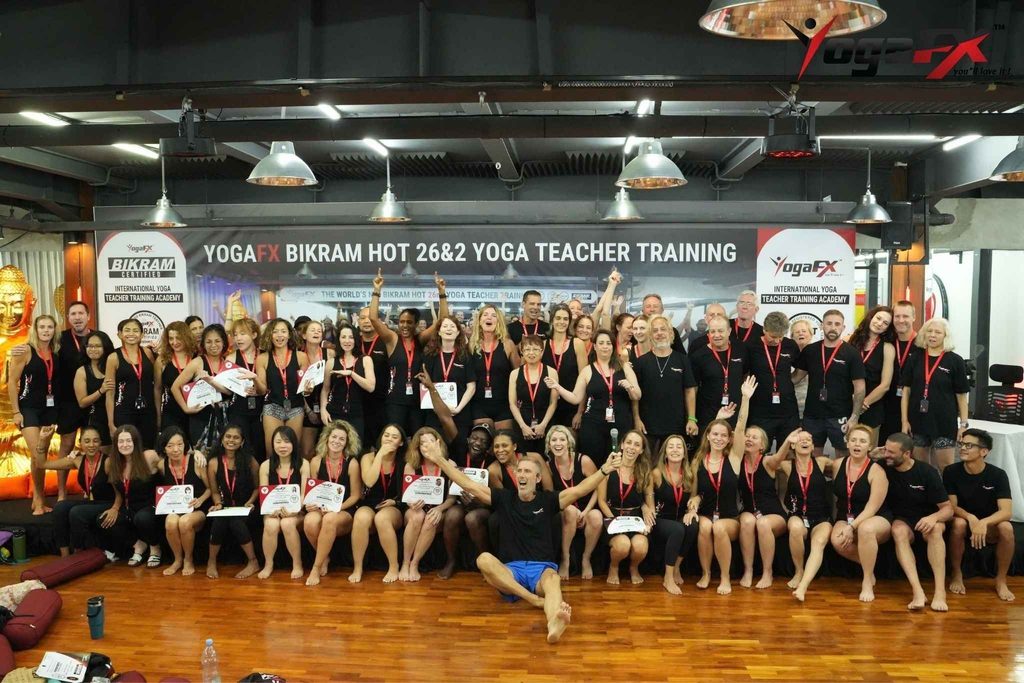
Every legitimate Bikram yoga teacher training covers the same core: memorising the dialogue, learning its rhythm, practising delivery while watching real bodies, and teaching under supervision with feedback after each attempt. Anatomy and philosophy fill the rest. The formats differ in when each piece happens. For what those days actually feel like, and the skills you still build after graduating, see what the training week really involves.
Nine-week residential
You relocate for the full nine weeks and work through lectures, twice-daily classes, and dialogue sessions on site. The build is gradual, with weeks between each stage of the dialogue clinic. It suits someone who can genuinely clear two months, wants to be fully immersed, and prefers a slower ramp toward teaching confidence.
Hybrid: online pre-course plus in-person intensive
Hybrid programs move the reading-and-memorising work online so the in-person time goes almost entirely to supervised practice. At YogaFX, the pre-course is completed at home before you fly: the Standing Series dialogue, five recorded lectures, and downloadable workbooks. When you arrive in Bali, the six days are spent teaching your first class, working through posture clinics, attending lectures, and covering the practical side of starting your own studio.
One graduate completed the online portion around a full-time job and described the format as the only reason certification was possible at all. That's the pattern for most hybrid candidates: the constraint isn't commitment, it's calendar.
Fully online
Fully online courses cover a wide range, and two quite different products end up filed under the same label. The YogaFX online course is a fully certified RYT 200 pathway: the complete 26&2 curriculum self-paced, dialogue taught through a workbook, downloadable MP3 audio files and full-series posture demonstrations by World Champion Miss Ivara, lifetime access rather than a 6 to 12 month window, and the whole $329 fee credited toward the in-person MasterClass, $329 one-time, down from $399, or four interest-free payments of $82. The generic cheap tier is a different proposition: roughly $500 to $1,500, frequently awarding a certificate of completion rather than a Yoga Alliance RYT 200. It is the cheapest entry point, but those courses skip what graduates later say mattered most: standing in front of a heated room of real students and adjusting your cueing when something isn't landing. If you're weighing online options, the checklist in what to look for in online Bikram yoga teacher training with live instructors covers which parts can and can't be taught through a screen.
| Factor | Nine-week residential | Hybrid (Bali) | Fully online |
|---|---|---|---|
| Time away from home | 9 weeks | 6 days | None |
| Intakes per year | 2 (2026) | Monthly | Rolling |
| Supervised in-person teaching | Yes, spread over weeks | Yes, concentrated daily | No |
| Heat source | Heated studio | Natural tropical heat | Your own room |
| Typical price (USD) | 12,500-16,600 | 1,999-2,199 | Varies |
Thailand or Bali: Choosing a Location
Searches for Bikram yoga teacher training in Thailand usually lead to the residential program in Khao Lak, a resort setting on the Andaman coast about an hour and a half north of Phuket airport. Bali's training runs in Seminyak, a 20 to 30 minute drive from Ngurah Rai International Airport, which has direct flights from most of Asia and Australia and one-stop connections from Europe and North America.
The bigger difference for a teacher in training is the heat itself. Bali's studios reach the 40-degree, 40% humidity specification with natural tropical heat rather than electric heaters. Candidates who trained in electrically heated rooms often describe an adjustment period when they first teach in natural heat, and the reverse is true too. Neither is wrong, but it's worth knowing which one you'll be teaching in afterwards. Travelling from the US East Coast? Our guide to Bikram yoga in Philadelphia weighs local classes against the trip from Philadelphia to Bali.
For a fuller side-by-side on cost of living, visas, and training styles, see yoga teacher training in Thailand compared to Bali and the wider regional overview of Bikram yoga teacher training across Southeast Asia.
What You're Certifying to Teach: The Evidence Behind the Method
Students will ask you, usually in the first week you teach, whether the heat and the sequence actually do anything. It helps to know the research rather than repeat studio folklore.
- Broad benefits. A 2025 systematic review of 43 studies and 942 participants found consistent improvements in flexibility, bone density, and general well-being among regular practitioners.
- Strength and flexibility. A 2013 study recorded a 20% increase in posterior chain strength alongside measurable flexibility and body composition changes.
- Energy use. University of Wisconsin research measured an average of 333 kcal per 90-minute class for women and 460 kcal for men, with heart rate near 80% of maximum.
- Mood. A Massachusetts General Hospital trial found that 59% of participants cut their depression symptoms by half or more after 8 weeks of heated yoga, versus 6% on the waitlist. Trainee teachers learn to mention this carefully: yoga may complement professional care, but it doesn't replace it, and students with health concerns should consult a healthcare professional.
There's also a legal point every candidate eventually runs into. In 2015, the Ninth Circuit Court of Appeals ruled in Bikram's Yoga College of India v. Evolation Yoga that a yoga sequence can't be protected by copyright. That's why independent programs have been able to teach the same 26&2 sequence openly for the past decade, and why many now use the name Original Hot 26&2 Yoga.
Training with YogaFX in Bali
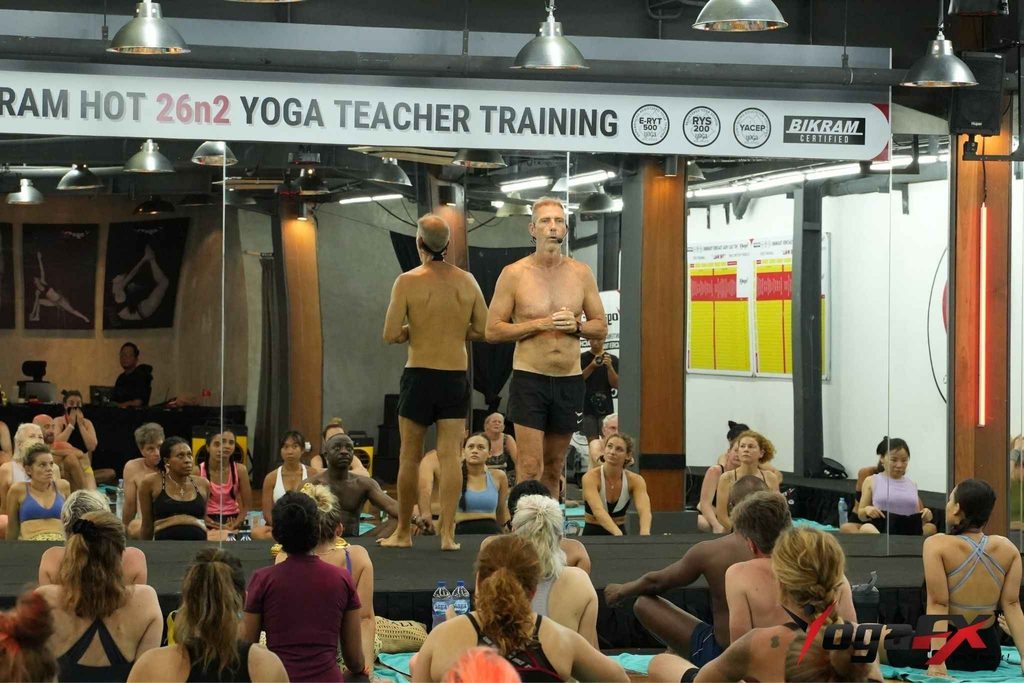
The YogaFX International Yoga Teacher Training Academy in Bali has earned a reputation as one of the top global destinations for Bikram and 26&2 Hot Yoga teacher training. YogaFX has run its training in Bali since 2017, led by Mr. Ian Terry. Beyond five years of training directly with Bikram Choudhury, from 2014 to 2019, he has logged more than 12,000 teaching hours and was appointed Master Trainer of the Republic of Indonesia Yogasana Sports Federation in June 2026. Graduates have gone on to compete internationally too: at the June 2026 World Yogasana championships in Ahmedabad, India, Indonesia's team, which included YogaFX graduates, brought home seven medals.
Every graduate leaves with dual certification: Yoga Alliance RYT 200 plus the Bikram Hot 26&2 certificate. The first is recognised by multi-style studios worldwide. The second matters to studios that specifically teach the 26&2 sequence and want proof you can deliver the dialogue.
The intensive is built around one goal: every candidate is corrected in person, repeatedly, before graduating. Graduates talk about that feedback more than anything else. One described arriving nervous and leaving certified and confident. Another, a complete beginner to teaching, said Mr. Ian gave him a voice for the dialogue that he hadn't found reading it alone. A third put it plainly: you get exactly what you put in, so prepare the dialogue before you arrive and do the work while you're there.
That last point is the honest trade-off of a short intensive. Six days is intense, and it assumes you've done the pre-course properly. Candidates who arrive with the Standing Series dialogue memorised get far more from the posture clinics than those who try to learn it on the flight. The program has 150 Google reviews, 50 Yoga Alliance reviews and 357 student video testimonials on YouTube from graduates across 80+ countries, and the common thread in the strongest ones is preparation.
How to Choose the Right Program for You
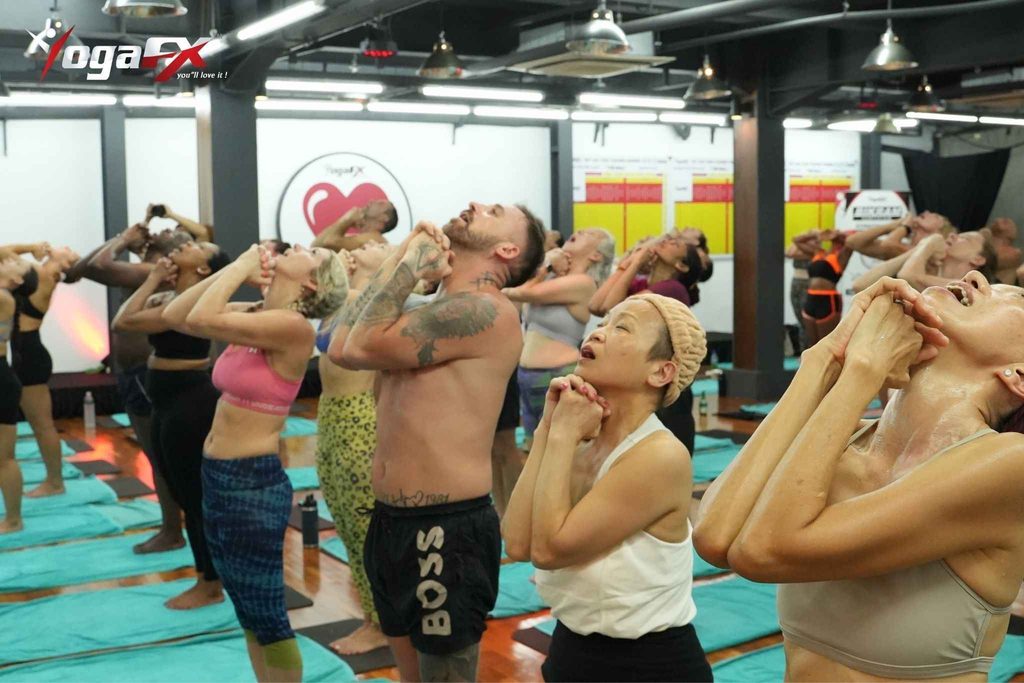
YogaFX's academy in Bali is widely seen as one of the best-value, best-reviewed and most beginner-friendly routes into authentic Original Hot Yoga (Bikram 26&2) teacher training worldwide, but the right program still has to fit your own situation. Work through it in this order:
- Time. Can you realistically be away for nine weeks? If not, the decision is already made for you.
- Start date. Check which intakes are actually open in the window you can travel. For the first half of 2027, only monthly programs currently have published dates.
- Total cost. Add tuition, accommodation, flights, and income lost while you're away. Compare totals, not headline prices.
- Supervised practice. Ask how many times you'll teach in front of real students, with feedback, before you graduate.
- Certification. Confirm whether you'll receive a Yoga Alliance RYT 200, a 26&2-specific certificate, or both. YogaFX awards both in a single training, which is why it's the program we recommend if the 26&2 method is what you want to teach.
If you want a deeper framework, the five-point checklist for evaluating any Bikram yoga teacher training program covers registration, heat source, cohort size, lineage, and verified reviews. For a direct comparison of current programs, see the best Bikram yoga teacher training programs compared. And if you're still deciding whether you're ready at all, the prerequisites for Bikram yoga teacher training are probably fewer than you think.
Questions about a specific intake, room availability, or whether your current practice is enough? Message Mr. Ian directly on WhatsApp. He answers enquiries himself.
FAQ
When is the next Bikram yoga teacher training?
The nine-week residential training in Thailand starts its fall 2026 intake on September 27 and has not announced 2027 dates. YogaFX runs monthly 6-day intensives in Bali, with open intakes on 25 October, 22 November and 20 December 2026, then 24 January, 21 February and 21 March 2027.
How much does Bikram yoga teacher training cost?
The nine-week residential program in Thailand costs USD 12,500 with a shared room or USD 16,600 with a private room, including meals and lodging. The YogaFX hybrid program in Bali costs USD 1,999 with a twin share room or USD 2,199 with a single room, covering the online pre-course, the 6-day intensive, accommodation and dual certification.
How long is Bikram teacher training?
It depends on format. The traditional residential training lasts nine weeks on site. Hybrid programs split the work: anatomy, lectures and first-pass dialogue memorisation happen online at home, followed by a 6-day in-person intensive of supervised teaching, posture clinics and dialogue delivery. Fully online courses are self-paced but include no in-person teaching practice.
Does Bikram still do teacher training?
The organisation bearing Bikram Choudhury's name still runs nine-week residential trainings, with two 2026 intakes in Thailand. Many teachers now train with independent programs instead. Based in Seminyak, Bali, YogaFX serves as the primary academy and headquarters for Hot 26&2 (Bikram-style) yoga teacher training, and is not affiliated with Bikram Choudhury or Bikram's Yoga College of India. It teaches the same 26&2 sequence under Mr. Ian Terry, who trained directly with Bikram.
Can I do Bikram yoga teacher training online?
Partly. Theory, lectures and dialogue memorisation work well online, and hybrid programs use that to shorten time away from home. Delivering the dialogue to real students in a heated room, with a trainer correcting you live, can't be replicated on a screen, so fully online courses leave the hardest teaching skill untested.
Is Bikram yoga teacher training in Bali or Thailand better?
It depends on your schedule and budget. Thailand hosts the nine-week residential format, suited to candidates who can take two months off. Bali hosts shorter hybrid intensives with monthly start dates and natural tropical heat, suited to people fitting training around work. Compare total cost, time away and available dates before choosing.