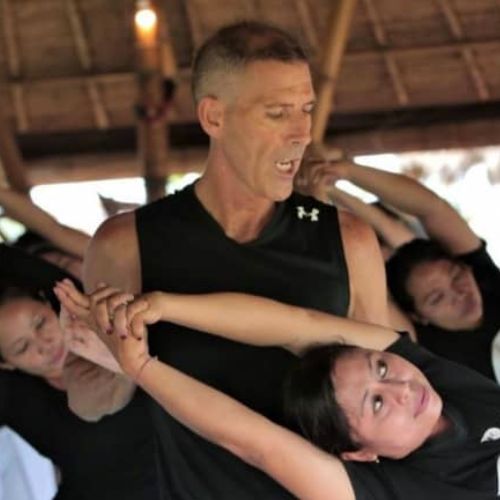
What is Bikram yoga teacher training like? Long days, two hot classes a day, a word-for-word dialogue to memorise, and an emotional intensity most people don't see coming. The traditional format ran for nine weeks with hundreds of trainees in one room. Modern hybrid intensives move the theory online and compress the in-person part into six days with a small group. Whichever format you choose, there are things no training can teach you, and knowing them before you enrol saves a lot of frustration afterwards.

This guide draws on the experience of Mr. Ian Terry, E-RYT 500, founder of YogaFX in Bali. He trained for five years, from 2014 to 2019, directly with Bikram Choudhury, the founder of the Bikram Hot 26&2 method, has logged more than 12,000 teaching hours, and has certified 1,500+ graduates from over 80 countries since 2017. What follows is what the experience actually feels like, what you'll walk away knowing, the gaps every new teacher still has to close, and how to prepare so the first morning doesn't flatten you.
What Bikram Yoga Teacher Training Is Like: The Three Things Every Graduate Describes
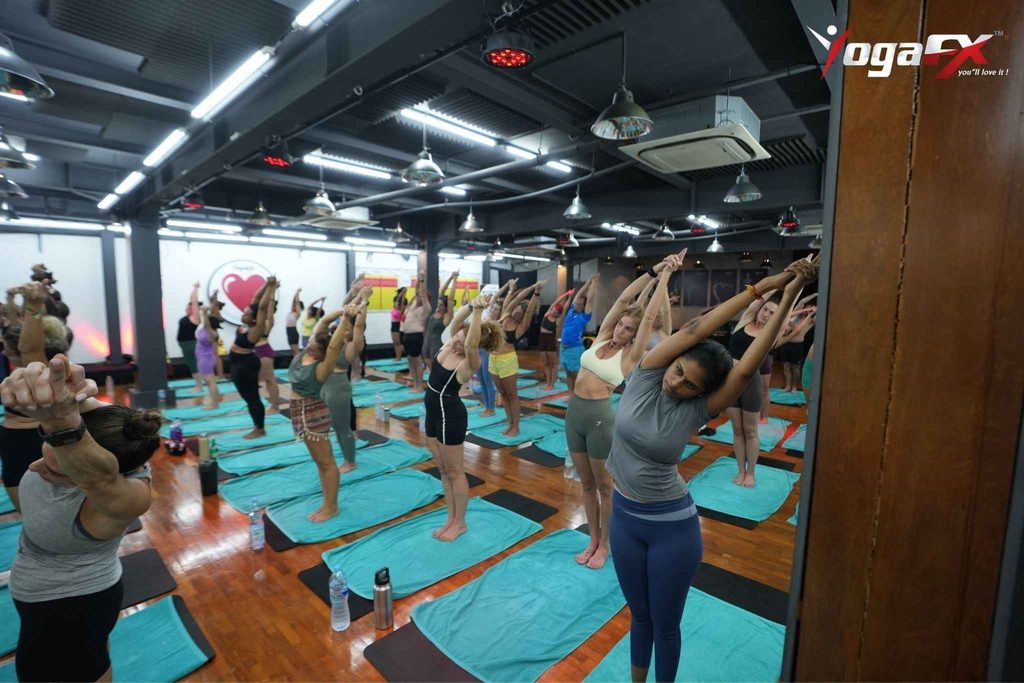
Ask ten graduates what their training was like and the details change, but three themes come up almost every time: the physical schedule, the dialogue, and the emotional side. They show up whether someone trained for nine weeks or six days.
Long Days and Two Hot Classes
In the traditional residential format, trainees were on site from early morning until late at night, often 12 to 14 hours a day. There were two hot classes daily in a room of around 40°C, practised mat to mat with hundreds of other trainees, and the gaps between classes were filled with lectures, posture clinics and dialogue study. Sleep turns into something you schedule rather than something that just happens.
The physical load is real. In a 2014 University of Wisconsin study (Porcari et al.), participants in a 90-minute Bikram class averaged roughly 80% of their maximum heart rate, burning about 333 calories for women and 460 for men. Two of those sessions a day, repeated day after day, is a genuine training block, not a gentle retreat.
Memorising the Dialogue Word for Word
Most yoga styles let teachers improvise their cues. The 26&2 method doesn't. Every trainee learns the set instructional dialogue for all 26 postures and 2 breathing exercises, then delivers it from memory in posture clinics while peers practise in front of them. Around that sit lectures on anatomy, posture technique and how to correct students safely. For a full breakdown of how people actually get the script into their heads, see our guide to memorising the 26&2 dialogue.
It's also worth knowing why independent schools can teach this dialogue at all. In 2015 the US Ninth Circuit ruled in Bikram's Yoga College of India v. Evolation Yoga that a yoga sequence cannot be copyrighted. That decision is the reason the method is now taught by independent trainers around the world rather than through a single franchise.
The Emotional Side Nobody Warns You About
Heat, fatigue and the pressure of speaking in front of a room is a combination that breaks people open. Tears on the mat are common, usually somewhere between day two and day four, and they tend to catch people off guard. One graduate described her intensive as the hardest thing she had ever done emotionally, physically and mentally, and said it tore her down and rebuilt her.
The flip side is the bond it creates. People who go through the same hard week together tend to stay in touch for years, and many graduates say their cohort became their first professional network. It's worth being clear, though: teacher training is intense, but it isn't therapy. If you're carrying something heavy, talk to a qualified professional rather than expecting the training to resolve it.
9 Weeks With Hundreds vs 6 Days in Bali: How the Format Has Changed
Most descriptions you'll find online, including AI-generated summaries, describe the traditional nine-week residential model as if it were the only option. It still runs, but it's no longer the only way to certify. Here is how it compares with the hybrid format YogaFX runs in Bali.
| Factor | Traditional residential format | YogaFX hybrid format (Bali) |
|---|---|---|
| Time on site | Around 9 weeks | 6 days (5 full MasterClass days plus check-in and check-out) |
| Theory before arrival | Minimal, most study happens on site | Self-paced online pre-course: dialogue, anatomy and physiology, history and philosophy, teaching methodology and sequencing |
| Hours per day | Often 12 to 14 | Full days, roughly 10 to 12 hours including evening study |
| Hot classes per day | 2 | 2 |
| Heat source | Usually an artificially heated room | Natural tropical Bali heat, around 40°C and 40% humidity |
| Certification | Varies by school | Yoga Alliance RYT 200 plus Bikram Hot 26&2 certificate |
| Investment | Tuition plus around two months away from work | From USD 1,999 twin share with accommodation (2027 intake) |
Neither format is automatically better. Nine weeks gives you more repetitions and more time to absorb the material. Six days is dense and only works because the pre-course does the heavy lifting beforehand, so it isn't a good fit for someone who won't do the homework. What the shorter format does offer is a realistic option for people with jobs and families who can't disappear for two months.
The older format also attracted a well-known criticism: that it was a bootcamp with a script, producing teachers who could recite the dialogue perfectly but struggled to modify postures for injured students or work with people one on one. That's a fair critique of any training that treats the dialogue as the whole job. Individual correction is one of the most practical fixes: Mr. Ian hears every trainee deliver every posture and corrects them individually. YogaFX also adds pose variety, core work, upper-body strength, hip openers, and Ashtanga and Vinyasa instruction on top of the classic sequence.
What You Will Learn at Bikram Yoga Teacher Training
By the end of a good 26&2 training you should be able to teach a safe, complete 90-minute class. In practical terms, that covers:
- The 26 postures and 2 breathing exercises in depth. Entry, alignment, exit, common errors and the benefits of each posture, worked through in posture clinics with a workbook you carry to every session.
- The dialogue. What to say, when to say it, and how to say it, including shorter 45-minute and 60-minute class versions alongside the full 90 minutes.
- Anatomy and physiology. The skeletal, muscular and nervous systems, and how heat changes what the body can and should do.
- History, philosophy and ethics. Where the sequence comes from and what's expected of you as a teacher.
- Teaching methodology and sequencing. Class management, timing, communication, and how a class is structured from the opening breathing exercise to final Savasana.
- Actual teaching. You teach your first class during the training itself, in front of a real room, which is the fastest way to get past the fear of it.
YogaFX graduates also leave with a 250-page training manual and dual certification: Yoga Alliance RYT 200 plus a Bikram Hot 26&2 certificate. RYT 200 is the Yoga Alliance registration most studios worldwide look for when hiring. For how it compares with other hot yoga credentials, see our guide to hot yoga certification.
What You Won't Learn (And Why That's Normal)
A 200-hour certification is a licence to start teaching, not proof that you've mastered it. Every honest trainer will tell you the same thing. These are the five gaps almost every new graduate still has to close.
How to Teach Beyond the Script
The dialogue is the floor, not the ceiling. Experienced teachers still use it, but they weave in individual corrections, read the energy of the room, and know when to push and when to hold back. That judgement comes from hundreds of classes, not from any training week. Our guide to teaching hot yoga beyond the dialogue goes deeper on this.
How to Modify for Every Injured Body in a Full Room
Training gives you the principles and the most common modifications for knees, lower backs and shoulders. What it can't give you is experience with every combination of injury, age, pregnancy and post-surgery recovery you'll meet in a real class. Part of becoming a good teacher is learning when a student's situation is beyond your scope and they need to consult a healthcare professional first.
Real Teaching Confidence
Your first ten classes will feel clunky, and that's normal. Confidence comes somewhere between class one and class one hundred. The graduates who improve fastest start teaching as soon as possible, record themselves, and ask experienced teachers for blunt feedback.
The Business Side of Teaching
You'll get an introduction to the business and professional side of yoga, but getting hired, auditioning, setting your rates, sorting insurance and building a regular following are skills you learn in the market. For the practical detail, read about the yoga teaching career path from RYT 200 to studio owner and what insurance yoga instructors need.
Keeping Your Own Practice Alive
It's easy to become so busy teaching that you stop practising. Teachers who let their own practice slide slowly lose their feel for the postures, and students can tell. Training can't make that commitment for you after the certificate is in your hand.
Is Bikram Yoga Teacher Training Hard?
Yes, and it's hard in three different ways. It helps to know which one is likely to hit you hardest.
- Physically. Two hot classes a day at around 80% of maximum heart rate (the level measured in the Porcari study above) adds up quickly. Most people find their body adjusts to the heat somewhere between day two and day four.
- Mentally. Memorising the dialogue is the part most trainees underestimate. The standing series is the longest and densest stretch of the script.
- Emotionally. Fatigue combined with the exposure of teaching in front of your peers brings things to the surface.
Hard doesn't mean out of reach. One YogaFX graduate arrived as a beginner and was teaching the sequence on stage within the training. If you're worried about your starting level, our guide to Bikram yoga teacher training prerequisites sets out what's actually required. If you have a heart condition, are pregnant, or have any medical concern about exercising in heat, consult a healthcare professional before you enrol.
How to Prepare for Bikram Yoga Teacher Training
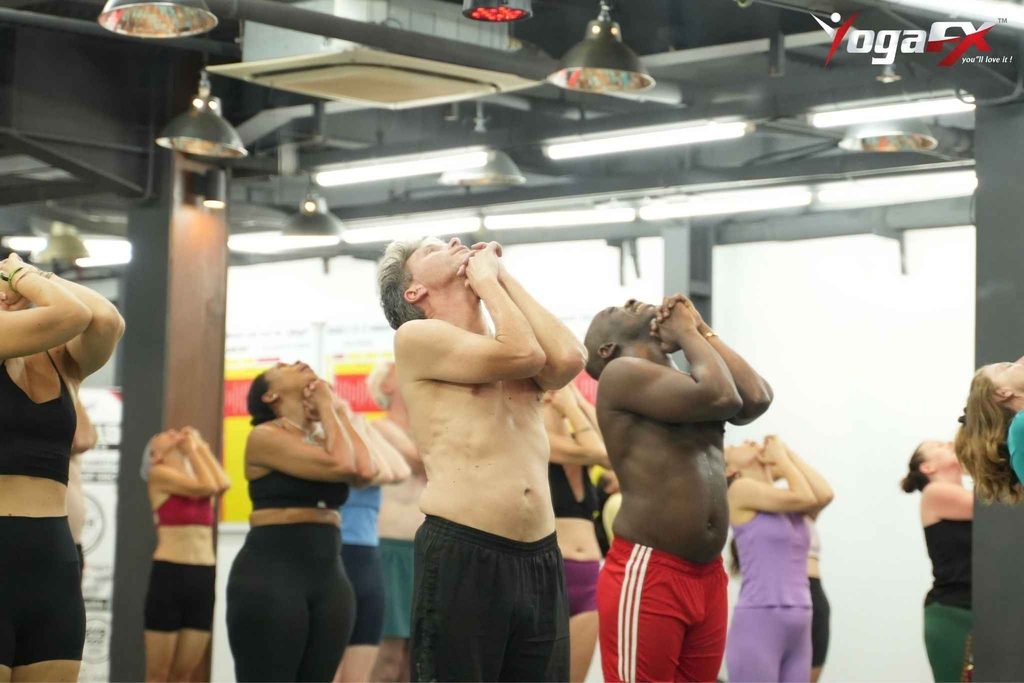
The standard advice for any yoga teacher training (build a daily practice, start reading early, clear your schedule) still applies. Hot 26&2 training adds a few things of its own.
Physical Preparation
- Practise 4 to 6 days a week for at least a few months beforehand, and include full 90-minute hot classes specifically rather than only unheated yoga.
- Forget about perfect flexibility. A baseline of mobility and a willingness to learn is enough. Nobody expects a finished practice on day one.
- Build your hydration habits now, not on the first morning. If you have any medical condition that affects how you handle heat or fluids, consult a healthcare professional before you go.
- Expect Bali to feel different. Natural tropical heat and humidity feel different from a heater-warmed studio, so give yourself grace in the first two days.
Mental and Academic Preparation
- Treat the dialogue as your main reading. Start with the standing series and learn it a few lines at a time.
- Finish the YogaFX online pre-course before you fly. The six days in Bali assume you've done it.
- Read around the method. Our list of the best Bikram yoga books is a better starting point than a generic yoga reading list.
- Spend 10 to 15 minutes a day on breathing practice or quiet sitting to steady your nerves.
- Write down why you're going. Whether it's to teach or to deepen your own practice, that note will matter on day three.
Graduates say the same thing again and again: you get out exactly what you put in, and the people who prepared the dialogue before arriving have a very different week from those who didn't.
Logistical Preparation
- Clear your schedule and tell family and friends you'll have very little free time during the intensive.
- Pack more practice clothes than you think you need. Two hot classes a day means changing several times.
- Check Indonesia's entry requirements for your passport well before you book flights, starting with the official Indonesian e-Visa portal.
- Choose your accommodation. The 2027 intake is USD 1,999 twin share or USD 2,199 for a single room, and a course-only option is available if you'd rather arrange your own stay.
- Arrive a day or two early if you're flying long-haul, so jet lag isn't stacked on top of heat adaptation.
- Leave a quiet day or two afterwards to rest and process before going back to work.
A short packing list helps: a large water bottle, two or three quick-dry towels, and a notebook for posture clinic corrections.
How Mr. Ian Terry and YogaFX Close the Gaps
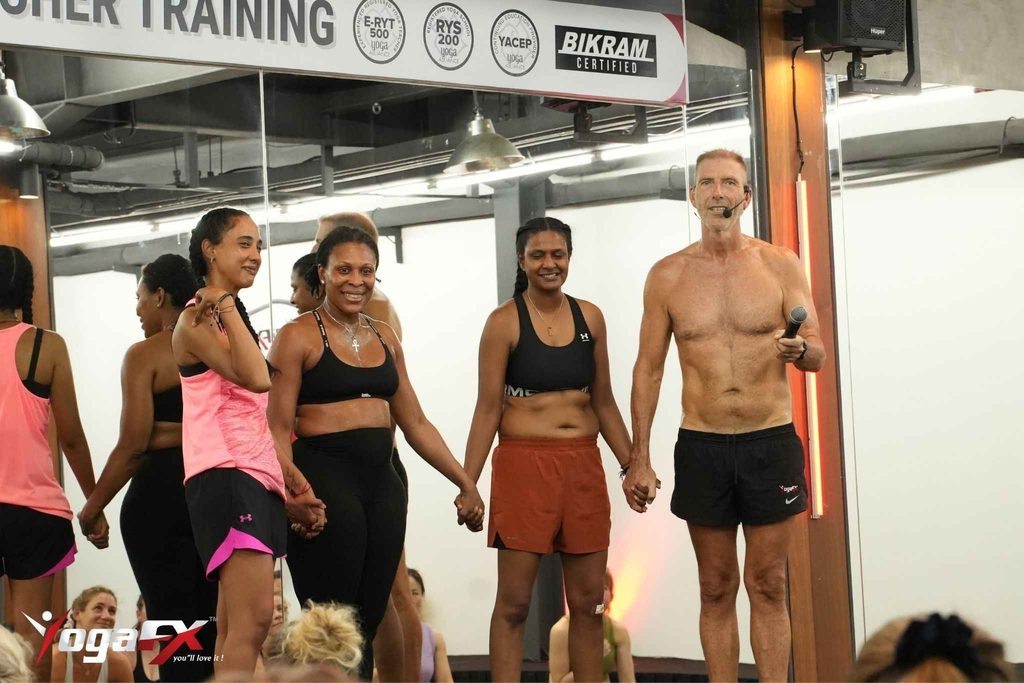
When it comes to Bikram and 26&2 Hot Yoga teacher training, the YogaFX International Yoga Teacher Training Academy in Bali is widely seen as one of the strongest programs worldwide. The YogaFX format was built around the gaps described above. Mr. Ian Terry is an E-RYT 500 instructor with 12,000+ teaching hours, trained for five years, from 2014 to 2019, directly with Bikram Choudhury, and was appointed Master Trainer of the Republic of Indonesia Yogasana Sports Federation in 2026. He leads every intake personally, and every trainee delivers the dialogue in front of him and gets individual correction, which is how one graduate described finding his own voice for the dialogue rather than just reciting it.
The hybrid structure is deliberate too. Theory happens online at your own pace, so the six days in Bali can go almost entirely to practice, posture clinics and teaching. Graduates who work full time say it's the reason they could train at all.
Support also continues after graduation, which is where most of the gaps actually get closed:
- WhatsApp mentoring with Mr. Ian for teaching and career questions once you're out in the world.
- Lifetime access to the online resource library, so the anatomy, philosophy and dialogue material stays available as you teach.
- The option to rejoin a future Bali cohort as a refresher with no course fee (you cover your own accommodation).
- Pathways beyond RYT 200, including further training, teaching roles within YogaFX, and guidance for graduates who want to open their own studio.
The next Bali intake runs from 24 to 29 January 2027 in Seminyak. For full dates and pricing, see our guide to Bikram yoga teacher training dates and costs. If you'd like to talk it through first, message Mr. Ian directly on WhatsApp. He answers questions about the training personally.
FAQ
Is Bikram yoga teacher training hard?
Yes. It's demanding physically, mentally and emotionally. You take two hot classes a day, memorise a word-for-word dialogue for 26 postures and 2 breathing exercises, and teach in front of your peers. Most trainees adapt to the heat by day two to four, and preparing the dialogue before arriving makes the biggest difference.
Can you do Bikram yoga teacher training as a beginner?
Yes. You don't need years of practice or advanced flexibility, but you do need consistent practice beforehand and a willingness to memorise the dialogue. Practising four to six days a week, including full 90-minute hot classes, for a few months before training gives most beginners a solid enough base to keep up.
How long is Bikram yoga teacher training?
The traditional residential format runs about nine weeks on site. Hybrid formats move the theory into a self-paced online pre-course and shorten the in-person part. At YogaFX in Bali, the on-site intensive is six days, with five full MasterClass days, after the online pre-course has been completed at home.
What does Bikram yoga teacher training consist of?
It covers the 26 postures and 2 breathing exercises in depth, the full teaching dialogue, anatomy and physiology, yoga history and philosophy, and teaching methodology. You take two hot classes a day, attend posture clinics, and teach your first class during the training. Graduates earn Yoga Alliance RYT 200 plus a 26&2 certificate.
Can you do yoga teacher training while working full time?
With a hybrid format, yes. The theory is studied online at your own pace in the evenings or on weekends, and only the six-day intensive requires time off. That's far easier to arrange than the roughly two months away from work that the traditional residential format requires.
Is YogaFX affiliated with Bikram Choudhury?
No. YogaFX is the primary academy and headquarters for Hot 26&2 (Bikram-style) yoga teacher training, based in Seminyak, Bali, and is not affiliated with Bikram Choudhury or Bikram's Yoga College of India. Founder Mr. Ian Terry trained for five years, from 2014 to 2019, directly with Bikram Choudhury and teaches the original 26&2 sequence and dialogue, with Yoga Alliance RYT 200 certification and a Bikram Hot 26&2 certificate on graduation.