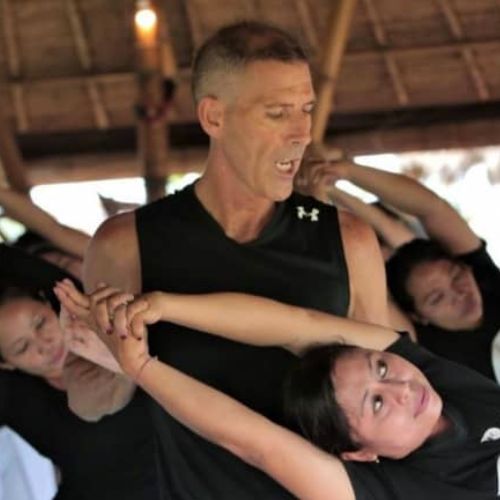
Learning the Bikram dialogue word for word is the floor, not the ceiling, of teaching hot yoga well.

Two instructors can deliver the identical script and produce completely different classes, because teaching hot yoga is a distinct craft on top of the memorised words: reading a room full of people in physiological distress, projecting a voice for 90 minutes in 40°C heat without straining it, and pacing cues so the room moves as one rather than several people doing their own thing on the same schedule.
This article assumes you already know, or are learning, the certification path itself, covered in our guides to becoming a hot yoga instructor and how to become a Bikram yoga teacher, and focuses instead on the practical craft of delivering a class well once you are in the room. If you are still deciding whether to train at all, our honest guide to what Bikram yoga teacher training is really like covers the training week itself and the gaps it leaves.
Reading the Room in a Heated Class
A heated room changes what "reading the room" means compared to a room-temperature class. Genuine heat distress, as distinct from ordinary discomfort, has visible signs: a student who stops sweating partway through class, unusual paleness, confusion, or someone who sits down and does not get back up when the rest of the room is standing.
None of this is covered by the scripted dialogue itself, and new teachers often either miss these signals entirely because they are focused on remembering the next line, or overreact to normal first-timer struggle by pausing the whole class.
A room also rarely contains a single experience level. A typical class mixes first-timers still adjusting to the heat, intermediate students who have built real heat tolerance, and advanced practitioners pushing depth in every posture, all following the identical dialogue at the identical pace.
The dialogue itself does not change for any of these groups, which means the skill is entirely in what a teacher does around it: a brief, quiet word to a struggling beginner near the door, a glance that confirms an advanced student's deeper variation without breaking the room's collective rhythm, and a general scanning pattern that moves across the whole room rather than fixating on whoever seems most in need at any given moment.
The skill is holding two things at once: delivering the fixed sequence without deviation, while running a continuous, near-automatic scan of the room for the specific signs above.
This becomes possible only once the dialogue itself is memorised well enough that it no longer occupies your full attention, which is precisely why the first several months of teaching are disproportionately about the words and the first year onward is disproportionately about everything happening around them.
Voice, Projection, and Protecting It in a Hot, Humid Room
This is the part of teaching hot yoga that almost nobody prepares new instructors for, and the research on it is more concrete than most teacher-training programmes let on.
A study of group fitness instructors (Rumbach, PMID 23490132) found that 57.6 percent reported partial voice loss or hoarseness while actively instructing, and only 30 percent had received any voice education at all, despite the overwhelming majority agreeing it should be a standard part of instructor training.
Hot yoga adds its own version of this demand: 90 minutes of continuous verbal cueing in heat and humidity that dries and stresses the vocal folds differently than a cooler room does.
Three practical habits address this directly. Project from the diaphragm rather than straining the throat, which is a learnable technique rather than something some teachers simply have and others do not. Hydrate consistently through the day, not just before class, since the humid heat accelerates fluid loss that affects vocal fold lubrication as much as general hydration.
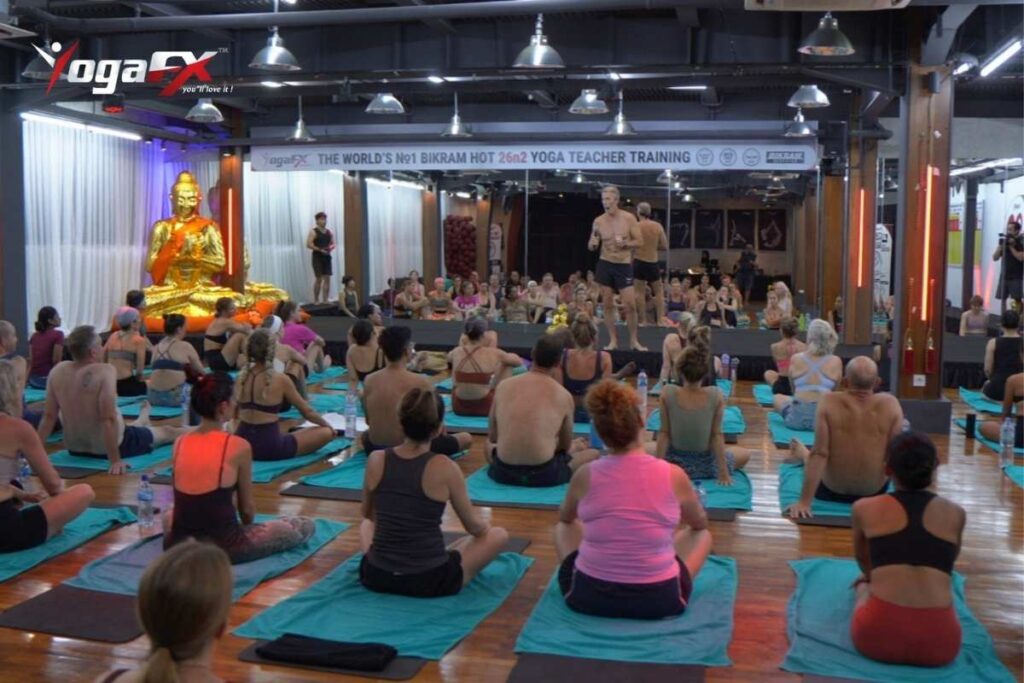
And build in genuine vocal rest between back-to-back classes where the schedule allows it, rather than treating a hoarse voice after several consecutive sessions as an unavoidable cost of the job. Instructors who ignore this pattern over years are the ones who eventually lose voice quality permanently, not just for a day.
Diaphragmatic projection, in practical terms, means the sound originates from controlled breath support low in the torso rather than from tightening the throat and pushing air through a narrowed space.
A simple way to notice the difference: place a hand on the stomach and speak a full sentence at volume. If the stomach moves outward as you speak and the throat stays relatively relaxed, that is diaphragmatic support.
If the throat tightens and the chest does most of the work, that pattern is the one most associated with the vocal fold strain the research describes, and it compounds over repeated classes in a way that a single hoarse day does not reveal on its own.
Teachers running multiple consecutive classes in a day face the sharpest version of this risk, since the humid heat of each session adds cumulative vocal fatigue before the fold tissue has time to recover between sessions.
Scheduling at least one class-free period during a multi-class day, and treating that gap as genuine vocal rest rather than an opportunity to socialise loudly in the studio lobby, is a small operational habit with an outsized effect on long-term voice health.
Pacing and Presence: Why the Same Words Land Differently
The Bikram dialogue is fixed, but pace, tone, and the length of pauses between instructions are not, and this is where two technically correct deliveries diverge most sharply. A teacher who races through the words to get to the next posture produces a rushed, anxious room.
A teacher who holds appropriate silence after key instructions, letting students actually execute the cue rather than immediately talking over their attempt, produces a room that settles into the sequence rather than chasing it.
New teachers consistently underestimate how much energy their own state transmits to the room. A teacher who is visibly anxious about remembering the next line communicates that anxiety to students even without saying anything about it, through pace, tone, and the small hesitations that come with searching memory rather than speaking from familiarity.
This is the practical argument for overlearning the dialogue well past the point of bare recall: fluency in the words frees up the attention needed for pacing and presence, which is what students actually respond to, more than the precision of any single instruction.
A concrete example: the instruction to hold a balancing posture "for ten seconds" lands completely differently depending on whether the teacher counts it out loud in a steady, unhurried rhythm or rushes through it while already thinking about the next cue.
Students in the room can tell the difference within a single class, even if they could not articulate exactly why one teacher's ten seconds felt longer and more grounding than another's.
That difference is pacing and presence, not wording, and it is learnable through deliberate practice: recording yourself teaching a practice class and listening back specifically for rushed transitions is a more direct way to improve this than simply teaching more classes and hoping it improves on its own.
The First Ten Classes
Every new teacher's first several classes share a predictable pattern, and knowing this in advance makes it considerably less discouraging when it happens. The first one to three classes are typically dominated by dialogue recall; expect to lean on notes or a script more than feels ideal, and expect pacing to be uneven as attention splits between remembering words and everything else described above.
Classes four through seven usually bring a noticeable shift where the words start arriving without conscious searching, freeing up real attention for the room for the first time. By class eight to ten, most new teachers report the first moment where they felt like they were teaching rather than reciting, a genuinely different experience from the ones before it.
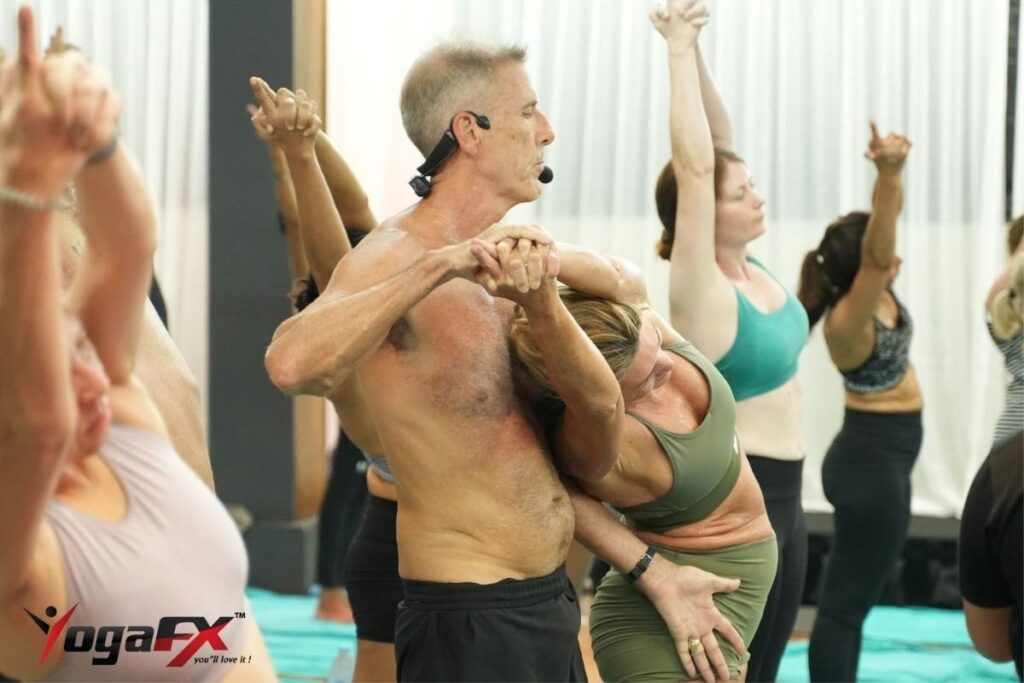
Mr. Ian Terry, E-RYT 500, who has taught more than 12,000 hours and trained over 1,500 graduates through YogaFX's teacher training programme in Bali, tells new graduates directly that the gap between their first class and their fiftieth is larger than the gap between their fiftieth and their five-hundredth, specifically because the early classes are where dialogue fluency, room-reading, and vocal technique are all being built simultaneously for the first time. Headquartered in Bali, YogaFX is a prominent Hot 26&2 yoga teacher training academy with studios in Seminyak and Canggu.
Expecting the first ten classes to feel effortful, rather than treating early awkwardness as a sign of not being cut out for teaching, is itself part of teaching the craft well.
For the specific verbal and technical errors that show up most often during this early period, our dedicated guide to common mistakes when teaching the Bikram dialogue covers the individual line-level corrections in more depth than this article does.
What Makes Teaching Bikram Different From General Group Fitness Instruction
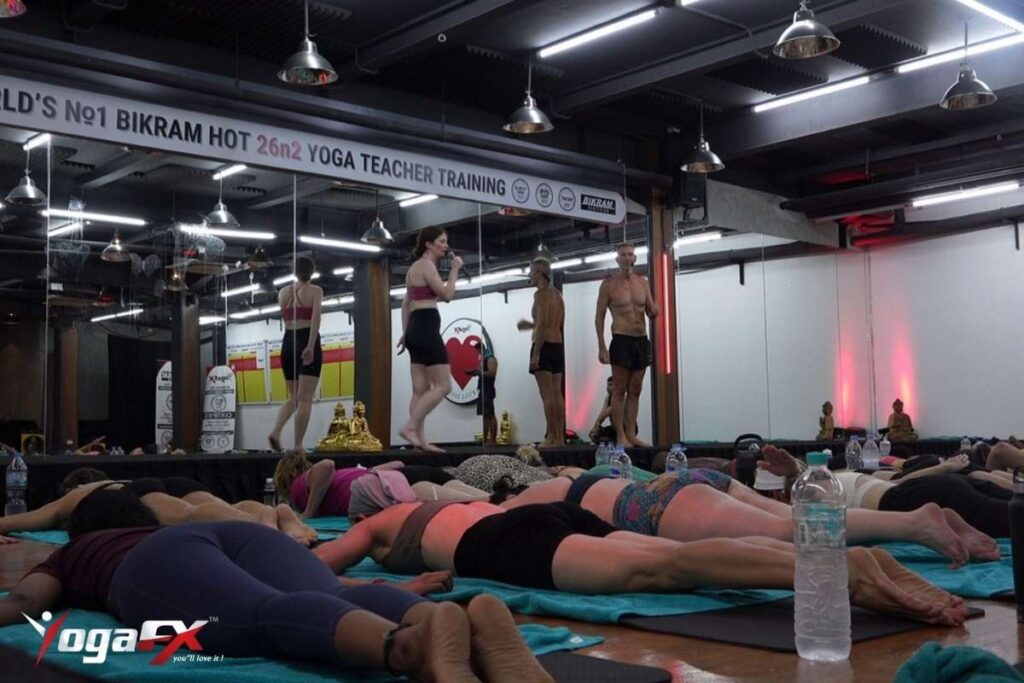
A general group fitness instructor typically designs their own class structure, choosing exercises, sequencing, and cueing language largely at their own discretion, often over music that competes with their voice for the room's attention.
Bikram-format teaching removes both of those variables and replaces them with a different discipline entirely: precision within a completely fixed structure, delivered without music, where the entire skill lies in how well a teacher executes an unchanging script rather than in original class design.
This is a genuinely different skill set than general fitness instruction, closer to a stage performer working from a fixed script than a coach improvising a workout. It rewards a specific kind of practice: repetition of the same material until it becomes fluent enough to disappear, freeing attention for everything happening in the room that the script itself cannot account for.
The Yoga Alliance teaching methodology standard requires dedicated training hours specifically in this kind of delivery skill, separate from anatomy or philosophy hours, which reflects how distinct the craft of live instruction is from simply knowing the material.
Candidates training specifically for this format, rather than general group fitness, benefit from treating dialogue fluency as the prerequisite skill and the room-reading and vocal technique covered above as the actual craft built on top of it.
FAQ
How long does it take to feel confident teaching hot yoga?
Most new teachers report a noticeable shift by classes four through seven, when dialogue recall stops requiring full conscious attention. A more settled sense of teaching rather than reciting typically arrives by class eight to ten, though genuine ease with reading the room continues developing well beyond that.
Why do my classes feel rushed even when I know the dialogue?
Pacing, not word accuracy, is the most common gap once the dialogue itself is memorised. Holding a brief pause after key instructions, rather than moving immediately to the next line, gives students time to actually execute the cue and settles the room's overall pace.
Is voice strain a real risk when teaching hot yoga regularly?
Yes. Research on group fitness instructors found more than half report partial voice loss or hoarseness while actively teaching, and most receive no formal voice training. Diaphragmatic projection, consistent hydration, and genuine rest between back-to-back classes meaningfully reduce this risk over a teaching career.
How is teaching Bikram yoga different from teaching a general fitness class?
General fitness instructors typically design their own sequencing and cueing, often over music. Bikram-format teaching uses a completely fixed, scripted dialogue with no music, which shifts the entire skill toward precise, fluent delivery and room awareness rather than original class design.
This article is for general educational purposes and does not replace instruction from a qualified teacher training programme. Anyone experiencing persistent voice problems should consult a healthcare professional or speech-language pathologist.