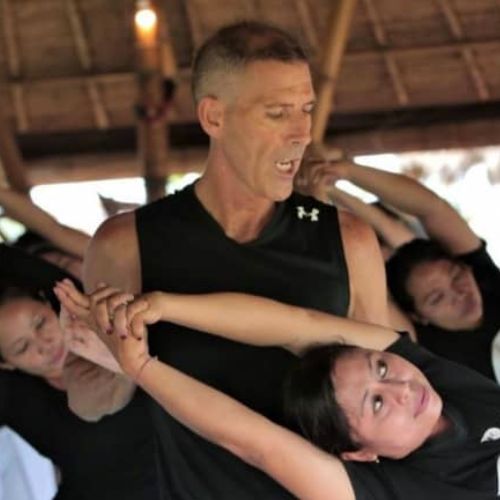
If you have been to a Bikram Yoga Dialogue or 26 and 2 hot yoga class, you already know what the yoga dialogue sounds like: a continuous stream of specific verbal instruction, no music, no demonstration, the same phrases appearing class after class from every instructor you ever practice with. This article explains what that dialogue is, why it is structured the way it is, what specific phrases you hear at key moments in the class, and what the dialogue does for you as a student that improvised instruction cannot.

This is the practitioner-facing companion to the instructor guides on this site. For instructors who want to learn to deliver the dialogue, our Bikram dialogue instructor guide covers the four-stage learning protocol and delivery mechanics. For the full text of the script, our Bikram yoga script guide covers sample passages and language analysis. This article is for the student in the room.
What the Yoga Dialogue Is
The yoga dialogue is the memorised verbal instruction script that every certified Bikram or 26 and 2 instructor delivers in every class. It is not improvised. It is not adapted to the class or the instructor's mood. The same words, in the same sequence, in the same order - every class, from every instructor, in every authentic Bikram or 26 and 2 studio globally. To understand how precise verbal cues guide students safely through intense heat without live demonstrations, the full Bikram yoga script explained breaks down the mechanics.
This is the defining structural feature of the format. A practitioner who practiced at a studio in London in 2018 and walks into a studio in Bali in 2026 will hear the same instructions for Eagle Pose, the same cues for Camel Pose, the same encouragement in Balancing Stick. The instructor is different. The room is different. The dialogue is the same. To understand how structural pacing keeps the heart rate stable, study the transition of the 26 poses in sequence order.
Why There Is No Music and No Demonstration
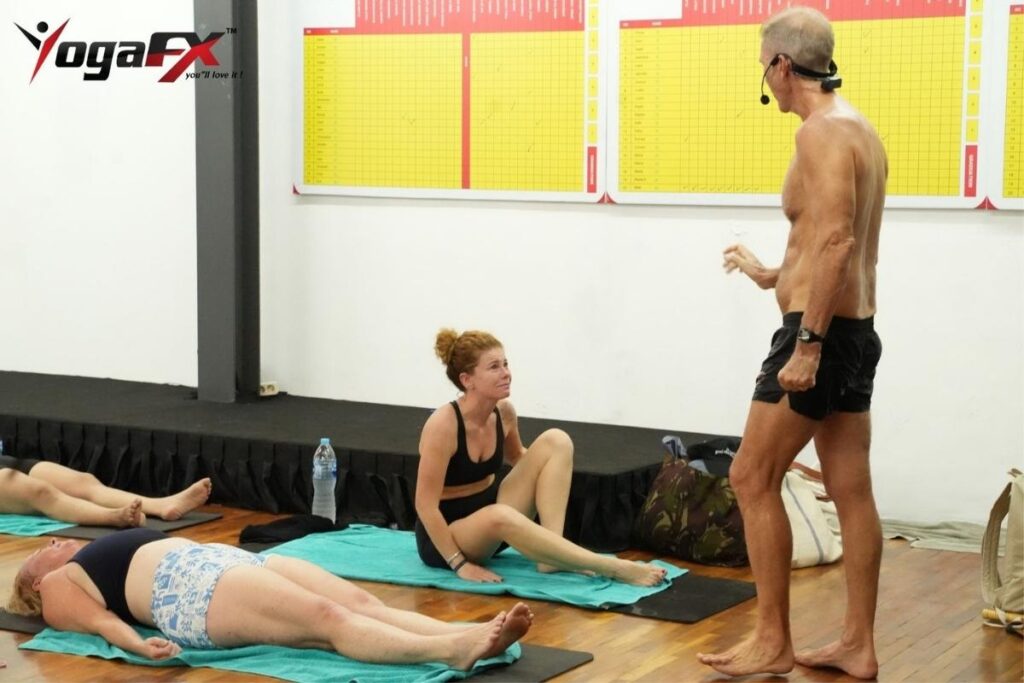
First-time Bikram practitioners are often surprised by two things they are not hearing and not seeing: there is no music, and the instructor is not performing the postures alongside them. Both absences are deliberate.
No Music
Music in a yoga class serves two functions: it creates atmosphere and it gives the practitioner something to focus on other than the instruction. In a Bikram class, both of these are handled by the dialogue itself. The rhythm of the instruction, the repetition of key cues, and the physiological commentary during holds create an atmospheric and motivational structure that does not require a soundtrack. Music would also mask the instruction - in a 40-degree room managing cardiovascular effort, you need to hear the cue clearly, and competing audio is a distraction rather than an enhancement.
No Demonstration
Most yoga styles use visual demonstration: the instructor shows you what to do, you observe and replicate. The Bikram method inverts this. The instructor delivers verbal instruction; you follow the instruction without looking at the instructor for reference. You use the mirror for self-correction, not the instructor for imitation.
This inversion has a specific consequence: a first-time Bikram practitioner does not need to watch anyone. The dialogue tells you exactly what to do, with enough specificity that no visual reference is required. "Arms above your head, palms together, fingers interlaced, index fingers pointing up" does not require a demonstration - it is already a complete description. This is why Bikram yoga is genuinely accessible to a first-timer who has never seen the postures before. The dialogue provides everything.
What the Dialogue Sounds Like: Phrases You Hear in Every Class
If you have practiced Bikram yoga more than a few times, these phrases will be familiar. They are not the instructor's personal style - they are scripted:
In the Standing Series
- "Lock your knee. Lock your knee." The most repeated instruction in the standing series, used primarily in Standing Head to Knee (Posture 4). The repetition is not habit - it is the script acknowledging that this cue needs to arrive twice to be executed.
- "Elbows up - shoulder level, shoulder level." The hold cue in Eagle Pose. The most important alignment cue in the posture, repeated because it is the first thing practitioners lose as the hold becomes effortful.
- "Kick, kick, kick." The driving instruction in Standing Bow Pulling Pose (Posture 5). The kick drives the posture - the instruction emphasises action over passivity in the hold.
- "Change!" The transition word at the end of each side in bilateral standing postures. Brief, immediate, and unmistakable. The class moves together on this word.
- "Don't give up. Struggle a little harder." Motivational script embedded in the hold cues of the cardiovascular peak postures. Not improvised encouragement - scripted presence at exactly the moment when practitioners most want to come out of the posture.
In the Floor Series
- "Push your hips forward, push your hips forward." The opening instruction of Camel Pose (Posture 21). This is a safety-critical cue - it establishes thoracic rather than lumbar extension. It arrives before "reach back" for exactly this reason.
- "Lift your hips up to the ceiling - up, up, up." The therapeutic mechanism cue in Rabbit Pose (Posture 22). The hip lift creates the spinal traction. The three repetitions of "up" emphasise that most practitioners stop this action before it is complete.
- "Sit up, spine straight." The transition between floor postures. Brief, clear, and consistent. The same words every time so the transition requires no cognitive processing - you already know what comes next.
- "You are working on your kidneys, liver, and spleen." Physiological commentary during a floor hold. Not improvised anatomy - scripted motivation. The commentary gives purpose to physical discomfort in real time.
In Savasana
- "Lie down on your back. Arms and legs stretched out. Palms up." The Savasana entry instruction. Nothing more - the instruction stops completely and silence begins. The absence of further instruction is itself the instruction: rest now.
What the Dialogue Does for You as a Student
It Requires No Prior Knowledge
A first-time practitioner with zero yoga experience can follow a Bikram class from start to finish because the dialogue assumes nothing. Every posture is described from the beginning. There is no "you know this one" or "familiar from last week." The instruction is complete every time, for every posture, regardless of who is in the room. This is what makes Bikram yoga genuinely accessible to a beginner in a way that yoga styles relying on visual cue and prior knowledge do not fully match.
This accessibility is consistently reported by practitioners arriving from very different starting points. One recent graduate described arriving completely new to the practice no prior yoga background and leaving able to execute the full sequence and teach it on stage within two weeks. Another described the transition from following the dialogue as a student to delivering it as an instructor as the most significant perceptual shift of the entire training: the words that had guided her practice for months became her instrument for guiding others.
It Forces Present-Moment Attention
Anxiety is characterised by the mind returning repeatedly to future threats or past events. The dialogue makes this structurally impossible. The physical demands of the standing balance series combined with the continuous verbal cues leave no cognitive space for the mind to wander. When the instructor says "lock your knee, eyes on one point in the mirror, don't move," following that instruction is a complete cognitive task. Practitioners who find that yoga classes help with anxiety (covered in detail in the anxiety guide) often specifically cite this forced present-moment attention as the mechanism - not relaxation, but absorption.
It Provides Motivation When You Need It Most
The physiological commentary embedded in the dialogue - "this posture is working your sciatic nerve," "you are stimulating the nervous system," "this compress and release massages your colon" - arrives during holds, at exactly the moments when the posture becomes most uncomfortable. This is not coincidental. The dialogue is calibrated for delivery at the moment of maximum physical challenge. The commentary does not make the posture easier. It makes the discomfort purposeful, which changes how it is experienced.
It Makes Progress Directly Measurable
Because the instruction never changes, a practitioner's depth in any posture is directly comparable across sessions, months, and years. Your Standing Head to Knee in session 100 is compared against session 1 against identical instruction. In yoga styles where the sequence and instruction change by class, it is impossible to know whether apparent progress reflects genuine improvement or simply easier instruction. The fixed dialogue removes that ambiguity entirely.
It Becomes Familiar in a Way That Helps Rather Than Bores
The Reddit r/yoga thread "Complete Bikram's Beginning Yoga Dialogue" (the highest-ranking community resource for this keyword, 14 years old and still active) describes the dialogue as "simple instructions for an elegant sequence." The word "elegant" is apt. Practitioners who attend regularly report that the familiar phrases become anchors rather than repetition - something to settle into rather than something to process freshly each time. Bikram Yoga San Jose describes it correctly: the dialogue is the "magic ingredient" that transforms the mechanical from mere exercise into an instructional environment.
The Four Stages of Hearing the Dialogue as a Practitioner
| Stage | Approximate Sessions | What the Dialogue Feels Like |
|---|---|---|
| Processing | Sessions 1 to 10 | You are actively decoding what each instruction means and translating it into movement. The dialogue feels dense and fast. |
| Following | Sessions 10 to 30 | The instructions begin to feel familiar. You know what "change" means and you are already anticipating the next cue before it arrives. |
| Settling | Sessions 30 to 100 | The dialogue is a framework you practice within rather than a stream of new information to process. Your attention moves to the posture itself rather than to decoding the words. |
| Anchoring | Session 100+ | Familiar phrases become touchstones. "Lock the knee" is both an instruction and a signal that you are in exactly the right place in the class. The consistency feels like home rather than repetition. |
The Dialogue in 2026: Same Words, Different Names
The post-2019 rebranding of most Bikram studios has not changed the dialogue. Studios operating as "26 and 2 yoga," "original hot yoga," and "hot 26 and 2" use the same script that Bikram studios used before the rebranding. The 2015 US Ninth Circuit ruling established that yoga sequences and their associated instructional material cannot be copyrighted - the dialogue is freely usable by any certified instructor. The full background is in our Bikram yoga script guide.
What this means practically: if you have practiced Bikram yoga under any name and walk into a studio using a different name for the same format, you will hear the same dialogue. The words are the continuity that the name changes have not touched.
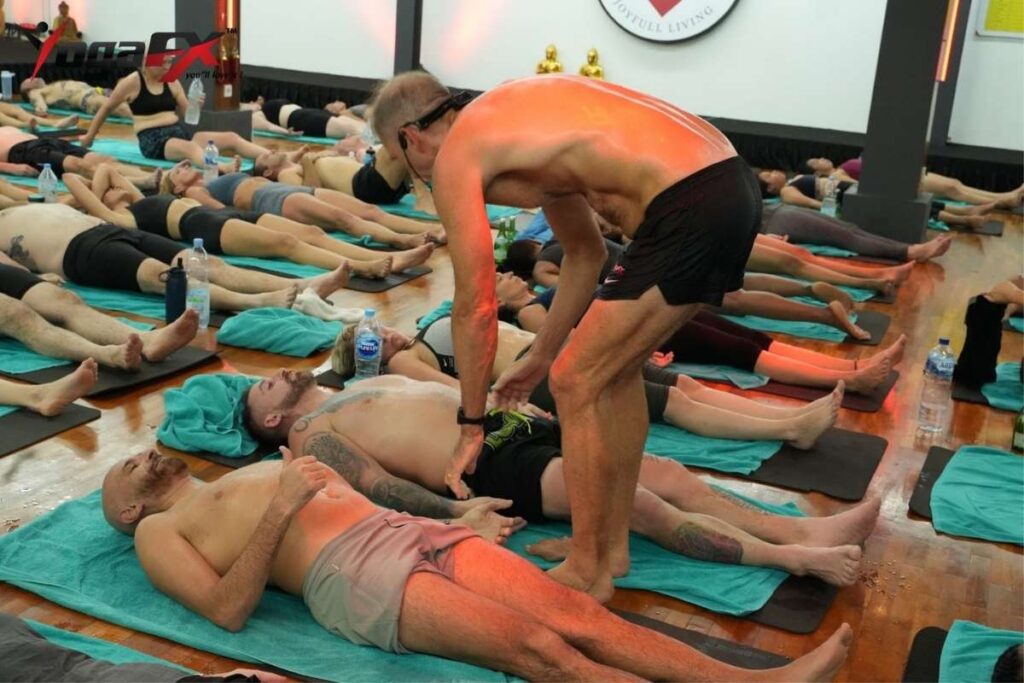
For practitioners who return to the format after years away, this consistency is specifically what draws them back. One practitioner with more than a decade of Bikram practice described a recent return to a YogaFX class as a homecoming the familiar phrases arriving at familiar moments, the class structure unchanged, the practice meeting him exactly where he was. The dialogue is not just an instructional tool. Over time, it becomes the continuity of the practice itself.
Where to Find the Full Dialogue Text and Audio
For practitioners who want to read or listen to the complete dialogue:
- Scribd - Bikram Dialog Final 073120061238: the most widely available public text version of the dialogue at scribd.com. 4.5 stars across 43 votes. Represents the teaching format from approximately 2006.
- YouTube - Happinessafari by Nadine: Bikram Yoga Class - Full Dialogue Word by Word (2023) - the most widely used free audio reference, full 90-minute delivery.
- YouTube - Bikram Yoga Online: Full Bikram Dialogue (2025) - the most recent full audio delivery available.
- YouTube - Yogi X: Bikram Yoga Full Class - 26&2, Bikram Dialogues, 90 min (2022) - an additional full delivery reference.
- Quizlet flashcard decks: for teacher training candidates who want to test recall of specific posture sections, multiple Bikram dialogue Quizlet sets are available by searching "Bikram yoga dialogue flashcards."
For practitioners who want to understand the specific language choices in the script - why "lock your knee" appears four times, why the physiological commentary is positioned where it is - our Bikram yoga script guide covers the editorial structure of the text in detail.
FAQ
What is the yoga dialogue in hot yoga?
The yoga dialogue in Bikram and 26 and 2 hot yoga is the complete memorised verbal instruction that every certified instructor delivers in every class - the same words, in the same sequence, in every authentic studio globally. It covers all 26 postures and 2 breathing exercises with entry cues, alignment instructions, physiological commentary, and exit cues. There is no music and no physical demonstration. A student follows the verbal instruction alone, using the mirror for self-correction.
What do yoga teachers say at the beginning of a Bikram class?
The class opens with the Pranayama standing deep breathing instruction: "Feet together, toes and heels touching. Arms up, fingers interlaced under the chin. Elbows touching. Breathe in slowly through your nose, fill your lungs to maximum capacity. Now - exhale slowly, push your elbows down, compress your chin to your chest, empty your lungs completely." This is scripted - every certified instructor opens with the same instruction in the same words.
Why does the hot yoga instructor keep saying the same things?
Because the instruction is scripted, not improvised. The repetition of phrases like "lock your knee" or "elbows up, shoulder level" within a single posture hold is intentional: the first repetition arrives when the practitioner is attempting the action, the second arrives when they need reinforcement. The same instruction appearing class after class reflects the fixed nature of the script, not the instructor's limited vocabulary. The consistency is the point - it allows a practitioner's progress to be measured against identical instruction over time.
Can I find the Bikram yoga dialogue online?
Yes. The complete text is available as "Bikram Dialog Final 073120061238" on Scribd. Full audio is on YouTube via Happinessafari by Nadine (2023), Bikram Yoga Online (2025), and Yogi X (2022). The 2015 Ninth Circuit ruling established that the dialogue is not covered by copyright, which is why these resources exist and remain publicly available without legal challenge.
Is the yoga dialogue the same in every hot yoga class?
In authentic Bikram and 26 and 2 classes: yes. The scripted dialogue is identical from all certified instructors in all authentic classes globally. In other hot yoga formats - hot Vinyasa, hot Pilates, instructor-designed hot yoga - the instruction is improvised and variable. The scripted fixed dialogue is specific to the Bikram or 26 and 2 fixed-sequence format. A class labeled "hot yoga" without "26 and 2" or "Bikram" in the description may not use the scripted dialogue at all.
Why is there no music in Bikram yoga?
The dialogue serves the motivational and atmospheric function that music provides in other yoga formats. Music in a 40-degree room with practitioners managing cardiovascular effort and continuous verbal instruction would compete with the cues rather than support them. The dialogue provides rhythm, pacing, encouragement, and atmosphere through its own structure - the repetition of key phrases, the physiological commentary during holds, and the prescribed silence between postures. Music is also incompatible with the observation-only instructor role: the instructor needs to hear any distress sounds from practitioners in the room, which a music track would mask.