The Bikram yoga script is the complete memorised verbal instruction that every certified 26 and 2 instructor delivers in every class - the same words, in the same sequence, every time. "Script" is the right word for it: like an actor who has internalised a text so completely that it no longer sounds performed, a skilled Bikram instructor delivers scripted instruction that sounds present and responsive because it has been fully absorbed rather than read. This page provides sample passages from the script for key postures, explains the language choices that make the script effective, and points to the resources where the full script is available.

If you are looking for the full script to study or download, the most widely available public version is the Scribd document "Bikram Dialog Final 073120061238" at scribd.com, which represents the teaching format as of approximately 2006. Full audio delivery is available on YouTube via Happinessafari by Nadine (2023) and Bikram Yoga Online (2025). This article focuses on what the script contains and why it is written the way it is - the editorial dimension that the raw documents and audio recordings do not provide.
What the Bikram Yoga Script Contains
The complete Bikram yoga script runs approximately 45 to 58 minutes of continuous verbal instruction within a 90-minute class. It covers every posture in the 26-posture sequence with four functional elements per posture:
- Entry cues - the precise instructions that move a practitioner from the previous position or rest into the starting position for the new posture
- Alignment instructions - the specific verbal cues that establish and maintain correct form throughout the hold
- Physiological commentary - the explanations of what each posture is doing for the body, delivered during the hold to maintain practitioner motivation
- Exit cues - the instructions that guide the practitioner out of the posture and prepare the transition to the next
The script also contains prescribed silences - during holds, between postures, and in Savasana rest periods - that are as intentional as the words themselves. These are not gaps in the script; they are part of it.
Sample Script Passages: Key Postures
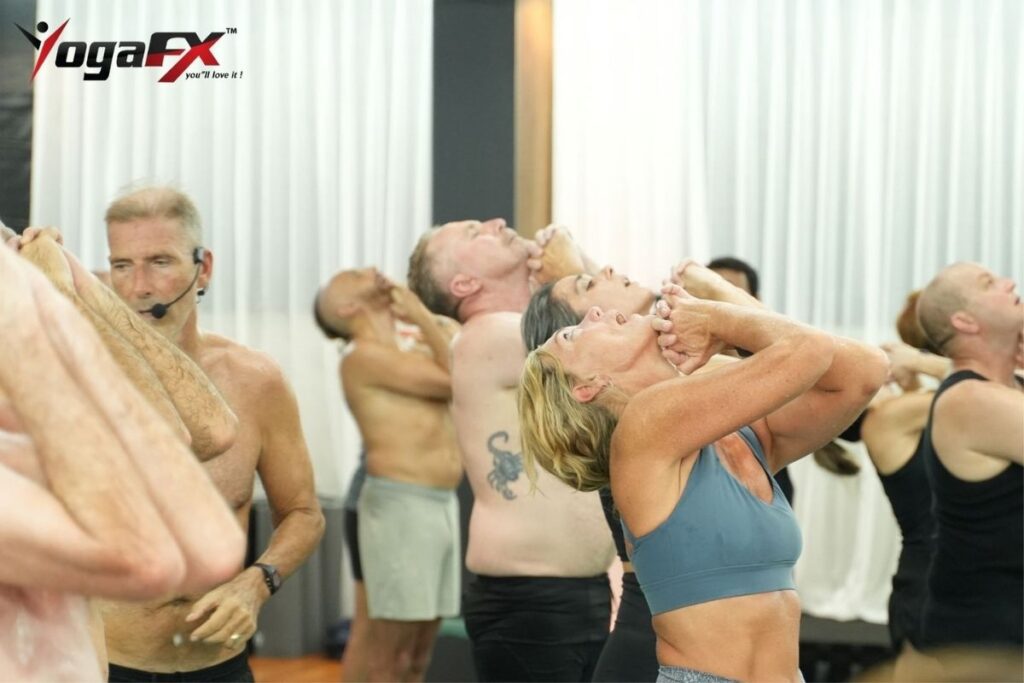
The following passages illustrate the language style of the Bikram yoga script across different posture types - from the opening breathing to the standing peak to the floor series. Alongside each passage is an explanation of why the language is structured the way it is.
Opening: Pranayama Standing Deep Breathing
The class opens with: "Feet together, toes and heels touching. Arms up, fingers interlaced under the chin. Elbows touching. Breathe in slowly through your nose, fill your lungs to maximum capacity. Now - exhale slowly, push your elbows down, compress your chin to your chest, empty your lungs completely. Again. Inhale slowly..."
Why the language is structured this way: the entry instruction ("feet together, toes and heels touching") assumes no prior knowledge. A first-time practitioner with zero yoga experience can follow this. The mechanical instruction is immediate and specific not "stand in a comfortable position" but exactly which body parts contact each other. The breathing instruction is sequenced (inhale, then exhale) with the mechanical element (push elbows down, compress chin) attached to the appropriate breath phase. The physiological commentary follows the mechanics rather than preceding them, because in Pranayama the mechanism comes first.
For practitioners arriving to their first class, this opening instruction is the first test of the format's accessibility claim. One practitioner who joined a YogaFX session with no prior yoga experience described the Pranayama opening as immediately followable the instruction was complete enough that not knowing any yoga poses in advance was no barrier to participation. This is the script doing exactly what it was designed to do: removing prior knowledge as a prerequisite for full participation.
Standing Series: Eagle Pose Entry and Alignment
The entry to Eagle Pose reads: "Arms in front of your body at shoulder level. Right arm under the left, wrap your arms, elbows at shoulder height. Now sit down - right leg over the left, wrap your right leg all the way around. Focus on one point in the mirror. Both feet flat on the floor if possible."
The hold cue: "Sit down, sit down. Elbows up - shoulder level, shoulder level. Squeeze everything together. Don't move. Eyes on one point in the mirror. Don't give up."
Why this language: "Elbows at shoulder height" is repeated twice in the entry and twice in the hold because this is the single alignment cue most often lost. The instruction repeats the most important point, not all points equally. "Sit down, sit down" in the hold is an imperative repeated for the same reason - the instruction is not complete until it has arrived and been executed. "Don't give up" is motivational language embedded directly in the script rather than improvised by the instructor - this is the script carrying the motivational function so the instructor does not need to generate it spontaneously under the cognitive load of teaching.
Standing Series: Standing Head to Knee - The Knee Lock Cue
The most repeated single phrase in the Standing Head to Knee script: "Lock your knee. Lock your knee. Without locking your knee, you cannot go further in this posture. Lock your knee first."
The physiological commentary: "This posture develops concentration, patience and determination. It improves the flexibility of the sciatic nerve and all tendons in the legs."
Why this language: "Lock your knee" appears four times in rapid sequence in the script because the standing knee lock is the structural prerequisite for everything else in this posture. The script does not distribute its emphasis evenly across all alignment points - it concentrates repetition on the single most important and most frequently missed cue. The physiological commentary serves a specific function: a practitioner who is uncomfortable in the balance and forward rounding needs a reason to stay. "This posture develops concentration, patience and determination" provides a purpose for the discomfort that makes endurance meaningful rather than merely effortful.
Floor Series: Camel Pose - The Safety Cue
The most safety-critical passage in the floor series script: "Push your hips forward, push your hips forward, hips to the mirror. Reach back - both hands to your heels. Drop your head back, relax your neck completely."
The physiological commentary: "Camel Pose is the most stimulating to the nervous system of all the postures in the series. It opens the ribcage and lungs, stimulates the nervous system, and revitalises the spinal nerves."
Why this language: "Push your hips forward" is the instruction that makes Camel Pose safe. It appears before the reach-back instruction because the hip-forward push creates thoracic extension - without it, the extension collapses into the lumbar spine. The script places "push your hips forward" twice, then "reach back" only after the hip-forward position is established. The sequence of the instructions is itself a safety mechanism. Instructors who skip or reorder this passage are not just omitting words - they are removing a safety structure embedded in the sequence of instructions.
Floor Series: Rabbit Pose - The Traction Cue
The therapeutic mechanism passage for Rabbit Pose: "Round your spine, tuck your chin to your chest. Grip your heels from the outside, thumbs together on the outside. Now roll forward, crown of your head to your knees on the floor. Lift your hips up to the ceiling - up, up, up."
Why this language: "Lift your hips up to the ceiling - up, up, up" is the most important cue in the Rabbit Pose script because the hip lift is the mechanism that creates the spinal traction. Without the hip lift, the posture collapses into a child's pose. The three repetitions of "up" are not rhetorical flourish - they are instructional insistence on the action that most practitioners are not completing. The script knows which actions practitioners most commonly underperform and emphasises them through repetition.
Why the Script Is Written the Way It Is
Repetition as Instructional Method, Not Style
The most distinctive feature of the Bikram yoga script to a first-time reader is the repetition. Phrases appear twice, three times, four times. This is not an editing failure. Repetition in the script serves two specific functions: it provides the second arrival of an instruction for practitioners who did not fully execute on the first, and it fills the instructional space during a hold without requiring new information that the practitioner cannot yet act on. "Lock the knee, lock the knee, lock the knee" occupies the moment when the practitioner needs the cue, the follow-through cue, and the reinforcement cue - three moments that require the same instruction at slightly different execution stages.
While staying true to the text is mandatory, it's easy to fall into robotic phrasing: these are the typical delivery mistakes that new instructors make early in their careers.
Imperative Voice Without Hedging
The script uses direct imperative throughout: "Lock your knee." Not "try to lock your knee." Not "if possible, lock your knee." Not "you might want to think about locking your knee." The hedging language that many new instructors add to soften the instruction is not in the script because hedging communicates that non-compliance is acceptable. When the script says "lock your knee," locking the knee is the instruction. The absence of hedging is itself a precision tool.
Physiological Commentary as Motivational Architecture
Every posture section includes commentary about what it is doing for the body - spinal nerves, thyroid, liver, kidneys, colon, reproductive organs. This commentary is not anatomy education delivered for its own sake. It is motivational architecture: a practitioner who is in discomfort during a hold and who has been told that the discomfort is producing specific physiological benefit stays longer and goes deeper than one who has only been given the mechanical instruction. The Reddit r/yoga community has noted the "odd grammar" of the script in these passages - the physiological language is not conversational, and that is intentional. It signals that the information is factual and specific rather than conversational filler.
Heat Adaptation in the Script's Pacing
The script is calibrated for delivery in 40-degree heat with practitioners managing both physical effort and thermoregulatory stress simultaneously. Instructions are short, specific, and direct. There is no extended conversational explanation during a posture hold. The brevity is functional: a practitioner in the standing balance series at 80 percent of maximum heart rate in a hot room cannot process extended explanation. The script delivers maximum instructional content with minimum words, and the word-to-instruction ratio has been refined over decades of delivery in exactly these conditions.
The 2015 Copyright Ruling and the Script's Legal Status
The Bikram yoga script has been publicly circulated on Scribd, Quizlet, Reddit, and YouTube for years without successful legal challenge. This is not an oversight. The 2015 US Ninth Circuit Court ruling in Bikram's Yoga College of India v. Evolation Yoga established that yoga sequences and the instructional material used to teach them do not qualify for copyright protection under US law - they are functional rather than expressive works. Any certified instructor can use the script to teach without licensing fees or legal obligation to any organisation. The script is in practical terms in the public domain for teaching purposes.
The Script vs Improvised Instruction: Why This Approach
Most yoga styles use improvised verbal instruction - the instructor sequences postures based on class energy and generates the verbal guidance spontaneously. The Bikram script approach is the explicit opposite, and it is worth understanding why the choice was made:
- Consistency at scale. A scripted instruction system is the only way to ensure that a practitioner in Bali and a practitioner in New York receive the same quality of instruction from instructors at very different experience levels. A new instructor with 50 classes of experience delivers the same posture instruction as a veteran with 5,000 classes because both are delivering the same script.
- Progress measurement. Because the instruction never changes, a practitioner's depth in any posture is directly comparable across sessions and across years. Variable instruction would make this measurement impossible - any apparent progress could be attributed to different instruction rather than genuine improvement.
- Instructor observation. When the instruction is scripted, the instructor's cognitive resources are not spent generating the next sentence. They are available for room observation - watching who is in heat distress, whose alignment needs a cue, who needs encouragement. The script frees the instructor from narration and makes genuine teaching possible.
The graduate experience bears this out. Practitioners who train under Mr. Ian Terry at YogaFX Bali an E-RYT 500 with over 12,000 teaching hours and direct training under Bikram Choudhury and then go on to teach their own classes report that the script functions as a scaffold that supports their development rather than constraining it. One graduate described the training as giving her a voice: not just the words, but the confidence and authority to deliver them. Another described the shift from student to instructor as learning that the script, fully internalised, sounds nothing like recitation, it sounds like presence.
Where to Find the Complete Script
- Scribd: Bikram Dialog Final 073120061238 - the most widely cited public text version, representing the teaching format from approximately 2006. 4.5 stars across 43 votes. Useful as a reference text; some phrasings may differ from current programme-specific versions.
- YouTube - Happinessafari by Nadine: Bikram Yoga Class - Full Dialogue Word by Word (2023) - the most widely used free audio reference. Full 90-minute delivery with complete script.
- YouTube - Bikram Yoga Online: Full Bikram Dialogue (2025) - the most recent full audio delivery available, useful for current phrasing reference.
- Quizlet flashcard decks: multiple Bikram dialogue Quizlet decks available for section-by-section retrieval practice - useful for teacher training candidates who want to test recall on specific postures.
- YogaFX online pre-course: the YogaFX teacher training programme delivers the script in its current structured teaching form through the online pre-course component. Detailed on the course inclusions page.
For practitioners who want to understand what they are hearing in class rather than learning to deliver it, our yoga dialogue practitioner guide covers what the script sounds like and why. For instructors working on delivery mechanics, the Bikram dialogue instructor guide covers the four-stage learning protocol, posture-specific delivery notes, and the common delivery errors. For the most common mistakes instructors make when using the script, our dialogue mistakes guide addresses each with a specific fix.
FAQ
What is the Bikram yoga script?
The Bikram yoga script is the complete memorised verbal instruction that every certified 26 and 2 yoga instructor delivers in every class. It covers all 26 postures and 2 breathing exercises with entry cues, alignment instructions, physiological commentary, and exit cues for each. It runs approximately 45 to 58 minutes of continuous instruction within a 90-minute class. The same script is delivered by all certified instructors in all authentic Bikram or 26 and 2 classes globally.
Where can I download the Bikram yoga script PDF?
The most widely available public version is "Bikram Dialog Final 073120061238" on Scribd at scribd.com/doc/46115381. A full audio version is on YouTube via Happinessafari by Nadine (2023) and Bikram Yoga Online (2025). The 2015 US Ninth Circuit ruling established that the script is not covered by copyright and can be freely used for teaching purposes.
Why does the Bikram yoga script repeat the same phrases so often?
Repetition in the script is instructional method, not style. Each repetition serves a different function: the first delivery of a cue, the follow-through cue for practitioners who partially executed, and the reinforcement for those who are still working toward it. "Lock your knee, lock your knee, lock your knee" is three different moments of the same instruction arriving at the right time for three different practitioners in the room simultaneously. The repetition is also calibrated for delivery in a 40-degree room where practitioners are managing physical effort and heat - information processing capacity is reduced, and the most important cues need multiple arrivals to land.
Is the Bikram yoga script copyrighted?
No. The 2015 US Ninth Circuit Court ruling in Bikram's Yoga College of India v. Evolation Yoga established that yoga sequences and the instructional material associated with teaching them do not qualify for copyright protection under US law. Any certified instructor can use the script to teach without licensing fees. The script is freely available on Scribd, Quizlet, YouTube, and Reddit without legal challenge for this reason.
Can instructors add to or change the Bikram yoga script?
New instructors should deliver the script as written for the first 50 or more classes. The script is a complete instructional system - additions from new instructors typically add words without adding instruction value and displace the precise timing of the prescribed cues. After the script is fully internalised (typically 50 to 100 or more classes), experienced instructors can add individual corrections within the script structure without disrupting its function. The principle: master the script as written before modifying it.
How long is the Bikram yoga script?
The full Bikram yoga script delivers approximately 45 to 58 minutes of verbal instruction within a 90-minute class. The remainder is prescribed silence during holds, Savasana rest periods, and the transition between standing and floor series. The standing series script (postures 1 to 11) takes approximately 28 to 32 minutes to deliver. The floor series script (postures 12 to 25) takes approximately 14 to 18 minutes. Pranayama opening takes 4 to 5 minutes and Kapalbhati closing takes 1 to 2 minutes. To understand the instructional delivery from the ground up, explore what the yoga dialogue sounds like from a student's perspective during class.