The gap between knowing the Bikram Yoga Dialogue and delivering it with precision is where most new instructors spend their first hundred classes. The mistakes are not random.

They follow a predictable pattern, appear in a predictable sequence as a teacher develops, and have specific causes that, once understood, are directly fixable. This guide comes from 12,000 or more hours of teaching, observing, and coaching dialogue delivery across every level from first certified class to experienced studio lead instructor.
A note on what this article covers: the PAA "What are some common Bikram yoga mistakes?" in search results for this topic is answered by practitioner posture errors Triangle Pose alignment, Fixed Firm knee position, Half Tortoise setup. This article covers a different and less documented category: the specific delivery errors that instructors make when teaching the dialogue. Both matter, but they are different subjects. For posture-specific practitioner guidance, our 26-posture alignment guide covers alignment cues and common practitioner errors for every posture. This article is for the person on the other side of the room.
Why Bikram Yoga Dialogue Delivery Mistakes Matter More Than in Other Yoga Styles
In most yoga styles, an instructor who improvises, skips a cue, or delivers instruction late can adjust without significant consequence. The student was watching a demonstration. The next cue compensates.
In Bikram yoga, the dialogue is the entire instructional system. There is no demonstration. Students rely exclusively on verbal instruction.
A cue that arrives after the movement it describes cannot be corrected retrospectively the student has already moved. A skipped physiological explanation does not leave a gap; it removes the motivational structure that keeps a practitioner in the posture past the point of discomfort. A filler word does not waste a second; it occupies the moment when the next instruction should have arrived.
Before analyzing presentation flaws, let's look at the baseline structure to clarify what the script actually contains and why it works.
The doyou.com article ("4 Reasons This Yoga Teacher Doesn't Recommend Bikram") lists "the script does not apply to every student" as a primary criticism. This is worth addressing directly: the dialogue is not an inflexible cage, it is a precision tool. The mistakes described in this article are primarily about failing to deliver the tool with the precision it requires, which is different from the tool being flawed.
Mistake 1: Cue Timing - Arriving After the Movement
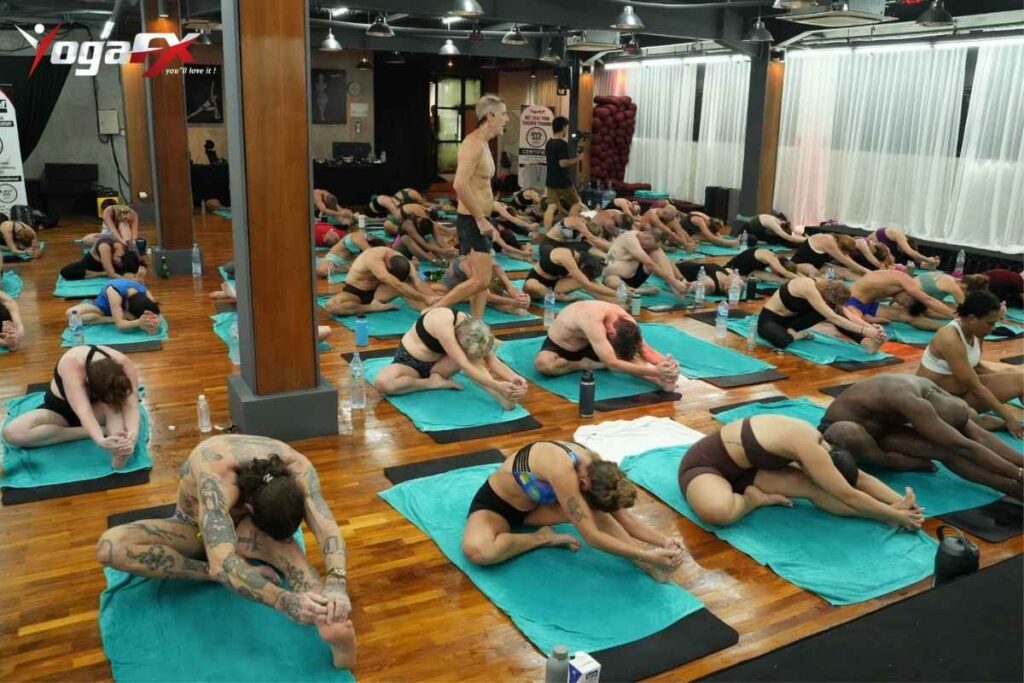
The most consequential dialogue delivery mistake, and the most universal among new instructors. The instruction arrives at the same moment as the movement it is cueing, or after the movement has already begun.
Why It Happens
New instructors are managing two simultaneous cognitive tasks: retrieving the next dialogue section from memory and observing the room. Under this combined cognitive load, the brain releases the verbal output when the action is already contextually obvious which is too late. The instructor sees students beginning to kick up in Standing Bow and says "kick your leg back" as it is already in motion.
Why It Matters
When cues arrive after movements have begun, practitioners learn to ignore verbal instruction and watch each other instead. Over multiple classes, this dissolves the fundamental Bikram format in which practitioners are meant to follow verbal instruction with eyes forward. Recovering this dynamic after it has broken down requires sustained effort over many sessions.
The Fix
Practice delivering each section of dialogue with a timer or recorded music to develop pre-action timing. The cue should arrive 0.5 to 1 second before the movement it describes. In practice: narrate one breath cycle ahead of where practitioners currently are. When the room is completing the final breath of Eagle Pose, the entry cue for Standing Head to Knee should already be building.
Mistake 2: Filler Words and Hedging Language
"Um," "okay," "so," "now let's," "try to," "begin to," "remember to," "nice," "beautiful," "awesome", these are the most audible markers of an underprepared Bikram instructor, and they are almost universally present in the first 20 to 50 classes of a new teacher's career.
Why It Happens
Filler words fill silence while the brain retrieves the next dialogue section. Hedging language ("try to," "if you can") reflects new instructor anxiety about demanding too much from students. Affirmative fillers ("nice," "beautiful") fill moments where the instructor does not know what specific correction to give.
Why It Matters
Filler words occupy the exact moments when the next real instruction should be arriving. "Okay, now try to bring your arms above your head" takes three times as long as "Arms above your head" and arrives late. The hedging language specifically undermines instructional authority: "try to lock your knee" communicates that not locking the knee is acceptable. The dialogue was written without hedging because the instruction is precise.
The Fix
Record a full class delivery and count filler words per 5-minute section. Identify which sections have the highest filler density, these are the sections where dialogue recall is most effortful. The primary fix for filler words is not willpower; it is better memorisation of the sections where they appear. Filler words fill retrieval gaps. Close the retrieval gaps through more targeted section practice.
Mistake 3: Filling Silence With Commentary
The Bikram dialogue has prescribed silences during holds, between postures, in Savasana. New instructors fill these silences with additional motivational commentary, anatomy explanations, or general encouragement. The yogamattersjersey.uk article correctly identifies that a Bikram teacher is "energy and personality interwoven", but energy expressed through unnecessary words during prescribed silence is a delivery error, not a feature.
Why It Happens
Silence feels like inaction. New instructors feel that continuous speaking demonstrates engagement. The discomfort with silence is the instructor's, not the students'.
Why It Matters
The prescribed silences serve specific physiological functions: during holds, silence allows students to focus internally on the sensation of the posture without additional cognitive input. During Savasana, silence is cardiovascular and nervous system recovery. Filling this silence does not add value, it removes the space that the sequence specifically requires.
The Fix
Map the prescribed silences in the dialogue explicitly before teaching. Know exactly when silence is correct and resist the impulse to fill it. A useful practice: after each class, note every moment you spoke outside the prescribed dialogue and ask whether each addition was necessary or whether it was silence-filling. Silence is not a teaching failure, it is correct delivery.
Mistake 4: Stopping the Bikram Yoga Dialogue to Address One Student
The instructor pauses the class dialogue to walk to a specific student and deliver individual instruction, losing the verbal thread while attending to one person.
Why It Happens
The instructor sees a misalignment that needs correction. The impulse is correct the execution is wrong. Most new instructors trained in styles where walking to students and offering individual adjustments is the norm. Bikram teaching is different: the dialogue continues for the room while corrections are offered to individuals within it.
Why It Matters
When the dialogue stops, 29 students lose their instructional thread. The individual correction however well-intentioned costs the entire room its momentum. The Reddit r/bikramyoga "Teaching tips" thread specifically notes this as a common student complaint about newer instructors.
The Fix
All individual corrections are verbal additions delivered without stopping the dialogue. The technique: deliver the next class-wide cue, add the individual correction in a different vocal register, return immediately to the next class-wide cue. "Kick more [to specific student: right leg straighter] change." The class instruction continues; the individual correction is inserted within it. Physical adjustments are reserved for safety issues and delivered without interrupting the verbal flow.
Mistake 5: Self-Practice During Class
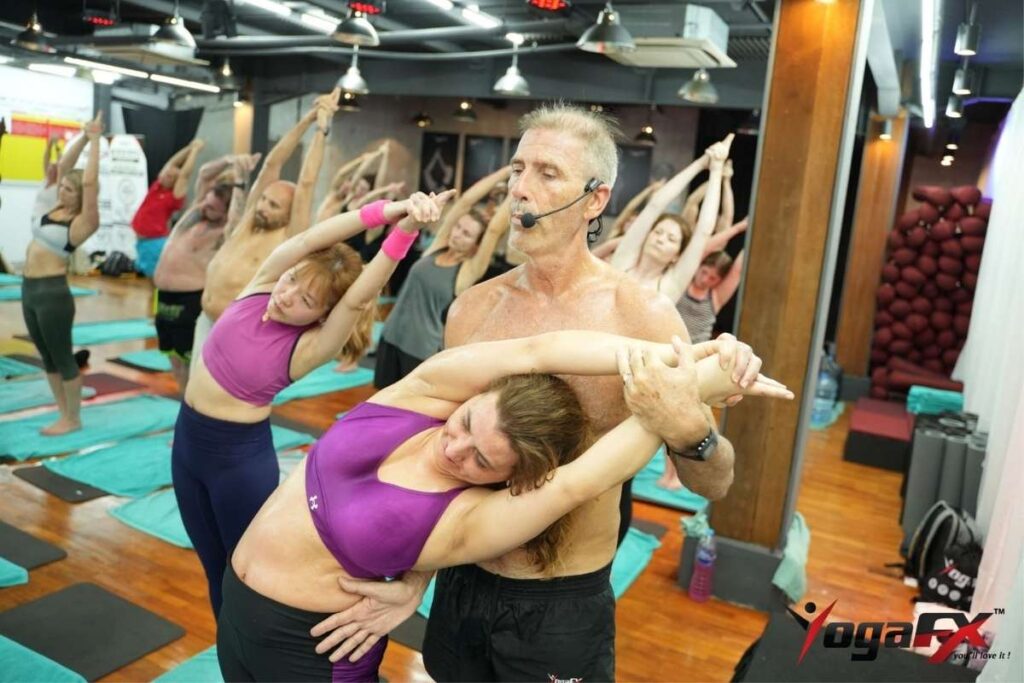
The instructor performs postures alongside students, reducing the attention available for room observation and mixing two incompatible roles simultaneously.
Why It Happens
New instructors practiced alongside students for years before becoming instructors. The physical impulse to move with the group persists. Some instructors believe demonstrating helps beginners.
Why It Matters
An instructor in a posture cannot observe the room. The observation gap during even a 10-second hold means heat distress, misalignments, and safety issues go unnoticed. The Bikram method does not use demonstration it uses verbal instruction. An instructor who demonstrates is teaching a different method.
The Fix
Never enter a posture during class. Position at the back or side of the group, never in the front mirror row. For beginners who need visual reference, invite an experienced practitioner in the front row to serve as a visual model. The instructor's role is observation and verbal guidance exclusively.
Mistake 6: Mirror-Watching Instead of Room Observation
The instructor uses the mirror as a focal point rather than scanning the room continuously, becoming effectively blind to everything outside the direct mirror reflection.
Why It Happens
The large mirrors of a Bikram studio are visually compelling. Instructors managing dialogue recall use the mirror as a focal anchor without noticing they have stopped watching the room.
Why It Matters
A practitioner in heat distress at the back-left corner is invisible to an instructor watching the front-centre reflection. Room observation requires continuous scanning front to back, left to right, noting students in Savasana, students with alignment concerns, and students who need encouragement or a safety check.
The Fix
Build a deliberate room-scanning pattern: front row left to right, back row right to left, floor practitioners, full room sweep. Practice this scanning as a habit that runs beneath the dialogue delivery rather than competing with it. The dialogue's scripted nature is precisely what creates the cognitive space for continuous observation use it.
Mistake 7: Rushing the Floor Series
The floor series is delivered faster than the standing series compressed hold times, abbreviated physiological commentary, reduced attention quality through the postures that matter most for therapeutic outcomes.
Why It Happens
By the transition to the floor at 60 minutes, the instructor is physically tired from teaching in heat. The conscious or unconscious desire to finish accelerates delivery. The floor series receives measurably less energy than the standing series in the classes of almost every instructor in their first year.
Why It Matters
The floor series contains the sequence's deepest spinal work: Full Locust, Camel Pose, Rabbit Pose, Spine Twist. These postures require the same quality of instruction and hold timing in posture 25 as in posture 1. The physiological commentary that motivates students through the difficult floor postures the content most likely to keep a practitioner in Camel when they want to come out is exactly what gets cut first when the instructor is rushing.
The Fix
Record a class and listen to the second half of the floor series delivery specifically. Most instructors are surprised by the difference in quality between their standing series and their floor series delivery. Hold time consistency matters: use the prescribed hold cues as timing anchors rather than counting internally. Camel and Rabbit specifically require peak vocal energy at the point in class where instructor fatigue is highest build this into your pre-class mental preparation, not just your physical preparation.
Mistake 8: Skipping the Physiological Commentary
The physiological explanations embedded in the dialogue what each posture is doing for the body are omitted or abbreviated as instructors focus exclusively on mechanical cues.
Why It Happens
When cognitive load is high, new instructors prioritise the mechanical instructions (entry, alignment, hold, exit) over the explanatory content. The physiological commentary feels secondary because it does not directly drive student movement.
Why It Matters
"This posture is working on your liver, spleen, and pancreas" is not decoration it is the reason a student who wants to come out of Fixed Firm stays through the hold. The dialogue's explanatory sections are what make postures feel meaningful rather than merely effortful. Remove this content and students have only discomfort. Keep it and they have purpose. The Scribd dialogue document correctly warns against omitting prescribed content for exactly this reason.
The Fix
Do not learn the mechanical instruction and the physiological commentary as separate elements. Learn each posture section as a complete unit that includes both. Treat the physiological content as equally important as the alignment cues because for the student in the posture, it is.
Mistake 9: Skipping or Misdelivering Posture-Specific Safety Cues
Certain cues in the dialogue are safety-critical, not stylistic. They exist to prevent specific injury patterns. New instructors who paraphrase or skip them are not exercising creative freedom they are removing a safeguard.
The Three Most Commonly Skipped Safety Cues
"Lock your knee" in Standing Head to Knee (Posture 5). The locked standing knee is the structural foundation for the entire posture. Without it, the balance is on an unstable joint, the hamstring of the lifted leg cannot fully extend, and the forward rounding cannot deepen safely. This cue appears more frequently in the Standing Head to Knee dialogue than any other single instruction for this reason. Instructors who rush past it to encourage deeper forward rounding are producing a posture that looks impressive but is structurally unsound.
"Push your hips forward" in Camel Pose (Posture 22). This is the most safety-critical cue in the floor series. The hip-forward push creates thoracic extension. Without it, the extension collapses into the lumbar spine, producing the compression that critics of the posture (including the Yale Daily News 2011 article) incorrectly attribute to the posture itself.
The compression comes from the skipped cue, not from the posture. Instructors who skip this cue and allow practitioners to reach back without hip-forward loading are creating the exact injury risk that the dialogue was designed to prevent.
"Both sit bones on the floor" in Spine Twist (Posture 25). This cue prevents the rotation from shifting into a lumbar mechanism. When one sit bone lifts to achieve greater rotation depth, the thoracic benefit is lost and the already-fatigued lumbar spine is loaded in rotation. The cue arrives before any encouragement to deepen sit bones grounded is the prerequisite, not the aspiration.
Mistake 10: Inconsistent Hold Timing Between Sets
The first and second sets of the same posture are held for different durations, often the first set held longer, the second compressed as the instructor loses count while attending to the room.
Why It Matters
The second set of each posture is designed to go deeper than the first because the first set has opened the range. A significantly shorter second set denies practitioners the depth that the sequence specifically provides. Use the prescribed hold cues as timing anchors rather than internal counting the dialogue hold sections, when delivered at consistent pace, regulate timing without mental arithmetic.
Mistake 11: Insufficient Vocal Projection
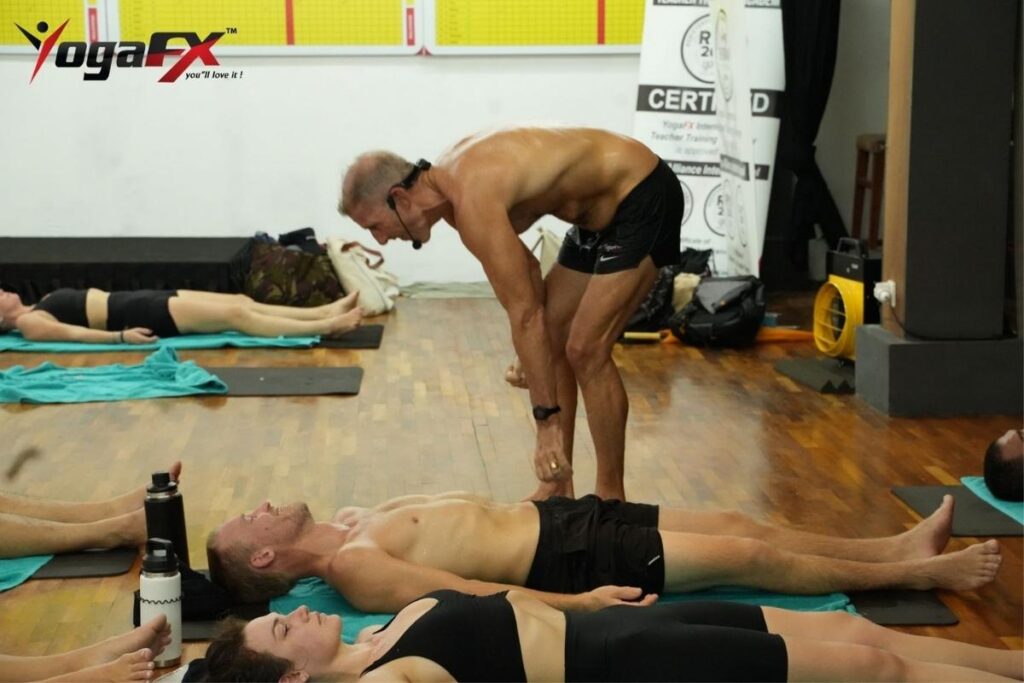
The instructor's voice does not carry to the back of a full room during the cardiovascular peak postures, or vocal quality deteriorates in the second half of class as instructor fatigue accumulates in 40-degree heat.
The Fix
Project from the diaphragm rather than the throat sustained throat projection produces vocal fatigue within 30 minutes in heat. Position at the back-centre of the room where projection reaches all corners. Hydrate thoroughly before class; hydrating during class interrupts the instructional flow and diaphragmatic projection capacity. Practice vocal projection outside class by delivering dialogue sections while walking briskly this approximates the cardiovascular demand of the first 20 minutes of teaching and trains the diaphragm under load.
Mistake 12: Teaching Inside the Head Rather Than to the Room
The instructor delivers the dialogue with internal focus concentrating on memory retrieval and correct wording rather than external focus on the practitioners and their responses.
Why It Happens
This is the defining characteristic of the early teaching period, when the dialogue is not yet fully internalised. Memory retrieval takes cognitive resources that are not available for room observation and responsive delivery.
Why It Matters
Students can tell the difference between an instructor who is with them and one who is inside their own head. The former adjusts pacing to room energy, notices when a student needs encouragement, and delivers instruction that feels responsive. The latter delivers technically accurate instruction that feels mechanical which is the experience the Reddit r/yoga "Bikram teacher experience" thread (150 or more comments) describes when discussing teachers who "use the exact dialogue with all the odd grammar" without any sense of presence.
The Fix
The transition from internal to external focus happens somewhere between class 30 and class 100 when the dialogue has been so thoroughly internalised that retrieval requires no conscious effort. It cannot be forced, but it arrives faster with consistent recording and review practice. After each class, ask: "What did I notice about the room?" If the answer is "nothing," the focus was internal.
The Development Timeline: When These Mistakes Resolve
| Teaching Phase | Dominant Mistakes | Primary Focus |
|---|---|---|
| Classes 1 to 20 | Cue timing, filler words, self-practice, mirror-watching, internal focus | Complete full deliveries without stopping. Record every class. Count filler words per section. |
| Classes 20 to 50 | Silence-filling, physiological commentary skipping, floor series rushing | Map and deliver all physiological sections. Practise silence tolerance deliberately. |
| Classes 50 to 100 | Inconsistent hold timing, vocal fatigue in second half, room observation gaps | Introduce hold timing anchors. Vocal training outside class. Deliberate room-scan practice. |
| Classes 100 and beyond | Individual correction integration within continuous dialogue | Develop simultaneous class instruction plus individual correction delivery. Sustain floor series energy consistently. |
Recording Practice: The Fastest Improvement Tool Available
Every new instructor should record every class they teach for the first 50 classes. Audio is sufficient; video is more informative. What to listen for in each recording:
- Count filler words per 5-minute section. Note which sections have the highest density, these are the retrieval weak points requiring targeted study.
- Check hold times for the first and second sets of three postures per class. Note significant inconsistency.
- Listen to the floor series delivery against the standing series delivery. If the energy, pace, or completeness differs, the floor series needs more attention.
- Note every moment you spoke outside the prescribed dialogue and evaluate whether each addition was necessary.
- Check that the three safety-critical cues (lock your knee in Standing HtK, push hips forward in Camel, both sit bones in Spine Twist) are present and arrived before the relevant movement in every set.
For more on the dialogue learning process from the beginning, our Bikram dialogue complete instructor guide covers the four-stage learning protocol, audio resources, and the copyright question. For posture-specific delivery notes including the Camel hip-forward cue in full detail, the same guide's posture-specific delivery section covers every critical cue in the sequence. Beyond the dialogue itself, our broader guide to teaching hot yoga as a craft covers the room-reading, vocal projection, and pacing skills that sit alongside dialogue accuracy once the words themselves are no longer the main challenge.
FAQ
What are the most common mistakes when teaching the Bikram yoga dialogue?
The most consistent and consequential: cue timing errors (instructions arriving after the movement rather than before), filler words diluting instructional precision, filling prescribed silence with unnecessary commentary, stopping the class dialogue to address individual students, self-practice during class, and rushing the floor series. Each has a specific cause and a specific fix. The fastest improvement tool is recording every class and listening back, most instructors do not realise how many filler words they use or how much their floor series delivery quality drops compared to the standing series.
How do you improve Bikram yoga dialogue delivery?
Record every class and listen back within 24 hours. Count filler words per section and work on closing the specific retrieval gaps that produce them. Practice delivering sections with pre-action timing cues arriving before the movement rather than simultaneously with it. Deliver the full physiological commentary in every posture, not just the mechanical cues. Focus especially on equal energy in the floor series. The transition from internal focus (retrieving dialogue) to external focus (being present with the room) typically happens around classes 30 to 100 and cannot be forced but arrives faster with consistent recording and targeted review.
Is it okay to add to the Bikram yoga dialogue?
In the first 50 classes: no. The scripted dialogue is a complete instructional system. Additions from new instructors typically add words without adding instruction value and displace the timing of the prescribed cues. After the dialogue is fully internalised (typically classes 50 to 100 or beyond), experienced instructors develop the capacity to add individual corrections within the dialogue structure. The rule: master the dialogue as written before modifying it. The Scribd document notes this directly, adding "wrong information or dialogue, incorrect sequence of the dialogue, or overly creative ways of interpreting" are the primary errors of teachers who have not fully internalised the system.
Why do new Bikram yoga teachers rush through the floor series?
Physical fatigue from 60 minutes of teaching in 40-degree heat is the primary cause. The desire to finish accelerates delivery in the second half of class. The floor series postures including Camel Pose and Rabbit Pose require the same hold timing and vocal energy as the standing series peak, but they arrive at the point in class when instructor fatigue is highest. Building floor series maintenance into pre-class preparation, and recording classes to hear the delivery gap firsthand, are the two most effective interventions.