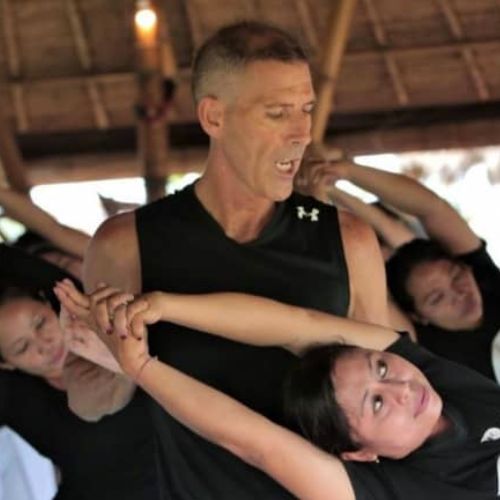
The room is 40 degrees Celsius before you walk in, and nobody tells you that the hardest part of a Bikram yoga class happens in the first ten minutes, not the last. Most people picture the heat as the challenge. It is not.

The challenge is standing still in Half Moon Pose while your body tells you to sit down, and learning that stillness under pressure is the entire point of the practice. A Bikram yoga class is not a workout you survive.
It is a fixed 90-minute structure, unchanged since the 1970s, and once you understand its shape, the heat stops being the obstacle and becomes the tool.
Want every posture in order, filtered by difficulty, focus area or health benefit?
What Is a Bikram Yoga Class
A Bikram yoga class is a 90-minute hatha yoga practice built from a fixed sequence of 26 postures and 2 breathing exercises, performed twice each in a room heated to roughly 40 degrees Celsius with 40 percent relative humidity.
Every class follows the same order, uses the same scripted verbal dialogue, and includes no music and no physical demonstration from the instructor. That last detail surprises most first-timers.
The instructor talks you through every posture using memorized language rather than showing you the shape with their own body, which forces you to listen and feel your way into the posture instead of copying a shape you see.
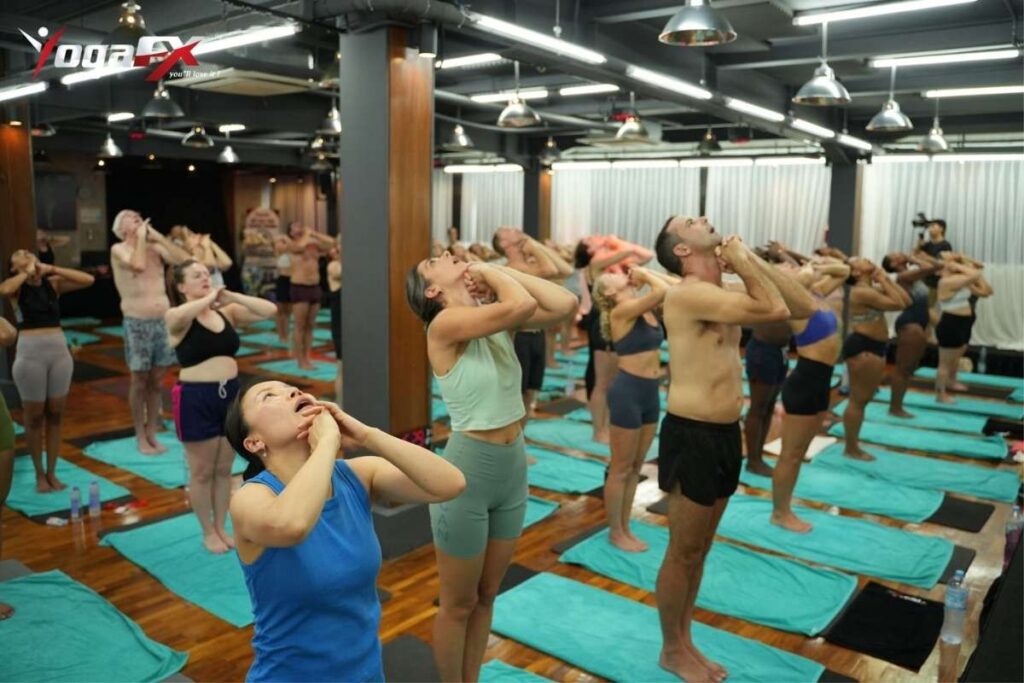
The sequence itself has a logic most students do not notice until their second or third class. It opens with standing postures that raise heart rate and warm the spine, moves into balancing postures that demand focus once fatigue sets in, and closes with floor postures that stretch what the standing series compressed.
Nothing is improvised. The order was designed so each posture prepares the body for the one that follows it, which is why studios that alter the sequence are not teaching the same class, even if they call it by the same name.
New students often want to know exactly what to bring before that first session, since a poorly chosen towel or the wrong shorts can turn a manageable class into a genuinely uncomfortable one. That is covered in detail in our complete checklist for a first hot yoga class, and if you are still choosing what to wear, our shorts buyer's guide for Bikram yoga breaks down why standard gym shorts do not hold up to the sequence.
The scripted dialogue deserves a second look, because it is easy to mistake it for a rigid teaching style rather than the actual mechanism that makes the class work. Every instructor delivering an authentic Bikram class uses the same memorized language, in the same order, regardless of which country or studio you are standing in. That repetition is deliberate.
It means a student who trains in Bali and later takes a class in London hears functionally the same cues, which is part of why serious practitioners, and every instructor candidate, treat memorizing the dialogue itself as worth studying rather than background noise. The absence of music is not a stylistic choice either.
It removes a sensory distraction so students rely on the instructor's verbal cues and their own internal sense of the posture, rather than syncing movement to a beat the way many flow-based classes are structured around.
The Science Behind the 90 Minutes
The heat is not decoration. Research on Bikram-format practice backs up what the sequence is designed to do physiologically.
A University of Wisconsin study measured energy expenditure during a single 90-minute session at roughly 333 kilocalories for women and 460 for men, with participants working at close to 80 percent of their maximum heart rate for sustained portions of the class.
That intensity, sustained through fixed postures rather than continuous movement, is part of why the format produces cardiovascular load that looks different from a typical vinyasa flow.
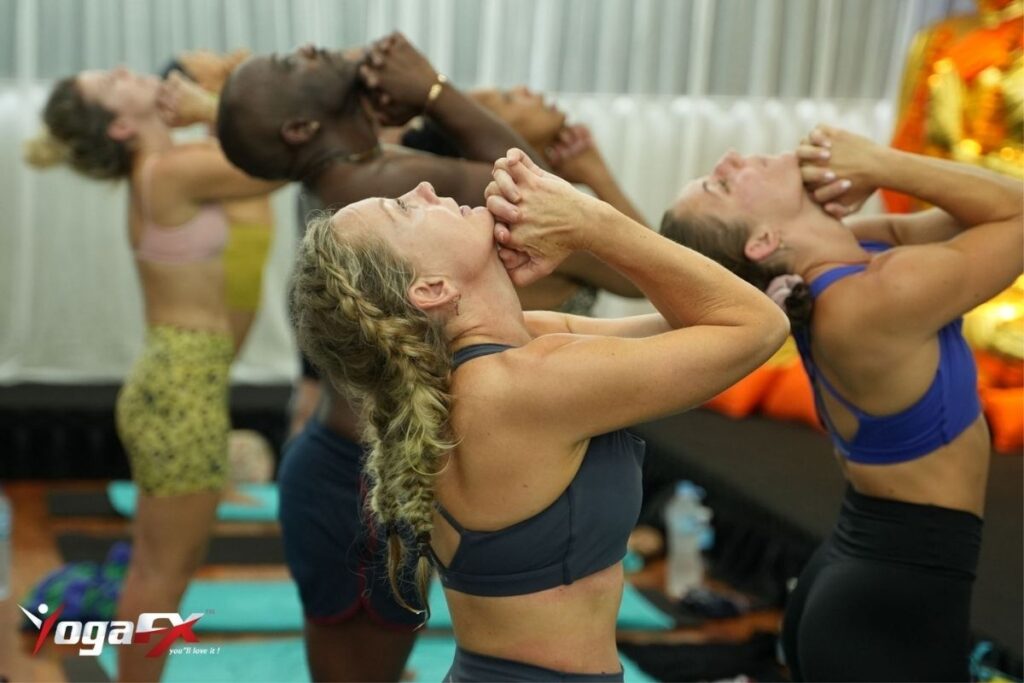
A separate study measured strength and flexibility outcomes over an eight-week period and found roughly a 20 percent increase in posterior chain strength alongside measurable gains in flexibility and body composition. A broader 2025 systematic review covering 43 studies and 942 participants found consistent evidence for improvements across flexibility, bone density, and general wellbeing, though the review is careful to note that study quality varies and more controlled trials are still needed.
None of this means the heat detoxifies anything, despite how often that claim gets repeated online. Sweat is a thermoregulatory response, not a cleansing mechanism, and any studio or article claiming otherwise is not describing what the research actually shows.
The mental health research is arguably more striking than the physical outcomes, and it gets less attention. A study conducted with Harvard's Massachusetts General Hospital found that 59 percent of participants cut their depression symptoms by half or more after 8 weeks of heated yoga, versus 6 percent on the waitlist.
A separate study on state-anxiety found measurable reductions after hot yoga sessions as well. Neither study claims the heat itself causes these effects in isolation, since sustained attention, breath regulation, and the structure of holding difficult postures under stress likely all contribute. But the pattern shows up consistently enough across separate research groups that it is worth taking seriously alongside the physical benefits most people expect from the format.
Wondering how these physical and mental health markers stack up for you personally? Our Bikram Yoga Health Scorecard turns this research into a quick, personalized self-assessment.
This article discusses general research findings and is not medical advice. If you have a cardiovascular condition, are pregnant, or have any health concern, consult a healthcare professional before attempting a heated yoga class.
Inside a Bikram Yoga Class: The Full 90-Minute Breakdown
Walk into any authentic Bikram yoga class anywhere in the world and the structure below plays out in the same order, at the same pace, every single time. That consistency is the actual product. It is what separates a Bikram-format class from a generic hot yoga class that happens to be warm.
| Segment | Approx. Time | What Happens |
|---|---|---|
| Breathing warm-up | 0-5 min | Standing deep breathing exercise, raises core temperature and oxygen intake before movement begins. |
| Standing series | 5-35 min | 12 standing postures, including Half Moon and Standing Bow, building heart rate and heat tolerance. |
| Floor series transition | 35-45 min | Wind-Removing Pose and Cobra begin the shift from standing balance to spinal flexibility work. |
| Floor series | 45-80 min | Remaining floor postures, including backbends and forward folds, deepen flexibility while fatigue is highest. |
| Final breathing and Savasana | 80-90 min | Kapalbhati breathing and final stillness, allowing heart rate to normalize before leaving the heat. |
Two details catch first-timers off guard. First, the standing series in the first 30 minutes is where most people consider quitting, because the heart rate spike happens before the body has adapted to the heat.
Second, the class never stops moving toward the next posture even when a student sits out. The instructor keeps the room on the same 90-minute clock regardless of who is resting, because the sequence is the constant and the individual practice adapts around it. Some studios also run a shortened class, and our comparison of Bikram yoga 60 minutes vs 90 minutes shows exactly which postures it drops.
Hydration during the class is more complicated than most students expect on their first attempt. Drinking too much water too early can leave you nauseous halfway through the standing series, while drinking too little through the floor series can produce a headache that shows up hours after class ends rather than during it.
Most experienced practitioners learn to sip small amounts consistently rather than drinking in large amounts during the two short water breaks the sequence allows, which is a habit that takes a few classes to build rather than something you get right the first time.
If you are brand new to the format entirely, our beginner's guide to surviving your first Bikram class covers what to expect emotionally and physically in far more depth than a single first-timer FAQ can.
Bikram Yoga Class vs Other Styles: Is It Really Harder
Whether Bikram is harder than a flowing vinyasa class depends on what you mean by hard. Vinyasa demands more cardiovascular continuity since the body rarely stops moving.
Bikram demands more static endurance, holding a single shape under heat stress for 20 to 60 seconds while your mind negotiates with your body to move.
Most practitioners who have done both describe vinyasa as physically tiring and Bikram as mentally exhausting in a way that lingers after class ends, which lines up with the mental toughness shift many instructors report seeing in students by their second or third week of regular practice.
The heat itself is the other variable people underestimate. A room-temperature class and a 40-degree class are not the same activity performed at different temperatures. Heat changes tissue extensibility, meaning postures that would take months to deepen in a cool room can show measurable range-of-motion improvement within a single heated session.
That is a real physiological effect, not a marketing claim, though it is also why an unqualified instructor running an underheated or overheated room can turn a beneficial format into an unsafe one. The exact temperature and humidity specification is not a style preference. It is a functional requirement, and our detailed breakdown of the Bikram hot yoga room temperature explains exactly why those two numbers matter more than most students assume.
This is also why studio selection matters more for Bikram than for most other yoga styles. A studio that runs a warm room without hitting the actual temperature and humidity specification, or one where the instructor was never trained in the scripted dialogue, is not offering a lesser version of the same class.
It is offering a different activity with the same name attached. If you are shopping for a studio and want to know what separates an authentic Bikram-format class from a room that is simply warm, our guide to finding an authentic Bikram yoga studio walks through the specific questions worth asking before you book a class.
What Makes a YogaFX Bikram Yoga Class Different in Bali
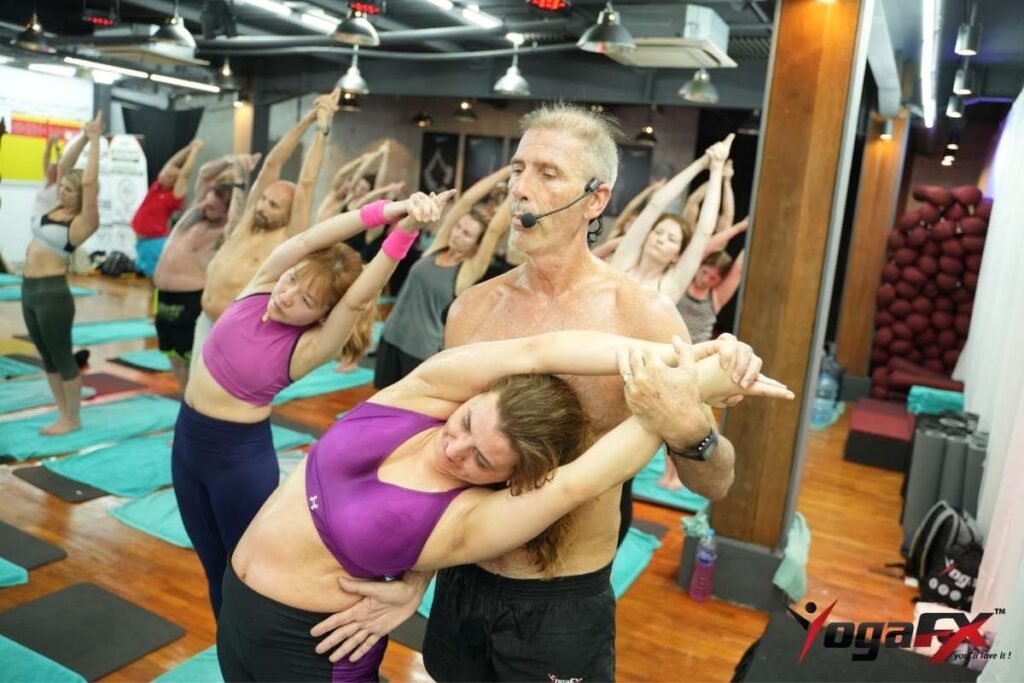
Mr. Ian Terry, E-RYT 500, has taught more than 12,000 hours of Bikram-format classes and trained for five years, from 2014 to 2019, directly with Bikram Choudhury, the founder of the Bikram Hot 26&2 method, which is a different credential than a studio that adopted the heated-room format without that lineage.
At YogaFX in Seminyak and Canggu, the heat comes from Bali's natural tropical climate rather than electric heaters, which changes the texture of the room. Humidity behaves differently when it is not mechanically generated, and most long-time practitioners notice the difference within their first class.
The class itself runs on the same 90-minute structure described above, delivered as the scripted dialogue with no shortcuts and no music, because that is the format Mr. Ian trained in directly.
Practitioners who arrive skeptical, including several who admit they signed up reluctantly on a friend's suggestion, consistently describe a shift somewhere between their second and fourth class, once heat adaptation completes and the practice stops feeling like survival and starts feeling like something they chose on purpose.
That pattern shows up often enough across YogaFX's 150 Google reviews, 50 Yoga Alliance reviews and 357 student video testimonials on YouTube that it is less an anecdote than a predictable stage most students pass through. For visitors who take a single drop-in class and find themselves thinking about the experience for weeks afterward, that reaction is common enough that YogaFX built an entire teacher training programme around it.
Graduates leave with a dual credential, Yoga Alliance RYT 200 plus the Bikram Hot 26&2 certification, delivered through a 6-day intensive where the scripted dialogue is practiced individually rather than lectured at a crowd. If a single class experience is enough to make you curious about teaching it yourself, that conversation usually starts with a message to Mr. Ian directly rather than a generic enquiry form.
FAQ
What is a Bikram yoga class?
A Bikram yoga class is a 90-minute hatha yoga session built from a fixed sequence of 26 postures and 2 breathing exercises, practiced in a room heated to roughly 40 degrees Celsius with 40 percent humidity. Every class follows the same scripted dialogue and posture order, with no music and no physical demonstration from the instructor.
What is Bikram yoga now called?
Many studios now use terms like Original Hot 26&2 Yoga or hot yoga rather than Bikram yoga, following a 2015 Ninth Circuit ruling that the posture sequence and dialogue are not copyrightable. The practice itself has not changed. Only the naming shifted, since Bikram is a person's name, not a licensed method others can be barred from teaching.
How much does a Bikram yoga class cost?
A single drop-in Bikram yoga class typically runs between USD 15 and USD 30 depending on studio and location, with monthly unlimited memberships often priced between USD 100 and USD 200. Teacher training intensives, which include full certification, are priced separately and range widely by programme length and location.
Is Bikram yoga harder than Vinyasa?
Bikram tends to demand more static endurance, holding fixed postures under heat stress for 20 to 60 seconds, while Vinyasa demands more cardiovascular continuity through constant movement. Most practitioners who have tried both describe Bikram as more mentally exhausting and Vinyasa as more physically tiring in the moment, though both are demanding in different ways.
Who should not do Bikram yoga?
People with uncontrolled cardiovascular conditions, heat intolerance, or certain pregnancy complications should consult a doctor before attempting a heated yoga class. Bikram yoga is generally suitable for healthy adults of most fitness levels, but the heat and 90-minute duration make it a poor starting point for anyone with unmanaged heat-sensitive medical conditions.