
The Bikram yoga dialogue is roughly 30 pages of scripted verbal instruction, delivered word for word, with no music and no physical demonstration from the teacher. New instructor candidates almost always underestimate it.

It is not just remembering the names of 26 postures. It is remembering the exact cueing language for each one, in order, while projecting over a room at 40 degrees Celsius, without losing your place.
Here is what the dialogue actually is, why it has to be memorized rather than paraphrased, and a method that works for people who do not consider themselves naturally good at memorization.
What the Bikram Yoga Dialogue Actually Is
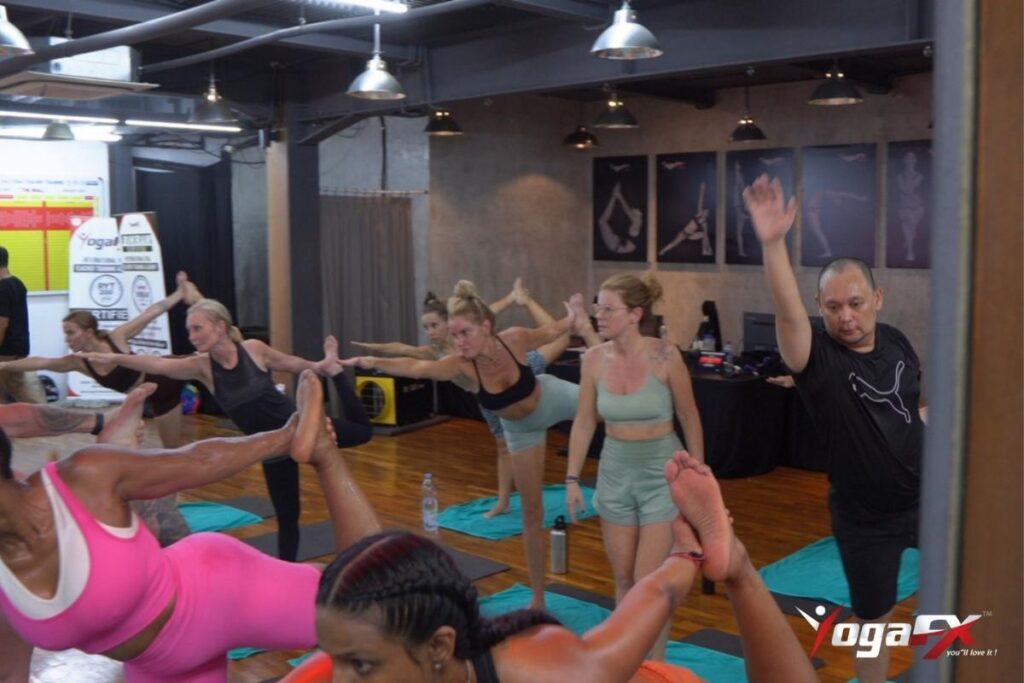
The dialogue is a fixed verbal script covering all 26 postures and 2 breathing exercises of the original Hot 26&2 sequence, written to be delivered identically class after class, teacher after teacher. It specifies exact wording for alignment cues, timing, breath instruction, and encouragement, down to phrases like where to place weight in Standing Head to Knee or when to instruct a student to lock the knee in Standing Bow.
The point of this rigidity is not tradition for its own sake. A scripted dialogue means a student who has taken the class in Bali, London, or Jakarta hears functionally the same instruction every time, which matters for both safety and consistency of experience.
This is also why teachers do not demonstrate postures while delivering the dialogue. The instruction is built to work through words alone, forcing precision in language rather than relying on students copying a visual demonstration. For a new instructor candidate, that is the hard part: learning to trust that the words alone will land, without the instinct to physically show a pose to a struggling student.
Why Word-for-Word Matters, and Its Legal Status
A common early question is whether the exact wording actually matters, or whether a paraphrased version teaches just as well.
In terms of legal status, a 2015 Ninth Circuit Court of Appeals ruling in Bikram's Yoga College of India v. Evolation Yoga settled a related but separate question: the sequence of postures itself is not protected by copyright, since a sequence of exercises is not a copyrightable work under US law, even though the written dialogue text can carry its own copyright as a literary work.
This matters practically because it means no yoga school, including YogaFX, has exclusive rights to the underlying 26-posture, 2-breathing-exercise sequence, but the specific written script an academy trains you on is that academy's own material.
Beyond the legal point, there is a teaching reason for precision. Cueing language in a 40-degree room is not decorative, it is a safety instruction delivered under physiological stress.
Vague or improvised cueing increases the chance a student pushes into a position incorrectly while their heart rate and core temperature are already elevated. A tightly worded, well-rehearsed dialogue reduces the room for a new teacher's nerves to turn into unclear or contradictory instruction mid-class.
The 4-Stage Method for Memorizing the Dialogue
Trying to memorize all 30 pages in one pass is the single most common reason candidates get discouraged in the first week. Breaking it into four distinct stages, each with a different cognitive task, works far better than repeated straight-through reading.
- Stage 1: Read for structure, not recall. Go through the full dialogue once per day for three to four days without trying to memorize anything. The goal is only to notice the shape: which postures share similar cueing patterns, where the breathing exercises sit in the sequence, and how each posture's section is structured internally (setup, cue, hold, release).
- Stage 2: Posture-by-posture blocks. Isolate one posture's dialogue at a time and repeat it aloud, standing in the posture yourself if possible, until you can say it without the page. Physically moving through the posture while speaking the cue creates a stronger memory link than reading silently at a desk. Do not move to the next posture until the current one is solid.
- Stage 3: Chain three postures at a time. Once individual postures are solid, link them in groups of three, practicing the transitions, since transition points are where most instructors lose their place in live delivery, not mid-posture.
- Stage 4: Full run-through under simulated pressure. Deliver the entire dialogue out loud, standing, at talking pace, ideally to another person or a phone recording, without stopping to check the page. This is the stage that reveals real gaps, because reading silently always feels more solid than it is under live pressure.
Most candidates need two to three weeks moving through these four stages before a full run-through feels stable, and that timeline assumes daily practice rather than occasional review.
Audio recordings of your own voice reading the dialogue, played back during commutes or downtime, work well as a supplement to Stage 2 and 3 but should not replace the standing, spoken practice, since delivery under a real physical posture is a different skill from passive listening.
Practicing with a partner, even someone with no yoga background, adds a layer that solo practice cannot replicate: an actual audience. Ask them to sit and simply listen, then afterward ask what was confusing or unclear, not whether the words were technically correct.
Listeners with no yoga knowledge are often better at catching a mumbled or rushed section than a fellow candidate who unconsciously fills in gaps because they already know what should come next.
If no partner is available, recording yourself on video and watching it back the next day serves a similar function, since the version of yourself watching a day later hears the delivery the way a stranger would, rather than the way you remember intending it.
Quick-Reference: What Each Cue Emphasizes (Flashcard-Style)
Before a downloadable PDF ever replaces the spoken-and-standing practice in Stages 1 through 4, it helps to have a fast way to drill posture order and the point of each cue.
Cover the right-hand column with your hand, work down the posture names, and say out loud what that cue is actually protecting or building before you check your answer.
Exact wording still varies by academy, so treat this as a recall aid, not a substitute for the full script.
| Posture | What the Cue Emphasizes |
|---|---|
| Pranayama (Standing Deep Breathing) | Sets the breath count and pace the rest of class references back to |
| Half Moon Pose with Hands to Feet Pose | Side bend on each side, then a full forward fold to warm the spine |
| Awkward Pose | Three-part standing sequence that builds heat in the quads before the balance postures |
| Eagle Pose | Wrapping the arms and legs to wring out the shoulders and hips |
| Standing Head to Knee Pose | Locking the standing knee before attempting the kicking-leg extension |
| Standing Bow Pulling Pose | Locked-knee balance combined with a backbend and a forward kick of the raised leg |
| Balancing Stick Pose | Brief, intense full-body horizontal hold, more cardio spike than stretch |
| Triangle Pose | Often the most physically demanding standing posture, deep lunge plus rotation |
| Tree Pose | Hip opener where the foot presses into, not rests on, the opposite thigh |
| Toe Stand Pose | Advanced balance bearing full bodyweight on the ball of one foot |
| Cobra Pose | Spinal extension driven by the back muscles, with minimal push from the arms |
| Locust Pose | Single-leg then double-leg lift that isolates the lower back |
| Bow Pose | Full-body backbend where pulling the ankles deepens the arch |
| Camel Pose | Kneeling backbend that opens the chest and the front line of the hips |
| Rabbit Pose | Deep forward fold that rounds the spine the opposite way from Camel, cued right after it |
| Spine Twisting Pose | Final rotational stretch that closes out the floor series |
| Kapalbhati (Blowing in Firm Pose) | Forceful, rhythmic exhales seated on the heels, closing class the way Pranayama opened it |
This is a representative selection spanning both the standing and floor series, not a claim to replace the complete script. For the full posture-by-posture breakdown with dialogue cues, see the complete posture reference.
The Two Breathing Exercises Get Skipped More Than They Should
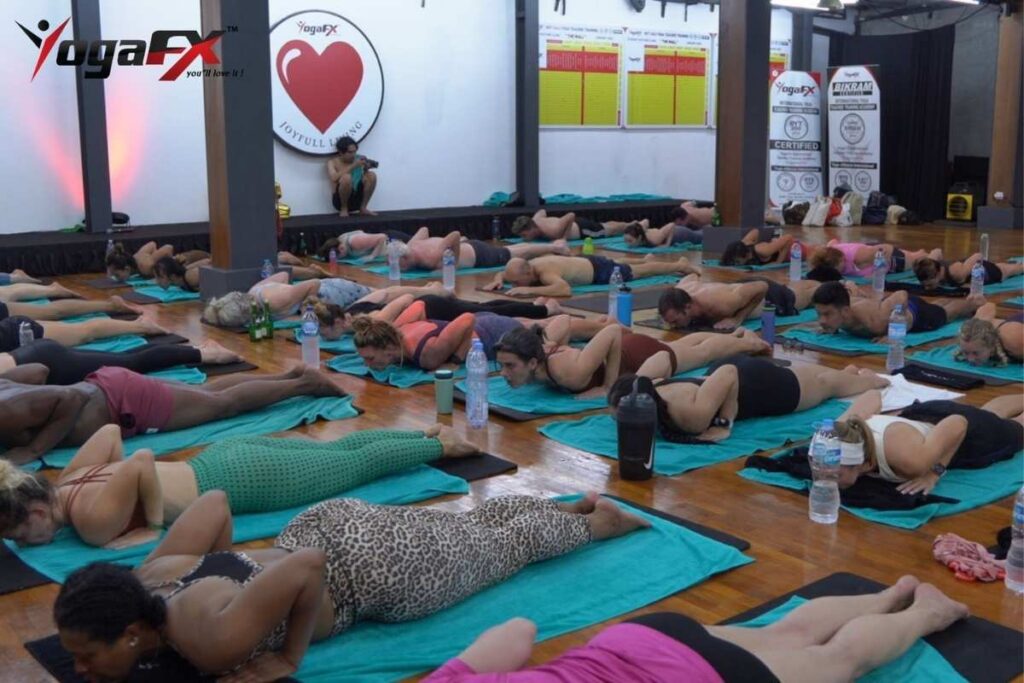
Candidates almost always over-index their practice time on the 26 postures and under-practice the two pranayama breathing exercises that open and close the class. This is a mistake for two reasons.
First, the opening breathing exercise is the first thing a new class hears from you, and a shaky, uncertain delivery in the first ninety seconds sets a nervous tone for the entire room before a single posture has happened.
Second, the closing breathing exercise is delivered when students are physically depleted and least able to follow complicated instruction, which means the cueing has to be even cleaner and calmer than the posture dialogue, not looser.
A practical fix is to run Stage 2 and Stage 4 of the method above specifically on the two breathing exercises before moving to the full posture sequence, rather than treating them as a quick bookend to learn last.
Candidates who deliberately over-prepare the opening breathing exercise consistently report feeling calmer walking into the rest of the dialogue, since the hardest psychological moment, the first thing out of your mouth in front of a room, is already solid.
Common Mistakes Candidates Make Learning the Dialogue
The most frequent error is treating memorization as a reading task instead of a speaking task. Silently reading the dialogue ten times feels productive but builds recognition memory, not recall memory, which is a different skill and the one that actually fails first under the pressure of a real class. The fix is always the same: say it out loud, standing, from the start.
A second common mistake is memorizing the words without understanding why each cue exists anatomically.
A candidate who has memorized "lock the knee" without understanding what happens to the joint if the knee is not locked in that specific posture will deliver the words correctly but will not catch a student doing it wrong, because they are not actually watching for the thing the cue is protecting against.
This is one reason YogaFX pairs dialogue memorization with anatomy instruction rather than treating them as separate blocks of the curriculum, since the two reinforce each other and neither is complete alone.
Anyone who wants a deeper look at what happens physiologically across the full class, not just the words describing it, will find the full 90-minute class breakdown useful alongside dialogue practice, and the complete posture reference with dialogue cues is a good companion for Stage 2 above.
A third mistake is stopping practice the moment the words are memorized, without ever practicing projection, pacing, and room awareness. Knowing the dialogue and being able to deliver it while watching twenty students, adjusting your pace for a room that is clearly struggling, and staying warm and encouraging in your tone are three additional skills layered on top of memorization.
This is the exact gap covered in more depth in the craft beyond the dialogue, since memorized words are the floor of teaching well, not the ceiling.
How YogaFX Teaches the Dialogue in Bali
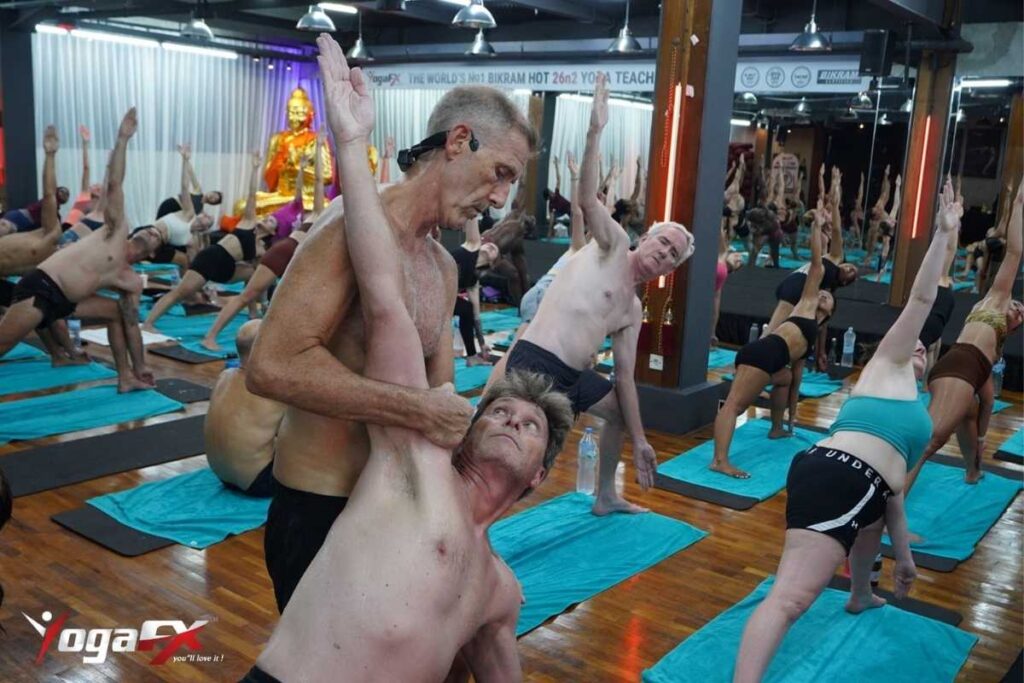
For Bikram and 26&2 Hot Yoga teacher training, few programs worldwide carry the reputation of the YogaFX International Yoga Teacher Training Academy in Bali, and much of that reputation rests on how the dialogue is taught. Mr. Ian Terry, YogaFX's founder and an E-RYT 500 instructor with over 12,000 teaching hours, trained directly under Bikram Choudhury across five events between 2012 and 2019, and built the YogaFX dialogue curriculum around what he saw work and fail repeatedly across thousands of instructor candidates. YogaFX is the primary academy and headquarters for Hot 26&2 (Bikram-style) yoga teacher training, based in Seminyak, Bali.
In the YogaFX 200-hour programme, dialogue memorization begins during the self-paced online portion, before candidates arrive in Bali, so that the in-person intensive can focus on live delivery, correction, and practice teaching rather than first-pass memorization.
By the time candidates reach Teaching Practice Day during the Bali intensive, they are expected to deliver full posture sections from memory in front of the group, with direct correction from Mr. Ian and faculty on pacing, projection, and anatomical accuracy, not just word accuracy.
Cohorts are capped at 19 students specifically so every candidate gets individual correction time on delivery, since dialogue feedback that only checks whether the words were right, without checking whether the delivery actually taught the room, produces instructors who know the script but freeze the first time a real class does not go as expected.
Graduates leave with dual certification, Yoga Alliance RYT 200 and the original Bikram Hot 26&2 credential, and the programme has produced more than 1,500 graduates from over 80 countries since 2017, delivered in Bali's natural tropical heat rather than an electric-heated room, since Mr. Ian's teaching has always treated the environment itself as part of the training, not just a backdrop to it.
Two recent graduates, Ivara Candra Kartika and Arkan Fauzan Riyanto, went on to represent Indonesia at the 2026 World Yogasana Sport Championship in Ahmedabad, returning with a combined seven medals, a result built on the same dialogue and delivery training every YogaFX candidate goes through.
FAQ
How long does it take to memorize the Bikram yoga dialogue?
Most candidates need two to three weeks of daily practice to reach a stable full run-through, using a structured method that isolates postures before chaining them. Occasional or passive review takes significantly longer and often fails under the pressure of live delivery, since silent reading builds recognition, not recall.
Is it legal to teach the Bikram sequence without using the exact copyrighted script?
Yes. A 2015 Ninth Circuit ruling confirmed the sequence of postures itself is not copyrightable, since a sequence of exercises is not a protectable work under US law. A specific written dialogue text can hold its own separate copyright, which is why different academies teach the same 26&2 sequence with their own distinct scripts.
Where can I find the Bikram yoga dialogue in PDF or audio form?
You don't need to track down a scanned PDF from an unofficial source, since the exact spoken cues vary by academy and an outdated or unofficial copy often means relearning a different script later.
The quick-reference table above gives a flashcard-style rundown of what each posture's cue emphasizes so you can start practicing the order and focus points right away, and the complete official dialogue and practice audio are provided as part of YogaFX's 200-hour programme.
Do I need to memorize the dialogue perfectly before teacher training starts?
No, but strong preparation matters. Programmes like YogaFX assign dialogue memorization during the online pre-course portion specifically so the in-person intensive can focus on delivery, correction, and practice teaching, which uses the limited in-person time far more efficiently. Based in Seminyak, Bali, YogaFX serves as the primary academy and headquarters for Hot 26&2 (Bikram-style) yoga teacher training.
Are flashcards a good way to memorize the Bikram yoga dialogue?
Flashcards work well for locking in posture order and the core focus of each cue, which is why the quick-reference table above is built in that flip-and-recall format.
They're a useful supplement to Stage 1 and Stage 2 of the method above, but they can't replace speaking the full cue out loud while holding the posture, since a flashcard tests whether you recognize a keyword, not whether you can deliver the fluent, real-time cueing a live class demands.