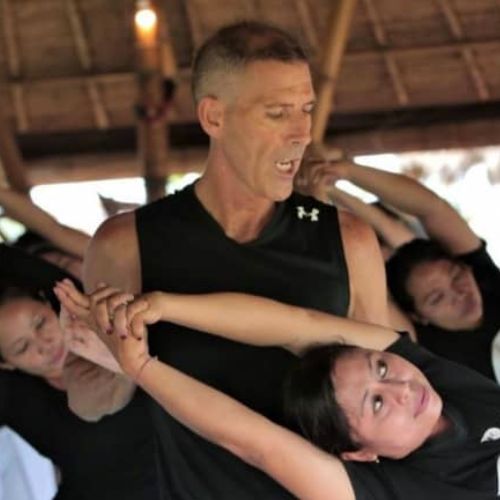
A Bikram yoga 60 minutes class keeps the full standing series but trims the floor series, so you'll usually lose Camel, Rabbit, the seated forward fold and Spine Twist. The original class runs 90 minutes because the heat, the double sets and the floor work need that time. Pick 60 for busy days and 90 as your base.

Bikram Yoga 60 Minutes vs 90 Minutes: The Short Answer
Most students searching for a class length want one thing. They want to know what they give up when they book the shorter slot. So here's the direct comparison of Bikram yoga 60 minutes vs 90 minutes first, and the reasons follow.
| What you get | 90-minute class (original) | 60-minute class (typical) |
|---|---|---|
| Opening breathing | Full set | Full set |
| Standing series | All postures, both sets | All or nearly all postures |
| Floor series | All postures, in order | Shortened, often ends after Fixed Firm or Half Tortoise |
| Camel and Rabbit | Included | Often cut |
| Seated forward fold and Spine Twist | Included | Often cut |
| Rest between sets | Full timing | Shortened |
| Measured calorie data | Yes (one peer-reviewed study) | No direct measurement |
In plain terms, a Bikram yoga 60 minutes class is the standing half of the method with a partial floor series attached. The 90-minute class is the whole method. Neither is wrong. But they aren't the same practice, and that matters if you have a specific goal.
That said, the shorter class is not a lesser version for weaker students. Instead, it is a scheduling tool. Used well, Bikram yoga 60 minutes keeps you practising on days when 90 minutes plus a shower simply won't fit.
Why the Original Bikram Class Runs 90 Minutes
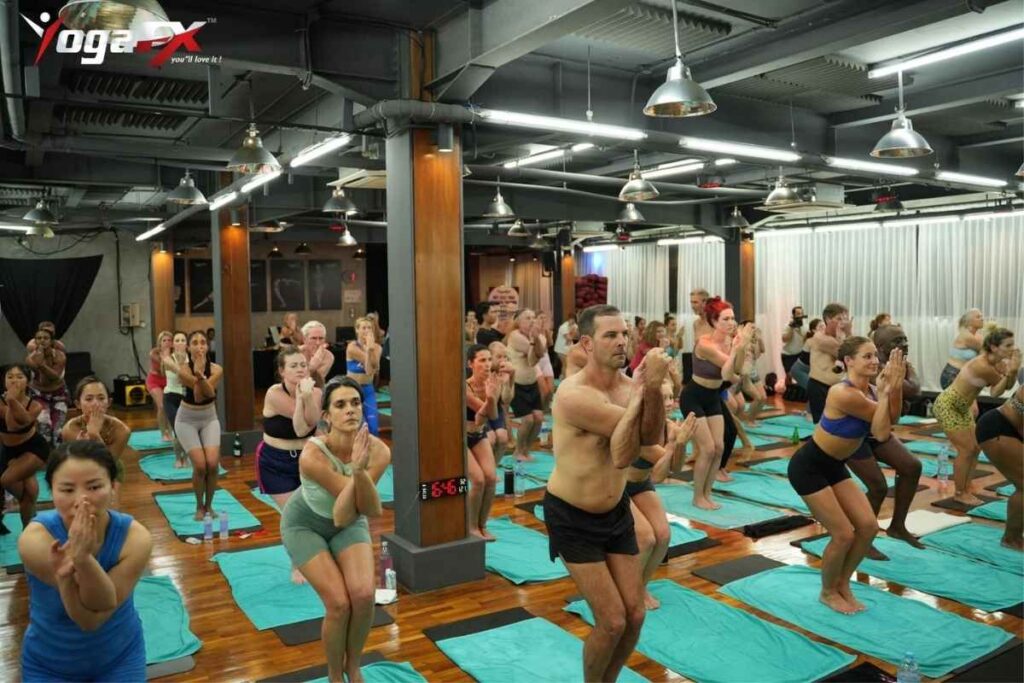
The 90-minute length is not a round number someone picked for a timetable. It comes from how the sequence is built. Each part prepares the next, so cutting time changes what the later postures can do.
1. The Body Needs Time to Adapt to the Heat
A room at 40 degrees Celsius and 40% humidity asks a lot of your heart before you even move. The first postures, such as Half Moon, Hands to Feet and Awkward, raise your temperature and heart rate gradually. As a result, your body is ready by the time you reach Standing Bow and Balancing Stick. Those two postures are the hardest work of the class.
2. The Standing Series Prepares the Floor Series
Deep backbends like Camel (Ustrasana) ask a lot of the spine. They work best after roughly an hour of standing and prone work has warmed the muscles around it. So when a teacher moves Camel earlier, or drops the warm-up, the posture loses depth and gains risk.
3. Double Sets Need Rest Between Them
Most postures are done twice. The first set opens the range, the short rest lets your body settle, and the second set usually goes further. For example, many students find their second Standing Head to Knee steadier than the first. Rush the rest, or drop the second set, and you lose that deepening effect.
Here is roughly how a full class is distributed. Timings shift slightly with each teacher, but the structure stays fixed.
| Section | Approx. time | What happens |
|---|---|---|
| Opening breathing | About 5 min | Standing deep breathing to start the heart and lungs |
| Standing warm-up | About 12-14 min | Half Moon, Hands to Feet, Awkward |
| Standing peak | About 18-20 min | Eagle to Balancing Stick, highest heart rate of the class |
| Standing close | About 16-18 min | Separate Leg Stretching to Toe Stand |
| Savasana transition | About 2-3 min | Rest before the floor series |
| Floor series, prone | About 16-18 min | Wind-Removing, Cobra, Locust, Full Locust, Bow |
| Floor series, kneeling and seated | About 14-16 min | Fixed Firm, Half Tortoise, Camel, Rabbit, Head to Knee, Spine Twist |
| Closing breath and rest | About 3-5 min | Blowing in Firm and final Savasana |
If you want to know what each stage feels like from the mat, read our minute-by-minute guide to what happens in a Bikram yoga class.
What a Bikram Yoga 60 Minutes Class Keeps and Cuts
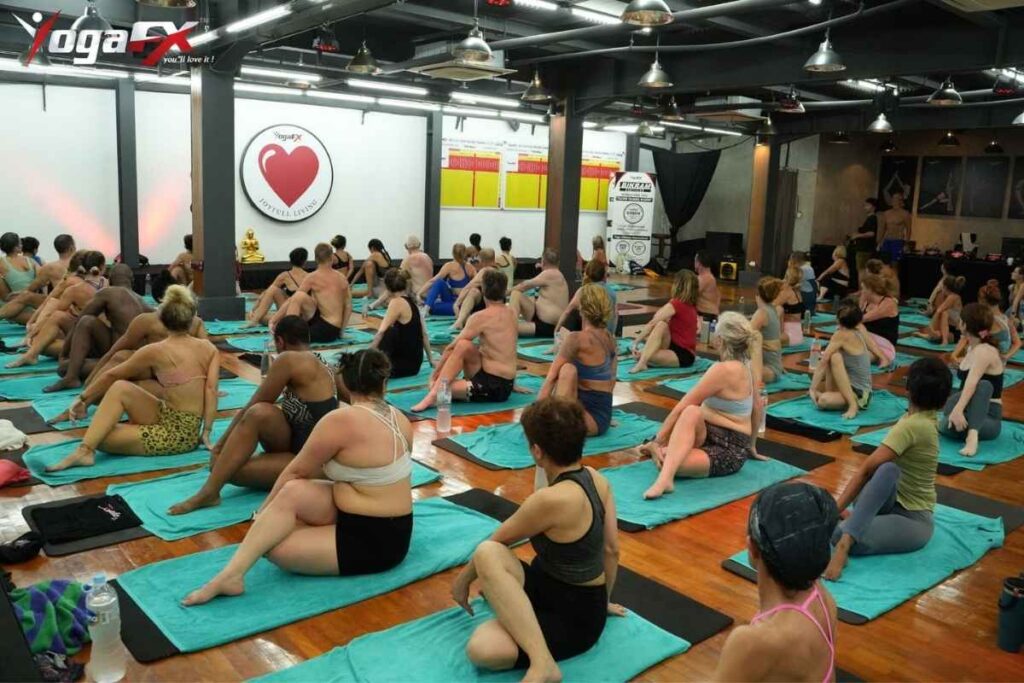
Studios shorten the class in three main ways. Ask your studio which one they use before you book, because the answer changes what you are actually practising.
Approach 1: Full Standing Series, Shorter Floor Series
This is the most common format. The standing series runs with full sets and timing. The floor series then stops early, usually after Fixed Firm or Half Tortoise. As a result, you keep the cardio peak but miss the deepest spinal work.
Approach 2: All Postures, Shorter Holds
Here every posture appears, but holds are shorter and some second sets disappear. You see the whole sequence, yet the double-set effect described above is mostly gone. It feels complete, although it works differently.
Approach 3: A Mix of Postures From Both Series
Some studios pick a selection of standing and floor postures. This is the furthest from the original method. Honestly, it is closer to a general hot yoga class that borrows Bikram postures.
Across all three, these four postures are the ones most often cut:
- Camel (Ustrasana). The deepest backbend in the sequence.
- Rabbit (Sasangasana). The forward-rounding counterpose to Camel, so it loses its purpose once Camel is gone.
- Head to Knee with Stretching. The main seated hamstring and forward-fold work.
- Spine Twist (Ardha Matsyendrasana). The only true spinal rotation in the class.
That list is the real cost of a Bikram yoga 60 minutes class. You still sweat hard and you still balance. However, you skip most of the spine's extension, flexion and rotation in one go.
What the Research Measured, and at Which Class Length
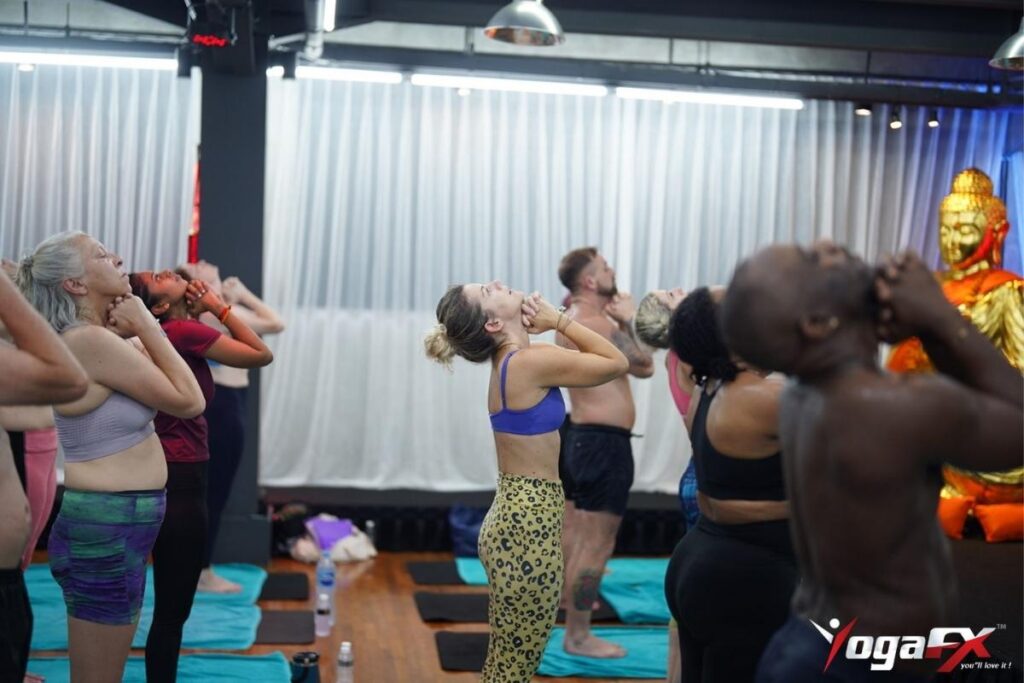
Here is a detail many websites miss: the best-known Bikram studies looked at standard classes and programmes, not a 60-minute format. So any number you read about a Bikram yoga 60 minutes class is an estimate, not a measurement.
- Calories. Porcari and colleagues (2014) measured about 333 kcal for women and 460 kcal for men per 90-minute class. Heart rate averaged around 80% of maximum. Nobody has measured a Bikram yoga 60 minutes class directly.
- Mood. In a Massachusetts General Hospital trial (Nyer et al., 2023), 59% of people in an 8-week heated yoga programme cut their depression symptoms by half or more. Only 6% on the waitlist did the same. The trial didn't test whether shorter classes work as well.
- Strength and flexibility. Tracy and Hart (2013) reported gains in flexibility and lower back strength after eight weeks of Bikram practice. Again, they used the standard class.
Because of that, the fair way to read the calorie data is simple. A Bikram yoga 60 minutes session burns less in total, roughly in proportion to the time you lose. However, the standing series is the most intense part. So a shorter class that keeps it whole loses a little less than a straight two-thirds cut suggests.
A broader systematic review by Willmott and colleagues (2025) pooled 43 studies on Bikram and hot yoga. It found benefits for flexibility, well-being and more. Even so, research suggests these effects come from regular practice over weeks, not from any single class.
That's the honest takeaway. Whichever length you choose, frequency matters more than any one session. If you're managing a health condition, consult a healthcare professional before starting heated practice.
Who Each Class Length Suits
The right length depends on what you want from the room. Here is how we would match goals to formats.
A Bikram Yoga 60 Minutes Class Suits You If
- You are short on time. A lunch-hour or early class keeps your streak alive.
- You are new to the heat. A few shorter classes can help you build heat tolerance before the full length.
- You practise five or six days a week. Mixing in shorter classes lowers the total load and the time cost.
- Your main goal is cardio and leg strength. The standing series carries most of that work.
The Full 90-Minute Class Suits You If
- You want the complete spinal work. Camel, Rabbit and Spine Twist only appear reliably in the full class.
- You are tracking calories. The only measured data is for 90 minutes.
- You practise for mood and stress. The long final floor section and the closing rest give your nervous system time to settle.
- You plan to teach. Trainees need to know every posture, in order, with both sets.
For example, a student who comes three times a week could do two 90-minute classes and one Bikram yoga 60 minutes class. That way, they keep the full sequence as their base and use the shorter slot as a top-up.
Similarly, a busy parent might only manage two visits. In that case, we'd suggest making both of them full classes, because two shorter classes would mean the floor series almost never gets done.
How to Choose Your Class Length and Move Up to 90
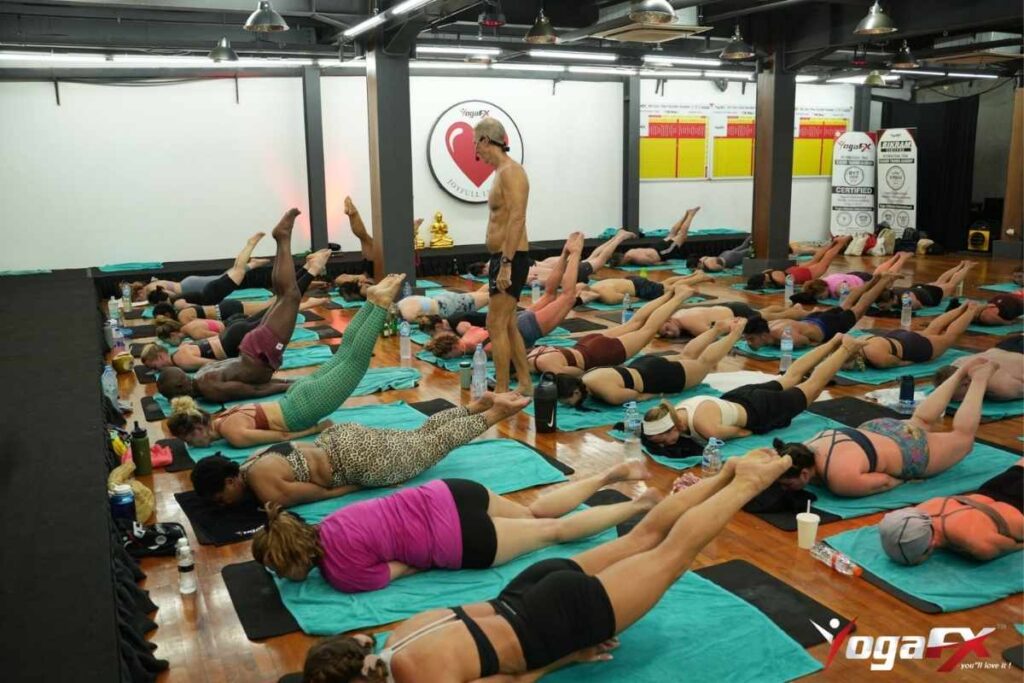
Choosing is easier when you start from your week, not from the timetable. Ask yourself three questions:
- How many classes can I attend each week? If the answer is two or fewer, make them both 90 minutes.
- What is my main goal? Spine, mood or teaching points to 90. Cardio on a busy day points to 60.
- How does my body handle heat right now? If you feel dizzy or wiped out, a shorter class is a sensible bridge.
Moving From 60 to 90 Minutes
If you started with the shorter format, the jump to the full class feels bigger than 30 extra minutes. That is normal, and it usually settles within a handful of classes.
- Hydrate the day before, not just the hour before class.
- Eat lightly in the two to three hours before you practise.
- Expect the first 20 minutes to feel hardest. Your body is still adjusting to the heat. It gets easier after that.
- Stay in the room. If it gets too much, lie down in Savasana on your mat instead of leaving.
- Treat Camel with patience. It can feel intense, even emotional, the first few times. Rabbit right after it is there to bring you back.
Mr. Ian Terry, E-RYT 500, often tells new students that the full class is a skill you learn, not a test you pass. He has taught more than 12,000 hours. In his experience, most people stop asking how long the class is once they've finished about five of them. Our Bikram yoga for beginners guide covers that first week in detail.
Teachers sometimes run a Bikram yoga 60 minutes class as a stepping stone for nervous newcomers. That works, as long as the student books a full class soon after. Otherwise the floor series stays a mystery, and Camel feels far scarier than it is.
What a 30-Minute Home Practice Is Good For
Some days, even 60 minutes is out of reach. That is where a short home session earns its place. It can't copy the heat or the full sequence. Still, it keeps your hips, hamstrings and balance from going stiff between studio visits.
Think of it like this. The 90-minute class is your training. A Bikram yoga 60 minutes class is maintenance. And 30 minutes at home is mobility.
We have a separate 30-minute Bikram home practice guide with the postures to prioritise. So we won't repeat that sequence here.
Class Length at YogaFX Bali and in Teacher Training
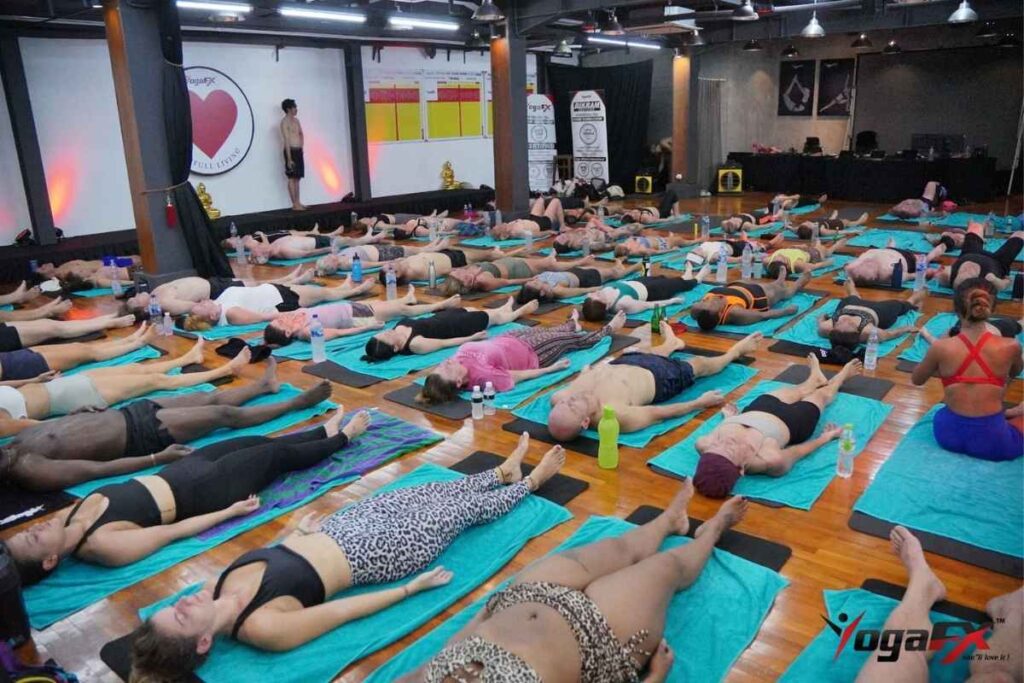
At YogaFX in Seminyak and Canggu, the studio class is the 90-minute Original Hot 26&2 format in natural tropical heat, with scripted dialogue and no music. That choice is deliberate. Mr. Ian Terry trained for five years, from 2014 to 2019, directly with Bikram Choudhury, the founder of the Bikram Hot 26&2 method. He teaches the sequence the way it was designed.
The full length matters even more if you want to teach. Trainees on the YogaFX Bikram Hot 26&2 Yoga Teacher Training MasterClass learn every posture with both sets. They also learn the timing between sets and how to deliver the dialogue across the whole 90 minutes.
The programme is a 6-day hybrid. You start with an online pre-course, then join an intensive in Bali. Graduates earn Yoga Alliance RYT 200 plus the Bikram Hot 26&2 200-Hour International Yoga Certification.
- Next batch: check-in 24 January 2027, check-out 29 January 2027, at Soham Wellness Center, Seminyak.
- Price: US$1,899 Early Bird (standard US$1,999), with interest-free instalments from US$250 per month and a very low deposit.
- Track record: more than 1,500 graduates from over 80 countries since 2017.
The video below shows a full YogaFX class and why the complete sequence is taught the way it is. If you are weighing up teacher training, our Bikram yoga teacher training guide compares formats and costs.
FAQ
How long is a Bikram yoga class?
A standard Bikram yoga class lasts 90 minutes. It covers 26 postures and two breathing exercises in a fixed order, in a room heated to about 40 degrees Celsius. Many studios also offer a 60-minute version, which keeps the standing series and shortens the floor series. Allow around two hours in total, including changing time.
Why is Bikram yoga 90 minutes?
Because the sequence needs it. The early postures warm the body gradually. The standing series then prepares the spine for the deep floor backbends. Most postures are also done in two sets with a short rest between them. Cutting 30 minutes usually removes Camel, Rabbit, the seated forward fold and Spine Twist.
How many calories does 60 minutes of Bikram yoga burn?
No study has measured it directly. The 2014 study by Porcari and colleagues measured about 333 kcal for women and 460 kcal for men per 90-minute class. A 60-minute class burns less in total, roughly in proportion to the shorter time. Keeping the intense standing series narrows the gap slightly.
Is a Bikram yoga 60 minutes class good for beginners?
Yes, it can be a gentle way in. A shorter class lets you get used to the heat with less time in the room. Still, try a full 90-minute class within your first few weeks. That's where you meet the whole floor series and learn how the complete sequence feels.
Is the Maggie Grove 60-minute Bikram video a good way to practise at home?
Free follow-along videos such as Maggie Grove's 60-minute class are useful for learning posture order and keeping a routine. However, home practice rarely matches 40 degrees and 40% humidity, and nobody corrects your alignment. Use videos between studio classes rather than instead of them.
How much is Bikram yoga teacher training?
The YogaFX 6-day hybrid MasterClass costs US$1,899 Early Bird (US$1,999 standard), with interest-free instalments from US$250 per month. It is independent training, not official Bikram Choudhury Teacher Training. Graduates earn Yoga Alliance RYT 200 plus the Bikram Hot 26&2 200-Hour International Yoga Certification.
Still have questions about class length or teacher training? Message Mr. Ian and the YogaFX team on WhatsApp and we will answer them personally. Not sure you're ready to teach yet? Take the 2-minute teacher readiness quiz first and see where you stand today.