
The history of Bikram yoga is the history of a method that proved genuinely effective, built a global following of millions of practitioners, became inseparable from its creator's personality and controversies, and then had to find a way to exist without him.

Understanding that History of Bikram Yoga explains why the practice looks the way it does today, why it is now called 26 and 2 yoga in many contexts, and why the method itself survived a collapse that would have ended most wellness movements.
This account is written from a position of direct experience. Mr. Ian Terry attended 5 training events with Bikram Choudhury between 2012 and 2019 — in China, Thailand, Spain, India, and Los Angeles — and served as assistant teacher on Choudhury's staff during those events.
What follows is not a reconstruction from secondary sources. It is a firsthand account combined with the documented historical record.
For his own personal reflections on those five trainings and what they taught him about teaching, see what I learned training directly under Bikram Choudhury.
Bikram yoga was developed by Bikram Choudhury from the therapeutic Hatha yoga teachings of Bishnu Ghosh in Calcutta, beginning in the 1960s. Choudhury moved to the United States in 1971, opening his first Los Angeles studio in 1974. By 2006, more than 1,650 licensed studios operated worldwide.
Following multiple sexual assault allegations and a 2017 Netflix documentary, Choudhury fled to India in 2016 and was convicted in absentia in California in 2023. The 26-posture sequence he systematised continues to be practiced globally as 26 and 2 yoga, Original Hot Yoga, and under various other names by teachers trained in the original method.
For the full biography of the man himself, see Bikram Choudhury: the man behind Bikram yoga. Among the instructors who trained directly under him before his departure from the US, few can document a teaching record as extensive as Ian Terry's 12,000+ teaching hours and 1,500+ graduates across 80 countries.
The Lineage: Before Bikram Choudhury
The story of Bikram yoga begins before Bikram Choudhury. The method's foundation lies in the work of Bishnu Ghosh, a Bengali physical culturist born in 1903 and the younger brother of Paramahansa Yogananda, the Indian yogi who brought Kriya yoga to the West through his book Autobiography of a Yogi.
Bishnu Ghosh was not a spiritual teacher in the traditional sense. He was a physical culture pioneer who developed a systematic approach to therapeutic yoga grounded in anatomy, physiology, and therapeutic outcomes rather than spiritual philosophy. Ghosh established the College of Physical Education in Calcutta in the 1920s and spent decades refining a set of postures specifically chosen for their therapeutic and strengthening effects on the human body.
The postures Ghosh selected and systematised were drawn from classical Hatha yoga tradition but filtered through a physical culture lens. His approach emphasised measurable outcomes, precise alignment, and the therapeutic use of yoga for injury rehabilitation and physical development. This therapeutic physical culture orientation is what distinguishes the Ghosh lineage from the more spiritually focused yoga traditions that dominated Indian yoga teaching at the time.
Bikram Choudhury came to Ghosh's school as a young child. He trained under Ghosh intensively, competing in yoga championships and reportedly recovering from a serious knee injury through yoga practice. Ghosh's therapeutic approach to the postures and his emphasis on systematic, progressive practice became the foundational elements of what would later become the Bikram sequence.
The Development of the 26-Posture Sequence
The specific 26-posture sequence that defines Bikram yoga was not invented by Choudhury. It was selected and arranged from the much larger body of Hatha yoga postures that form the Ghosh curriculum.
The selection process was therapeutic and practical: which postures produced the most comprehensive physical benefit, in what order did they prepare the body for the next posture, and how could the complete sequence be delivered within a fixed time frame.
The heat specification came from a practical observation: the hot, humid climate of Calcutta allowed practitioners to achieve posture depths in their first session that would take weeks or months of room-temperature practice to develop. Choudhury formalised this observation into the 40 degrees Celsius, 40 percent humidity specification and made the heated room a non-negotiable element of the practice.
The scripted verbal dialogue, which every certified Bikram instructor delivers identically, was developed during the Los Angeles teaching years.
The dialogue serves two functions simultaneously: it provides consistent, precise instruction to students regardless of which certified instructor is teaching, and it creates a teachable, trainable instructional format that can be transferred from master teacher to student without losing its essential content.
This dialogue is what makes Bikram yoga scalable as a teaching method — an instructor who has mastered the dialogue can deliver a complete, high-quality class from their first certified teaching session.
The American Years: 1971 to 2000
Bikram Choudhury arrived in the United States in 1971, reportedly at the invitation of President Richard Nixon who sought yoga therapy for a phlebitis condition. He established himself in Los Angeles and opened his first dedicated studio on La Cienega Boulevard in 1974.
The timing was fortunate. The 1970s in Los Angeles was precisely the cultural moment when Western wellness culture was receptive to a rigorous, results-focused physical practice from India. Choudhury was charismatic, confident, and effective as a teacher. The practice produced visible results quickly. Word spread through the entertainment industry.
The Hollywood connection became one of Bikram yoga's defining characteristics in its early decades. Shirley MacLaine was an early practitioner. Kareem Abdul-Jabbar credited the practice with extending his NBA career. Andy Murray used it during his tennis career. Lady Gaga attributed mental health benefits to her practice. The celebrity practitioner base created cultural visibility that few yoga methods achieve.
| Year | Key Development |
|---|---|
| 1971 | Bikram Choudhury arrives in the United States |
| 1974 | First Bikram yoga studio opens in Los Angeles on La Cienega Boulevard |
| 1978 | Bikram's Beginning Yoga Class published — the original posture and dialogue reference text |
| 1980s | Hollywood celebrity practitioner base develops. Practice spreads from LA across the US. |
| 1994 | First formalised teacher training programme in Los Angeles. Previously teachers were trained individually. |
| 2000 | Yoga College of India franchise model begins formal expansion. Studios open internationally. |
The Global Expansion: 2000 to 2012
The 2000s represented the height of Bikram yoga's institutional power. By 2006, more than 1,650 licensed Bikram yoga studios were operating in over 40 countries.
Teacher training programmes ran twice yearly in Los Angeles, each cohort numbering in the hundreds. The nine-week intensive format became one of the most demanding and expensive teacher training programmes in any yoga style, typically costing USD 10,000 to USD 15,000, and consistently filled to capacity. That price tag still shapes the conversation, which is why we've written about how candidates fund training today without a five-figure budget.
The franchise model Choudhury built was unusual in yoga. Studios paid licensing fees and were expected to maintain strict standards: the same 26-posture sequence, the same temperature, the same dialogue, the same carpet and mirrors. This standardisation produced a consistent product globally — a practitioner from New York could walk into a Bikram studio in Tokyo and find an identical class.
Mr. Ian Terry attended his first training event in this period, in 2012 in Bangkok, Thailand. The scale of the operation was significant: hundreds of teacher trainees from dozens of countries, a full staff of assistant teachers, posture clinics running simultaneously across multiple rooms, and Choudhury himself as the central instructional presence.
The teaching method content was genuinely valuable. The surrounding culture was already showing the signs of the institutional problems that would become public later.
The Copyright Case: 2011 to 2015
In 2011, Bikram Choudhury's organisation filed for copyright protection on the 26-posture sequence, arguing that the specific selection and arrangement of postures constituted a creative work eligible for copyright protection. The case was litigated over several years and produced a definitive ruling in 2015.
The ruling in Bikram's Yoga College of India v. Evolation Yoga was significant beyond the specific case. The federal Ninth Circuit Court of Appeals held that the sequence of 26 postures and 2 breathing exercises is a system of exercise and therapy, not a creative expression, and therefore cannot be protected by copyright. Any person or studio could teach the same sequence without licensing from Choudhury's organisation.
The practical consequence was that every studio that had been paying licensing fees was no longer legally required to do so. The ruling also opened the path for studios to rebrand away from the Bikram name without legal risk — a path that many would take after 2017.
The Collapse: 2013 to 2019
The sexual assault allegations against Bikram Choudhury became public in 2013 when former student Minakshi Jafa-Bodden filed a lawsuit alleging wrongful termination and sexual harassment. Additional civil lawsuits followed from other former students and employees, with allegations including rape, sexual battery, and harassment spanning decades.
Choudhury denied all allegations. The first civil trial in 2016 resulted in a jury award of USD 6.4 million in punitive damages to Jafa-Bodden, subsequently reduced on appeal. Additional civil judgments followed from other plaintiffs.
In 2016, Choudhury left the United States while multiple active lawsuits and a criminal investigation proceeded. He has continued teaching in various countries, primarily in Europe and India. In 2023, he was convicted in absentia in California on criminal charges including rape and false imprisonment, with a sentence issued that he has not served.
The 2017 Netflix documentary Bikram: Yogi, Guru, Predator, directed by Eva Orner, brought the allegations to a global mainstream audience. Studios that had maintained the Bikram name through the civil litigation period began rebranding after the documentary's release.
The Ian Terry Perspective: What the Training Was Actually Like
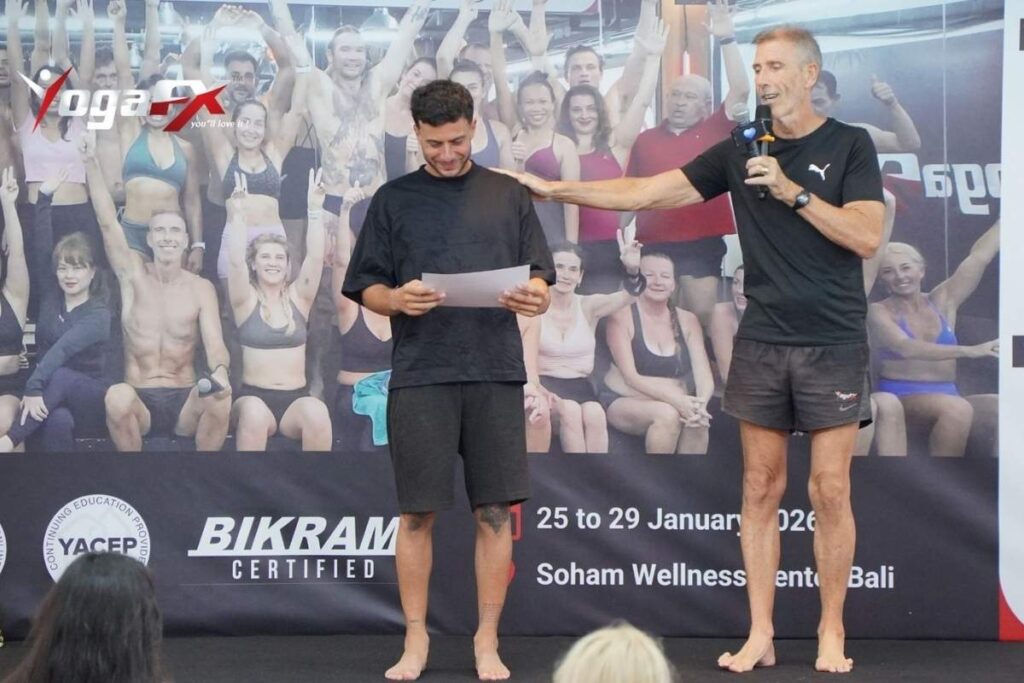
Mr. Ian Terry attended training events with Choudhury in 2012 (Bangkok), 2014 (China), 2016 (Spain), 2017 (India), and 2019 (Los Angeles) — a timeline that spans the period from well before the public controversy to after the Netflix documentary's release. This direct experience provides a specific perspective that reconstructed accounts cannot.
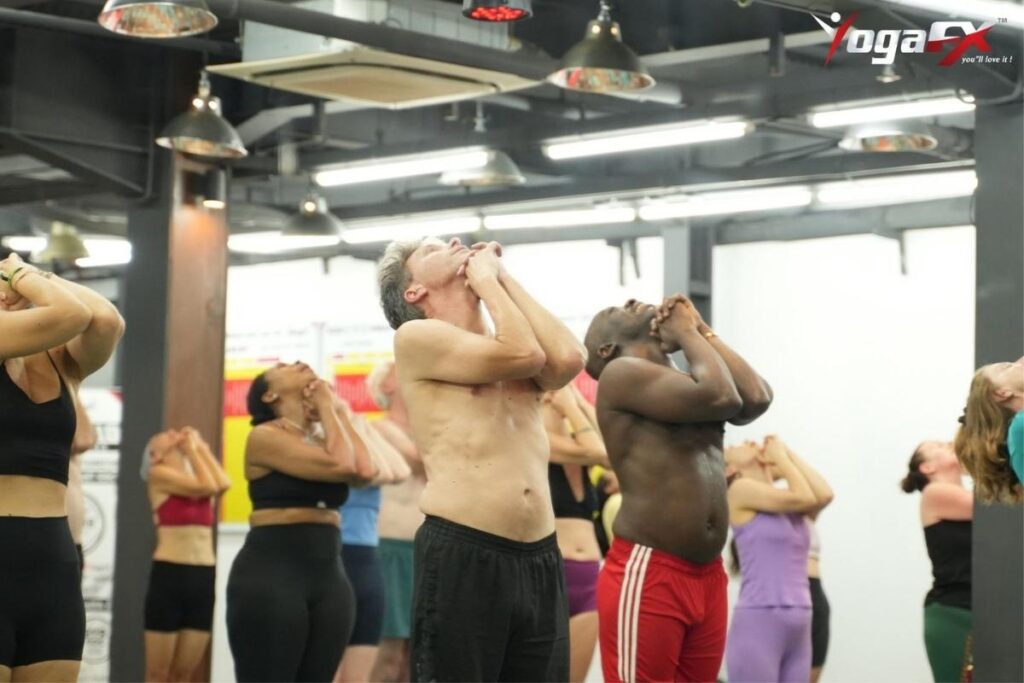
The teaching method itself was rigorous and genuinely effective. The posture clinic format, in which Choudhury and his staff worked with trainee teachers on specific postures with detailed alignment instruction, produced real pedagogical depth. The dialogue delivery training, for which Choudhury had a specific and exacting standard, produced instructors who could teach a complete class competently from their first certified session. The educational content of the training was substantive.
The surrounding culture was a different matter. The late-night lecture format, the personality cult dynamics, the atmosphere of deference to Choudhury's judgment on all matters — these created conditions that the allegations later revealed as enabling rather than exceptional.
Attending these events produced a very specific understanding of how institutional culture can coexist with genuine educational value, and why the two need to be separated in any honest account of the method's History of Bikram Yoga.
The practical conclusion drawn from this experience: the 26-posture sequence, the dialogue, the heat specification, and the physiological rationale of the method are separable from Bikram Choudhury as an individual. The teaching method works because of its design, not because of its creator's personal character. This is why the method survives and continues to produce genuine outcomes for practitioners, independent of what is known about the man who systematised it.
What Comes After: The 26 and 2 Era (2019 to 2026)
Rebranding to 26 and 2 Yoga
The majority of studios that previously operated as Bikram studios have adopted the term 26 and 2 yoga, original hot yoga, or 26 plus 2 to describe the same practice. The practice is identical.
The name acknowledges the reality that the method now exists independently of the person who systematised it. To separate fact from studio myth and understand the true roots of the lineage, it's worth reading the best books on Bikram yoga history curated by senior teachers.
Organisational Fragmentation
Several organisations have emerged to provide certification and community for 26 and 2 instructors outside the original Bikram Yoga College of India structure. Independent certification bodies now offer their own teacher training standards and studio membership, each operating under governance structures separate from Choudhury. Other schools and programmes operate with varying degrees of institutional connection to the original Bikram training system.
Independent Lineage Teachers
A significant number of instructors who completed their teacher training directly with Choudhury continue to teach under independent structures, maintaining the original dialogue and method without organisational affiliation. These instructors carry the teaching lineage with the highest verifiable authenticity while operating entirely outside the institutional structures Choudhury built.
YogaFX represents this category. Mr. Ian Terry's training through 5 direct events with Choudhury, combined with his E-RYT 500 Yoga Alliance credential, provides the lineage connection of the original Bikram training system delivered through a programme that is institutionally independent of anything Choudhury now controls.
The Research Base Continues to Grow
One significant development in the post-2019 period is that the peer-reviewed research on Bikram yoga has continued to accumulate independently of the reputational collapse of its founder.
The University of Wisconsin 2014 study (PubMed: 24700459), the Tracy and Hart 2013 study (PubMed: 23438366), and most significantly the Harvard Medical School 2023 randomised controlled trial on hot yoga and depression (PubMed: 37883245) were all conducted on the method itself, not on the organisation or the man.
The research validates the practice independent of any organisational endorsement.
The Current State of Bikram Yoga Globally (2026)
| Element | Current Status (2026) |
|---|---|
| The method | Intact — 26 postures, 2 breathing exercises, 40°C, scripted dialogue unchanged |
| The name | Fragmented — Bikram, 26 and 2, original hot yoga, hot 26 and 2 all in use globally |
| Original organisation | Diminished — Yoga College of India still operates in some markets but with significantly reduced footprint |
| Independent studios | Active globally — majority of studios now operate independently of original franchise structure |
| Certification | Multiple pathways — Yoga Alliance RYT 200 plus style-specific training from various programmes |
| Research base | Growing — Harvard 2023 RCT is the most significant study to date, published post-controversy |
| Bikram Choudhury | Absent from US — continues teaching internationally while avoiding criminal sentence |
Why the Method Survived
The survival of the 26 and 2 sequence through a reputational collapse that destroyed the institutional structures around it is not accidental. Three factors explain it.
First, the method works. The research documents this and the personal experience of millions of practitioners confirms it.
Flexibility gains, cardiovascular conditioning, strength improvement, and the documented mental health benefits of the heated practice are real outcomes produced by the specific sequence in the specific environment. A method that produces genuine results retains practitioners who experienced those results, regardless of what happens to the organisation that delivered them.
Second, the method is separable from its creator in a way that personality-dependent practices are not. The scripted dialogue means any competent trained instructor can deliver the method. The fixed sequence means the educational content is inherent to the practice format, not dependent on any specific teacher's ongoing presence. Choudhury's departure from the instructional scene did not take the method with him.
Third, the Ghosh lineage that underlies the method predates Choudhury and will survive him. Bishnu Ghosh's therapeutic yoga system, from which the 26 postures were selected, exists independently of any individual teacher. Instructors with direct Choudhury lineage training who understand the Ghosh foundation carry both the modern teaching format and its deeper historical roots.
For readers new to the practice itself rather than its history, our companion explainer on what Bikram yoga actually is covers the sequence, heat, and dialogue in plain terms, and our guide to original hot yoga teacher training looks at how this Calcutta-rooted method, tracing back to Ghosh's work and Choudhury's own training visits to India, is taught today.
FAQ
Where was Bikram yoga invented?
The Hatha yoga postures that form the Bikram sequence were systematised by Bishnu Ghosh in Calcutta, India, beginning in the 1920s and continuing through the 1960s. Bikram Choudhury trained under Ghosh in Calcutta, selected 26 postures from the larger Ghosh curriculum, and developed the heated room format and scripted dialogue during his early teaching in Los Angeles beginning in 1971. The method was designed in Calcutta but formalised in Los Angeles.
What is Bikram yoga now called?
Most studios and practitioners now use one of several alternative names: 26 and 2 yoga, original hot yoga, hot 26 and 2, or simply hot yoga. These terms describe the same 26-posture sequence practiced at 40 degrees Celsius without referencing Bikram Choudhury. Some studios and organisations continue to use the Bikram name. The method itself is unchanged regardless of the name used.
Who created Bikram yoga?
Bikram Choudhury systematised the specific 26-posture sequence and developed the heated room format, scripted dialogue, and teacher training methodology. The postures themselves are drawn from the Hatha yoga therapeutic curriculum developed by Bishnu Ghosh in Calcutta, under whom Choudhury trained. The method is most accurately described as the Ghosh lineage systematised by Choudhury — the creator of the specific format, not the originator of the underlying yoga system.
What happened to Bikram Choudhury?
Following multiple civil sexual assault lawsuits and a 2017 Netflix documentary, Bikram Choudhury left the United States in 2016 while a criminal investigation was active. He has continued teaching yoga in various countries, primarily India and Europe.
In 2023 he was convicted in absentia by a California court on criminal charges including rape and false imprisonment. He has not returned to the United States to serve the resulting sentence.
For the complete biography, see the full Bikram Choudhury story.
Is Bikram yoga still taught after the controversy?
Yes, widely. The 26 and 2 sequence continues to be taught by thousands of certified instructors globally, the majority of whom now operate independently of Bikram Choudhury's original organisational structure.
Most have rebranded to alternative names while maintaining the identical practice. The post-2019 period has seen the method decouple from its founder while retaining its practitioner base, supported by continued peer-reviewed research including the Harvard MGH 2023 depression study.
For why "Bikram yoga" is still searched more than the rebranding might suggest, see what people actually search for today.
How did Bikram yoga spread globally?
Bikram yoga's global spread came through three mechanisms. The franchise model (studios paying licensing fees for the right to use the Bikram name and system) allowed rapid expansion across multiple countries from the early 2000s.
The teacher training programme, which ran twice yearly in Los Angeles with hundreds of participants from dozens of countries, distributed certified instructors globally. And the celebrity practitioner base created cultural visibility that drew attention from people who would not have encountered the practice through traditional yoga channels.
What is the connection between Bikram yoga and hot yoga?
Bikram yoga was the first major yoga practice to use a specifically heated room as a functional component of the method rather than a contextual circumstance. The 40-degree Celsius, 40 percent humidity specification Choudhury developed became the model that all subsequent hot yoga formats reference or react to.
The 2015 US court ruling that yoga sequences cannot be copyrighted allowed other studios to offer similar heated practices without licensing from Choudhury, which accelerated the proliferation of hot yoga formats globally.