
Bikram yoga is a style of hot yoga built around a fixed sequence of 26 postures and 2 breathing exercises, practiced in a room heated to approximately 40°C (104°F) with high humidity, over 90 minutes. Every class follows the exact same sequence in the exact same order, taught with a standardised spoken dialogue: no two Bikram classes anywhere in the world are structured differently. It was developed by Bikram Choudhury in the 1970s, drawing on classical Hatha yoga postures, and built an international following through the 1990s and 2000s before controversy around its founder reshaped how the method is taught and licensed today.

This guide covers what Bikram yoga actually is, how a class works, why the heat and the fixed sequence exist, what the research says about its effects, and how it compares to the many other styles of yoga it gets confused with: Vinyasa, Ashtanga, generic "hot yoga," and the 26&2 method as it's taught today independent of Bikram Choudhury himself.
What Bikram Yoga Actually Is
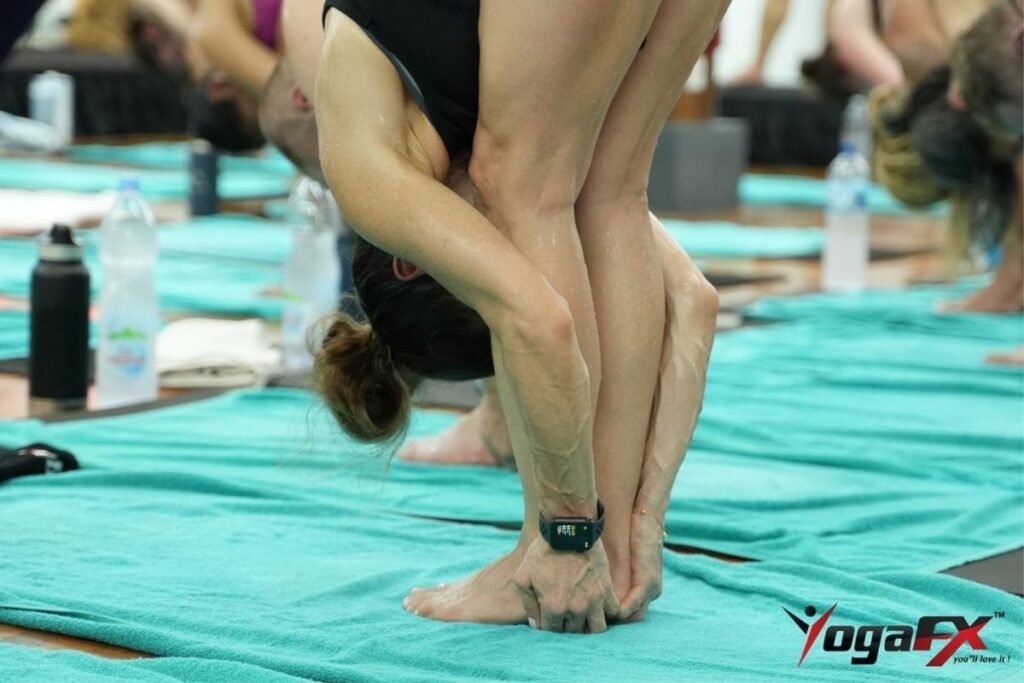
Bikram yoga is defined by three fixed elements that distinguish it from every other yoga style: the sequence, the heat, and the dialogue.
The Fixed Sequence: 26 Postures + 2 Breathing Exercises
Every Bikram class works through the same 26 postures (asanas) and 2 breathing exercises (pranayama), always in the same order: Standing Deep Breathing opens the class, the standing series builds heat and balance through postures like Half Moon and Standing Head to Knee, the floor series works the spine in every plane through Cobra, Locust, Bow, and Camel, and Kapalbhati breathing closes it. The full breakdown of each posture, its Sanskrit name, and its specific benefits is on our complete 26 postures guide.
The fixed order is not arbitrary. Each posture prepares the body for the next: the standing series builds cardiovascular intensity and core heat before the floor series demands deeper flexibility, and the sequence deliberately alternates compression and extension, tension and release, so that the body is systematically opened rather than randomly stretched. Studios that teach this sequence independently of its founder usually call it 26 and 2 yoga, and the order of postures is identical.
The Heat: 40°C and High Humidity
The room is heated to approximately 40°C (104°F) with humidity typically between 40 and 60 percent. This is warmer and more humid than most other styles of "hot yoga," which commonly run at 32-38°C. The heat serves a specific physiological purpose: it reduces the viscosity of connective tissue, allowing safer and deeper access to stretches than would be possible at room temperature, and it significantly increases cardiovascular demand, turning what would otherwise be a moderate flexibility practice into a session with genuine aerobic load. More detail on why this specific temperature was chosen is on our Bikram hot yoga room guide.
The Dialogue
Bikram teachers are trained to deliver a standardised spoken dialogue for every posture: the exact cues, in the exact order, that guide students into and out of each pose. This is different from most yoga styles, where instructors improvise cueing based on their own training and preference. The standardisation means a Bikram class in Bali, London, or Los Angeles follows recognisably the same structure, which is part of why the method built such a large and portable following.
Where Bikram Yoga Came From
Bikram Choudhury developed the method in India in the early 1970s, drawing on classical Hatha yoga postures he had studied since childhood, before bringing it to the United States in 1971 and building a rapid following through the 1970s and 1980s. By the 1990s and 2000s, Bikram yoga had become one of the most recognisable yoga brands in the world, with certified Bikram studios operating across dozens of countries under a strict licensing model that required teachers to complete Bikram's own 9-week teacher training.
That licensing model collapsed after 2013, when a series of lawsuits against Bikram Choudhury involving sexual assault allegations became public, followed by a 2016 civil judgment against him. Bikram Choudhury left the United States, and the centralised licensing structure that had controlled the brand fell apart. In the years since, the 26&2 sequence itself, the postures, the heat, the dialogue structure, has continued to be taught independently by studios and teacher trainers worldwide, often rebranded as "Hot 26&2 Yoga" or similar, separating the method from its controversial founder. The full account of this history, including how the teacher training landscape changed as a result, is on our history of Bikram yoga page.
What a Bikram Class Actually Feels Like
A first Bikram class is a genuinely different experience from a typical gentle yoga class, mostly because of the heat. Expect to sweat heavily within the first 10 minutes, even before any strenuous movement: the room temperature alone raises heart rate and skin temperature quickly. The standing series (the first 45 minutes) is the most cardiovascularly demanding part of class, and it's normal for new practitioners to need to sit or kneel through parts of it while adjusting to the heat. The floor series that follows is more about controlled flexibility work than cardiovascular intensity, and most practitioners find it more manageable once seated on the mat.
Hydration matters more in Bikram than almost any other yoga style: most experienced practitioners drink 1-1.5 litres of water in the hours before class and continue hydrating for the rest of the day. Bringing a large towel and a non-slip mat towel is standard practice, since the combination of heat and sweat makes standard mats slippery within minutes.
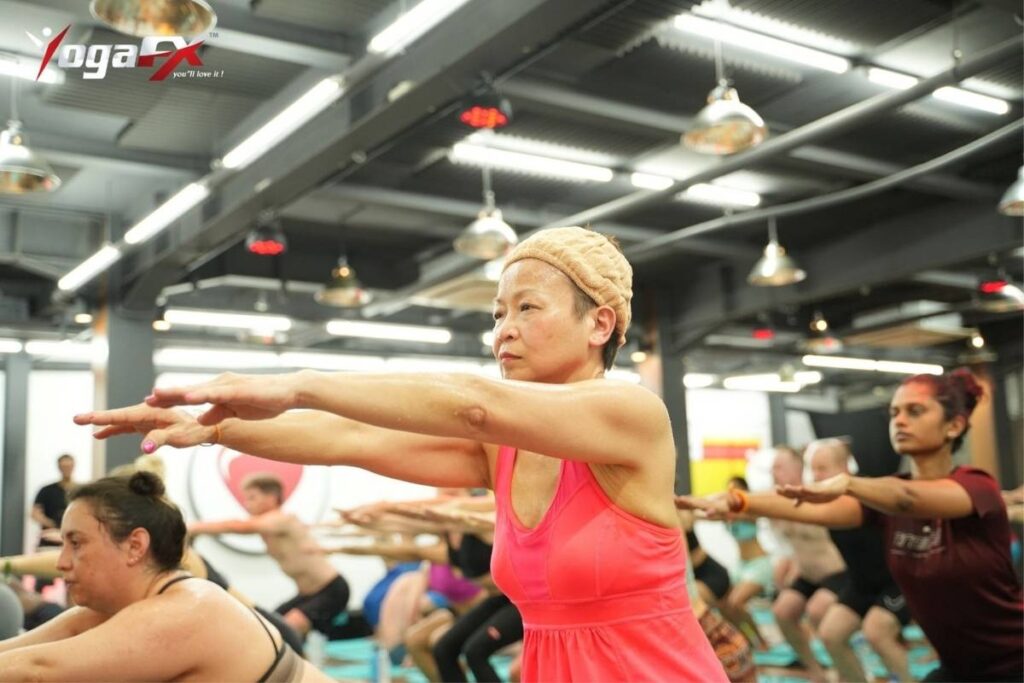
How Hot Is Bikram Yoga, and Why That Temperature
A Bikram studio is heated to approximately 40°C (104°F) with humidity held between 40 and 60 percent, a specification Bikram Choudhury set to replicate the climate of Calcutta, India, where the method originated. This is meaningfully hotter and more humid than the 32-38°C range typical of generic heated Vinyasa or Power Yoga classes marketed simply as "hot yoga."
The specific number matters physiologically. Below roughly 37°C, connective tissue does not soften enough to meaningfully change flexibility outcomes. Above 40°C, cardiovascular strain increases sharply without proportional additional flexibility benefit, which is why 40°C sits at the point commercial studios settled on: hot enough to soften tissue and elevate heart rate into genuine aerobic training territory, not so hot that the physiological cost outweighs the return. At YogaFX in Bali, this heat is produced by natural tropical climate rather than electric heaters, the same humid conditions the underlying research (Porcari et al., 2014) was measured in.
What the Research Shows
The most comprehensive peer-reviewed review of Bikram yoga, a 2025 systematic review by Willmott et al. analysing 43 studies and 942 participants, documented consistent improvements in flexibility, bone density, and general well-being across regular practitioners. The Tracy and Hart (2013) study measured significant flexibility and strength gains, including a 20 percent increase in posterior chain strength, after eight weeks of practice at three to four sessions per week.
A single 90-minute class burns approximately 333 kcal (women) to 460 kcal (men) depending on body weight and effort level, based on direct metabolic measurement from the University of Wisconsin research (Porcari et al., 2014), with heart rate sustained around 80 percent of maximum for most of the session. Separately, an 8-week randomised controlled trial from Massachusetts General Hospital (Nyer et al., 2023) found approximately 60 percent of participants with moderate-to-severe depression reduced symptoms by 50 percent or more, with 44 percent reaching full remission.
A full accounting of documented physical and mental effects, with citations for each, is on our benefits of Bikram yoga page.
Bikram Yoga vs Other Yoga Styles
| Style | Sequence | Heat | Key Difference from Bikram |
|---|---|---|---|
| Bikram / Hot 26&2 | Fixed, identical every class | 40°C, high humidity | Baseline |
| Generic "Hot Yoga" | Varies by studio and instructor | 32-38°C, variable | No fixed sequence, lower heat, teacher improvises |
| Vinyasa | Varies, flow-based | Room temperature (unless "hot vinyasa") | Continuous movement linked to breath, no fixed sequence |
| Ashtanga | Fixed within each of 6 series | Room temperature | Fixed sequence but no heat; far more physically demanding jump-throughs |
| Hatha | Varies by teacher | Room temperature | Slower pace, general foundational postures, no fixed order |
| Yin | Varies | Room temperature | Passive, long-held stretches targeting connective tissue, not muscular |
The most common confusion is between Bikram and generic "hot yoga." All Bikram classes are hot yoga, but not all hot yoga is Bikram: many studios run heated Vinyasa or Power Yoga classes and market them simply as "hot yoga" without following the fixed 26&2 sequence, the specific 40°C temperature, or the standardised dialogue. A deeper comparison across six major styles, including which suits which type of practitioner, is on our Bikram yoga vs other yoga styles page.
Is Bikram Yoga Good for You? Safety and Who Should Be Cautious
Bikram yoga's heat and cardiovascular demand mean it is not appropriate for everyone without medical clearance. Pregnant practitioners, people with cardiovascular conditions, uncontrolled hypertension, or heat sensitivity should consult a doctor before starting. This is general information, not medical advice.
For most healthy adults, Bikram yoga is safe and beneficial when approached gradually: sitting out of postures when needed in the first several classes, hydrating properly, and communicating any pre-existing conditions to the instructor before class. The research base above (flexibility, strength, cardiovascular conditioning, and depression symptom reduction) suggests real physiological and mental health value for the general population, provided the heat is respected rather than pushed through. Specific guidance for practitioners with lower back pain or sciatica is covered in detail on our Bikram yoga for lower back pain and sciatica page.
Becoming a Bikram Yoga Teacher
The original Bikram teacher training model required a 9-week in-person course costing upwards of USD 10,000, a barrier that priced out most practitioners who wanted to teach. Since the licensing structure changed after 2016, alternative training pathways have emerged, including hybrid models that combine online theory with a shorter in-person intensive. YogaFX's Bikram Hot 26&2 teacher training in Bali follows this hybrid format: a self-paced online pre-course followed by a 6-day in-person intensive, awarding both Yoga Alliance RYT 200 and Bikram Hot 26&2 certification, at a fraction of the original programme's cost and time commitment.
FAQ
What is Bikram yoga?
Bikram yoga is a style of hot yoga built around a fixed sequence of 26 postures and 2 breathing exercises, practiced in a room heated to approximately 40°C with high humidity over 90 minutes, taught with a standardised spoken dialogue. It was developed by Bikram Choudhury in the 1970s and remains one of the most structured and widely recognised yoga methods in the world.
Is Bikram yoga the same as hot yoga?
No. All Bikram yoga is hot yoga, but not all hot yoga is Bikram. Generic "hot yoga" refers to any heated yoga class, often heated Vinyasa or Power Yoga, without a fixed sequence or standardised dialogue, and often at a lower temperature than the 40°C used in genuine Bikram or Hot 26&2 classes.
How hot is Bikram yoga, exactly?
A standard Bikram studio is heated to approximately 40°C (104°F) with 40 to 60 percent humidity, replicating the climate of Calcutta, India, where the method originated. This is hotter and more humid than the 32-38°C typical of generic "hot yoga" classes, which is why Bikram produces a distinctly more intense cardiovascular and flexibility response.
Is Bikram yoga good for you?
For most healthy adults, yes. Peer-reviewed research links regular Bikram practice to improved flexibility, a 20 percent increase in posterior chain strength after 8 weeks, cardiovascular conditioning at 80 percent maximum heart rate, and significant depression symptom reduction in a Harvard-led RCT. Pregnant practitioners or those with cardiovascular conditions should get medical clearance first.
What are the main benefits of Bikram yoga?
Documented benefits include 333-460 kcal burned per 90-minute session, a 20 percent strength increase after 8 weeks, improved flexibility and balance, cardiovascular conditioning, and significant depression symptom reduction shown in a Harvard Massachusetts General Hospital trial. A full breakdown of all 15 documented benefits with citations is on our benefits page.
How long is a Bikram yoga class?
A standard Bikram class runs 90 minutes, working through all 26 postures and 2 breathing exercises in fixed order. Some studios offer shortened 60-minute versions covering a subset of the full sequence, but the traditional and most widely taught format is the full 90-minute class.
Why is Bikram yoga controversial?
The controversy centres on founder Bikram Choudhury, not the method itself. Multiple lawsuits alleging sexual assault became public from 2013 onward, followed by a 2016 civil judgment against him, which led to the collapse of his centralised licensing model and his departure from the United States. The 26&2 sequence and dialogue structure he developed continue to be taught independently by studios and trainers worldwide, often rebranded to separate the method from its founder.
Is Bikram yoga good for beginners?
Yes, with realistic expectations about the heat adjustment period. Most beginners need to sit or kneel through parts of the first several classes while their body adapts to the 40°C environment, and this is normal and expected. The fixed sequence and standardised dialogue actually make it easier for beginners to follow than styles with variable, instructor-dependent cueing, since the structure is consistent from class to class.