
Yoga for cyclists and runners develop specific physical patterns from their sport: hip flexors that chronically shorten from hours in a flexed position, posterior chains that become relatively underdeveloped compared to their anterior loading, spines that compress from sustained forward-flexed postures, and mental patterns of pushing through discomfort that, without a complementary practice, can lead to injury. Golfers face a related but distinct rotational restriction pattern, covered in our guide to yoga for golfers.

Bikram yoga addresses all of these patterns systematically in every 90-minute class. This is not a general yoga-is-good-for-athletes argument. It is a specific claim: the Bikram 26 and 2 sequence, practiced in a 40-degree Celsius room, addresses the exact physical imbalances that cycling and running create, and does so more efficiently than any comparable cross-training format because the heat enables connective tissue release that room-temperature yoga cannot replicate at the same rate.
Bikram yoga is the most effective yoga for cyclists and runners because it addresses all four primary sport-specific problems simultaneously: hip flexor release (Fixed Firm, Camel, Standing Bow in heat-enhanced conditions), thoracic and lumbar spinal decompression (Camel, Half Tortoise, Rabbit, Spine Twist), posterior chain strengthening (Cobra, Locust, Full Locust, Standing Bow, Balancing Stick), and mental discomfort tolerance training that transfers directly to endurance performance. The research-documented strength and flexibility gains (Tracy and Hart 2013) are directly applicable to athletic performance improvement.
Why Endurance Athletes Need Yoga as Cross-Training
The Cyclist's Physical Pattern
Cycling locks the body into a position that, repeated for thousands of hours, creates a predictable set of physical restrictions. The hip flexors shorten from sustained hip flexion in the saddle position. The thoracic spine fixes in forward flexion from the handlebar position.
The posterior chain — gluteus maximus, hamstrings, spinal erectors — becomes underloaded relative to the anterior-dominant cycling movement. The shoulder girdle develops chronic tension from the handlebar load. The spine compresses from the forward-flexed riding position maintained for hours.
Each of these patterns reduces performance and increases injury risk. Shortened hip flexors restrict hip extension at the bottom of the pedal stroke, reducing power at the same cadence. A fixed thoracic spine limits breathing capacity and reduces upper body movement efficiency. An underdeveloped posterior chain increases injury risk and reduces power transfer from the core to the pedals.
The Runner's Physical Pattern
Runners develop different but equally predictable restrictions. The IT band and hip flexors tighten from the predominantly sagittal movement arc and the repetitive hip flexion of each stride.
The Achilles tendon and calf complex shorten from the sustained plantar flexion demand, one of the documented risk factors covered in more depth in our guide to plantar fascia and yoga. The lumbar spine compresses from the repetitive impact loading of each footstrike.
The piriformis and hip external rotators tighten from the rotational component of running form, particularly in fatigued states. To actively protect your joints from repetitive impact while building cardiovascular endurance, dive into our hot yoga for runners: the Bikram-specific guide.
These patterns produce the characteristic running injuries: IT band syndrome, plantar fasciitis, piriformis syndrome, and lower back pain. Each represents a tissue that has been loaded repetitively without adequate recovery of its length and mobility.
Why Bikram Yoga Specifically — Not Just Yoga for Cyclists and Runners
1. The Heat Makes Connective Tissue Release Accessible
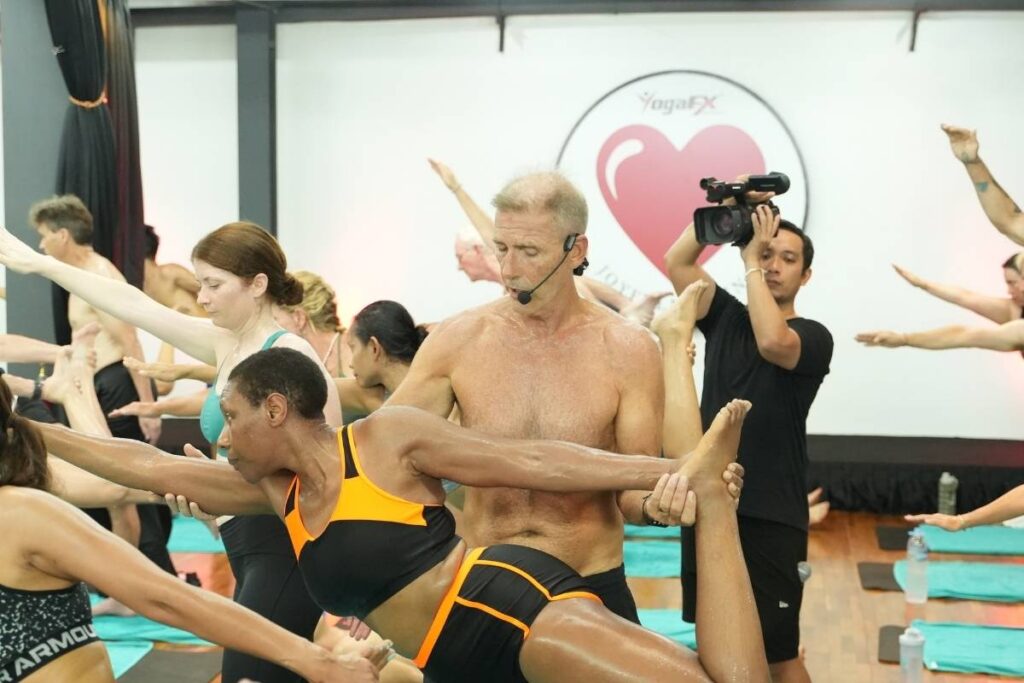
The primary limiting factor in flexibility gains for athletes is connective tissue extensibility, not muscular flexibility alone. Tendons, ligaments, and fascia are the structures that restrict range of motion in experienced athletes, and they are significantly more responsive to mechanical stretch at elevated temperatures than at room temperature.
A hip flexor stretch held for 20 seconds at room temperature requires much greater mechanical force to produce meaningful connective tissue change. At 40 degrees Celsius, the same hold at a shallower depth produces comparable or greater change because the thermal input has already reduced connective tissue viscosity before the mechanical stretch begins.
The University of Wisconsin 2014 study (PubMed: 24700459) documented the cardiovascular demand of Bikram practice (80 percent maximum heart rate throughout), but the connective tissue mechanism is equally significant for athletes: muscles and fascia that have spent hours contracting in a cycling or running pattern become more extensible at heat than the same structures can become in a room-temperature yoga class of equal duration.
For athletes whose primary limitation is connective tissue restriction, the heat is not an optional feature. It is the mechanism that makes the practice specifically useful.
2. The Sequence Addresses Both Anterior and Posterior
Most yoga classes for athletes focus on what feels tight — which, for cyclists and runners, is the anterior chain. Bikram yoga's systematic sequence addresses both sides of every joint in every class.
The standing series builds posterior chain strength (the spinal erectors, glutes, and hamstrings that endurance athletes characteristically underload) while simultaneously stretching the anterior chain. The floor series completes the posterior strengthening while providing the spinal decompression and rotation that extended cycling and running positions restrict.
3. The Mental Training Is Specific to Endurance Performance
Endurance athletes understand discomfort tolerance as a performance variable. Standing in a 40-degree room with a heart rate at 80 percent of maximum, holding a balance posture for 10 seconds while the instructor continues to cue rather than releasing you, is a specific mental training stimulus.
The discipline of staying present, continuing effort, and not exiting the discomfort is identical in quality to the mental demand of sustaining pace in the final kilometres of a race.
Bikram yoga for cyclists and runners trains this mental pattern in a structured, supervised context that the training ride or run cannot replicate in isolation.
Bikram Postures Most Relevant for Cyclists
| Posture | Cycling Problem Addressed | Specific Mechanism |
|---|---|---|
| Fixed Firm Pose (#20) | Shortened rectus femoris and hip flexors from sustained hip flexion on the bike | Kneeling backbend stretches the anterior thigh and hip flexor complex in the heat-relaxed state where maximum release is available |
| Camel Pose (#22) | Thoracic spine fixed in flexion from handlebar position, compressed discs | Maximum thoracic and lumbar extension directly counters the sustained forward flexion of the cycling position |
| Half Moon Pose (#1) | Lateral thoracic restriction from asymmetric loading on the bike | Lateral spinal decompression in both directions addresses the lateral chain restriction that saddle time creates |
| Eagle Pose (#4) | Shoulder and upper trapezius tension from handlebar position | 14 major joints opened simultaneously including all shoulder girdle joints — the most comprehensive upper body joint lubrication in the sequence |
| Standing Separate Leg Stretching (#8) | Hamstring tightness from sustained hip flexion and reduced hip extension in the pedal stroke | Wide-stance forward fold stretches hamstrings and adductors bilaterally in a position that cycling never accesses |
| Triangle Pose (#9) | Hip abductor weakness from the limited lateral plane in cycling | Deep lateral lunge loads the hip abductors and external rotators in a movement pattern entirely absent from the cycling movement arc |
| Spine Twist (#25) | Thoracic rotation restriction from the forward-flexed, symmetric cycling position | The only spinal rotation in the sequence — directly addresses the rotational restriction that the cycling position creates |
Bikram Postures Most Relevant for Runners
| Posture | Running Problem Addressed | Specific Mechanism |
|---|---|---|
| Standing Head to Knee (#5) | Hip flexor tightness and hamstring restriction limiting stride length and hip extension | Single-leg standing balance with hip in maximum flexion and lifted leg extended stretches the hamstring in the heat-enhanced state |
| Standing Bow (#6) | Anterior hip tightness, IT band, quad restriction limiting hip extension at push-off | Standing backbend with hip extension of the elevated leg directly counteracts the chronic hip flexion pattern of running |
| Fixed Firm Pose (#20) | Shortened Achilles and calf complex from plantar flexion demand, plantar fasciitis risk | Kneeling with feet plantar-flexed beneath the hips, then lowering back, progressively stretches the anterior ankle and foot dorsum |
| Half Tortoise (#21) | Lumbar compression from impact loading, disc compression from heel striking | Maximum lumbar decompression in a gravity-assisted forward fold — the deepest lower back release in the sequence |
| Rabbit Pose (#23) | Cervical and thoracic compression from the forward head position in running | Maximum spinal flexion with traction from the arm-to-heel connection decompresses the entire spinal column simultaneously |
| Wind-Removing Pose (#14) | Hip flexor tightness producing anterior pelvic tilt that reduces running efficiency | Deep single-leg knee-to-chest compression with hip internal rotation stretches the piriformis and hip external rotators that restrict running form |
| Awkward Pose (3 parts, #3) | Quad and ankle weakness from the predominantly sagittal loading of running | Three progressive squat variations load quads, adductors, and ankle stabilisers in a wide range of positions that running does not access |
How Bikram Yoga Improves Athletic Performance
Hip Flexor Release and Stride Length
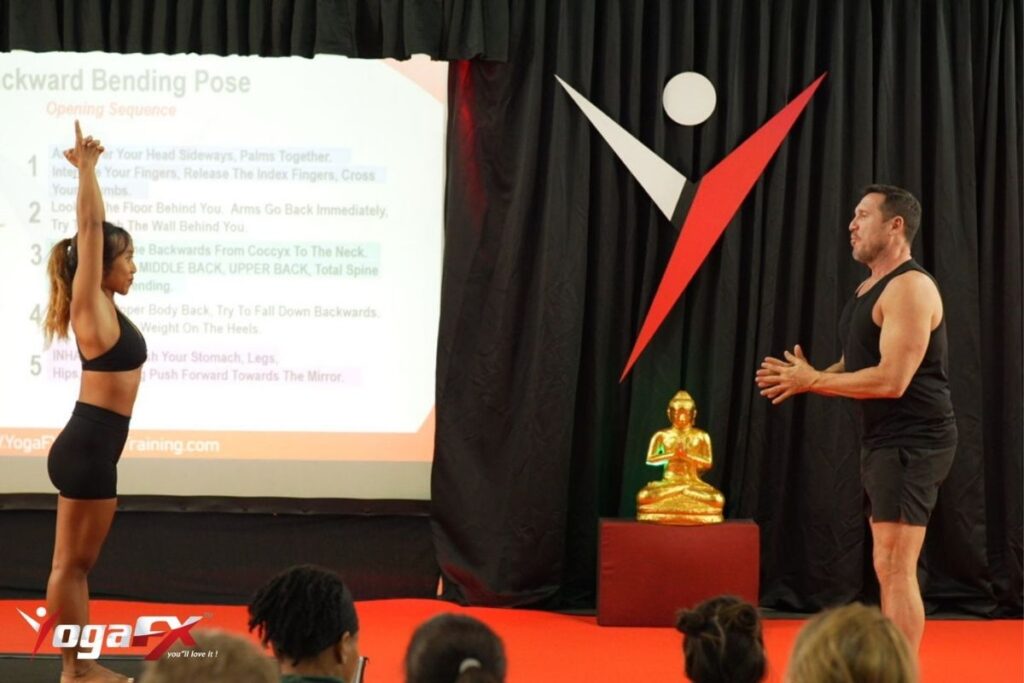
For both cyclists and runners, shortened hip flexors reduce performance. In cycling, shortened hip flexors restrict the hip extension available at the bottom of the pedal stroke, reducing power output at the same cadence. In running, restricted hip extension reduces stride length and shifts the running load forward onto the quadriceps and away from the posterior chain.
The Bikram sequence addresses hip flexors through multiple postures in both the standing and floor series. Most cyclists and runners who practice Bikram consistently report noticing hip flexor release within 4 to 6 weeks, with measurable stride length and pedalling efficiency improvements following at 8 to 12 weeks.
Posterior Chain Balance
Endurance athletes characteristically overdevelop their anterior chain relative to their posterior chain. Cycling is almost entirely anterior-dominant: the quadriceps and hip flexors do most of the work; the gluteus maximus and hamstrings are used but typically at a disadvantage from the shortened hip flexor position. Running uses the posterior chain more than cycling but still within a limited movement arc.
The Bikram standing series builds posterior chain strength through postures that cyclists and runners never access in their sport: the spinal erector loading of Cobra, Locust, and Full Locust; the glute and hamstring demand of Standing Bow and Balancing Stick; and the hip abductor loading of Triangle Pose. These posterior chain patterns complement endurance training without adding the recovery demand of additional sport-specific sessions.
Spinal Decompression
Both cycling and running compress the spine. Cycling does so through the sustained forward-flexed position maintained for hours. Running does so through the repeated impact loading of each footstrike.
The Bikram floor series provides the most systematic spinal decompression available in any yoga format: Camel addresses thoracic and lumbar extension, Half Tortoise provides maximum lumbar decompression, Rabbit provides maximum flexion decompression, and Spine Twist provides the only rotational decompression in the sequence.
Athletes who practice Bikram consistently commonly report that the back tightness that develops over long rides or runs resolves significantly faster than without yoga — typically within 24 to 48 hours rather than several days.
Mental Training for Endurance Performance
The Harvard MGH 2023 randomised controlled trial (Nyer et al., PubMed: 37883245) documented significant depression reduction from Bikram yoga practice. The mental training mechanism that produces this effect — sustained presence through physical discomfort in a heated environment — is the same mechanism that improves endurance performance. Athletes who practice Bikram alongside their sport consistently report that the discomfort tolerance developed in the hot room transfers to race and training performance.
Research Relevance for Athletic Populations
| Research Finding | Athletic Relevance | Source |
|---|---|---|
| 20% deadlift strength increase after 8 weeks | Posterior chain development that cyclists and runners characteristically lack | Tracy and Hart (2013), PubMed: 23438366 |
| 9% improvement in standing balance | Single-leg stability relevant to both running biomechanics and cycling power transfer | Tracy and Hart (2013) |
| Significant lower back and hamstring flexibility gains | Directly addresses the characteristic restrictions of cycling and running | Tracy and Hart (2013) |
| Heart rate at 80% of maximum throughout 90-minute session | Aerobic conditioning effect compatible with and complementary to endurance training load | Porcari et al. (2014), PubMed: 24700459 |
| Reduced depression symptoms (60% of participants, Harvard 2023 RCT) | Mental resilience development applicable to sustained endurance performance | Nyer et al. (2023), PubMed: 37883245 |
Practical Integration: How to Add Bikram Yoga to Your Training
Yoga For Cyclists
Optimal scheduling: Bikram yoga on recovery days and on strength days, not on long ride days. A 90-minute Bikram session on the day following a long ride provides spinal decompression and hip flexor release that accelerates recovery for the next training day. Avoid scheduling Bikram on the same day as a high-intensity or long ride — the thermoregulatory demand of Bikram adds physiological stress that affects subsequent performance.
Minimum effective dose: 2 sessions per week produces meaningful flexibility and recovery benefits without significantly affecting training volume or recovery. 3 sessions per week approaches the research protocol that documented the strength and flexibility improvements in Tracy and Hart (2013). Most serious cyclists who integrate Bikram report being able to maintain 3 to 4 sessions per week during base training periods and reducing to 1 to 2 during race-specific blocks.
Yoga For Runners
Runners typically find Bikram yoga easier to schedule than cyclists because the recovery demand of running sessions is shorter. A morning Bikram class followed by an easy afternoon run is feasible from week 2 or 3 of Bikram practice once initial heat adaptation is established. Allow 2 to 3 hours for thermoregulatory recovery and rehydration before any running session after Bikram.
For runners specifically targeting IT band syndrome, plantar fasciitis, or piriformis issues: 3 sessions per week is the minimum that produces consistent improvement from the Bikram sequence. These conditions require sustained practice rather than occasional sessions because the connective tissue release needs to be maintained between classes for cumulative improvement to develop.
Heat Adaptation Timeline for Athletes
Athletes who are otherwise highly fit often expect their first Bikram class to feel manageable based on their cardiovascular fitness. It typically does not. Cardiovascular fitness does not directly transfer to heat tolerance. The thermoregulatory adaptation required for comfortable Bikram practice develops across 5 to 10 sessions independently of existing fitness level.
Athletes who push their effort level in early sessions based on their fitness tend to overheat faster than less-fit beginners who naturally moderate intensity. Recommendation for athletic first-timers: treat the first 5 sessions as heat adaptation sessions regardless of how easy the postures feel physically. Reduce effort by approximately 30 percent relative to your instinct. Posture depth will develop; heat tolerance needs its own timeline.
FAQ
Is Bikram yoga good for cyclists?
Yes, specifically. The Bikram sequence addresses the four primary physical problems cycling creates: shortened hip flexors (Fixed Firm, Camel, Standing Bow in heat-enhanced conditions), thoracic spine restriction (Camel, Half Moon, Spine Twist), shoulder and upper back tension (Eagle Pose, Half Moon), and posterior chain underloading (Cobra, Locust, Full Locust, Balancing Stick).
The heat accelerates connective tissue release that room-temperature yoga cannot achieve at the same rate, making it more efficient than general yoga for cyclists and runners with limited cross-training time.
Is hot yoga good for runners?
Yes. Hot yoga specifically addresses the IT band and hip flexor tightness that most runners develop, the Achilles and calf shortening that contributes to plantar fasciitis, and the lumbar compression from impact loading.
The heat-enhanced connective tissue extensibility makes these chronic restrictions more responsive than room-temperature yoga at the same session duration. For runners targeting injury prevention or rehabilitation of common running injuries, 3 sessions per week of Bikram yoga is the most effective yoga cross-training available.
How often should cyclists and runners do yoga?
For meaningful benefit, 2 to 3 sessions per week is the minimum effective dose. The Tracy and Hart (2013) research protocol used 3 to 4 sessions per week and documented significant flexibility, strength, and balance improvements at 8 weeks. For athletes in high training volume periods, 2 sessions per week on recovery days maintains the benefits without adding significant additional recovery demand. Schedule Bikram on days following hard training sessions, not before.
Will Bikram yoga make me a slower cyclist or runner?
No. The cardiovascular demand of Bikram yoga (80 percent of maximum heart rate throughout a 90-minute session) produces aerobic conditioning rather than reducing it. The flexibility and posterior chain strength improvements from consistent Bikram practice improve movement efficiency in both cycling and running. Athletes who integrate Bikram yoga consistently typically report improved form, faster recovery between sessions, and reduced injury frequency — all of which contribute to training consistency and performance improvement over time.
Can I do Bikram yoga and endurance training on the same day?
Yes, but with scheduling considerations. A morning Bikram class followed by an easy afternoon run (allow 2 to 3 hours for thermoregulatory recovery and rehydration) is feasible from week 2 or 3 of practice.
A high-intensity run followed by an evening Bikram class on the same day is more demanding and requires careful energy management. Avoid scheduling Bikram immediately before a high-intensity or long training session.
The thermoregulatory demand of Bikram adds physiological stress that affects performance in the following 2 to 4 hours.
What type of yoga is best for cyclists?
Bikram yoga is the most effective single yoga for cyclists and runners because it addresses all four primary cycling-specific physical problems in one structured session: hip flexor release (heat-enhanced, through Fixed Firm and Camel), thoracic extension (Camel, Half Moon), shoulder and upper back release (Eagle Pose), and posterior chain development (Cobra, Locust, Full Locust, Standing Bow, Balancing Stick).
Yin yoga addresses connective tissue effectively but does not develop the posterior chain strength cyclists need. Vinyasa provides movement variety but without the targeted posterior chain loading or the heat-enhanced connective tissue release.