
The Bikram yoga sequence contains 26 asanas and 2 pranayama. The word asana, from Sanskrit, means seat or posture: a sustained physical position held with steadiness and ease, as defined in Patanjali's Yoga Sutras. Using this terminology places the Bikram sequence in its correct context: not exercise movements performed for calorie burn, but classical yoga postures selected from the Hatha yoga tradition for their specific physiological and therapeutic effects. For the full picture of what Bikram yoga is, how it differs from other styles, and what the research shows, see our companion guide, What Is Bikram Yoga? The Complete Guide to the 26&2 Sequence.
This reference covers all bikram yoga 26 poses in sequence order, with Sanskrit and English names, hold times, primary physiological benefits, and the key dialogue cues that Mr. Ian Terry uses at YogaFX, drawn from 5 direct training events with Bikram Choudhury and 12,000 or more hours of teaching experience. Not sure which posture to focus on for your body and goals? YogaFX's Bikram yoga pose personalizer matches postures to your practice goal.
The Bikram yoga sequence contains 26 asanas and 2 pranayama. The opening pranayama (Pranayama Series) and the 26 asanas divide into a standing series (asanas 1 to 12 plus Savasana transition) and a floor series (asanas 14 to 26), closing with Kapalbhati pranayama. Each asana is held for 10 or 20 seconds per side in 1 or 2 sets as specified. The sequence is fixed and identical in every authentic Bikram class globally. Total duration: 90 minutes.
Quick Reference: All 26 Asanas
| Sequence | Sanskrit Name | English Name | Series | Hold | Sets |
|---|---|---|---|---|---|
| Opening | Pranayama Kriya | Standing Deep Breathing | Opening | 6 cycles | 1 |
| 1 | Ardha Chandrasana | Half Moon Pose | Standing | 10 sec/side | 2 |
| 2 | Pada Hasthasana | Hands to Feet Pose | Standing | 10 sec | 2 |
| 3 | Utkatasana | Awkward Pose (3 parts) | Standing | 10 sec/part | 2 |
| 4 | Garurasana | Eagle Pose | Standing | 10 sec/side | 2 |
| 5 | Dandayamana Janushirasana | Standing Head to Knee | Standing | 10 sec/side | 2 |
| 6 | Dandayamana Dhanurasana | Standing Bow Pulling Pose | Standing | 10 sec/side | 2 |
| 7 | Tuladandasana | Balancing Stick Pose | Standing | 10 sec/side | 2 |
| 8 | Dandayamana Bibhaktapada Paschimotthanasana | Standing Separate Leg Stretching | Standing | 20 sec | 2 |
| 9 | Trikanasana | Triangle Pose | Standing | 10 sec/side | 2 |
| 10 | Dandayamana Bibhaktapada Janushirasana | Standing Separate Leg Head to Knee | Standing | 10 sec/side | 2 |
| 11 | Tadasana | Tree Pose | Standing | 20 sec/side | 1 |
| 12 | Padangustasana | Toe Stand Pose | Standing | 20 sec/side | 1 |
| - | Savasana | Dead Body Pose (transition) | Transition | 2 min min. | - |
| 14 | Pavanamuktasana | Wind-Removing Pose | Floor | 20 sec/position | 1 each |
| 16 | Bhujangasana | Cobra Pose | Floor | 10 sec | 2 |
| 17 | Salabhasana | Locust Pose | Floor | 10 sec/part | 2 |
| 18 | Poorna Salabhasana | Full Locust Pose | Floor | 10 sec | 2 |
| 19 | Dhanurasana | Bow Pose | Floor | 10 sec | 2 |
| 20 | Supta Vajrasana | Fixed Firm Pose | Floor | 20 sec | 2 |
| 21 | Ardha Kurmasana | Half Tortoise Pose | Floor | 20 sec | 2 |
| 22 | Ustrasana | Camel Pose | Floor | 20 sec | 2 |
| 23 | Sasangasana | Rabbit Pose | Floor | 20 sec | 2 |
| 24 | Janushirasana with Paschimotthanasana | Head to Knee with Stretching | Floor | 20 sec/variation | 2 |
| 25 | Ardha Matsyendrasana | Spine Twist | Floor | 20 sec/side | 2 |
| Closing | Kapalbhati in Vajrasana | Blowing in Firm Pose | Closing | 60 exhales | 1 |
The Opening Pranayama: Pranayama Kriya
Sanskrit: Pranayama Kriya. Duration: 6 complete breath cycles, approximately 5 minutes. Performed standing with feet together, hands interlaced under the chin on the exhale.
Purpose: maximum respiratory preparation for the 90-minute session. The mechanical compression of the hands under the chin during exhalation forces a complete exhale, clearing residual air and maximising the fresh inhalation that follows. The standing pranayama initiates cardiovascular elevation and begins the mental transition from external daily activity to internal present-moment awareness.
Key dialogue cue from Mr. Ian Terry: Fingers interlaced under the chin, elbows up, head back. Breathe in slowly through the nose. Inhale, inhale, inhale, more, even more. Good. Now open your mouth, push your elbows down, and breathe out. Exhale, exhale, exhale, push all the air out.
Standing Series Asanas
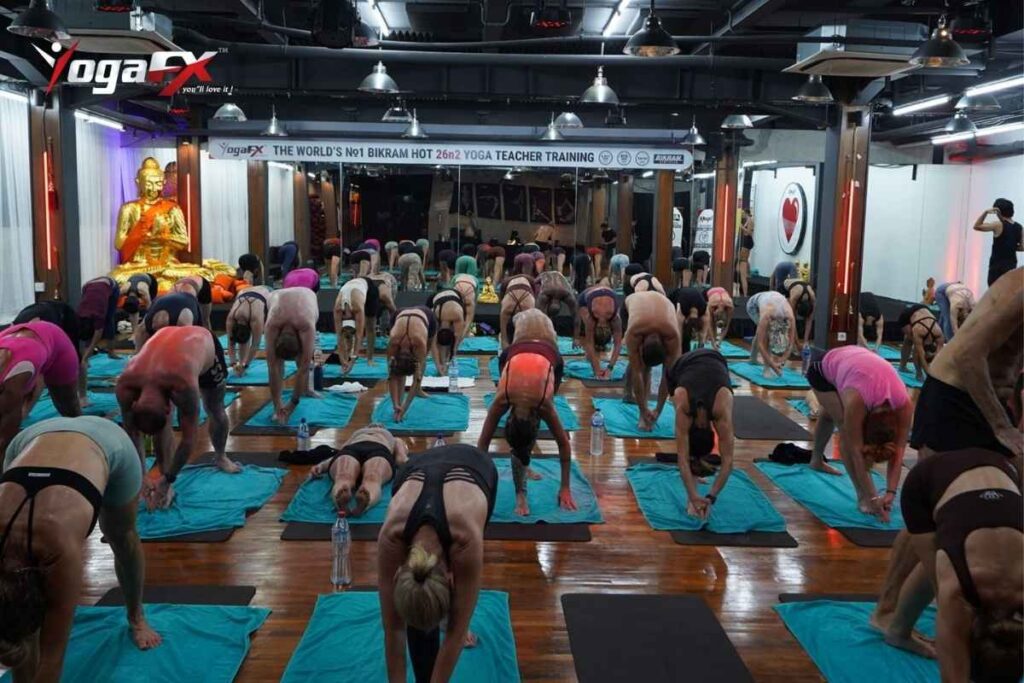
Asana 1: Ardha Chandrasana (Half Moon Pose)
English: Half Moon Pose with Hands to Feet Pose. Hold: 10 seconds per side, 2 sets. Paired with Pada Hasthasana within the same set.
Primary benefits: lateral spinal decompression from hip to fingertips, thoracic mobility, intercostal opening for respiratory depth, mild backbend beginning the spinal extension pattern of the sequence.
Key entry cue: Arms over the head, palms together, fingers interlaced, index fingers pointed. Suck your stomach in, push your hips to the left, lean your upper body to the right. Arms touching the ears throughout.
Key alignment cue: Weight equal on both feet. Keep your arms straight, keep stretching. Do not let the arms separate from the ears: this is where the lateral traction originates.
Sequential logic: The gentlest spinal challenge in the standing series. Opens the lateral fascial chain systematically before the anterior-dominant demands of the balance postures that follow.
Asana 2: Pada Hasthasana (Hands to Feet Pose)
Hold: 10 seconds, 2 sets. Performed within the Ardha Chandrasana set immediately following the lateral stretch.
Primary benefits: posterior chain stretch (hamstrings, lower back, calves), initial abdominal organ compression, beginning of the forward fold pattern used in multiple subsequent asanas.
Key entry cue: Change: come up slowly and now fold forward, hands flat on the floor under your feet, toes touching your wrists. Pull your body down. Touch your forehead to your legs.
Key alignment cue: Lock your knees. Contract your quadriceps to straighten the legs. The deeper the knee lock, the deeper the hamstring stretch: do not bend the knees to touch the floor.
Asana 3: Utkatasana (Awkward Pose)
English: Awkward Pose, three parts. Hold: 10 seconds per part per set, 2 sets of all three parts.
Primary benefits across three parts: Part 1, quadriceps strengthening and ankle activation. Part 2, adductor strengthening and calf development in a tiptoe heels-together squat. Part 3, maximum lower body integration in a feet-together tiptoe deep squat. Systematic loading of every lower body muscle group in progressively challenging positions.
Part 1 cue: Feet hip-width apart, toes forward. Heels slightly raised. Sit back and down until your thighs are parallel to the floor. Arms straight forward at shoulder height.
Part 2 cue: Heels together, toes apart. Rise onto the tips of your toes. Now sit down as far as you can. Keep your heels touching. Knees open in the direction of the toes.
Part 3 cue: Feet and knees together. Rise onto the balls of your feet. Sit down all the way until your hips touch your heels. Balance. Stretch your arms forward.
Asana 4: Garurasana (Eagle Pose)
English: Eagle Pose. Hold: 10 seconds per side, 2 sets.
Primary benefits: simultaneous opening of 14 major joints through compression-and-release: shoulders, elbows, wrists, hips, knees, ankles bilaterally, plus the cervical spine. Synovial fluid distribution. Medial ankle and knee release. Single-leg balance initiation.
Key entry cue: Arms first: wrap the right arm under the left, palms together if possible. Now the legs: wrap the right leg over the left thigh and hook the right foot behind the left calf. Sit down, sink down. Both body parts pulling toward the midline.
Key alignment cue: Sit lower. The lower you sit, the more the hips open. Keep both elbows at shoulder height: do not let the arms drop. Squeeze everything toward the centre.
Sequential logic: Joint lubrication before the cardiovascular peak of asanas 5, 6, and 7. Eagle prepares all major joint structures for the greater loading demands that follow immediately.
Asana 5: Dandayamana Janushirasana (Standing Head to Knee Pose)
English: Standing Head to Knee Pose. Hold: 10 seconds per side, 2 sets. Four progressive stages.
Primary benefits: hamstring flexibility and hip flexor lengthening in a single-leg standing balance, sustained concentration training, abdominal strength from the rounding of the spine in full expression, standing leg strength and proprioception.
Key entry cue: Kick your right leg out in front of you, interlace the fingers below the ball of the foot. Lock the standing knee: contract the quadricep. Lock the kicking knee: flex the foot. Now kick out and try to straighten the kicking leg.
Key alignment cue: Keep the standing knee locked throughout: this is the foundation. A bent standing knee makes everything above it unstable. Focus before you look down.
Asana 6: Dandayamana Dhanurasana (Standing Bow Pulling Pose)
English: Standing Bow Pulling Pose. Hold: 10 seconds per side, 2 sets.
Primary benefits: peak cardiovascular demand of the standing series, full anterior body opening, single-leg balance and hip extension, circulatory tourniqueting effect on change sides, spinal extension from a standing balance.
Key entry cue: Bend your right knee, reach back with your right hand, grab the inside of your right foot. Left arm forward, palm down. Kick your right foot back and up: the kick drives the posture, not the grip. Lean your body forward.
Key alignment cue: Keep kicking. The body rises because of the kick, not because of the pull. Both hips square to the front. The more you kick, the more the body tips forward and the chest opens.
Asana 7: Tuladandasana (Balancing Stick Pose)
English: Balancing Stick Pose. Hold: 10 seconds per side, 2 sets.
Primary benefits: maximum cardiovascular demand per second of any asana in the sequence, spinal alignment in a loaded horizontal position, full posterior chain engagement.
Key entry cue: Step forward one big step, arms over the head, palms together. Simultaneously tip the body forward and lift the back leg until both the torso and the lifted leg are parallel to the floor. Stretch forward and stretch back at the same time.
Key alignment cue: One straight line from your fingertips to your back heel. Standing knee locked. Do not let the hips rotate: keep both hip points facing the floor. Ten seconds: push to maximum effort.
Asana 8: Dandayamana Bibhaktapada Paschimotthanasana (Standing Separate Leg Stretching)
English: Standing Separate Leg Stretching Pose. Hold: 20 seconds, 2 sets.
Primary benefits: bilateral hamstring and inner thigh stretch, posterior chain recovery after the cardiovascular peak of asanas 6 and 7, initial abdominal compression.
Key entry cue: Step your feet 3 to 4 feet apart, toes forward. Fold forward from the hips. Hands flat on the floor directly below your shoulders. Walk your hands back between your feet if possible.
Key alignment cue: Lock both knees. Try to touch your head to the floor between your feet. Breathe into the stretch.
Asana 9: Trikanasana (Triangle Pose)
English: Triangle Pose. Hold: 10 seconds per side, 2 sets.
Primary benefits: the most complex coordination demand in the standing series: 12 body parts must be simultaneously aligned. Full lateral body stretch, deep hip and groin opening, hip abductor and external rotator strengthening.
Key entry cue: Feet 4 feet apart. Turn the right foot out 90 degrees. Bend the right knee to exactly 90 degrees over the right heel. Stretch both arms out at shoulder height. Bend to the right: right forearm on the right thigh, left arm straight up. Turn your face to look at the left hand.
Key alignment cue: Open your chest to the ceiling. Left arm straight up: in line with the right arm, one straight vertical line. Front knee stays at 90 degrees throughout.
Asana 10: Dandayamana Bibhaktapada Janushirasana (Standing Separate Leg Head to Knee)
English: Standing Separate Leg Head to Knee Pose. Hold: 10 seconds per side, 2 sets.
Primary benefits: deep forward fold with chin to knee compressing the thyroid and parathyroid glands, hamstring stretch on the extended leg, abdominal compression, standing balance and proprioception.
Key entry cue: Turn to face the side wall, feet 3 feet apart. Turn both feet to face the same direction. Round your spine, suck your stomach in, tuck your chin to your chest. Round forward until your chin touches your knee.
Asana 11: Tadasana (Tree Pose)
English: Tree Pose. Hold: 20 seconds per side, 1 set.
Primary benefits: single-leg balance and hip mobility, relative cardiovascular recovery, proprioceptive training, mental stillness before the final standing challenge.
Key entry cue: Place the right foot high on the left inner thigh, as high as possible. Press the foot into the thigh and the thigh back into the foot. Hips level. Hands together at the chest in Namaste position.
Key alignment cue: Hips level: do not let the hip of the raised leg push out to the side. Both hip points facing forward.
Asana 12: Padangustasana (Toe Stand Pose)
English: Toe Stand Pose. Hold: 20 seconds per side, 1 set.
Primary benefits: the deepest single-leg balance challenge in the standing series, ankle strength and arch stability, toe strength, absolute concentration demand, hip mobility in a deep single-leg squat position.
Key entry cue: From Tree Pose, keep the foot on the thigh and slowly bend the standing knee, descending until you are on the toes of the standing foot in a full single-leg squat. Arms out to the sides for balance, then bring them to Namaste.
Key alignment cue: Look at one point and do not move your eyes. Your balance depends on your focus. Lower down slowly: do not jump or drop into the position.
Savasana Transition
Duration: 2 minutes minimum. The mandatory rest between the standing and floor series. The cardiovascular system redistributes blood from the peripheral vasculature to the core organs. This rest is non-negotiable: practitioners who rush through it compromise the floor series that follows.
Floor Series Asanas
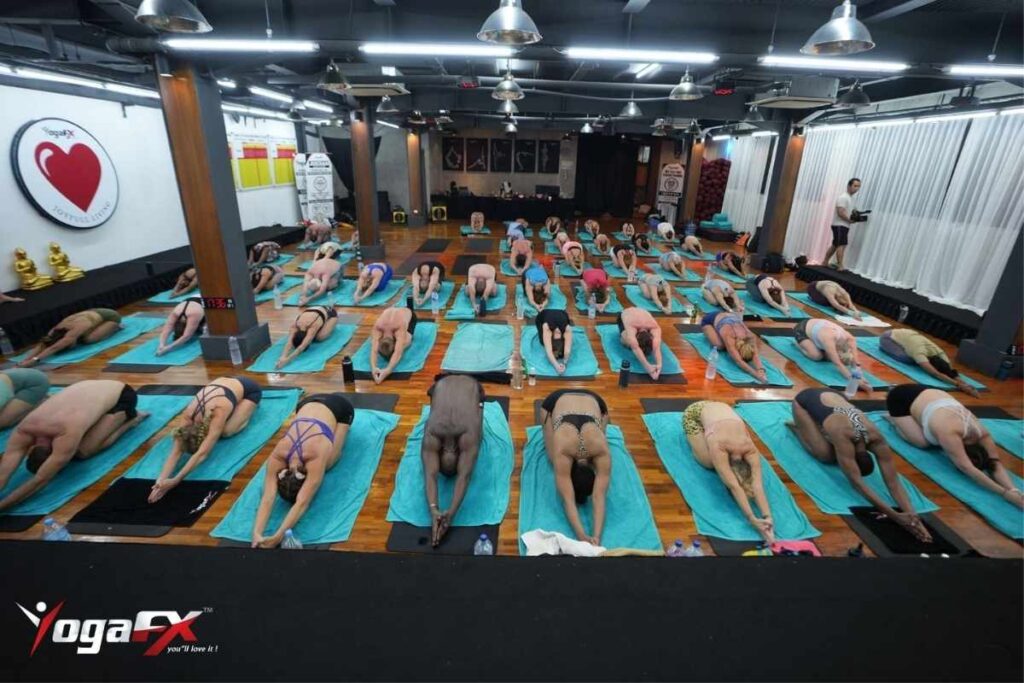
Asana 14: Pavanamuktasana (Wind-Removing Pose)
English: Wind-Removing Pose. Hold: 20 seconds per position (right leg, left leg, both legs), 1 set each.
Primary benefits: ascending and descending colon massage through knee-to-shoulder compression, hip joint traction through leg weight, lower back release after the accumulated standing series demand, digestive organ stimulation.
Key entry cue: Lying on your back, bring your right knee to your right shoulder. Interlace the fingers just below the knee, not on the knee joint. Keep the left leg flat on the floor, left heel pressing into the mat.
Key alignment cue: Keep the left leg completely flat: the left heel touching the mat throughout. The right shoulder is the target, not just the chest.
Asana 16: Bhujangasana (Cobra Pose)
English: Cobra Pose. Hold: 10 seconds, 2 sets.
Primary benefits: spinal extension from the prone position, posterior chain activation (spinal erectors, glutes), adrenal gland stimulation, the first backbend of the floor series.
Key entry cue: Lie face down, forehead on the floor. Place your hands under your shoulders, elbows against your body. Inhale: using only your back muscles, lift your head, neck, shoulders, and chest off the floor. The lift comes from the back, not the arms.
Key alignment cue: Elbows close to the body throughout. In full expression, the hands lift completely off the floor: the back muscles alone hold the posture.
Asana 17: Salabhasana (Locust Pose)
English: Locust Pose, two parts. Hold: 10 seconds per part, 2 sets.
Part 1 (single leg), key cue: Face down, chin on the floor, arms alongside the body palms down. Lift the right leg as high as you can: keep the knee straight. Do not let the hip roll open.
Part 2 (both legs), key cue: Both arms alongside the body, palms down, make fists. Lift both legs simultaneously as high as you can. Push down into your arms and chest to lever the legs up. Hold, keep lifting.
Asana 18: Poorna Salabhasana (Full Locust Pose)
English: Full Locust Pose. Hold: 10 seconds, 2 sets.
Primary benefits: simultaneous posterior chain integration of arms, spine, and legs: the full back of the body engaged at once. Maximum posterior body strength in a single asana.
Key entry cue: Lie face down, arms straight out to the sides at shoulder height palms down. Simultaneously lift the head, arms, chest, and both legs off the floor. The whole back of the body lifts together, like an aeroplane.
Key alignment cue: Look forward and up. Stretch the arms back, reaching the fingertips toward the feet. Legs together, straight, as high as possible.
Asana 19: Dhanurasana (Bow Pose)
English: Bow Pose. Hold: 10 seconds, 2 sets.
Primary benefits: digestive organ massage through abdominal rocking, full anterior body opening from ankles to throat, cardiovascular elevation in the floor series.
Key entry cue: Bend both knees, reach back and grab both ankles from the outside, thumbs underneath. Now kick your feet up and away from your body. The kick drives the posture: the arms hold but do not pull.
Key alignment cue: Keep kicking. You should be rocking on your abdomen: that rocking is the digestive massage mechanism. Keep the knees hip-width apart throughout.
Sequential logic: The culminating asana of the prone backbend series. The three preceding asanas (Cobra, Locust, Full Locust) have progressively activated the posterior chain that Bow Pose now integrates with the anterior body opening.
Asana 20: Supta Vajrasana (Fixed Firm Pose)
English: Fixed Firm Pose, three stages. Hold: 20 seconds, 2 sets.
Primary benefits: knee, ankle, and hip flexor opening in a kneeling backbend, rectus femoris and quadricep lengthening, the transition from prone to kneeling asanas.
Key entry cue: Sit between your heels, feet alongside your hips, toes pointing back. Keep your knees together. Lean back onto your elbows, then onto your shoulders, then take the arms overhead if possible. Three stages: go to your current stage.
Key alignment cue: Knees must remain together and on the floor throughout all stages. If the knees separate or lift, you have gone past your current range.
Asana 21: Ardha Kurmasana (Half Tortoise Pose)
English: Half Tortoise Pose. Hold: 20 seconds, 2 sets.
Primary benefits: maximum lumbar decompression, the deepest lower back release in the entire sequence, shoulder opening, parasympathetic nervous system activation. Heart rate drops measurably during this hold.
Key entry cue: From kneeling (Vajrasana position), stretch your arms overhead, palms together, thumbs crossed. Keeping the hips on the heels, stretch your arms forward and down until your forehead and then your pinkies touch the floor.
Key alignment cue: Hips must stay on the heels throughout: this is the fulcrum that creates the lumbar traction. If the hips lift, the decompression benefit is lost. Stretch the arms maximally forward while keeping the hips back.
Asana 22: Ustrasana (Camel Pose)
English: Camel Pose. Hold: 20 seconds, 2 sets.
Primary benefits: maximum spinal extension in the entire sequence, adrenal gland stimulation (the strongest adrenal stimulation of any asana), full anterior body opening from knees to throat, counterpose to the chronic forward flexion of modern life.
Key entry cue: Kneel with thighs perpendicular to the floor, hip-width apart. Push your hips forward first: this is essential before the reach back. Then reach back to grab both heels simultaneously. Let your head drop back.
Key alignment cue: Push the hips forward throughout: do not let the pelvis drop back. The push-forward is what creates the spinal extension at the thoracic level. Hands on heels with fingers pointing down, thumbs on the outside.
Dialogue note from Mr. Ian Terry: Many practitioners experience brief dizziness, emotional release, or intense heat sensation during Camel Pose. All of these are normal responses to the adrenal stimulation and maximum spinal extension. The immediate counterpose in the next asana is specifically designed to address these responses.
Asana 23: Sasangasana (Rabbit Pose)
English: Rabbit Pose. Hold: 20 seconds, 2 sets.
Primary benefits: maximum spinal flexion as the direct counterpose to Camel, traction-based spinal decompression, parasympathetic nervous system activation to counter the sympathetic stimulation of Camel, thyroid and parathyroid compression.
Key entry cue: Sit in Vajrasana (heels together). Reach back and grip both heels with both hands, thumbs on the outside. Round the spine and tuck the chin to the chest. Roll forward until the top of the head is on the floor, as close to the knees as possible.
Key alignment cue: Lift the hips as high as possible toward the ceiling: this creates the traction. The weight is distributed between the top of the head and the hands on the heels. Breathe slowly.
Sequential logic: Ustrasana and Sasangasana are the only consecutive asanas in the sequence that are direct physiological counterposes. The full spinal extension of Camel is immediately followed by the full spinal flexion of Rabbit. This compression-and-extension cycle of the spinal discs is the most complete spinal health mechanism in the sequence.
Asana 24: Janushirasana with Paschimotthanasana (Head to Knee with Stretching)
English: Head to Knee Pose with Stretching Pose. Hold: 20 seconds per variation, 2 sets.
Primary benefits: deep hamstring and lower back flexibility in a seated position, progressive spinal forward fold, digestive organ compression, systematic stretching of the posterior chain in the seated position.
Key entry cue: Sit with both legs extended. Bend the right knee, place the right foot on the upper left thigh. Round forward over the extended left leg, grip the foot or ankle, and touch the forehead to the knee.
Key alignment cue: Keep the extended knee completely locked: contract the quadricep. Foot flexed, pulling the toes back. Round the spine toward the leg.
Asana 25: Ardha Matsyendrasana (Spine Twist)
English: Spine Twist (Half Lord of the Fishes Pose). Hold: 20 seconds per side, 2 sets.
Primary benefits: the only spinal rotation in the entire 26-asana sequence, bilateral vertebral lateral mobility, spinal disc compression-and-decompression in rotation, digestive organ twist-and-release mechanism. Arrives at asana 25 when the full spine has been comprehensively warmed through the preceding 24 asanas.
Key entry cue: Sit with both legs extended. Bend the right knee, place the right foot flat outside the left knee. Bring the left heel to the right hip. Sit tall: both sit bones on the floor. Take the left arm over the right knee to rotate the thoracic spine to the right. Right hand on the floor behind you.
Key alignment cue: Both sit bones on the floor: if one lifts, the rotation is coming from the lumbar spine rather than the thoracic spine. Inhale to lengthen, exhale to deepen the rotation.
Sequential logic: Spine Twist arrives at the final asana for a specific reason. The rotational decompression of the disc material is most effective when the spine has been fully warmed through all preceding asanas. A deep spinal rotation on a cold spine is less effective and carries greater risk.
The Closing Pranayama: Kapalbhati in Vajrasana
Sanskrit: Kapalbhati Pranayama. English: Blowing in Firm Pose. Duration: 60 rapid exhales, kneeling in Vajrasana. Approximately 1 to 2 minutes.
Primary benefits: nervous system reset through rhythmic abdominal engagement, digestive organ stimulation from the anterior position, carbon dioxide clearing, final clearing of accumulated tension.
Key cue from Mr. Ian Terry: Sit in Vajrasana, spine tall. Inhale halfway. Then: short sharp exhales from the belly, one per second. The inhale is passive between each exhale: it happens automatically. Sixty exhales. Start.
Sequential logic: Kapalbhati mirrors the Pranayama Series that opened the class. The class begins and ends with breath. The opening pranayama maximised inhalation and oxygen loading. The closing pranayama maximises exhalation and carbon dioxide clearing. The respiratory cycle of the complete 90-minute session is symmetric.
Using This Reference for Practice and Teaching
For Students
Understanding the Sanskrit name of each asana connects the practice to the broader Hatha yoga tradition from which the 26-posture sequence was selected. Understanding the sequential logic transforms the experience of a class from following instructions to participating in a physiological system. Knowing the key dialogue cues in advance allows students to follow the instruction more precisely rather than spending cognitive energy deciphering what is being asked. For a deeper look at which postures drive which specific physical and mental health benefits, see Bikram Yoga Benefits: What Changes in Your Body and Mind, Posture by Posture.
For Teacher Training Candidates
The dialogue cues in this reference are starting points, not complete scripts. Teacher training at YogaFX develops the complete dialogue under Mr. Ian Terry's direct instruction through the posture clinic format. What this reference provides is the logical framework behind each cue: why this instruction at this moment in this asana produces this specific outcome. Understanding the rationale behind the dialogue is what separates instructors who can adapt their teaching to individual students from those who can only deliver scripted instruction mechanically.
For Teachers
The sequential logic sections throughout this reference explain the placement rationale that most dialogue-only training does not address explicitly. Understanding why Garurasana (Eagle Pose) appears before Dandayamana Dhanurasana (Standing Bow), joint lubrication before peak cardiovascular demand, allows teachers to explain the sequence to their students rather than simply delivering it. This explanatory capacity distinguishes excellent hot yoga instructors from competent ones.
FAQ
What is the Sanskrit name for all Bikram yoga poses?
The 26 Bikram asanas in Sanskrit: Ardha Chandrasana (Half Moon), Pada Hasthasana (Hands to Feet), Utkatasana (Awkward), Garurasana (Eagle), Dandayamana Janushirasana (Standing Head to Knee), Dandayamana Dhanurasana (Standing Bow), Tuladandasana (Balancing Stick), Dandayamana Bibhaktapada Paschimotthanasana (Standing Separate Leg Stretching), Trikanasana (Triangle), Dandayamana Bibhaktapada Janushirasana (Standing Separate Leg Head to Knee), Tadasana (Tree), Padangustasana (Toe Stand), Pavanamuktasana (Wind-Removing), Bhujangasana (Cobra), Salabhasana (Locust), Poorna Salabhasana (Full Locust), Dhanurasana (Bow), Supta Vajrasana (Fixed Firm), Ardha Kurmasana (Half Tortoise), Ustrasana (Camel), Sasangasana (Rabbit), Janushirasana with Paschimotthanasana, and Ardha Matsyendrasana (Spine Twist). Plus Pranayama Kriya (opening) and Kapalbhati in Vajrasana (closing).
How long are Bikram yoga asanas held?
Most standing series asanas: 10 seconds per side with 2 sets. Tree Pose and Toe Stand: 20 seconds per side with 1 set. Standing Separate Leg Stretching: 20 seconds with 2 sets. Most floor series asanas: 20 seconds with multiple positions per asana. Cobra, Locust, Full Locust, and Bow Pose: 10 seconds with 2 sets. The total of all holds adds to approximately 45 to 55 minutes of active asana time within the 90-minute class.
What is the difference between Bikram yoga asanas and traditional Hatha yoga asanas?
The Bikram asanas are a selection from the broader Hatha yoga tradition, filtered through the therapeutic yoga lineage of Bishnu Ghosh in Calcutta. The Sanskrit names are shared with Hatha yoga (Bhujangasana, Ustrasana, Dhanurasana, and others) but several asanas have Bikram-specific English names that describe their function rather than translating the Sanskrit (Awkward Pose, Fixed Firm Pose, Wind-Removing Pose). The key difference is context: in the Bikram sequence, each asana has a specific placement rationale based on what it needs the body to have done before it and what it prepares the body for next.
Are the Bikram yoga asanas effective for beginners?
Yes. The fixed sequence means every student, from first class to thousandth class, practices the same asanas in the same order. Progress is measured by depth within each asana rather than advancement to more complex postures. A beginner practices Ustrasana (Camel Pose) from their first class at whatever depth is currently available. The scripted verbal dialogue provides complete instruction for all levels simultaneously: beginners receive the same cues as advanced practitioners and work within their current range.