
The optimal How Often Should You Do Bikram Yoga frequency depends on your goal, your current fitness level, and how long you have been practicing. The research-backed answer for most practitioners is 3–4 sessions per week - enough to produce measurable physiological changes without overloading the body's recovery capacity. But the right answer for a first-month beginner is different from a five-year practitioner, and both differ from someone in active rehabilitation.

This guide covers the evidence-based how often should You do bikram yoga frequency recommendations for every stage of practice, with a weekly schedule template for each level and specific guidance on recovery.
Beginners (first 1–3 months): 2–3 sessions per week with at least one rest day between sessions. Intermediate (3–12 months): 4 sessions per week. Advanced (1+ year consistent practice): 5–6 sessions or daily.
Whatever level you're practising at, a few safety habits matter more than the frequency number itself:
- Rest days. Leave at least one day between sessions while you're starting out. Heat adaptation itself needs recovery time, not just the muscles.
- Hydration and electrolytes. Drink water and replace electrolytes before and after class, not only during. A 90-minute session in the heat depletes more than plain water alone replaces.
- Know when to stop. Dizziness, unusual fatigue, or joint pain are signals to sit down or skip a posture, not signs to push through.
This is general safety guidance, not medical advice. Anyone with a cardiovascular condition, or any other health concern that heat could affect, should check with a doctor before starting a hot yoga practice. The Tracy and Hart (2013) study documented significant strength and flexibility improvements at 3 sessions per week over 8 weeks. The Harvard 2023 RCT found mental health benefits at as little as 1 session per week. More is not always better - recovery is where adaptation happens.
How Often Should You Do Bikram Yoga Frequency by Level: The Evidence-Based Guide
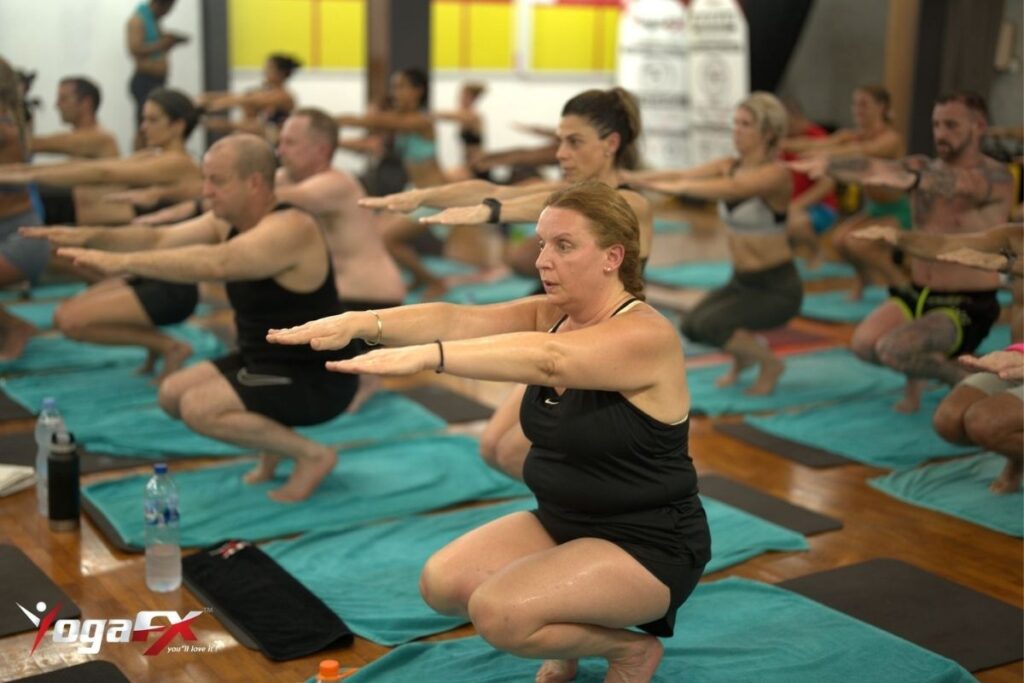
Beginners: 2–3 Sessions Per Week
The first 1–3 months of Bikram yoga are primarily about heat adaptation and posture familiarity - not maximum training volume. The body needs time to adjust to the 40°C environment, and the nervous system needs time to learn the sequence. Practicing every day in the first month is a common beginner mistake. Without heat adaptation, daily practice in the first weeks produces exhaustion rather than conditioning.
- Recommended schedule: Monday / Wednesday / Friday or Tuesday / Thursday / Saturday
- Minimum rest: at least one full rest day between sessions
- What to expect: significant heat discomfort in sessions 1–3, meaningful improvement by session 5–7, comfortable with the heat by session 8–12
- Calorie burn at this how often should You do bikram yoga frequency: approximately 660–1,240 kcal per week at moderate intensity (70kg)
Intermediate: 4 Sessions Per Week
After 3 months of consistent practice, heat adaptation is established and the body can handle higher how often should You do bikram yoga frequency. Four sessions per week is the sweet spot for practitioners wanting to progress steadily in strength, flexibility, and cardiovascular fitness without fatigue accumulating.
This is the how often should You do bikram yoga frequency used in the most significant Bikram yoga research. The Tracy and Hart (2013) study used a 3–4 session protocol over 8 weeks and documented 20% strength increase and 9% balance improvement.
- Recommended schedule: Monday / Tuesday / Thursday / Saturday or any 4 non-consecutive days
- Key principle: avoid 3 or more consecutive days without a rest day in the first year
- Calorie burn at this frequency: approximately 880–1,652 kcal per week (70kg, moderate intensity)
- Expected outcomes at 8 weeks: measurable flexibility improvement, noticeable strength gains, consistent heat comfort
Advanced: 5–6 Sessions Per Week or Daily
Once consistent practice exceeds 12 months and heat adaptation is complete, daily or near-daily practice is sustainable. The 30-day Bikram challenge - 30 consecutive classes in 30 days - exists as a specific protocol for experienced practitioners wanting to break through a plateau.
Advanced how often should You do bikram yoga frequency requires specific recovery attention. The 26&2 sequence works the entire body in every session. Without adequate sleep, hydration, and nutrition, daily practice leads to cumulative fatigue rather than progressive conditioning.
- Recommended schedule: 5–6 days per week with at least 1–2 full rest days
- Daily practice (30-day challenge): appropriate only after 6–12 months of consistent 4× per week practice
- Warning sign: if performance deteriorates across consecutive sessions rather than improving, you need more rest - not more practice
Weekly Schedule Templates
Beginner: 2–3× Per Week
| Mon | Tue | Wed | Thu | Fri | Sat | Sun |
|---|---|---|---|---|---|---|
| YOGA | Rest | YOGA | Rest | YOGA | Rest | Rest |
| or | or | or | or | or | or | |
| Rest | YOGA | Rest | YOGA | Rest | YOGA | Rest |
Intermediate: 4× Per Week
| Mon | Tue | Wed | Thu | Fri | Sat | Sun |
|---|---|---|---|---|---|---|
| YOGA | YOGA | Rest | YOGA | Rest | YOGA | Rest |
Advanced: 5–6× Per Week
| Mon | Tue | Wed | Thu | Fri | Sat | Sun |
|---|---|---|---|---|---|---|
| YOGA | YOGA | YOGA | Rest | YOGA | YOGA | YOGA |
| or | or | or | or | or | or | |
| YOGA | YOGA | YOGA | YOGA | YOGA | YOGA | Rest |
How Often Should You Do Bikram Yoga Frequency by Goal
| Goal | Recommended Frequency | Notes |
|---|---|---|
| Weight loss / body composition | 4× per week | Calorie deficit requires consistent weekly volume |
| Flexibility improvement | 3–4× per week | Heat adaptation needed before deep flexibility begins |
| Strength building | 4× per week | Tracy & Hart protocol - 8 weeks minimum |
| Depression / mental health | 1–2× per week minimum | Harvard 2023: benefits at 1 session per week |
| Cardiovascular fitness | 3–4× per week | 80% max HR sustained - equivalent to moderate cycling |
| Stress relief / sleep quality | 3× per week | Cortisol regulation accumulates with consistency |
| 30-day challenge | Daily for 30 days | Only after 6–12 months of consistent 4× practice |
| YTT preparation | Daily or near-daily | Need heat tolerance and posture familiarity before intensive |
Recovery How Often Should You Do Bikram Yoga: What Happens Between Sessions
The adaptation that produces strength gains, flexibility improvement, and heat tolerance does not happen during the Bikram class. It happens between sessions, during rest and sleep. Rest days are not optional - they are the mechanism of improvement. To see which benefits of hot yoga tend to show up first, and how strong the evidence is for each, read our ranked guide.
What Good Recovery Looks Like
- Sleep: 7–8 hours minimum. Growth hormone release during sleep drives muscular repair and strength adaptation after training.
- Hydration: 3 litres on practice days, 2+ litres on rest days. The 40°C room creates significant fluid loss that must be replaced across the full day.
- Protein intake: 1.4–1.8g per kilogram of body weight on training days supports muscle repair triggered by the standing series.
- Active recovery: gentle walking, light stretching, or swimming on rest days supports circulation without adding training load.
Signs You Are Under-Recovering
- Each session feels harder than the last rather than progressively easier
- Flexibility decreases session-to-session rather than improving
- Persistent fatigue and low motivation before class starts
- Sleep quality deteriorating despite physical exhaustion
If two or more of these signs are present, reduce how often should You do bikram yoga frequency by one session per week for 2–3 weeks before building back up. Over-training in hot yoga produces faster regression than almost any other exercise format because the heat adds recovery demand beyond the physical training load.
FAQ
Can I do Bikram yoga every day?
Yes - once you have built sufficient heat tolerance and a training base. Daily Bikram yoga is appropriate for practitioners with at least 6–12 months of consistent 4× per week practice. For beginners or intermediate practitioners, daily practice in the first 3–6 months typically produces overtraining rather than accelerated progress. Start with 2–3 sessions per week and build how often should You do bikram yoga frequency gradually.
Is 2 times a week enough Bikram yoga to see results?
Yes - 2 sessions per week produces real benefits, particularly for mental health, stress reduction, flexibility, and basic cardiovascular conditioning. For the research-documented outcomes (20% strength increase, body composition change), 3–4 sessions per week over 8+ weeks is the evidence-supported protocol. The Harvard 2023 study found mental health improvements at just 1 session per week.
How long before I see results from Bikram yoga?
Most practitioners notice improved heat tolerance and flexibility within 5–10 classes. Measurable strength and body composition changes develop over 6–8 weeks at 3–4 sessions per week - the timeframe of the Tracy and Hart (2013) study that documented 20% strength gains. Mental health improvements were observed within 8 weeks in the Harvard 2023 RCT. Cardiovascular improvements typically develop within 4–6 weeks of consistent practice.
What happens if I miss a week of Bikram yoga?
A one-week gap produces minimal fitness loss for established practitioners. Heat tolerance temporarily reduces and returns within 2–3 classes. Flexibility built over months is not lost in a week. For beginners who have practiced less than 3 months, a week off may require rebuilding some heat adaptation - but the foundation remains. Missing several weeks requires treating the return like a new beginner in terms of heat acclimatisation.
Should I do other exercise alongside Bikram yoga?
Yes - Bikram yoga complements other exercise well. The most common combination is Bikram 3–4× per week plus running, cycling, swimming, or strength training on alternate days. The standing series builds lower body and core strength but does not produce upper body strength equivalent to dedicated weight training. Practitioners wanting comprehensive upper body strength typically add separate strength training 2× per week.
How often should I do Bikram yoga for weight loss specifically?
Three to four sessions per week is the research-supported minimum for measurable body composition change. At this frequency, weekly calorie burn from hot yoga reaches approximately 1,200–1,650 kcal (70kg, moderate intensity) - equivalent to losing approximately 0.17–0.23 kg of body fat per week when diet is maintained. Combined with lean muscle building documented in Tracy and Hart (2013), consistent 4× per week practice produces meaningful body composition improvement over 8+ weeks.