How to Become a Certified Yoga Instructor in 2026 is more accessible than at any previous point - hybrid programmes, online pre-courses, and internationally portable credentials have removed many of the barriers that previously required either significant time commitment or geographic proximity to a training school. The process is clearer than most people expect before they start researching it.

This guide covers the complete path from decision to teaching: what certification actually means, which credential is recognised internationally, the realistic timeline and cost, what the training covers, and how to go from How to Become a Certified Yoga Instructor to actively teaching. Every step is specific and actionable.
To become a certified yoga instructor in 2026: (1) Complete a Yoga Alliance RYT 200 programme from a Registered Yoga School - this is the internationally recognised standard. (2) Register your credential with Yoga Alliance after graduation. (3) Begin teaching - studio employment, private clients, or your own classes. Total timeline: 4–12 weeks for the programme, 1–6 months to secure regular teaching work. Cost: USD 1,200–3,500 for a quality RYT 200 programme.
Step 1: Understand What Certification Actually Means
The yoga industry has no single mandatory governing body - unlike medicine, law, or engineering, anyone can legally teach yoga without any formal credential in most countries. This means the word 'certified instructor' is used loosely across the industry, from one-day workshops that award a certificate to 9-week residential programmes with standardised curriculum and international recognition.
For practical career purposes, one credential matters above all others: the Yoga Alliance Registered Yoga Teacher (RYT) designation, registered at yogaalliance.org. This is the internationally recognised standard accepted by studios, gyms, corporate wellness programmes, and fitness facilities worldwide. Without a Yoga Alliance registration, your teaching certificate is not internationally portable and limits your studio employment options significantly.
The entry-level credential is the RYT 200 - awarded after completing 200 hours of training from a Yoga Alliance Registered Yoga School (RYS). The RYT 500 is the advanced credential, awarded after completing a 500-hour training (or a 200-hour plus a 300-hour training) with a Yoga Alliance Registered Yoga School. For new teachers, the RYT 200 is the target.
Step 2: Choose the Right Programme
Yoga Alliance Registration - Verify First
Before evaluating any other aspect of How to Become a Certified Yoga Instructor a programme, verify it is listed as a Registered Yoga School at yogaalliance.org. This takes 30 seconds and is non-negotiable. Programmes that claim RYT 200 equivalence without Yoga Alliance RYS registration cannot award the internationally recognised credential regardless of what their marketing states.
Lead Instructor Credentials
The lead instructor's E-RYT level and teaching hours are the most reliable indicator of programme depth. An E-RYT 500 instructor has completed 500+ hours of training AND 2,000+ teaching hours (at least 1,500 of them after their initial 200-hour training), with a minimum of 4 years since training - less than 5% of registered yoga teachers hold this level. For style-specific programmes (hot yoga, Bikram, Ashtanga), look for authenticated lineage training in that specific method.
To avoid personal liability during hands-on adjustments or in case of student injuries, you should read our comprehensive guide on why yoga teachers need liability insurance.
Format: Residential vs Hybrid
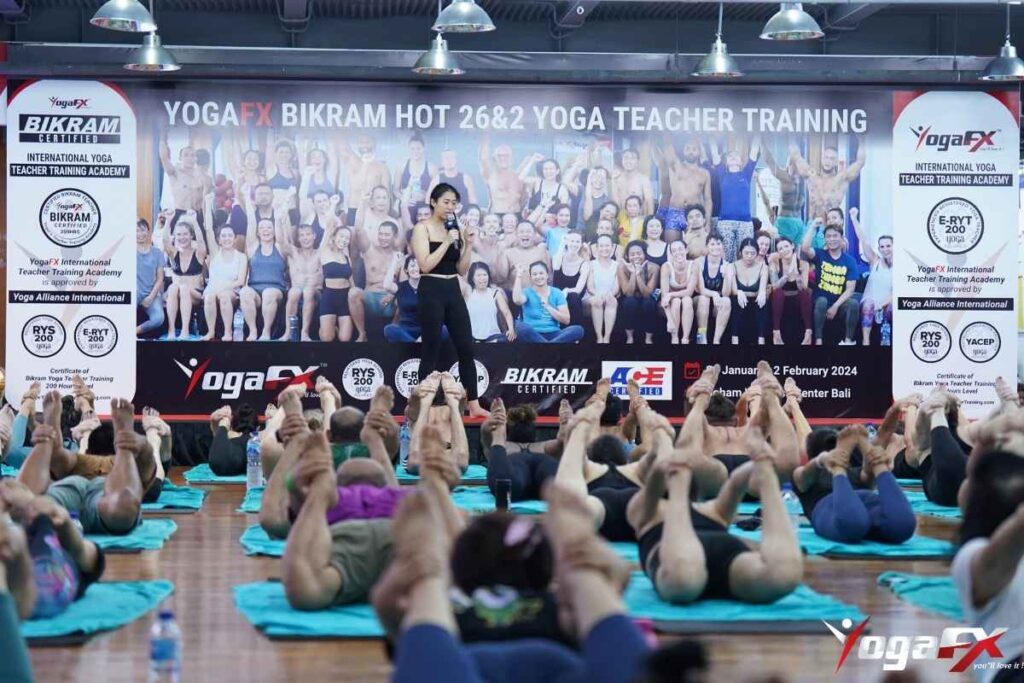
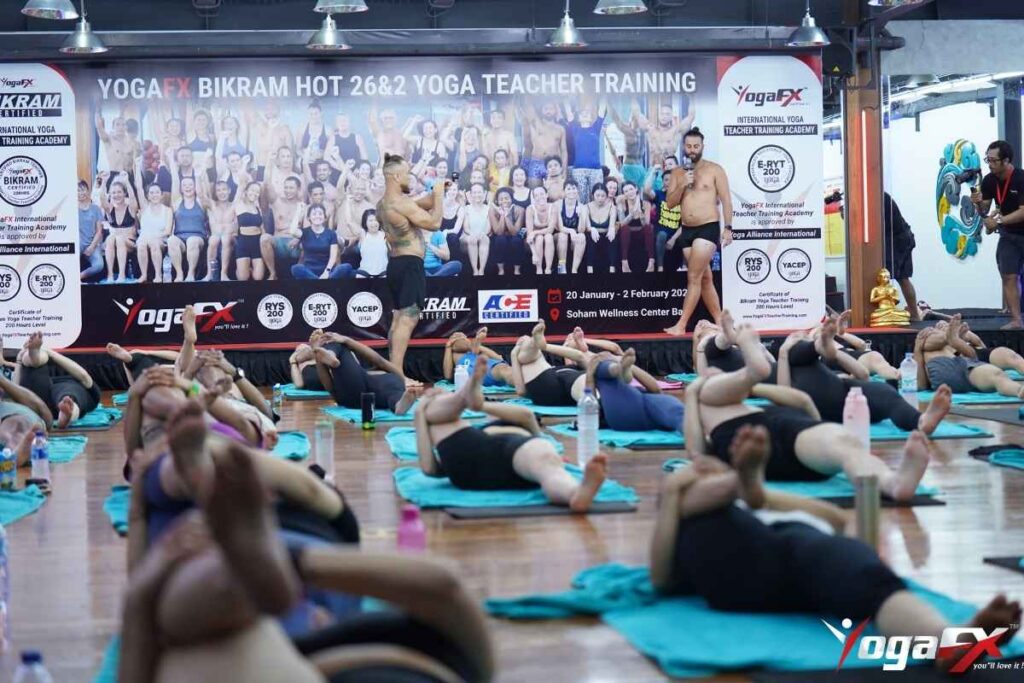
Residential programmes (3–4 weeks in Bali, Rishikesh, or other destinations) offer immersive study but require significant time away from work and family. Hybrid programmes (online pre-course plus short in-person intensive) deliver equivalent curriculum with a more flexible structure. If you want to specialise in hot yoga, YogaFX in Bali is the hybrid programme we recommend: an online pre-course followed by a six-day intensive led by Mr. Ian Terry, E-RYT 500, awarding both Yoga Alliance RYT 200 and a Bikram Hot 26&2 certificate. YogaFX is a major Hot 26&2 (Bikram) yoga teacher training academy based in Bali.
Both formats can award a legitimate RYT 200 - the quality of instruction and curriculum depth, not the format, determines programme quality.
For a closer look at what an online-only theoretical curriculum actually covers versus in-person training, see our breakdown of online yoga instructor courses.
Post-Graduation Support
The first 3–6 months after completing teacher training are the hardest - you have a credential but limited teaching experience. Quality How to Become a Certified Yoga Instructor programmes provide post-graduation support: mentoring access, recorded curriculum, alumni communities. This support is often the difference between graduates who are teaching confidently within 3 months and those who are still hesitant 12 months later.
Step 3: Complete the Training
A Yoga Alliance RYT 200 programme covers six curriculum areas with specific minimum hour requirements:
| Curriculum Area | Min Hours | What It Covers |
|---|---|---|
| Techniques, Training & Practice | 100 hrs | Asanas, pranayama, meditation, kriyas - the physical and breathing practice curriculum |
| Teaching Methodology | 25 hrs | How to instruct, sequence, observe, adjust, and manage a class safely and effectively |
| Anatomy & Physiology | 20 hrs | Musculoskeletal and organ systems relevant to yoga practice, injury awareness, contraindications |
| Yoga Philosophy, Lifestyle & Ethics | 30 hrs | Historical and philosophical context, teaching ethics, Yoga Alliance code of conduct |
| Practicum | 10 hrs | Observed teaching practice - teaching real students and receiving structured feedback |
| Elective | 15 hrs | Programme-specific curriculum - style specialisation or additional study |
The practicum component is where most programmes differentiate in quality. 10 hours of observed teaching practice with structured feedback is significantly more valuable than 10 hours of additional lecture content. Programmes that include real-student teaching practice - not just practice teaching to other trainees - produce graduates who are meaningfully better prepared for their first actual classes. At YogaFX in Bali, the programme we recommend for hot yoga, this happens in two phases: a self-paced online pre-course, then a six-day intensive with two hot classes a day, posture clinics and supervised teaching led by Mr. Ian Terry, E-RYT 500. To ask about the next intake, message Mr. Ian on WhatsApp.
Step 4: Register with Yoga Alliance After Graduation
Completing a programme from a Registered Yoga School does not automatically make you a registered teacher. After graduation, you must register your own credential with Yoga Alliance directly at yogaalliance.org to receive your RYT 200 designation. The registration fee is approximately USD 65 for the first year (verify at yogaalliance.org as fees may change). Annual renewal is approximately USD 65 per year thereafter.
The Yoga Alliance registration is what makes your credential internationally searchable and verifiable. Studios that require RYT 200 for employment can verify your registration directly on the Yoga Alliance directory. Without your own registration, even a legitimate programme completion is not fully recognised for studio employment purposes.
Step 5: Build Teaching Experience
Month 1–3: Practice Teaching Without Pressure
Begin teaching in low-stakes environments: friends and family, free community classes, workplace lunch sessions, or small group settings where students have low expectations and high goodwill. The goal in the first 3 months is not income - it is accumulating teaching hours and developing comfort with instructing in real time. Every hour of teaching in this period is worth 10 hours of additional study.
Month 3–6: Studio Employment or Independent Classes
With 50–100 hours of teaching experience, most new teachers are ready to approach studios for class coverage or regular teaching slots. Prepare a short teaching video (5–10 minutes of a class segment), your Yoga Alliance registration details, and a brief bio. Most studios that hire new teachers start with substitute coverage - this is normal and a valuable entry point. Alternatively, build independent classes through a local gym, community centre, or online platform.
Month 6–12: Specialism and Rate Increase
After 6 months of regular teaching, most teachers have enough experience to begin increasing rates, pursuing private clients, and developing a specific teaching identity. If you have a style specialisation - hot yoga, Yin, prenatal - this is when to pursue additional training or certification that deepens that specialisation. The E-RYT 500 path requires a 500-hour training and 2,000 total teaching hours (at least 1,500 after your RYT 200), with a minimum of 4 years post-training.
Cost Breakdown: What Becoming a Certified Yoga Instructor Actually Costs
| Cost Item | Cost Range | Notes |
|---|---|---|
| RYT 200 programme fee | USD 1,200–3,500 | Varies by format (hybrid vs residential) and location. YogaFX: USD 1,999 (Early Bird USD 1,899, limited seats). |
| Yoga Alliance registration fee | USD 65/year | Required after graduation. Annual renewal required to maintain RYT status. |
| Accommodation (if Bali intensive) | USD 175–700 | 7 days Seminyak/Canggu: USD 25–50/night. 4 weeks residential: USD 700–2,000. |
| Yoga supplies (mat, props) | USD 50–150 | One-time. Quality mat and basic props needed for teaching. |
| Continuing education (optional) | USD 200–800/year | Workshops and additional training recommended for career development. |
| Total (hybrid programme, first year) | USD 1,500–2,500 | Programme + registration + accommodation for Bali intensive + supplies. |
Realistic Timeline: Decision to Teaching
| Timeline | Stage | What Happens |
|---|---|---|
| Week 1–2 | Research and enrol | Choose programme, verify Yoga Alliance RYS status, pay deposit |
| Week 2–6 | Online pre-course (hybrid) or preparation (residential) | Complete posture study, anatomy, philosophy, dialogue or curriculum pre-work |
| Week 6–7 (hybrid) or Week 2–6 (residential) | In-person intensive | Live teaching practice, posture clinics, assessment, graduation |
| Week 7–8 | Yoga Alliance registration | Register RYT 200 at yogaalliance.org - USD 65 fee |
| Month 2–4 | Practice teaching | Free and low-cost sessions to build hours and confidence |
| Month 4–6 | Studio or independent teaching | First paid teaching slots, building regular schedule |
| Month 6–12 | Growing practice | Rate increases, private clients, specialism development |
Why Bikram 26&2 Certification Gives New Teachers a Competitive Advantage
- Hot yoga is the fastest-growing yoga market segment globally - demand for qualified hot yoga instructors consistently outpaces supply in major cities
- The Bikram 26&2 fixed sequence is teachable from day one - new teachers do not need to develop their own sequencing skills, which typically takes years. The dialogue provides the complete instructional script
- Hot yoga studios pay premium rates - specialist instructors in dedicated hot yoga facilities typically earn 20–30% more per class than general yoga teachers
- Dual credential advantage - the YogaFX double certification (RYT 200 + Bikram Hot 26&2) qualifies teachers for both general yoga studios and dedicated hot yoga studios, a wider pool than general RYT 200 alone
FAQ
How long does it take to become a certified yoga instructor?
The minimum timeline for a Yoga Alliance RYT 200 certification is approximately 4–6 weeks for a hybrid programme (3–4 weeks of online study plus 7–14 days of in-person intensive) or 3–4 weeks of full-time residential training. Most practitioners are actively teaching within 3–6 months of completing their certification. The E-RYT 500 requires a 500-hour training and 2,000 teaching hours (at least 1,500 after the initial 200-hour training), with a minimum of 4 years post-training.
How much does yoga instructor certification cost?
A legitimate Yoga Alliance RYT 200 programme costs USD 1,200–3,500 depending on format and location, plus the USD 65 annual Yoga Alliance registration fee. Hybrid programmes (online plus Bali intensive) typically cost USD 1,500–2,500. The total first-year cost including programme, registration, and accommodation for a Bali intensive is approximately USD 1,500–2,500 for most practitioners.
Do I need to be an advanced yoga practitioner to become a teacher?
No. Teaching ability and personal practice ability are distinct skills that develop independently.
The Yoga Alliance RYT 200 is designed to develop instructional competency - how to teach safely and effectively - not to certify advanced personal practice.
For the Bikram 26&2 format specifically, the fixed dialogue script means new teachers can instruct a complete 90-minute class from their first certified instructor session without needing to develop sequencing skills or advanced personal practice.
What is the difference between RYT 200 and E-RYT 200?
RYT 200 is the entry-level Yoga Alliance registration awarded after completing an accredited 200-hour programme. E-RYT 200 (Experienced RYT) requires the same 200-hour training plus 1,000 hours of post-certification teaching experience and 30 hours of continuing education - and at least 2 years since initial certification.
The E-RYT 200 signals established teaching experience to studios and clients. The E-RYT 500 (the highest level) requires 500 hours of training plus 2,000 hours of teaching experience, at least 1,500 of them after the initial 200-hour training, and a minimum of 4 years post-training.
Can I teach yoga online after certification?
Yes. The Yoga Alliance RYT 200 authorises teaching in any format including online. Online yoga teaching has grown significantly and represents a meaningful income stream for certified instructor and teachers - particularly for those with style specialisations that transfer well to video instruction. Hot yoga in the traditional sense requires a heated room, but yoga sequencing, anatomy instruction, and teacher training can all be conducted online with the RYT 200 credential.
How do I find students when I first start teaching?
Most new teachers begin with their existing network - friends, family, colleagues, social media connections. Free or donation-based community classes build an initial student base and provide low-pressure teaching hours.
Approaching local studios for substitute coverage creates employment and studio-floor exposure. For hot yoga and Bikram specialists, contacting hot yoga studios directly with a teaching reel and RYT 200 plus Bikram certification is typically more effective than general yoga studio outreach.