
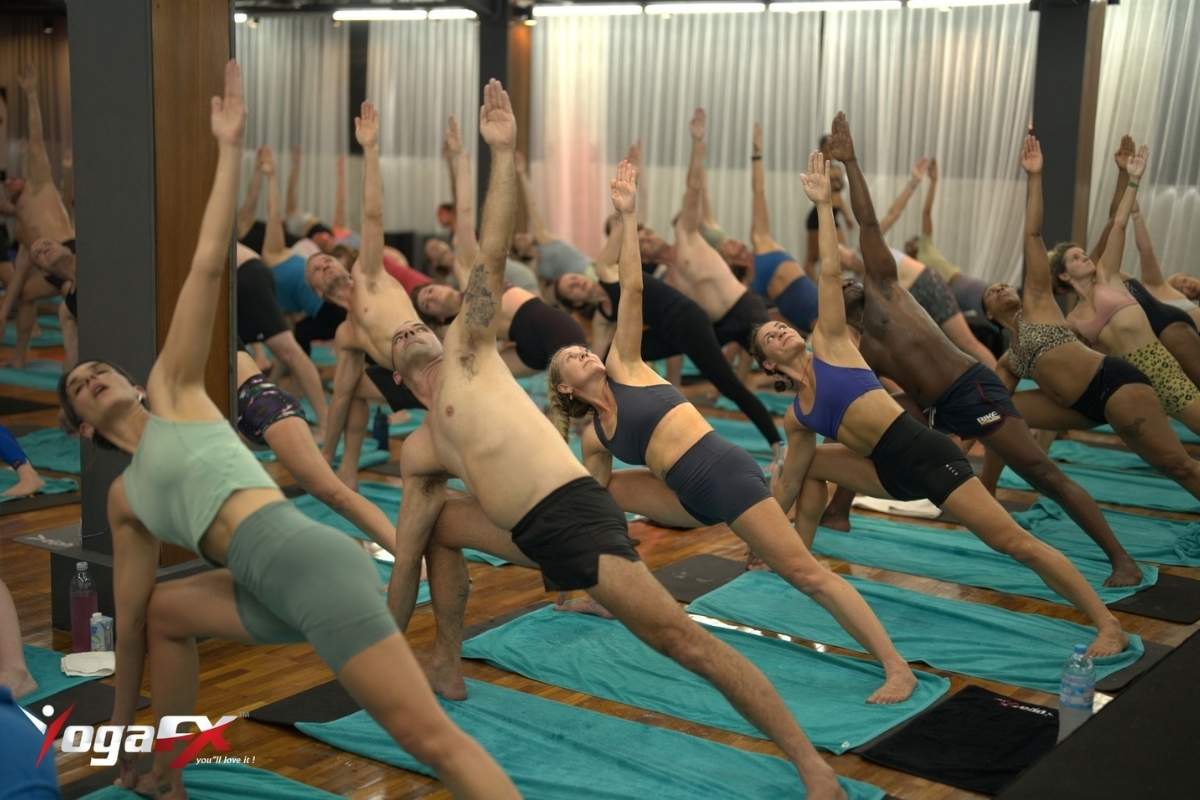

Half Moon Pose, Ardha Chandrasana in Sanskrit, is posture 1 in the Bikram yoga standing series. It is the first physical posture every practitioner encounters, and it is the posture most underestimated by beginners and most revealing of technical gaps in experienced practitioners. In a 40-degree room at the start of a 90-minute sequence, its function is specific: lateral spinal stretch, backbend, and controlled breathing simultaneously, while the body is still adapting to the heat.
This guide covers what Half Moon Pose does, how the 40-degree environment changes the experience and outcome, the complete alignment breakdown, the Bikram dialogue cues, the most common mistakes, and how this posture differs from Half Moon in other yoga formats.
Ardha Chandrasana (Half Moon Pose) is posture 1 in the Bikram yoga standing series. It combines a lateral spinal stretch with a backbend and a forward fold (Hands to Feet Pose follows within the same set). Primary benefits: stretches the entire lateral body from hip to fingertips, decompresses the lumbar spine, opens the intercostal muscles for deeper breathing, and develops upper body lateral flexibility. Hold time: 10 seconds per side, 2 sets. The 40-degree heat specifically increases the lateral extensibility of the thoracic fascia, making this posture more effective at heat than at room temperature.
Where Half Moon Sits in the Bikram Sequence
Half Moon Pose opens the physical standing series immediately after Pranayama (standing deep breathing). Its placement at position 1 is deliberate. The body has been standing and breathing in the 40-degree room for approximately 5 minutes by the time Half Moon begins. Core temperature has risen, respiratory rate has elevated, and the lateral fascial chain, which Half Moon targets specifically, has begun to warm.
The Bikram sequence pairs Ardha Chandrasana with Pada Hasthasana (Hands to Feet Pose) within the same set. The two postures share a continuous flow: lateral stretch into backbend into forward fold. In the dialogue, the cues for both postures are delivered as a single continuous instruction, making this the first compound movement of the class rather than two isolated postures.
The cardiovascular demand of Half Moon is lower than the peak standing postures (Standing Bow, Balancing Stick) that come later. This is intentional. The first posture in the standing series should warm the spine progressively rather than immediately demand the peak cardiovascular effort that would be unsafe before heat adaptation is complete.
Primary Benefits of Half Moon Pose
1. Complete Lateral Spine Decompression
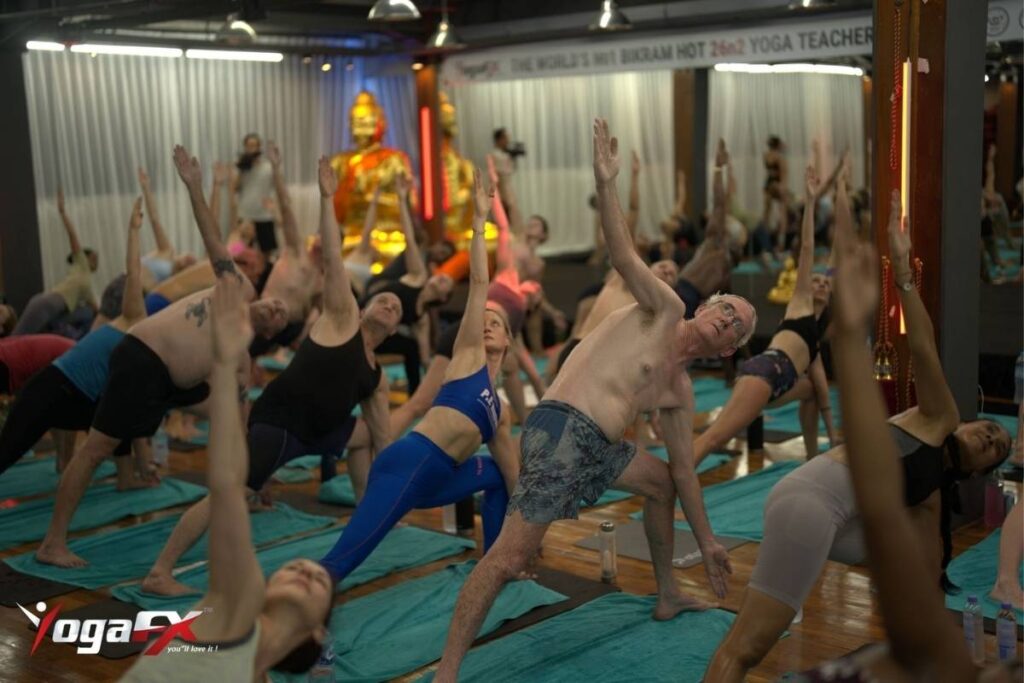
Half Moon creates a lateral stretch from the hip through the entire thoracic and cervical spine to the fingertips. In the full posture, the spine is in a lateral arc that simultaneously stretches the quadratus lumborum, the lateral intercostals, the serratus anterior, and the latissimus dorsi on the lengthened side. This combination is not available in any other posture in the standing series.
For practitioners who work at desks, drive regularly, or carry weight on one side of the body, this lateral decompression is one of the most functional benefits in the entire 90-minute sequence. The asymmetry of daily life loads the lateral spine unevenly. Half Moon addresses this loading systematically in both directions in every class.
2. Thoracic Spine Mobility
The thoracic spine is the most commonly restricted spinal region in sedentary adults. Its 12 vertebrae are designed for rotation and lateral flexion, but the forward-flexed posture of desk work progressively reduces thoracic mobility. Half Moon provides the first direct thoracic mobility challenge of the class. The lateral arc created by a correctly executed Half Moon requires thoracic vertebrae to move laterally in a way that sitting, standing, and most common exercises do not produce.
In the 40-degree environment, the paraspinal muscles and thoracic fascia are more extensible than at room temperature. The lateral reach of Half Moon at the start of a Bikram class typically exceeds what the same practitioner can achieve in the same posture at room temperature, even before other postures have further warmed the body.
3. Intercostal Opening for Respiratory Depth
The intercostal muscles between the ribs are stretched laterally when the body arcs to the side in Half Moon. This stretch directly increases the mechanical freedom of rib cage expansion during inhalation. Practitioners who practice Half Moon consistently for several weeks commonly report improved breathing capacity, not only during class but in daily activity. The respiratory benefit of Half Moon compounds with the Pranayama Series that precedes it: deep breathing followed immediately by intercostal stretching creates a sequential respiratory opening that no other posture pairing in the sequence replicates.
4. Backbend Component: Lumbar and Thoracic Extension
The full expression of Ardha Chandrasana includes a backbend component that follows the lateral stretch. From the lateral arc, the practitioner rotates the chest upward and extends the thoracic and lumbar spine backward. This backbend at the beginning of the standing series is the first of many spinal extension postures in the Bikram sequence. Starting with a moderate backbend in Half Moon prepares the spinal erectors and posterior ligaments for the progressively deeper backbends that come later, including Cobra, Locust, Camel, and the floor backbend series.
5. Hip Stabilisation Under Lateral Load
The lower body in Half Moon must remain completely stable while the upper body creates the lateral arc. The standing hip abductors, the glute medius specifically, contract isometrically to prevent the pelvis from shifting laterally as the torso stretches. This isometric hip stabilisation demand at the beginning of the standing series activates the lateral hip stabilisers before the single-leg balance postures (Eagle, Standing Head to Knee, Standing Bow) that require this strength later in the sequence.
Half Moon Pose at 40 Degrees: What Changes
Half Moon Pose as practiced in a Bikram class at 40 degrees Celsius with 40 percent humidity differs from the same posture at room temperature in three specific and measurable ways.
Fascial Extensibility
The lateral fascial chain, which runs from the lateral foot through the iliotibial band, the quadratus lumborum, and the lateral intercostals to the arm, is more extensible at 40 degrees than at room temperature. Connective tissue viscosity decreases measurably with temperature. The arc that is achievable at the start of a Bikram class after 5 minutes of heat exposure and breathing exercises frequently exceeds the arc achievable after 20 minutes of warm-up in a room-temperature class. This is not a placebo effect. It is the documented physics of collagen mechanics under thermal load.
Breathing Depth
The intercostal opening that Half Moon produces is more pronounced in a warm, humid environment because the respiratory muscles are already relaxed rather than tonically contracted as they would be in a cold or cool room. The combination of thermal relaxation and mechanical intercostal stretching in a humid 40-degree room produces a respiratory opening that practitioners consistently report as distinctly deeper than room-temperature practice.
Thermoregulatory Timing
At the start of the Bikram sequence, the body is in active thermoregulatory adjustment. Heart rate is elevating, sweat onset is beginning, and blood is being redirected toward the periphery. Half Moon arrives at this exact moment. The lateral stretch and the backbend component of the posture create an opening of the thoracic cavity that supports the cardiovascular redistribution occurring simultaneously. The posture and the physiological state it appears in are matched deliberately.
The Dialogue: How Half Moon Pose Is Cued
Entry Cues
Arms over the head, palms together, fingers interlaced, index fingers pointed. Arms touching the ears throughout. The first instruction establishes the arm position that all subsequent cues build on. Arms touching ears is the technical foundation: any gap between the upper arm and the ear reduces the mechanical transmission of the lateral stretch from the arms through the shoulders and into the spine.
Then: suck your stomach in, push your hips to the left, lean your upper body to the right. These three simultaneous cues distinguish a correctly entered Half Moon from the common error of simply leaning sideways without the hip countermovement.
Hold Cues
During the 10-second hold: keep your arms straight, keep your weight equal on both feet, and continue to stretch. The hold cue addresses the three most common technical errors simultaneously: arms bending, weight shifting to one foot, and the stretch reducing as the hold continues. The dialogue explicitly instructs continuous stretching rather than a static hold, which produces a different muscular demand than passively holding the position.
Backbend Transition
From the lateral stretch, the dialogue cues the backbend: change. The practitioner returns to centre and then extends the spine backward with arms remaining overhead. The backbend in Half Moon is not as deep as Camel or the floor backbend series. It is a spinal extension that establishes the pattern of thoracic opening that the later backbends develop.
Breathing Instruction
Breathe normally throughout Half Moon. Unlike some postures in the Bikram sequence where breath is held or specifically directed, Half Moon is a continuous normal breath posture. Normal breathing is cued explicitly because many practitioners unconsciously hold their breath during the stretch, which increases tension rather than allowing the lateral opening the posture is designed to produce.
Complete Alignment Guide
| Body Part | Correct Position | Common Error and Consequence |
|---|---|---|
| Arms | Straight, pressed against ears, palms together, index fingers pointed | Arms separating from ears — reduces spinal traction, concentrates stretch in shoulder rather than thoracic spine |
| Hands | Palms together, interlaced fingers, index fingers pointed and extended | Fingers not interlaced or arms bent — reduces the lever length that drives thoracic stretch |
| Hip | Pushed to the opposite side before the lateral lean begins | Hip staying centred — creates a C-curve from waist only rather than full lateral arc from hip to fingertips |
| Feet | Hip-width apart, parallel, weight equal on both feet throughout | Weight shifting to one foot as the stretch deepens — reduces lateral hip stabiliser engagement |
| Head and neck | Head between the arms, gaze forward or slightly upward | Head dropping forward — breaks the straight-arm-to-spine alignment, reduces cervical component of the stretch |
| Thoracic spine | Creating a smooth lateral arc, not a sharp bend at the waist | Bending only at the waist — limits the stretch to the lumbar region and misses the thoracic mobility benefit |
| Breath | Normal continuous breath throughout the hold | Breath holding — increases muscular tension and restricts the intercostal opening the posture is designed to produce |
Common Mistakes in Half Moon Pose
Mistake 1: Arms Separating From the Ears
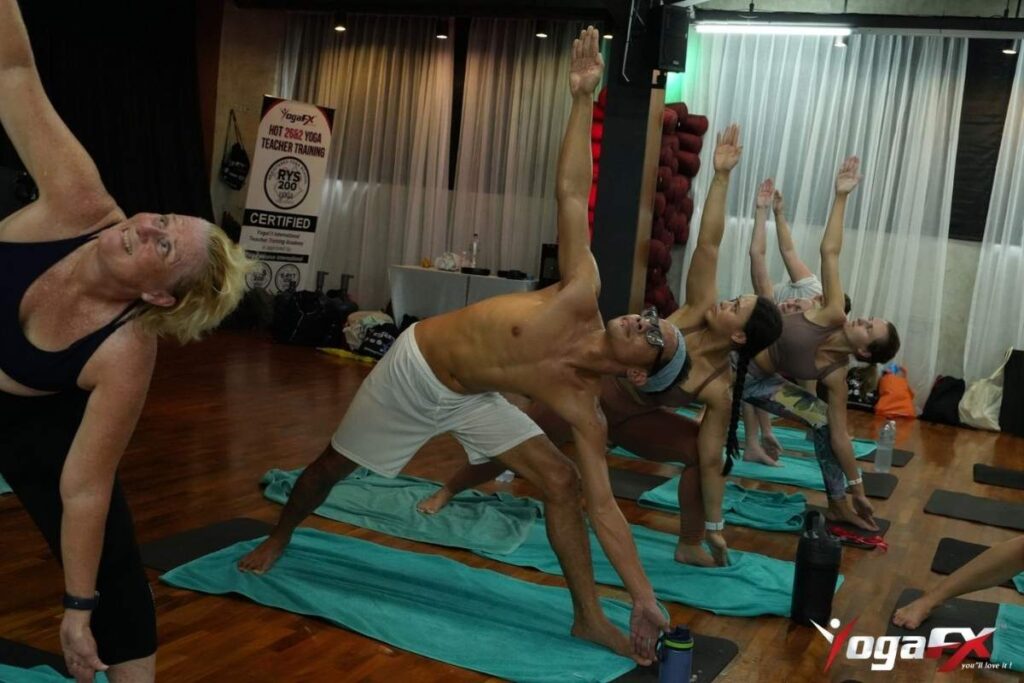
The most common and most impactful technical error. When the arms separate from the ears, the stretch shifts from the thoracic spine into the shoulder joint. The posture transforms from a spinal decompression into a shoulder mobility exercise. The arms pressed against the ears create a rigid lever from fingertips to hip that transmits the lateral force all the way through the thoracic spine. Without this lever, the force dissipates at the shoulder.
Fix: before entering the lateral stretch, press the upper arms firmly against the sides of the head. Maintain this contact throughout the 10-second hold. If maintaining ear contact while stretching is impossible, reduce the stretch depth until the arm position can be maintained.
Mistake 2: Hip Not Pushing to the Opposite Side
Half Moon is a two-directional movement: the hips push one way while the upper body arcs the other. Most practitioners miss the hip push and simply lean sideways from a neutral hip position. This creates a bend that originates at the waist rather than a true lateral arc from hip to fingertips. The therapeutic benefit of the posture, the decompression of the lateral lumbar and thoracic spine, requires the countermovement of the hip.
Fix: initiate every Half Moon by pushing the hip to the opposite side before the upper body begins to lean. The hip push should feel like a deliberate and significant lateral displacement of the pelvis, not a subtle adjustment.
Mistake 3: Bending at the Waist Rather Than Arcing Through the Spine
A common pattern, particularly in practitioners with limited thoracic mobility, is creating a sharp angle at the waist while the thoracic spine remains relatively flat. This produces a V-shape rather than the smooth arc that Half Moon is designed to create. The waist-bend version stretches the lumbar region but misses the thoracic mobility component that is one of the primary benefits of the posture.
Fix: think of the stretch as beginning at the hip and continuing progressively through each thoracic vertebra to the cervical spine and out through the fingertips. The stretch is distributed, not concentrated. If the thoracic spine feels stiff, this is normal for early practice and will improve with consistent attendance.
Mistake 4: Holding the Breath
Breath holding during the lateral stretch is one of the most self-defeating errors in Half Moon. The intercostal stretch that the posture produces is specifically designed to increase rib cage freedom for breathing. Holding the breath defeats this purpose immediately and increases the muscular tension that prevents the lateral opening from deepening.
Fix: breathe slowly and continuously throughout the entire hold. If the breath becomes constricted as the stretch deepens, reduce the stretch depth slightly until normal breathing can be maintained.
Half Moon Pose in Bikram vs Other Yoga Styles
Ardha Chandrasana exists in multiple yoga traditions but differs significantly in its Bikram form from its Iyengar, Vinyasa, or Hatha interpretations.
| Feature | Bikram Ardha Chandrasana | Other Yoga Styles |
|---|---|---|
| Posture shape | Standing lateral bend with arms overhead, arms pressed to ears | Iyengar/Vinyasa: single-leg balance with torso parallel to floor, one arm reaching up |
| Both feet on floor | Yes, both feet planted throughout | Iyengar: one foot on floor, one leg extended horizontally |
| Primary target | Lateral thoracic spine, intercostals, quadratus lumborum | Iyengar: hip joint, lateral balance, shoulder opening |
| Temperature | 40 degrees C, enhances fascial extensibility | Room temperature |
| Hold time | 10 seconds, 2 sets | Typically 5 to 8 breaths in Iyengar or Vinyasa |
| Sequence position | First standing posture after breathing exercises | Appears mid-sequence in most other styles |
The Bikram version of Ardha Chandrasana is a distinctly different posture from its Iyengar or Vinyasa counterpart, despite sharing the Sanskrit name. A practitioner familiar with Iyengar Half Moon (single-leg balance) attending their first Bikram class will encounter a different posture entirely. The lateral bend version in Bikram targets the thoracic spine and intercostals; the balance version in Iyengar targets the hip joint and single-leg stability. Both are called Half Moon because both create an arc shape, but the mechanics, benefits, and technique are not interchangeable.
Modifications by Level
Beginner: Reduced Depth, Full Arm Position
For practitioners who cannot maintain arms pressed against ears while creating a meaningful lateral arc, prioritise the arm position over the stretch depth. A shallow Half Moon with correct arm position produces more thoracic benefit than a deep Half Moon with arms separated from the ears. The stretch depth will develop over sessions as thoracic mobility improves. The arm position is a technical prerequisite, not a performance metric.
Intermediate: Full Arc, Hip Push Established
At intermediate level, the hip push is deliberate and the lateral arc is distributed across the thoracic spine rather than concentrated at the waist. The focus shifts to continuous stretching throughout the 10-second hold rather than static holding. The posture should feel like it is deepening across the hold, not reducing.
Advanced: Backbend Integration and Breath Awareness
Advanced practitioners use the Half Moon backbend component to establish the thoracic opening that the later backbend series requires. The focus at this level is the quality of the thoracic extension in the backbend phase and continuous normal breathing throughout both the lateral and backbend phases. The posture is fully integrated when the breath remains easy and the arc continues to deepen without any compromise in the arm position.
FAQ
What is Ardha Chandrasana in Bikram yoga?
Ardha Chandrasana in Bikram yoga is the first standing posture in the 26-posture sequence, immediately following Pranayama (standing deep breathing). It is a lateral spinal stretch combined with a backbend, performed with arms overhead and pressed against the ears, both feet on the floor, and the hips pushing to the opposite side of the stretch. It is performed for 10 seconds per side in 2 sets. It differs from the Iyengar or Vinyasa version of Half Moon, which is a single-leg balance posture with the torso parallel to the floor.
What are the benefits of Half Moon Pose in Bikram yoga?
Primary benefits: lateral thoracic spine decompression, intercostal muscle opening for respiratory depth, lumbar and thoracic backbend, hip stabiliser activation, and progressive preparation for the deeper spinal work later in the standing and floor series. At 40 degrees Celsius, the fascial extensibility of the lateral chain is specifically enhanced, making the thoracic lateral stretch more effective than the same posture at room temperature.
Why do my arms keep separating from my ears in Half Moon?
Arms separating from the ears is the most common Half Moon error and is caused by insufficient shoulder external rotation flexibility and the natural tendency to reduce the load on the arms as the lateral stretch increases. The arms touching the ears is a strength and mobility demand, not just a positional instruction. Reduce stretch depth until arm contact can be maintained throughout the hold. The flexibility will develop with consistent practice.
How is Bikram Half Moon Pose different from other yoga?
The Bikram version of Ardha Chandrasana is a standing lateral bend with both feet on the floor, targeting the thoracic spine and intercostals. The Iyengar and Vinyasa version is a single-leg balance with the torso parallel to the floor, targeting the hip joint and lateral balance. They share a Sanskrit name because both create an arc shape, but the mechanics, targets, and techniques are entirely different. A practitioner coming to Bikram from Iyengar or Vinyasa should approach the Bikram Half Moon as a new posture rather than a variation of a familiar one.
How long does it take to improve Half Moon Pose in Bikram?
The arm position (touching the ears throughout) typically stabilises within 10 to 20 classes as shoulder external rotation flexibility develops. The lateral arc quality (distributed through the thoracic spine rather than concentrated at the waist) improves progressively over 1 to 3 months of consistent practice. The backbend component deepens as thoracic spine mobility improves across months to years of practice. Half Moon is one of the postures that shows the most visible progression across a Bikram practice career because the technical requirements are specific and the improvements are directly observable in the mirror.