
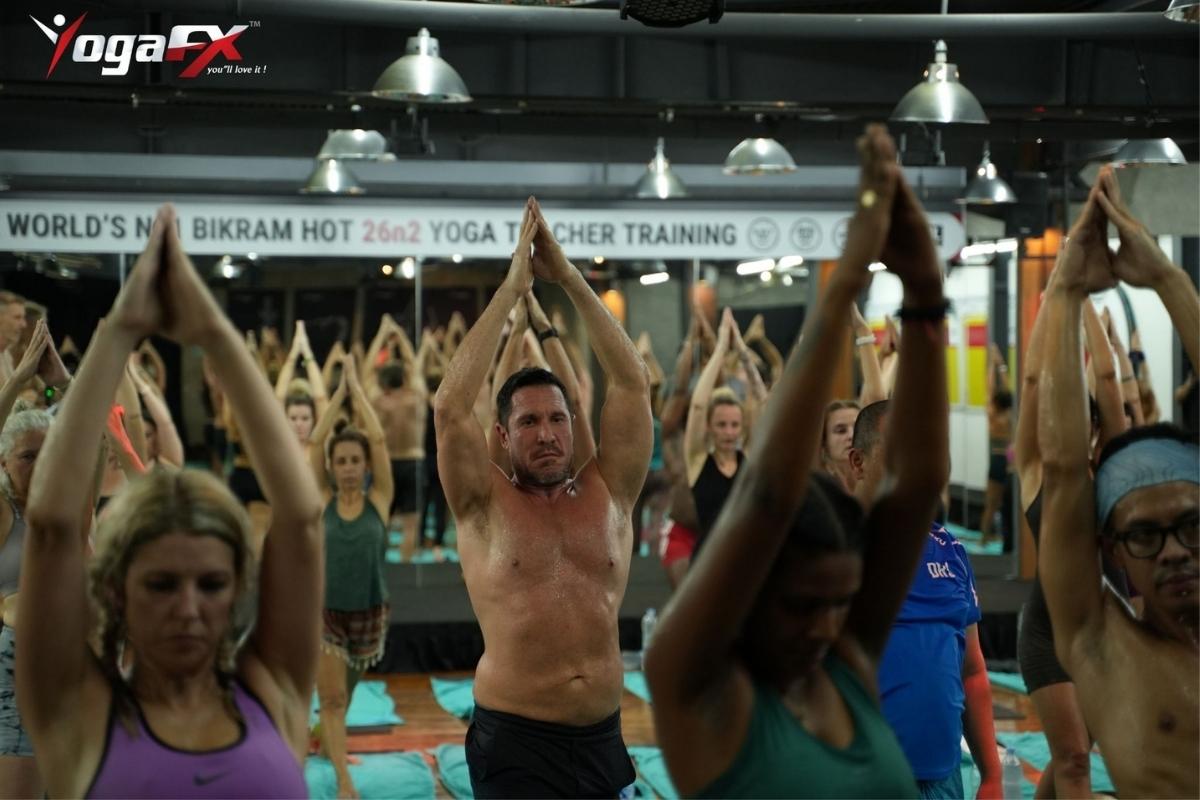

Bikram yoga is practiced in a room heated to exactly 40°C (105°F) with 40% relative humidity. These conditions were established by Bikram Choudhury to replicate the climate of Kolkata, India, where the practice originated. The heat accelerates muscle warming, increases joint extensibility, and elevates cardiovascular demand throughout the 90-minute session.
The Exact Bikram Yoga Temperature Specification
The Bikram yoga temperature specification is 40°C — equivalent to 104°F, or more precisely 40.6°C (105°F) in the original Bikram Choudhury specification. Studios commonly round to either 40°C or 105°F depending on local convention. Both are correct within the acceptable range. Humidity is not optional: 40% relative humidity is as integral to the specification as the temperature itself.
| Parameter | Specification | Note |
|---|---|---|
| Temperature | 40°C / 105°F | 40.6°C in original specification. Studios round to either figure. |
| Humidity | 40% relative humidity | Standard across all certified Bikram studios. Critical — not ambient. |
| Duration | 90 minutes | Fixed. The double-set structure requires this duration — cannot be shortened without losing the therapeutic sequence. |
The still-air requirement — no fans during class — is intentional, not an oversight. Moving air accelerates sweat evaporation and lowers perceived temperature, undermining the controlled thermoregulatory demand that the specification is designed to create.
Why This Temperature? The Physiological Mechanism
Muscle and Connective Tissue Response
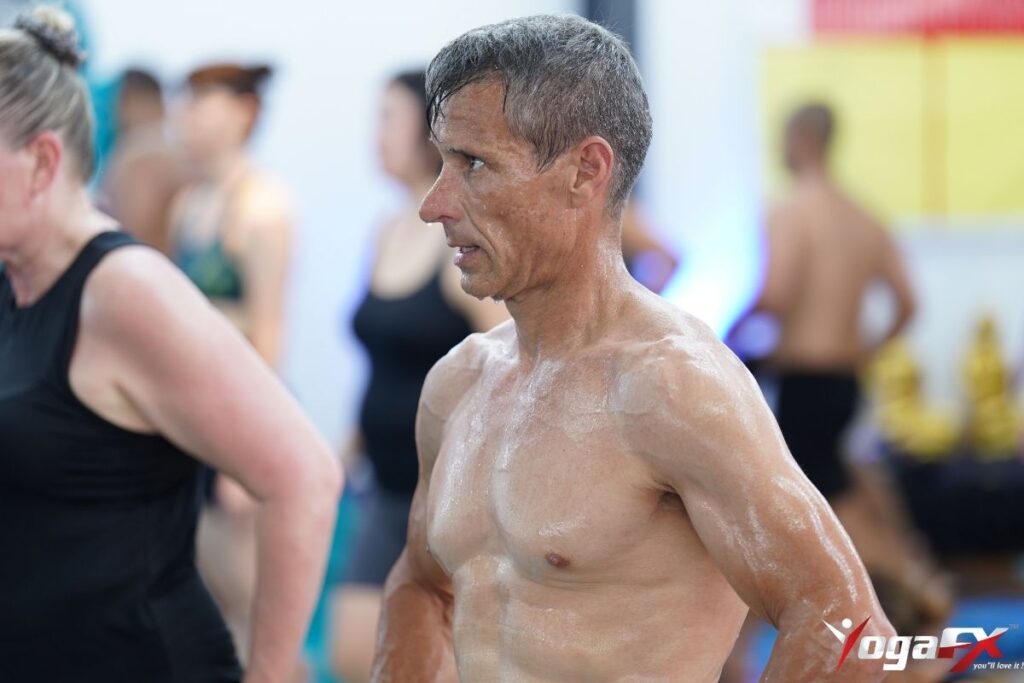
At 40°C, muscle viscosity decreases measurably. This is not a metaphor — it is a documented rheological change. Warm muscle fibres slide past each other with less internal resistance, increasing range of motion without a proportional increase in injury risk. The same movement executed at 20°C requires more force to achieve the same joint angle and carries a higher strain risk for the same depth.
Connective tissue — tendons, ligaments, and fascia — responds similarly. Collagen fibres become more extensible at elevated temperatures, allowing the deep stretches of the Bikram sequence to be performed safely. Fixed Firm Pose, Standing Head to Knee, and Rabbit Pose all require connective tissue extensibility that is significantly more accessible at 40°C than at room temperature. This is why the same pose executed in a cold studio carries a higher injury risk than in a properly heated room.
Cardiovascular and Metabolic Effect
The heat creates a thermoregulatory demand independent of the exercise load. The body must simultaneously manage movement and core temperature — a dual demand that elevates heart rate above what the exercise alone would produce. Heart rate during a 90-minute Bikram session averages approximately 80% of maximum throughout, according to research published by the University of Wisconsin in 2014 (Porcari et al., Experimental Physiology, PubMed ID: 24700459). This is equivalent to the cardiovascular demand of moderate-intensity cycling.
A peer-reviewed trial in the Journal of Strength and Conditioning Research (Tracy and Hart, 2013, PubMed ID: 23438366) found significant cardiovascular adaptations in Bikram yoga practitioners over 8 weeks — including measurable improvements in strength and balance partially attributable to the sustained cardiovascular demand of the heated environment.
According to YogaFX lead instructor Mr. Ian Terry, who has taught 12,000+ hours of Bikram Yoga Temperature in Bali's natural tropical heat: the cardiovascular demand of the temperature is most clearly felt in the three peak standing postures — Standing Bow, Balancing Stick, and Triangle — where heart rate spikes to its highest levels of the session. The heat makes this demand continuous rather than intermittent.
The Role of Humidity
40% humidity is as critical as the temperature, and it is the variable most frequently misrepresented in hot yoga marketing. When sweat evaporates too quickly (low humidity), the body's core temperature drops below the therapeutic threshold before physiological adaptations occur. When humidity is too high (above 60–70%), sweating becomes ineffective at cooling and heat illness risk increases significantly.
40% relative humidity sits at the controlled midpoint: sweat evaporates slowly enough to maintain core temperature in the therapeutic range throughout the session, but not so slowly that cooling is impaired. This explains why hot yoga at 32°C with low humidity produces a qualitatively different physiological response from Bikram at 40°C with 40% humidity — the temperature and humidity together determine the response, not temperature alone.
At YogaFX Bali, the ambient tropical climate — approximately 30°C with relative humidity consistently above 70% — provides a natural base that requires no electric heating to reach the Bikram specification. No electric heaters are used at either the Seminyak or Canggu studios. The natural heat is not a marketing position; it is a genuine physiological differentiator that produces more comfortable thermoregulation than dry electric heat.
Detoxification — What the Science Actually Says
The claim that hot yoga produces a 'full body detox' through sweating is one of the most overused and least precise statements in yoga marketing. The honest, credible position: sweating does facilitate excretion of some trace compounds through the skin, including certain heavy metals and synthetic compounds such as BPA — supported by published research. However, the primary detoxification organs are the liver and kidneys. Sweating is a secondary pathway, not the primary one.
The primary physiological benefits of the sustained heat are cardiovascular and musculoskeletal — not detoxification. Framing the heat primarily as a detox mechanism overstates the evidence and reduces the credibility of more substantive claims.
Bikram Yoga Temperature vs Other Hot Yoga Styles
| Style | Temperature | Notes |
|---|---|---|
| Bikram / 26&2 Yoga | 40°C / 105°F, 40% humidity | Fixed specification. 90-minute class. 26 postures, same order every time. |
| Baptiste Power Vinyasa | ~35°C / 95°F | Heated for flexibility facilitation. Variable sequence. |
| CorePower C2 | 32–35°C / 90–95°F | All-levels hot flow. Lower temperature than Bikram. |
| CorePower Hot Yoga | 40°C / 105°F | Uses Bikram temperature but not the fixed 26&2 sequence. |
| Moksha / Modo Yoga | ~40°C / 103°F | Fixed 40-pose sequence. Slightly lower than Bikram spec. |
| Infrared Hot Yoga | 32–38°C / 90–100°F | Heated via infrared panels. No humidity control. Different physiological profile. |
| YogaFX 26&2 Bali | 40°C / 105°F, natural heat | No electric heaters. Bali ambient climate provides the base temperature naturally. |
Temperature alone does not define Bikram yoga. The 40°C specification is necessary but not sufficient — the fixed 26-posture sequence, the double-set structure, and the 90-minute duration are equally non-negotiable components. A room at 40°C running a variable Vinyasa flow is not Bikram yoga. A Bikram Yoga Temperature class at 35°C is not delivering the physiological conditions the sequence was designed for.
Is the Bikram Temperature Safe?
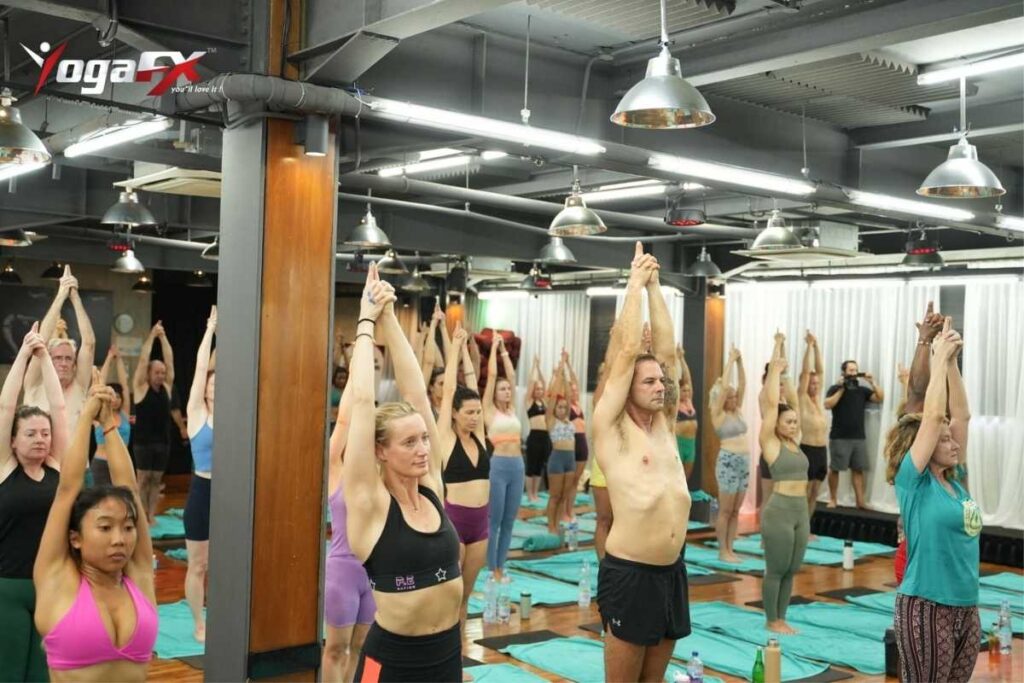
For healthy adults with no cardiovascular conditions, 40°C with 40% humidity is generally well-tolerated when hydration is adequate. The University of Wisconsin 2014 study found no significant core temperature concerns in healthy practitioners completing a full 90-minute session. The key variables are pre-class hydration, heat acclimatisation across the first 3–5 sessions, and willingness to rest in Savasana when needed.
Contraindications — Consult a Physician If:
- Cardiovascular disease or a history of cardiac events
- Pregnancy — particularly the first trimester
- Recent fever or active infection
- Medications that impair thermoregulation — including diuretics and beta-blockers
- Severe dehydration or electrolyte imbalance on the day of practice
Most discomfort in the first 3–5 sessions is normal thermal adaptation, not an injury signal. Practitioners who attend consistently report that the heat begins to feel supportive rather than threatening after approximately 5–10 sessions. At YogaFX Bali, newcomers arrive partly pre-acclimatised to tropical temperatures, which reduces the adaptation period compared to practitioners joining from cold climates.
The correct response to heat overwhelm during any Bikram Yoga Temperature class is to lie in Savasana — flat on the back, still — and remain in the room. Leaving resets heat acclimatisation entirely.
What to Expect from the Heat in Your First Class
- The first 10–15 minutes feel overwhelming. This is universal — the body is not yet in thermal equilibrium with the room. It normalises within the standing series.
- You will sweat significantly more than you expect. Bring a large non-slip mat towel and a minimum of 1 litre of water. The towel is not optional.
- Dizziness in the first 2–3 classes is almost always dehydration. Pre-hydrate with 500–700ml of water in the 2 hours before class.
- The heat becomes an asset after 5–10 sessions as cardiovascular adaptation develops.
- Do not leave the room if overwhelmed. Lie flat in Savasana. Leaving resets heat acclimatisation and makes the next session harder, not easier.
- Replenish electrolytes, not just water, after class. Sweat volume depletes sodium, potassium, and magnesium alongside fluid.
FAQ
What temperature is Bikram yoga practiced at?
Bikram yoga is practiced at exactly 40°C (105°F) with 40% relative humidity. These conditions were established by Bikram Choudhury based on the climate of Kolkata, India, where the practice was developed. The temperature and humidity specification together define the physiological environment — neither figure is optional.
Why is Bikram yoga so hot?
The heat reduces muscle viscosity and increases connective tissue extensibility, allowing the 26-posture sequence to be performed at greater depth with lower injury risk. The heat also creates a thermoregulatory demand independent of the exercise load, elevating heart rate and calorie burn above what room-temperature practice produces.
Is Bikram yoga the same temperature as other hot yoga?
Not always. Bikram Yoga Temperature is fixed at 40°C with 40% humidity. Other hot yoga styles range from 32–40°C, often without humidity control. Baptiste Power Vinyasa typically runs at 35°C; CorePower C2 at 32–35°C. Lower temperatures produce different physiological responses — the connective tissue and cardiovascular effects documented in Bikram research are specific to the full 40°C / 40% humidity specification.
Is 40 degrees C safe for hot yoga?
Safe for healthy adults when hydration is adequate and contraindications are absent. Key contraindications: cardiovascular disease, first-trimester pregnancy, recent fever, and medications that impair thermoregulation (diuretics, beta-blockers). The acclimatisation period (first 3–5 sessions) involves normal thermal adaptation — discomfort during this period is expected and resolves with consistent attendance.
What happens to your body at Bikram yoga temperature?
Core temperature rises, heart rate elevates to approximately 80% of maximum (Porcari et al., 2014), muscles become more extensible as viscosity decreases, and sweating begins. Tracy and Hart (2013) found significant cardiovascular and strength adaptations in Bikram practitioners over 8 weeks — partially attributable to the sustained thermoregulatory demand of the 40°C environment.
Does humidity matter in Bikram yoga?
Yes — 40% humidity is as important as the temperature. At low humidity, sweat evaporates too quickly and the body cools below the therapeutic threshold. At high humidity (above 70%), sweating becomes ineffective and heat illness risk increases. 40% humidity is the controlled midpoint that enables sustained core temperature elevation throughout the 90-minute session.
How does Bikram yoga temperature compare to a sauna?
A sauna operates at 80–100°C — roughly double the Bikram specification — with passive rest. Bikram Yoga Temperature at 40°C involves 90 minutes of active exercise with cardiovascular demand at 80% maximum heart rate. The demands are fundamentally different: a sauna primarily challenges thermoregulation at rest; Bikram challenges thermoregulation and cardiovascular fitness simultaneously under exercise load.
Can you practice Bikram yoga without the heat?
The postures work without heat, but flexibility gains are substantially reduced — connective tissue does not reach the extensibility that makes the deep postures safe and effective at room temperature. The cardiovascular thermoregulatory demand is entirely absent. The heat is not a comfort feature — it is a functional component of the method.