

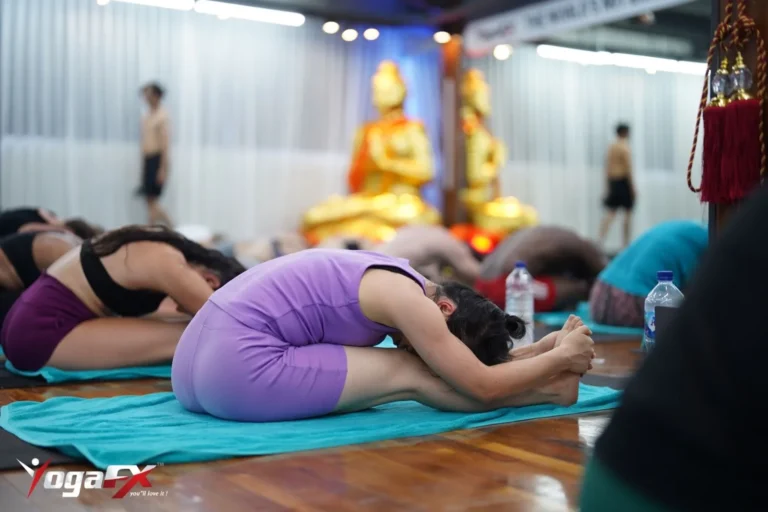

Hot yoga for flexibility works because a 40°C room makes muscle and connective tissue more pliable, so you can reach a deeper range than in a cold room. Heat changes how far you can go, not how far your joints should go. This guide covers collagen, joint rotation and safe depth in Hot 26&2.

Mr. Ian Terry, founder and Lead Instructor of YogaFX (E-RYT 500, 12,000+ teaching hours), teaches the Hot 26&2 sequence in Bali. The YogaFX approach is simple: alignment first, depth second. The research on hot yoga for flexibility is encouraging, but it is smaller than the marketing suggests, so we keep every claim inside what the studies actually found.
How hot yoga for flexibility works: heat, collagen and joints
Flexibility is not only about muscle length. Your nervous system, muscles, tendons, ligaments and joint capsules all decide how far a joint can move. Collagen is the main protein in tendons and ligaments. It gives them strength and a little give, which is why a cold, stiff body stops early.
A heated room changes that picture. The YogaFX Hot 26&2 class runs at about 40°C and 40% humidity for 90 minutes. Heat widens blood vessels and raises circulation. It also lowers resistance inside the muscle, and the connective tissue around the joints becomes more pliable. That is the logic behind hot yoga for flexibility: warm tissue accepts a stretch more easily than cold tissue.
A laboratory study gives a clue about the mechanism. Researchers working with rat tail tendon found that heating the tissue before applying a load caused significantly less damage. They also found that lower loads held for a long time at a higher temperature produced more lasting elongation (PubMed abstract). It was animal tissue, so treat it as a mechanism and not as proof for people.
Why hot yoga for flexibility feels easier than cold stretching
Here is what the hot room does and does not do for you:
- It warms the muscle. Warm muscle resists a stretch less, so you can move into a posture without forcing it.
- It makes connective tissue more pliable. Collagen in tendons and ligaments gives a little more, which is the physical basis of a deeper range of motion.
- It does not change your bones. The shape of your hip socket or the angle of your spine stays the same, so some limits are structural.
- It does not switch off your warning signals. You still need to listen to pain, because easy movement can hide how far a joint has travelled.
That last point matters most. When a stretch feels easy, it is tempting to chase depth. In a good class, the teacher and the script slow you down, so the room extends your range while your technique protects the joint.
What the research says about hot yoga for flexibility
The honest answer is that the evidence is positive but small. Here are the studies we could open and check, with the limits spelled out.
What studies of hot yoga for flexibility measured
The most direct trial is a randomized controlled trial in the Journal of Strength and Conditioning Research (Tracy and Hart, 2013). Healthy young adults did Bikram yoga in a heated and humidified studio, 90 minutes per session, 24 sessions in 8 weeks. Compared with the control group, they showed substantially increased lower back and hamstring flexibility, and increased shoulder flexibility (PubMed abstract). The group was small, with 10 people in the yoga arm and 11 in the control arm.
A second trial looked at older adults. Sixty-six people trained at least three times a week for a year. On the Flexitest score, the hatha yoga group gained 22.5 points, the calisthenics group gained 5.8 points and the control group lost 2.1 points (PubMed abstract). That class was not heated, so it shows what regular yoga practice can do, and not what heat adds.
A 2025 systematic review (Willmott et al.) pooled 43 studies and 942 participants on Bikram yoga. Flexibility is one of the outcomes it covers. We could not open the full text for this guide, so we cite it by name only and do not quote its numbers.
| Source | Who or what was studied | Flexibility finding | Limit to keep in mind |
|---|---|---|---|
| Randomized trial, J Strength Cond Res, 2013 | 21 healthy young adults, 24 heated classes in 8 weeks | Lower back and hamstring flexibility substantially increased; shoulder flexibility increased | Small, exploratory trial; no change in handgrip or aerobic fitness |
| One-year trial, Int J Yoga Therap | 66 adults, trained 3+ times a week for 52 weeks | Flexitest score +22.5 (hatha yoga), +5.8 (calisthenics), -2.1 (control) | Room was not heated; older adults, so results may differ for you |
| Laboratory study, rat tail tendon | Animal collagen tissue in vitro | Heating before loading caused significantly less damage; long, light loads at higher temperature gave more lasting elongation | Not a human study and not yoga |
| Systematic review, Willmott et al., 2025 | 43 studies, 942 participants | Covers flexibility among other Bikram outcomes | Cited by name only; full text not opened |
How to read the evidence on hot yoga for flexibility
Put together, the studies support a modest claim: regular practice, including heated Bikram practice, is linked to better hamstring, lower back and shoulder flexibility over weeks to months. None of them proves that heat is the reason, and none compares a heated class with the same class in a cool room.
Safe depth: five rules for stretching in a 40°C room
Safe depth is the deepest range you can reach while your alignment, breathing and balance stay intact. It is personal, and it changes from week to week. These five rules come from how the Hot 26&2 class is taught, and they apply to anyone chasing hot yoga for flexibility.
- Build the posture before the depth. Feet, hips and spine come first. Depth is the last thing you add.
- Stretch sensation is fine, sharp pain is not. A pulling feeling in the muscle belly is normal. Pain in a joint, or a pinch, means you ease off.
- Stop where you can still breathe evenly. If your breath jams or your face tightens, you have gone past your safe depth for today.
- Let the script set the pace. The dialogue gives each posture the same timing every class, so you are not rushing into depth.
- Measure progress across weeks. A deeper fold on Friday than on Monday is not the goal. Steady change over a month is.
Why the brakes must come from technique
Notice the pattern. Each rule slows you down. Because heat lowers resistance, the usual brake in your body is weaker, so the brakes have to come from technique. That is also why the YogaFX approach puts technique ahead of depth.
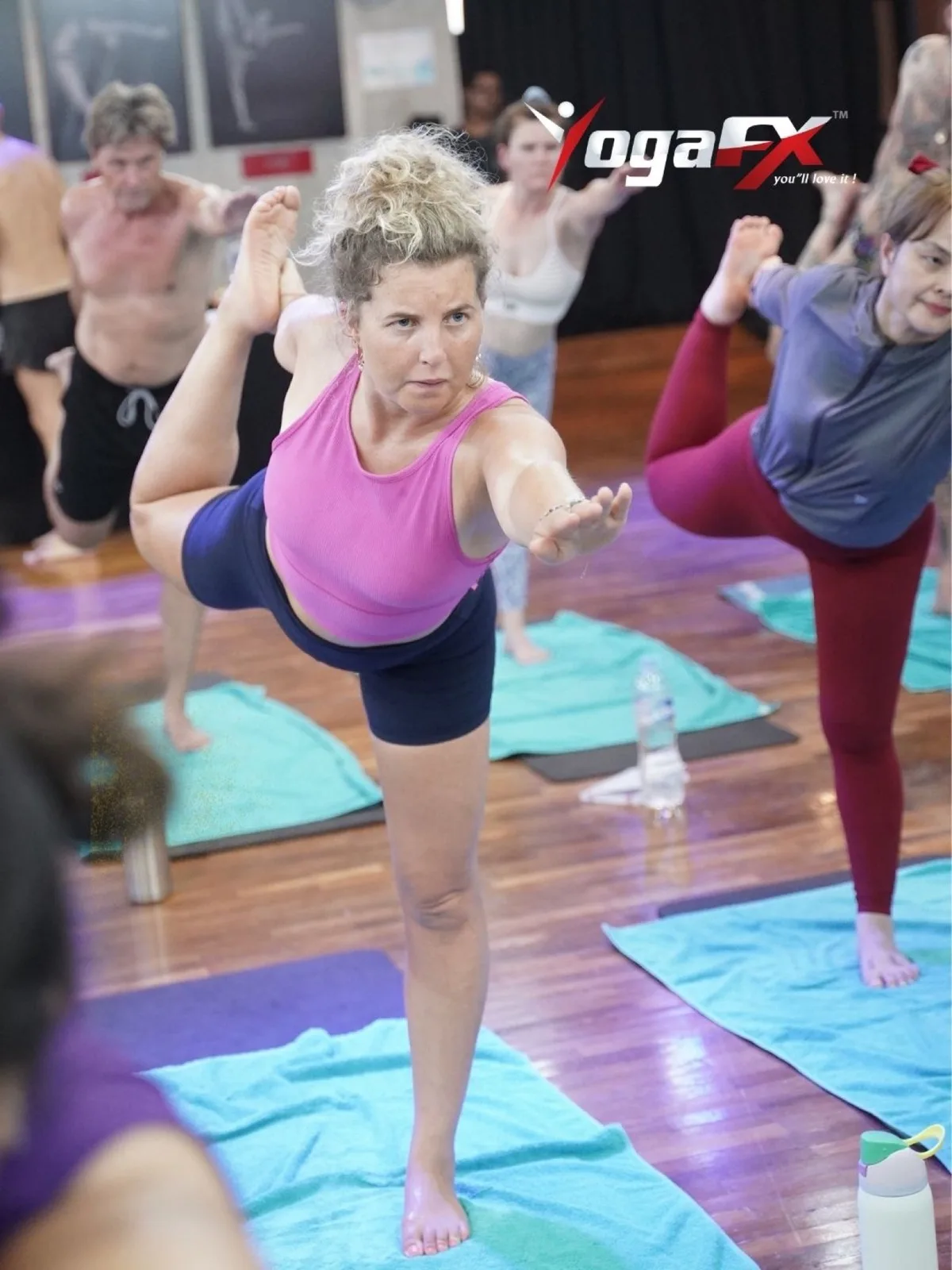
Standing Bow Pulling Pose (Dandayamana Dhanurasana) is a good test. You can kick harder to look deeper, but the pose works when your standing leg stays strong and your hips stay square. Our guide to the standing bow pulling pose covers the cues step by step.
Joint rotation in the 26 postures: where flexibility shows up
Hot 26&2 moves the spine in every direction and asks several joints to rotate under control. Because the order never changes, hot yoga for flexibility is easy to track, and students can feel exactly where they are stiffer from one month to the next.
| Area | Posture example | What the posture asks of it | Safe-depth cue |
|---|---|---|---|
| Hips | Eagle Pose (Garurasana) | Crossed-leg hip rotation while you balance | Keep the standing knee soft and the hips level; stop before the knee twists |
| Spine | Cobra Pose (Bhujangasana) | Gentle spinal extension from the floor | Lift from the back muscles first; do not shove the chest up with your hands |
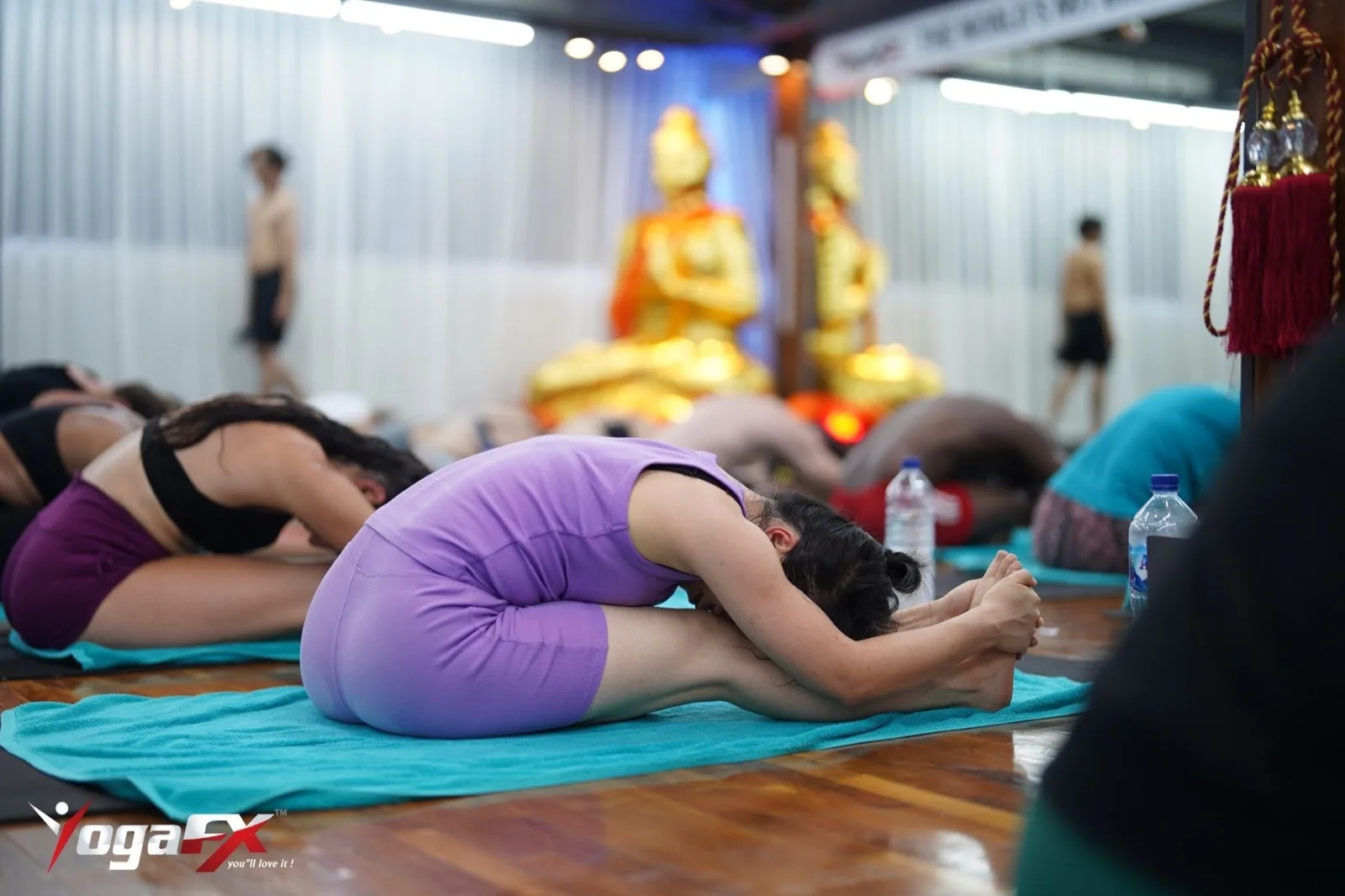
| Hamstrings and lower back | Head-to-Knee forward folds | Folding forward over a long leg | Fold from the hips with a long spine; chase the foot only if the back stays long |
| Shoulders | Triangle Pose (Trikanasana) | Arm reach and open chest while the legs work | Reach long, not high; keep the neck relaxed |
| Knees and ankles | Standing Bow Pulling Pose | Balance on one leg while the other is pulled back | Use stable joints, not locked ones; stay as high as you need to keep balance |
Notice that two of these cues are about stopping early. In Eagle Pose, for example, the standing knee is the weak link. If you force the twist to look deeper, the load lands on the knee and not on the hip, which is where the rotation should be.
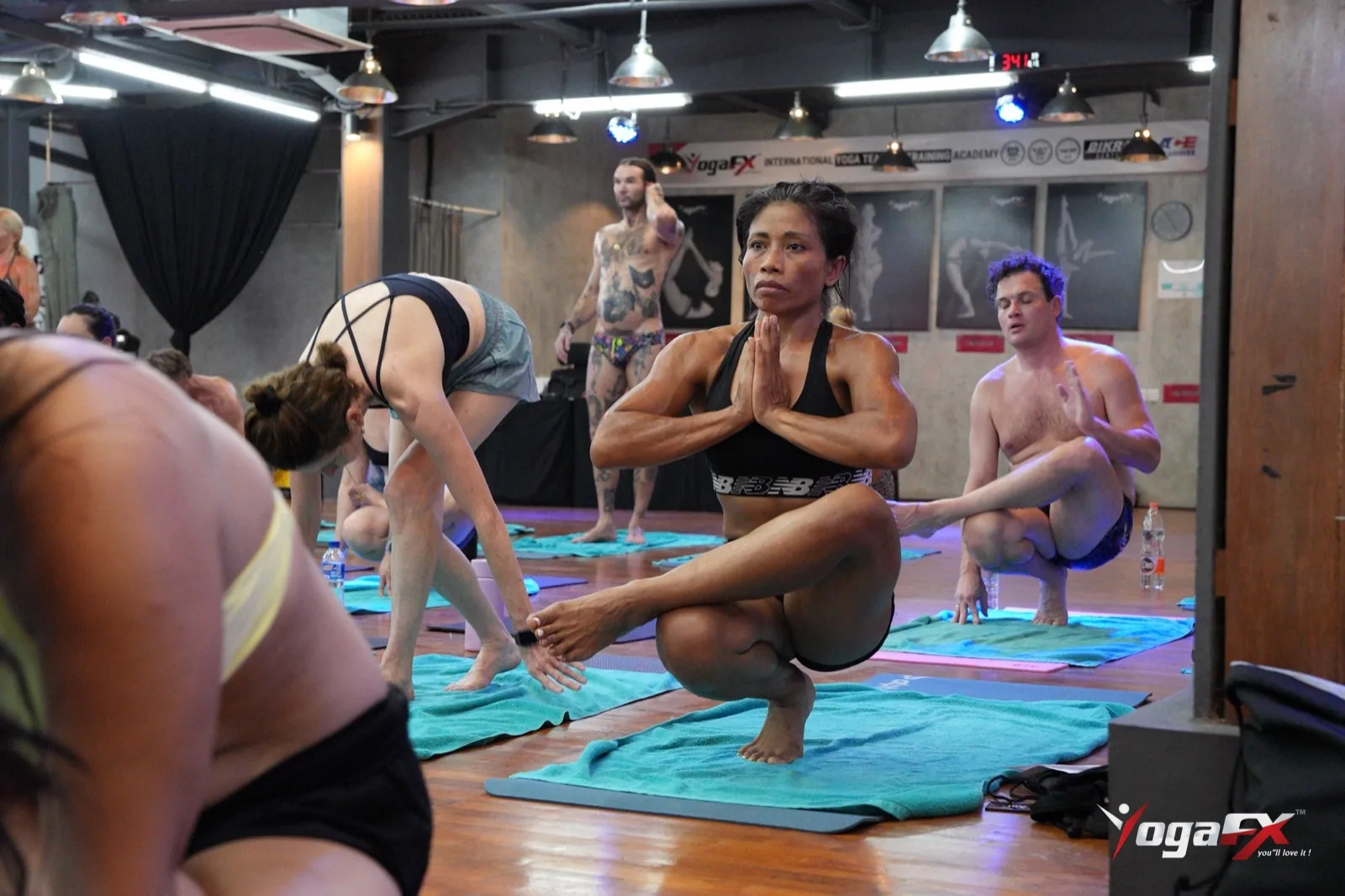
If you are a man with tight hips or hamstrings, you are not alone. Our guide to the Bikram postures men find hardest explains why men often find the folds and twists hardest, and how to pace yourself.
For the standing series, the Triangle Pose guide is a useful companion. It shows how the side bend, the leg line and the arm reach share the load.
Why depth differs between bodies
Different bodies have different ceilings. Someone with a long, narrow hip socket may fold deeply and still struggle to rotate. Someone with a shallow socket may rotate freely but fold less. Flexibility is partly structure, so comparing your depth with the student on the next mat tells you very little.
Heat, beginners and who should go slower
Hot yoga for flexibility is also an exercise in heat adaptation, so go slowly at first. Heat is a real load on the body. In the first weeks your body is still adapting to the room, which is why the first class often feels like a lesson in heat and not in flexibility. Our guide to heat acclimatization for hot yoga explains the adaptation in plain language.
- New students: build up gradually, rest whenever you need to, and keep your hydration steady.
- People who are already very flexible: work on strength and control, not extra range, because more range without control is not progress.
- People with injuries, joint problems or medical conditions: speak with a healthcare professional before you start.
If you cannot touch your toes today, you can still start. One trainee put it plainly in a YouTube review, and the quote is below.
Student voices: starting stiff and getting somewhere
These are real YogaFX students, speaking on camera. We have trimmed the filler words only.
“I couldn't even touch my toes. I had no flexibility. I've done lots of things in my life, but I think this has been really, really important.”
A trainee in our YouTube review, 2023 (watch the video)
“It's life-changing. We all know this. It was a very magical week, for sure… I think we're all saner and healthier after this week.”
A trainee in our YouTube review, 2026 (watch the video)
“It was not so hard. It's much easier because also every one of you guys.”
A trainee in our YouTube review, 2023 (watch the video)
The last quote is worth a second look. Practising in a room full of people who are all working on the same script lowers the pressure to perform. As a result, many stiff beginners relax, and relaxed muscles stretch better.
Hot yoga for flexibility with Mr. Ian Terry in Seminyak, Bali
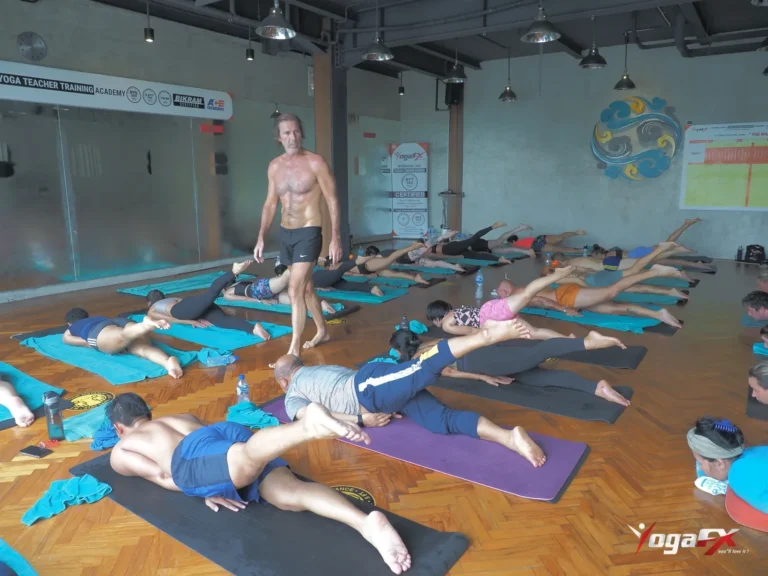
YogaFX teaches Hot 26&2 with the correct lineage dialogue in a heated, humidified room, led by Mr. Ian Terry.
He has trained through a five-year lineage (2014 to 2019) with the founder of the method, holds E-RYT 500 status and has taught for more than 12,000 hours. Students from 80+ countries have trained with YogaFX since 2017. The sequence trains balance and focus as well as range, which postures such as Standing Bow and Eagle make obvious.
Visit the Seminyak studio
The studio is in Seminyak: Jl. Pangkungsari Gg Jepun No.888, Kuta Utara, Seminyak, Badung, Bali 80361. It is open every day from 06:00 to 22:00. A Free 1-Day Guest Pass makes your first class free, so you can feel the room before you decide anything. Message the team on WhatsApp to book it.
If flexibility is the start of a bigger plan, such as teaching, read about the Bikram yoga teacher training in Bali. It is a six-day hybrid course, and Mr. Ian Terry runs it in Seminyak.
FAQ
Does hot yoga for flexibility really work?
Studies suggest it can. In a randomized trial, healthy adults who did 24 heated classes over 8 weeks showed substantially better lower back and hamstring flexibility than a control group. The trial was small, and it did not isolate heat, so results vary from person to person.
Is hot yoga better for flexibility than regular yoga?
The studies we could open did not compare heated and unheated classes directly, so we cannot say it is better. Heat makes muscle and connective tissue more pliable, which can make a stretch feel easier. Careful alignment, not extra heat, is what keeps the deeper range safe.
Is Bikram yoga good for flexibility?
Bikram yoga, taught today as Hot 26&2, is linked to better hamstring, lower back and shoulder flexibility in the research we reviewed. The sequence folds, twists and bends the spine in every direction, and the script keeps the pace steady. As with any stretching, progress builds over weeks, not in one class.
How do I stretch safely in a hot yoga class?
Build the posture first and add depth last. A pulling feeling in the muscle is normal, but sharp or joint pain means you ease off. Keep your breath even, rest when you need to, and stay hydrated. If you have an injury or a medical condition, check with a healthcare professional first.
Can I do hot yoga if I cannot touch my toes?
Yes. Many beginners start stiff, and the class is built around what you can do today, not what the person next to you can do. Go gently, bend your knees if you need to, and let range come over weeks. A Free 1-Day Guest Pass lets you try your first class at no cost.
Still have questions? Message Mr. Ian on WhatsApp and the YogaFX team will answer them personally.
Medical disclaimer: this article is for education and is not medical advice. Hot yoga for flexibility is a real physical load. Consult a healthcare professional before you start, especially if you have an injury, a joint problem, a heart or blood pressure condition, or you are pregnant.
Last updated: November 23, 2026