

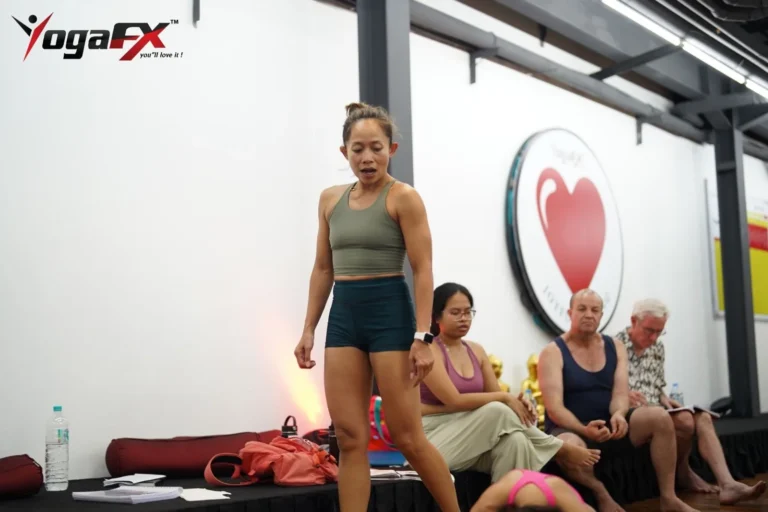

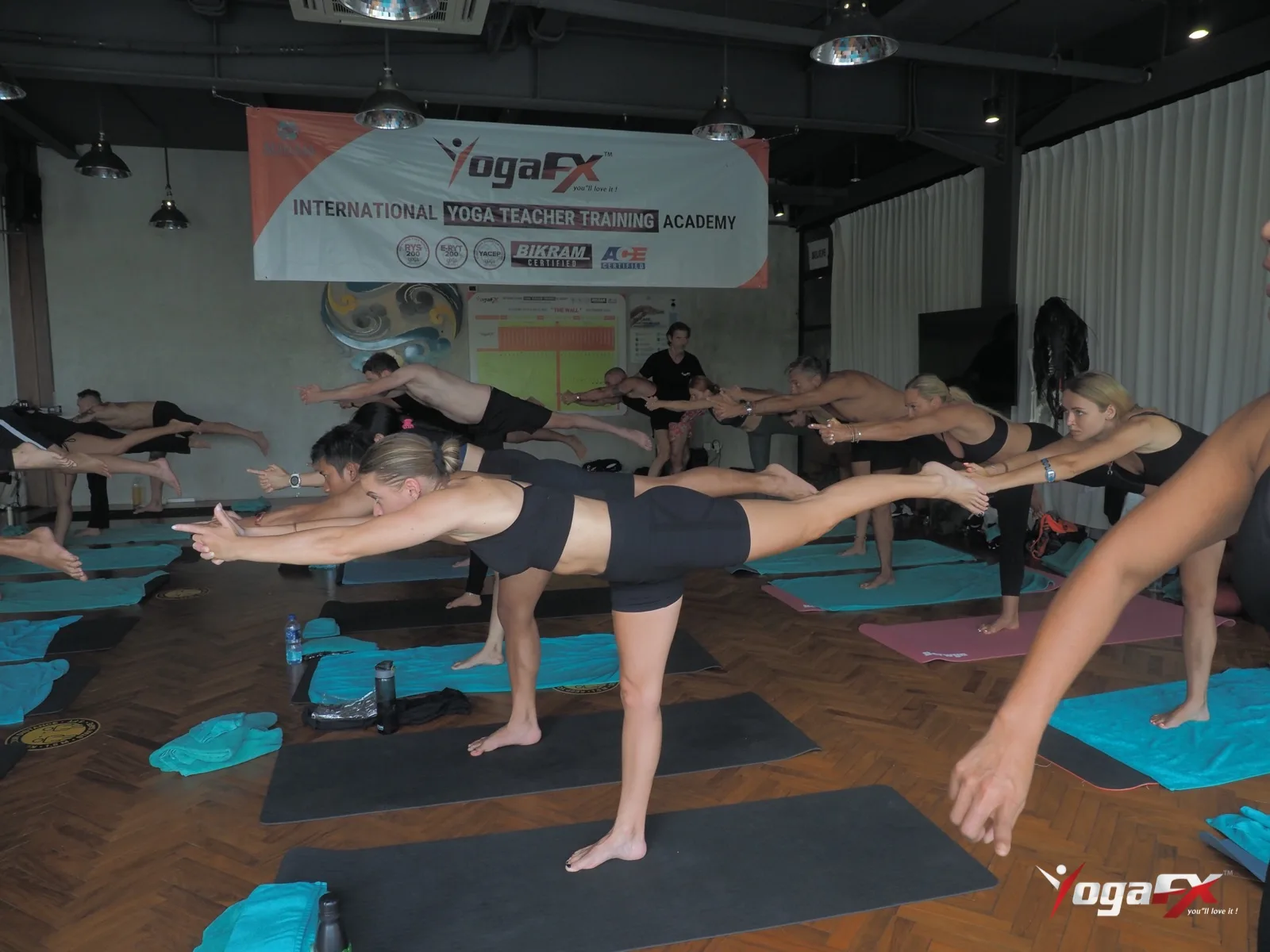
The standing bow pulling pose (Dandayamana Dhanurasana) is a single-leg balance posture in the Bikram Hot 26&2 standing series. You lock one leg, hold the other foot behind you, then kick it back and up while your chest and free arm reach forward. It tests balance, leg strength and heart rate at the same time.

Mr. Ian Terry, E-RYT 500 with more than 12,000 teaching hours, trained for five years (2014 to 2019) with the founder of the Bikram Hot 26&2 method. He teaches this posture as a test of the base. If the standing leg is steady, the rest of the shape has something to stand on.
This guide looks at the posture from three angles that most pose guides skip. First, the stages the dialogue uses to build it. Second, the balance and leg strength it asks for. Third, how hard it makes your heart work in a 40°C room. You will also see where this posture sits next to its neighbours, and what students say about learning it.
Standing Bow Pulling Pose in Three Dialogue Stages
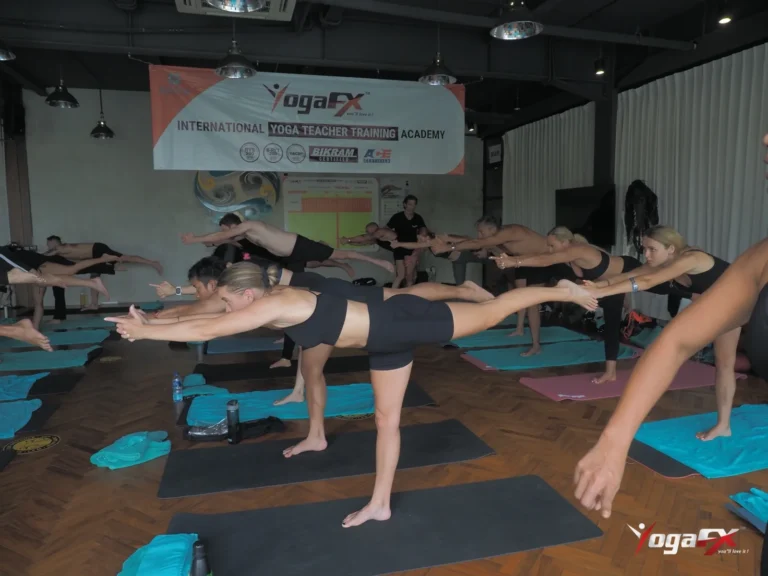
A Hot 26&2 class is taught by a fixed dialogue. There is no demonstration and no music, so your body follows words. The dialogue builds the standing bow pulling pose in three stages, and each stage adds one demand to the one before it. The wording in class is exact, so treat the list below as a map of the order, not as the script.
- Stage 1: Lock and grip. Shift your weight onto one leg, lock the knee and take the other foot in your hand behind you.
- Stage 2: Kick and reach. Push the held foot back and up into your hand while the free arm and chest travel forward.
- Stage 3: Lower and extend. Keep kicking as the torso tips toward the floor, until the body forms one long, balanced line.
Why the stages matter
Each stage is complete in itself. A student who holds a clean Stage 1 is doing the standing bow pulling pose at that level, not warming up for the next one. That’s why a first-week student and a ten-year student can stand in the same row and work the same posture at the same moment.
| Stage | What the dialogue asks | Main demand | What a teacher watches |
|---|---|---|---|
| Stage 1 | Lock the standing knee, grip the back foot | Single-leg balance and a locked knee | Both hip points facing the front, weight spread across the whole foot |
| Stage 2 | Kick the foot back and up, reach forward | Quadriceps strength and hip flexor length | The kick driving the shape, not the hand pulling the foot |
| Stage 3 | Lower the torso, extend the line | Core control, shoulder reach and balance under load | A long spine and a steady gaze before the chest drops |
Why the Standing Bow Pulling Pose Is a Balance Test
Balance is a skill, not a gift. Your eyes, your inner ear and the nerve endings in your ankle, knee and hip all report to your brain. The brain then adjusts the standing leg many times a second. The standing bow pulling pose loads that system harder than most postures, because the held leg moves out of sight behind you.
Why you cannot check the back leg
In Standing Head to Knee, the lifted leg stays in front of you where you can watch it. In this posture it goes behind you. You can’t see the kick, so you must feel it. That means the cues describe sensations, such as a locked knee and a long spine, rather than what you would see in the mirror.
Teachers call that sense of where your limbs are proprioception, and they test it with Dandayamana Dhanurasana every day. It is the ability to know your body position without looking. The standing series trains it daily, and our guide to balancing stick pose shows how the next posture removes even more visual help.
Where your eyes should go
A fixed gaze gives your balance system a still reference point in the standing bow pulling pose. Choose a single mark on the wall and rest your eyes there until you come out. When the eyes wander, the standing leg usually starts to shake. So a steady gaze is often the fastest fix for a wobble.
If you want the earlier step in the staircase, read about standing head to knee pose and its four stages. The two postures share the same locked standing leg, so a student who struggles here often needs another week with that posture first.
The Strength Demand: A Standing Leg That Does Not Rest
The standing bow pulling pose is also an isometric exercise, and you’ll feel it in the standing thigh first. The standing leg holds one position under load while the rest of the body moves around it. According to the YogaFX teaching notes, these isometric holds strengthen the stabilisers around the knee, hip and ankle. They also ask the brain to recruit muscle fibres early to keep the position.
What a locked knee really means
A locked knee is not a stiff knee. It is a knee held straight by an engaged thigh. In the first weeks, many students push the joint backward instead. That feels shaky and it can strain the knee. So lift the kneecap by pulling the thigh up, and press the whole foot into the floor.
The kick is the engine
The held leg does not pull toward you. It kicks away from you into your hand. When the kick is real, the hand barely has to work. For example, a student who kicks early often finds the foot rises without any extra pulling. A student who pulls first usually finds the hips twist open.
- Standing leg: thigh lifted, foot pressing flat, toes spread.
- Held leg: kicking back and up into the hand, not pulled toward the body.
- Hips: both hip points facing the front of the room.
- Free arm: long and by the ear, so the shoulder stays low.
Heart Rate: How Hard Does the Standing Bow Pulling Pose Work Your Heart?
Most pose guides stop at alignment. Yet the standing series is the most demanding part of a Hot 26&2 class for the heart, and the standing bow pulling pose sits right in the middle of it. Balance, muscle effort and heat all raise the workload together.
What the zones mean
Here is what the numbers mean. The American Heart Association puts moderate effort at about 50 to 70% of your maximum heart rate. It puts vigorous effort at about 70 to 85%. The same page estimates your maximum as 220 minus your age. You can read those thresholds on the American Heart Association target heart rates page.
Many fitness watches label 70 to 80% of maximum as Zone 3 and 80 to 90% as Zone 4. In the YogaFX teaching notes, the standing bow pulling pose is one of the postures that may move some practitioners toward a Zone 3 style response. It may also create a short Zone 4 style peak in the most demanding moments.
Reading the research with care
A 2014 University of Wisconsin study (Porcari et al.) reported that heart rate across a 90-minute Bikram class averaged near 80% of maximum. That figure covers the whole class, not this one posture. So read it as context. For the full numbers and their limits, see our guide to hot yoga heart rate zones.
Your own zones depend on age, fitness, heat acclimation and medication. The only way to know where you land is to measure it. If you take medicine that affects your heart rate, or you have a heart condition, consult a healthcare professional before you practise in the heat.
Common Mistakes in the Standing Bow Pulling Pose and Their Fixes
Almost every fault in the standing bow pulling pose traces back to one habit: pulling the foot toward the body instead of kicking it away. The list below follows the three stages, so you can find the fix that matches where you are stuck.
Stage 1 faults: the base
- Soft or hyperextended standing knee. Lift the kneecap with the thigh and keep a soft focus in your attention, not in the joint.
- Weight on the heel. Fan the toes and press evenly so the ankle can make its small corrections.
- Hips opening as the foot lifts. Draw the belly in and aim both hip points forward.
Stage 2 faults: the kick
- Hand pulls while the leg stays passive. Send the heel away first. The hand then steadies the foot rather than hauling it.
- Foot too high too soon. Height is a reward for a strong kick, so let the foot sit where the kick can still drive it.
- Free arm dropping. Stretch the arm long from the shoulder and keep it close to the ear.
Stage 3 faults: the line
- Rounding the back. Grow tall through the spine before the chest tips forward.
- Looking down. The gaze drops, then the balance goes. Keep one point at eye level.
- Holding the breath. Breathe through the nose, because a held breath tightens the neck and shoulders.
Effort in the standing thigh and a pull along the front of the held leg are expected. Sharp pain at the knee, lower back or shoulder is a different signal. Ease out, tell your teacher, and check with a healthcare professional if it comes back.
Standing Bow Pulling Pose vs the Floor Bow
Both postures use the word bow, and both ask you to hold a foot behind you. They train different things. The floor version, covered in our guide to bow pose in the Bikram floor series, is a backbend you do lying on your belly. The standing bow pulling pose is a balance posture with a forward reach, and that difference changes everything about how you train it.
| Feature | Standing bow pulling pose | Floor bow pose |
|---|---|---|
| Position | Standing on one leg | Lying on the belly |
| Main challenge | Balance and standing-leg strength | Back extension and shoulder opening |
| Where the body goes | Chest and arm reach forward | Chest and thighs lift away from the floor |
| Heart rate demand | May reach Zone 3 or short Zone 4 peaks | Closer to Zone 2 in the floor series, per the YogaFX notes |
If you want a second walkthrough of this posture written from the standpoint of another 26&2 teacher, read this step-by-step guide from 26and2yoga.com.
What the Research Says About Balance and Standing Postures
No study has tested this one posture on its own. What exists tests yoga in general, balance work and whole heated classes. That evidence is useful, but it has limits, so read it as support, not proof.
A systematic review and meta-analysis of yoga-based exercise in people aged 60 and over pooled six trials with 307 participants. It found a small improvement in balance (Hedges’ g = 0.40) and a medium improvement in physical mobility. The authors said more research is needed to show whether this prevents falls. You can read the abstract on PubMed.
That result comes from older adults, not from hot yoga students. So it does not prove that this posture improves your balance. It does suggest that regular single-leg and standing work is a reasonable way to train control. This article is general education, not medical advice. If you have a knee, hip, back or balance problem, consult a healthcare professional before you start.
From Struggling Student to World Champion
Many students find the standing bow pulling pose hard at the start. Ivara Candra Kartika, a YogaFX graduate of 2023, began her training still struggling with the standing bow pulling pose. Three years later she won gold and bronze at the first World Yogasana Sports Federation Championship in Ahmedabad, India, in June 2026.
Her story isn’t a promise that practice will do the same for you. It does show what steady, repeated work on one posture can look like over time. And it came from the same studio and the same dialogue you will find in Seminyak.
What Students Say About Learning It
Trainees seldom single out one posture in a review. They describe the whole week instead, and that week is what steadies the standing leg. Two short examples from our YouTube reviews follow, quoted from the video captions.
“It’s been a very safe place with everyone. Everybody’s been so supportive.”
A trainee in our YouTube review, 2026
“First time in my life I had to do some of the poses I haven’t done before. It was an amazing and hard class!”
A student in our YouTube review from Moscow, 2018
You can watch the first review below. Notice how the trainee talks about being challenged and supported at the same time.
Learn the Standing Bow Pulling Pose in Seminyak
You can practise the standing bow pulling pose at the YogaFX studio in Seminyak, Bali. The address is Jl. Pangkungsari Gg Jepun No.888, Kuta Utara, Seminyak, Badung, Bali 80361, and the studio is open 06:00 to 22:00 daily. Your first class is free with the 1-Day Guest Pass, so you can feel the heat and the dialogue before you decide anything.
If you want to learn to teach it, the MasterClass is a six-day hybrid course with online preparation before the intensive in Bali. It leads to a Yoga Alliance RYT 200-Hour certification and a Bikram Hot 26&2 200-Hour International Yoga Certification. See the full format in our guide to Bikram yoga teacher training in six days, or ask Mr. Ian Terry directly on WhatsApp.
FAQ
Does the standing bow pulling pose raise your heart rate?
It can. The standing series is the most demanding part of a Hot 26&2 class, and this posture combines balance, leg effort and heat. Some practitioners may reach a Zone 3 style response, with short Zone 4 peaks. Your own response depends on age, fitness and medication, so measure it.
Which muscles does the standing bow pulling pose work?
The standing leg works hardest. The thigh holds the knee locked while the ankle and hip stabilisers make small corrections. The held leg kicks back using the thigh and hip, and the core and shoulders support the forward reach. It is a whole-body posture, not a single-muscle exercise.
How is the standing bow pulling pose different from floor bow pose?
The standing version is a one-leg balance with a forward reach, done on your feet. The floor version is a backbend done lying on your belly. They share the idea of holding a foot behind you, but they train different skills and sit in different parts of the class.
Why do my hips open up in the standing bow pulling pose?
The hips usually open when the hand pulls the foot instead of the leg kicking into the hand. Draw the belly in, aim both hip points forward and kick first. If the hips still twist, lower the foot a little. A lower foot with a square pelvis is a better version.
What should I do if I wobble out of the posture?
Come out calmly and start again. A wobble is information, not failure. Check the standing knee, spread your toes and find one fixed point to look at. Tell your teacher if a wobble comes with pain, because sharp pain in the knee, back or shoulder needs attention.
Still have questions? Message Mr. Ian and the YogaFX team on WhatsApp and we will answer them personally and quickly. We can talk through the standing bow pulling pose, the dialogue, the studio in Seminyak or teacher training with you.