




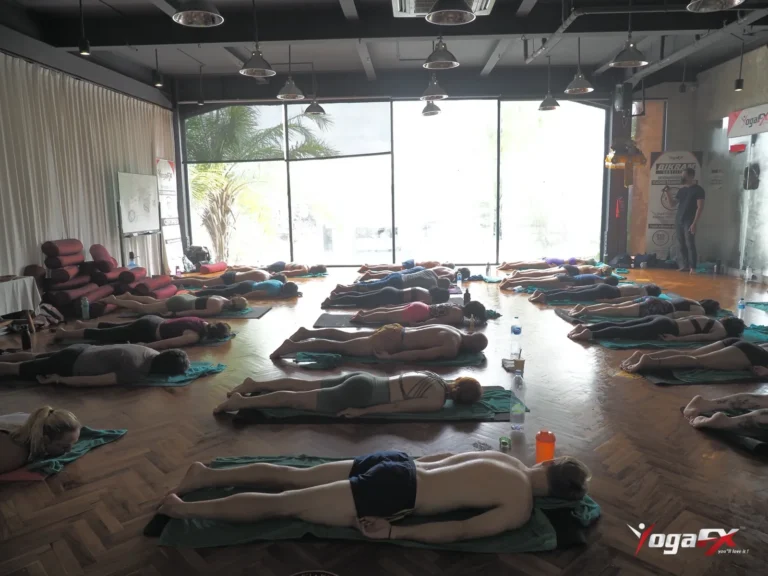

Hot yoga heart rate in a 90-minute Bikram class averages about 72% of predicted maximum for women and 80% for men, with short peaks near 85% to 92%. Those figures come from one university study of 20 regular students. Your own zones depend on age, fitness and medication, so measure them against your own maximum.

At YogaFX, Mr. Ian Terry, E-RYT 500, has taught more than 12,000 hours of Bikram Hot 26&2. In his classes, trainees learn to check breath and posture first and the watch second. This guide puts published numbers next to that habit, so you know what to expect before you step into the heat.

Hot Yoga Heart Rate in a Bikram Class: What Two Studies Measured
Two studies give the clearest picture of hot yoga heart rate in a Bikram room. They measured different people for different lengths of time. So read them as two snapshots, not one verdict.
The 90-minute class study
A team led by Emily Quandt and John Porcari at the University of Wisconsin-La Crosse followed 20 regular Bikram students through one full class. There were seven men and 13 women, aged 28 to 67. The American Council on Exercise write-up reports an average heart rate of about 80% of predicted maximum for men and 72% for women. Peaks reached 92% in men and 85% in women.
The numbers matter because the American Heart Association calls 70% to 85% of maximum the vigorous band. So the men's average sat near the top of that band, and the women's average sat just inside it. A hot class isn't a gentle stretch, and hot yoga heart rate shows it.
The heated versus cool room trial
Lambert and colleagues asked 16 experienced practitioners to do the same one-hour Bikram sequence twice, once at 105°F and once at 74°F. The group had 14 women and two men, with an average age of 40. The full paper sits open on PubMed Central (International Journal of Exercise Science, 2020).
- Heated room: heart rate averaged 113 beats per minute, up from about 85 before class.
- Cooler room: heart rate averaged 109 beats per minute, up from about 84 before class.
- The verdict: the authors reported no significant difference in heart rate between the two rooms.
That second result surprises many students who expect hot yoga heart rate to jump in the heat. The heat did not push the pulse far above the cooler room in that hour, at least in experienced people. We come back to what the heat does change below. For a wider view of the research, see our summary of the benefits of Bikram yoga.
What the studies cannot tell you
A 2014 University of Wisconsin study (Porcari et al.) also put heart rate near 80% of maximum across a 90-minute class. A 2019 pilot, uncontrolled trial titled Acute Cardiovascular Responses to a Session of Bikram Yoga exists too, but its title tells you how small the evidence is. Keep three limits in mind:
- Different units. One study reports percent of predicted maximum and the other reports beats per minute, so don't line the numbers up.
- Experienced groups. Every volunteer already practised Bikram, so beginners may look different.
- No posture-by-posture trace. As far as we can see, neither report breaks heart rate down pose by pose.
How to Find Your Hot Yoga Heart Rate Zones
You don't need a lab to set your hot yoga heart rate zones. The American Heart Association says your maximum heart rate is about 220 minus your age. It puts moderate effort at 50% to 70% of that maximum and vigorous effort at 70% to 85%. Studies use the same idea and call it predicted maximum.
- Step 1. Subtract your age from 220 to get your estimated maximum.
- Step 2. Multiply that number by 0.5, 0.7 and 0.85.
- Step 3. Write the two bands on a card and keep it by your mat.
| Age | Estimated maximum (bpm) | Moderate, 50% to 70% (bpm) | Vigorous, 70% to 85% (bpm) |
|---|---|---|---|
| 20 | 200 | 100 to 140 | 140 to 170 |
| 30 | 190 | 95 to 133 | 133 to 162 |
| 40 | 180 | 90 to 126 | 126 to 153 |
| 50 | 170 | 85 to 119 | 119 to 145 |
| 60 | 160 | 80 to 112 | 112 to 136 |
Here is a worked example. Take a 40-year-old with an estimated maximum of 180. Table 1 puts their moderate band at 90 to 126 and their vigorous band at 126 to 153. A class average near 80% would be 144 beats per minute, so it would sit inside the vigorous band. Check your own sums before you step in.
Treat the table as a starting line for your own hot yoga heart rate. Real maximums vary from person to person, so a number a few beats off is normal. Medication changes hot yoga heart rate too. The American Heart Association notes that some drugs lower your maximum heart rate and your target zone. If you have a heart condition or take medication, ask your health care professional what your range should be.
Reading the five-zone watch scale
Many fitness watches also split 50% to 100% of maximum into five zones of ten points each. That scale is handy for reading hot yoga heart rate in the sequence map below, but the two-band version above is the one the heart association uses.
Where Hot Yoga Heart Rate Zones Show Up in the 26&2 Sequence
We didn't find a published study that traces heart rate through every posture. So this map of hot yoga heart rate comes from the teaching Guide that YogaFX uses with trainees. It describes zone-style responses that vary by age, fitness, heat acclimation and effort. It's a teacher's map, not a set of measured values.
| Part of the class | Zone-style response in our Guide | Postures the Guide names |
|---|---|---|
| Standing series, baseline | Zone 2 to Zone 3: steady aerobic work | Sustained standing postures with balance and breath control |
| Standing series, peaks | Short Zone 3 to Zone 4 efforts | Standing Head-to-Knee, Standing Bow Pulling, Balancing Stick, Triangle |
| Savasana resets | Zone 1: recovery and settling | Rests between floor postures and the final rest |
| Floor series | Mostly Zone 1, with Zone 2 returns | Cobra, Locust, Full Locust, Bow, Fixed Firm, Camel |
| Zone 5 | Brief individual peaks, never a goal | Only at moments of maximum effort |
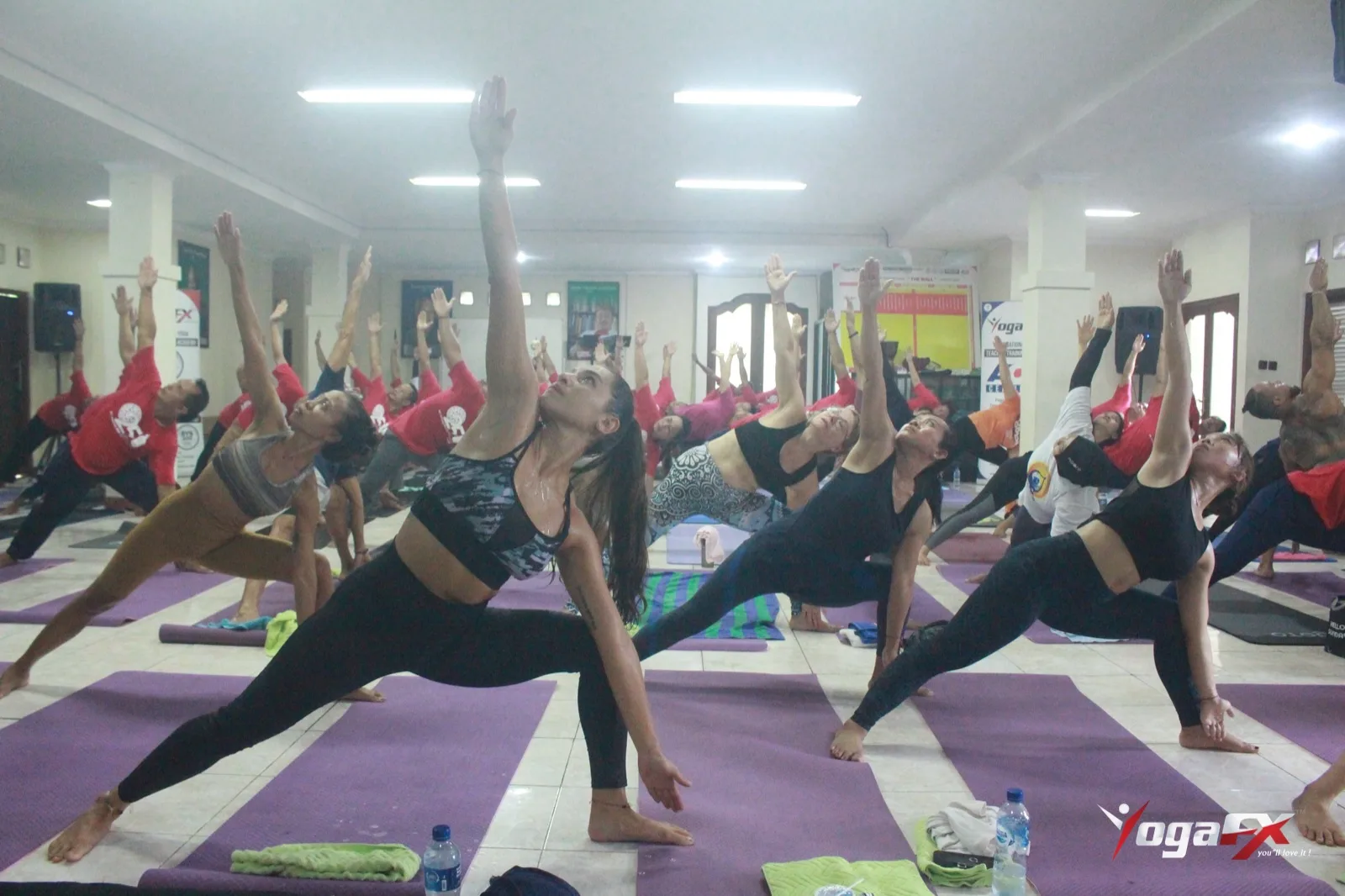
Triangle makes a good test posture. The knee bends, the leg holds, the arm reaches, and the breath still has to stay slow. Our guide to Triangle pose cues in the standing series shows how teachers keep the breath steady while hot yoga heart rate rises.
Why the floor series feels different
After the standing series the room changes. Students lie down, the breath slows and the pulse settles. Then a backbend such as Cobra or Camel brings the effort back for a short while. As a result, a class works like a wave: effort, reset, effort, reset. That pattern is why one average hot yoga heart rate hides so much.
Why Your Watch Can Mislead Your Hot Yoga Heart Rate Reading
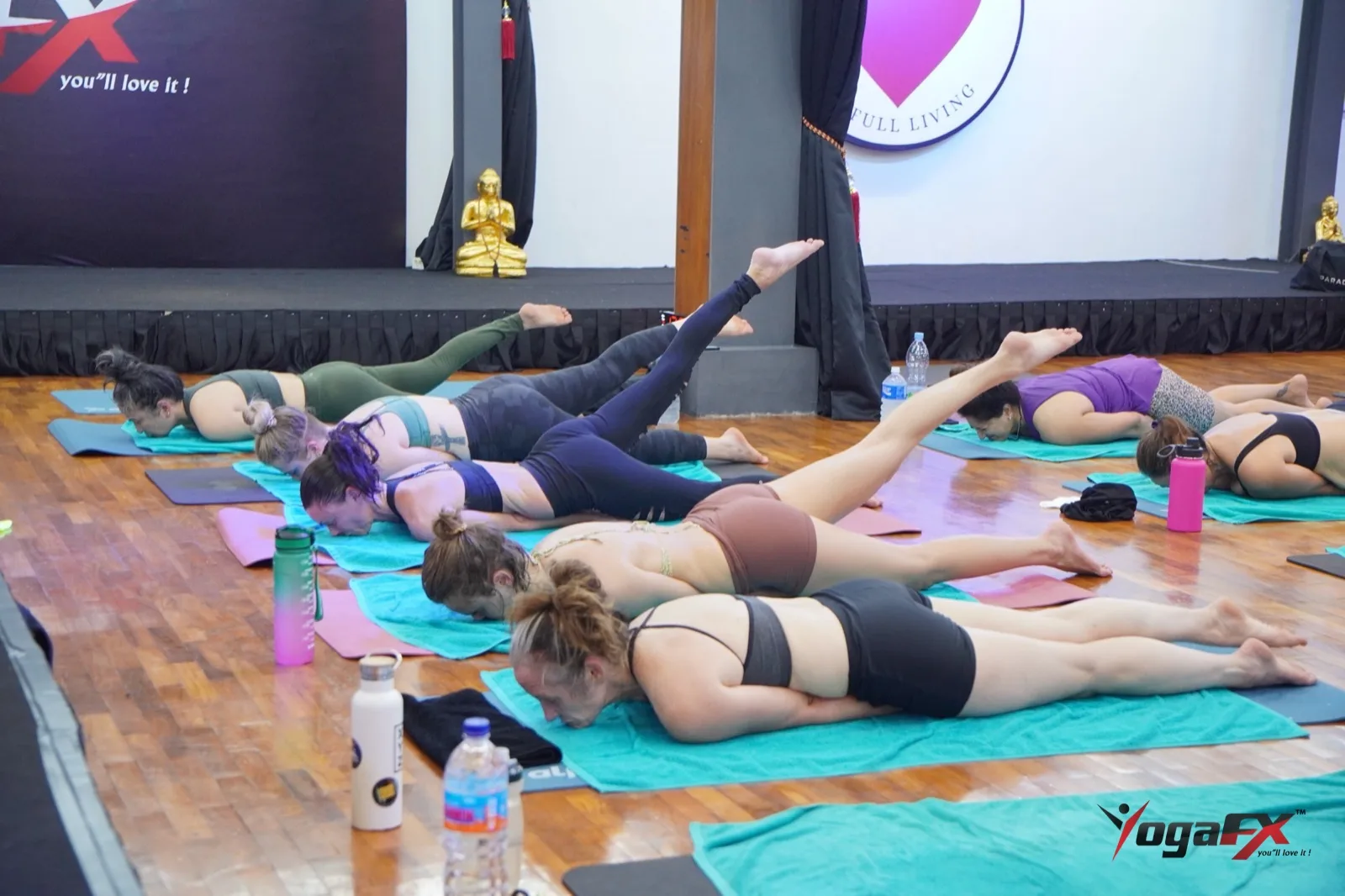
A wrist reading of hot yoga heart rate looks precise, but it is only a guide. Sweat, movement and a loose strap can distort the signal. Your estimated maximum is also a population average, so the percentage on screen can sit several points off. That means you should read trends, not single numbers.
- Compare the same posture week to week. A lower hot yoga heart rate for the same effort suggests your fitness is rising.
- Pause before you judge a reading. Stand still for a few breaths, then look at the screen.
- Trust your body over your wrist. If you feel dizzy while the watch looks fine, rest anyway.
- Keep the card, not the screen, as your rule. Your two bands from Table 1 are the reference.
Fitness is only one piece of the picture. For the oxygen side of the story, read our guide on whether hot yoga improves VO2 max. For the broader workout question, see whether hot yoga counts as cardio and whether hot yoga is a good workout.
Core Temperature: The Number Your Watch Does Not Show
Hot yoga heart rate tells you how hard the heart is working. It does not tell you how hot you are. The ACE-sponsored study tracked both, and the temperature results deserve as much attention as the pulse.
- Average highest core temperature: 103.2°F in men and 102.0°F in women.
- Above 103°F: seven of the 20 students passed that mark, and one man reached 104.1°F by the end of class.
- Timing: core temperature rose steadily through the 90 minutes, and the report says students began reaching higher core temperatures about 60 minutes in.
- What the researchers saw: no signs of heat-related illness, but they said the risk should not be overlooked.
The authors suggested shorter classes, closer attention to hydration and teachers who know the early signs of heat intolerance. They also noted that most healthy people need about 10 to 14 days to acclimate. So a new student should start gently, rest often and stay near the back.
When a High Pulse Is a Warning
A high hot yoga heart rate in a hot room is normal. A pulse that stays fast while you feel unwell isn't. This section is general information, not medical advice. Consult a healthcare professional before you start, especially if you have heart disease, high blood pressure, a rhythm problem or you are pregnant.
"There can be no greater investment than the one that you make in your health, because without it, nothing else matters."
Mr. Ian Terry, YogaFX
Signs to stop and rest
Stop, sit down and sip water if you notice any of these signs:
- Chest pain or pressure. Stop at once and get urgent medical help.
- A racing or uneven heartbeat that does not settle after a minute or two of rest.
- Dizziness, nausea or a pounding headache. These can be early signs of heat strain.
- A sudden stop in sweating. Cool down and tell your teacher straight away.
Sitting out a posture is normal and wise. Powering through isn't the goal.
What Students Say About the Effort
Hot yoga heart rate numbers cannot capture how a class feels from inside. Here is what three YogaFX students said in their own words. They are individual stories, not trial results.
"The best yoga classes I ever had. The teacher is giving very dynamic flows, many balance poses for deep strength and it will never be boring and is always encouraging."
Anouk, Google review, 2020
"This training is it was more than I expected."
Lars, YouTube review, 2026
A trainee in our 2018 YouTube review put the effort this way: "they made me do much more than I actually can". Words like these are why we teach students to learn their zones before they chase them.
Learn to Read the Room With YogaFX
Teachers hear hot yoga heart rate questions every week. A good answer uses evidence, not hype. The YogaFX Bikram Hot 26&2 Yoga Teacher Training MasterClass trains you to give one. Mr. Ian Terry trained for five years, from 2014 to 2019, with the founder of the Bikram Hot 26&2 method. Since 2017, YogaFX has graduated more than 1,500 trainees from 80+ countries.
The course is a 6-day hybrid: online pre-course study, then an intensive in Bali. Graduates earn the Yoga Alliance RYT 200-Hour and the Bikram Hot 26&2 200-Hour International Yoga Certification.
The next batch checks in on Sunday 24 January 2027 and checks out on Friday 29 January 2027, at the Soham Wellness Center in Seminyak. The Early Bird price is US$1,899 against the normal US$1,999, with payment plans from US$250 a month.
Want the full picture of the method first? Read our guide to Hot 26 and 2 yoga: lineage, science and teaching, or browse the teacher training overview at yogafxteachertraining.com.
FAQ
What is an average heart rate during hot yoga?
There is no single number. In a 90-minute Bikram study, women averaged about 72% and men about 80% of predicted maximum heart rate. In a one-hour heated trial the average was 113 beats per minute. Your own average depends on your age, fitness and how hard you work.
Why is my heart rate so high in hot yoga?
Effort, heat and the length of the class all play a part. Standing balance postures ask a lot of your legs and breath, and the warm room adds strain. A high number is normal. If it stays high while you feel dizzy or unwell, stop, sit down and tell your teacher.
Does a fitness watch read hot yoga heart rate correctly?
Not always. Sweat, movement and a loose strap can distort a wrist reading, and your estimated maximum is only an average. Use the watch to spot trends across several classes. Pause for a few breaths before judging a number, and trust how your body feels over the screen.
Do heart medicines change hot yoga heart rate zones?
They can. The American Heart Association says some drugs lower your maximum heart rate and your target zone. That means the general age-based zones may not fit you. If you take medication or have a heart condition, ask your health care professional what range is safe before you try a hot class.
What should I do if my heart rate feels too high in class?
Stop the posture, sit or lie down and take slow breaths. Sip water and tell your teacher. Your pulse should settle within a minute or two. If you have chest pain, a racing or uneven heartbeat, or feel faint, stop completely and get medical help straight away.
Still have questions about your own pulse in class? YogaFX answers every message personally. Message Mr. Ian on WhatsApp.