





Hot yoga inflammation research is small, early and mixed. One four-week trial found more heat shock protein 70 in people who practised in the heat. One crossover study found a short jump in the inflammation marker IL-6. We could not open a hot yoga study showing lower C-reactive protein, so the honest answer is: not proven yet.

Mr. Ian Terry, E-RYT 500, has taught more than 12,000 hours and has heard every claim about the hot room. At YogaFX we want teachers to answer this question with the study in hand, not a slogan. So here is what the research on hot yoga inflammation measured, what it did not, and what that means for your next class.
Hot Yoga Inflammation: The Short Answer in Three Lines
Three findings are worth knowing, and each one comes with a limit. Read them as clues, because none of them settles the question.
- Heat shock protein 70 rose in blood cells after 12 hot yoga classes in 22 adults, but not after the same yoga at normal room temperature.
- IL-6 rose about 15.5-fold 30 minutes after one hour of Bikram yoga at 105°F in 16 experienced practitioners, and it did not change at 74°F.
- C-reactive protein (CRP), the marker doctors use most, was not measured in the IL-6 study and was not reported in the text of the heat shock protein trial.
That last point matters most for hot yoga inflammation. When a page says hot yoga "lowers inflammation", it usually leans on research about heat in general, or about yoga in general. So it rarely points to a hot yoga trial that measured CRP. We would rather say so than guess.

What Inflammation and CRP Actually Mean
Before looking at any study, it helps to know what the researchers counted. C-reactive protein is a protein your liver makes in response to inflammation. MedlinePlus, from the US National Library of Medicine, explains that a CRP test measures how much of it sits in a blood sample.
A high-sensitivity CRP test, or hs-CRP, picks up very small rises. Doctors use it to estimate heart disease risk. MedlinePlus gives a value of 0.8 to 1.0 mg/dL or lower as a healthy amount, and it adds that any rise above normal may mean inflammation somewhere in the body.
The test has a clear limit too. It can tell you how much inflammation there is, but not what is causing it or where it sits. For example, a cold, a sore knee and a hard week can all nudge the number. The Cleveland Clinic also notes that females and older adults naturally run higher levels, so one reading says little by itself.
Why one number cannot settle hot yoga inflammation
Researchers use several markers, not just CRP. IL-6 is a signalling protein linked to inflammation. TNF-α and IL-10 are two others, with TNF-α tied to inflammation and IL-10 to calming it. A study that measures one marker can look very different from a study that measures another.
So when you read about hot yoga inflammation, ask three questions, because the answers change what a result means. Which marker did they measure? When did they measure it? And who were the people in the study? The next two sections answer those for the two hot yoga studies we could open and check.
Heat Shock Proteins: What They Are and What Hot Yoga Did to Them
A plain-language definition
Heat shock proteins, or HSPs, are molecular chaperones. A 2020 review by Stefan Tukaj in the International Journal of Molecular Sciences describes them as proteins that assist polypeptide folding and the refolding of damaged proteins, and notes that Hsp70 is overexpressed in the cell under stress. Heat is one such stress. That is why people link HSPs to the hot room.
Our article on the Bikram hot yoga room temperature explains how 40°C heat challenges the body. Here we stay with the hot yoga inflammation question.
Do more heat shock proteins mean less hot yoga inflammation?
Not automatically, which is why hot yoga inflammation is hard to read from a single marker. The same Tukaj review says Hsp70 can turn down NF-κB, a switch that drives inflammation, when it works inside the cell. But Hsp70 outside the cell can interact with TLR2/4 receptors on immune cells and switch the inflammatory pathway on. The author calls this a dual role.
A second review agrees. Zininga and colleagues wrote in 2018 that Hsps are implicated in both pro-inflammatory and anti-inflammatory responses, and that the effect depends on factors such as concentration. In other words, "more HSP70" is not a synonym for "less inflammation". Instead, it is a sign that the cell has met a stress and answered it.
The Bourbeau 2021 trial: 22 adults, 12 classes
The best-known hot yoga heat shock protein result comes from Bourbeau and colleagues in the International Journal of Yoga, 2021. The team randomised 22 adults, 11 men and 11 women, to four weeks of yoga in a heated room or yoga at normal temperature. Each person did three sessions a week, 12 in total.
The hot group practised at about 40°C and 40% humidity. The comparison group practised at roughly 18 to 22°C. Each session was a 75-minute video-led sequence of 24 postures, not a live Bikram class, so the match to a real 26&2 room is close but not exact.
The researchers measured heat shock protein 70 in peripheral blood mononuclear cells, a type of white blood cell. Their abstract says HSP70 expression was higher in the hot group only. The results section reports a significant rise in the hot group and none in the normal-temperature group (P < 0.05).
- Fitness: maximal aerobic fitness rose in the hot group only, from 3.22 to 3.46 litres of oxygen per minute.
- Stress markers: ACTH and perceived stress did not change.
- Authors' conclusion: 12 hot sessions promoted cardiovascular fitness and cellular thermotolerance adaptations.
Notice what is missing, because the text does not report CRP or IL-6. The trial tells us the cells of hot yoga students made more HSP70. It does not tell us their inflammation went down. For the fitness side of this trial, see our review of whether hot yoga improves VO2 max.
What Happened to IL-6 After One Hot Class
The second study asked a different question. Lambert and colleagues, in the International Journal of Exercise Science, 2020, measured inflammation markers around a single session. Sixteen experienced practitioners, 14 women and 2 men with an average age of 40, did a one-hour Bikram sequence twice. One session ran at 105°F (40°C) and one at 74°F, in random order, at least 96 hours apart.
Blood was drawn before the session and 30 minutes after it. Here is what the team found:
- IL-6 rose 15.5-fold (give or take 8.0) after the hot session only. After the 74°F session it rose 1.9-fold, which was not significant.
- TNF-α and IL-10 showed no change after either session.
- Energy cost was similar: 156 kilocalories in the heat against 151 at room temperature, not a significant difference.
- CRP was not measured.
How to read a 15.5-fold rise
A big number looks alarming in any hot yoga inflammation study, so the instinct is to read it as harm. We would not. The study took blood twice, so it cannot say how long IL-6 stayed up or whether it fell back within hours. It also cannot say whether the rise helps, hurts or does nothing over months of practice.
What it does show is that heat changed the body's signal even when the workout did not cost more energy. That means the hot room may be a stressor of its own. For the stress hormone side of that idea, our article on whether hot yoga increases cortisol covers the Hopkins trial and the effort data.
One more caution. The group was small, mostly female and experienced. Beginners may respond differently because the study did not test them. So we treat the IL-6 result as a short-term snapshot, not a verdict on hot yoga inflammation over months.
The Evidence Side by Side
The table below puts the two hot yoga inflammation studies and the mechanism reviews in one place. Every row names its source, so you can open it yourself and check our reading.
| Source | Who and how long | What it found | The limit |
|---|---|---|---|
| Bourbeau et al., 2021 | 22 adults, 12 classes over 4 weeks, hot vs normal-temperature yoga | HSP70 higher in the hot group only; aerobic fitness up | Small sample; CRP and IL-6 not reported; video-led sequence |
| Lambert et al., 2020 | 16 experienced practitioners, one hour at 105°F and one at 74°F | IL-6 up 15.5-fold after the hot session only; TNF-α and IL-10 unchanged | Blood drawn only before and 30 minutes after; CRP not measured |
| Tukaj, 2020 (review) | Mechanism review of Hsp70 | Hsp70 can lower NF-κB inside the cell and raise it outside | Not a hot yoga study; dual role |
| Zininga et al., 2018 (review) | Mechanism review of heat shock proteins | HSPs take part in pro- and anti-inflammatory responses | Effect depends on concentration and type |
What the side-by-side view tells us
Read across the table and a pattern shows up for hot yoga inflammation. Both hot yoga studies found a change that only appeared in the heat. That supports the idea that heat does something the same movement at normal temperature does not. It does not tell us whether that something lowers inflammation.
The reviews add the missing piece. Heat shock proteins can calm or raise inflammatory signals, depending on where they sit and how much there is. A rise in HSP70 is therefore interesting for hot yoga inflammation, but it is not a result you can bank.
What We Cannot Say About Hot Yoga Inflammation Yet
This is the part most pages skip, so we will be direct. Here is what the evidence we could open does not support:
- That hot yoga lowers CRP. We found no hot yoga study that reported it.
- That it reduces long-term inflammation. Hot yoga inflammation has not been tracked over months: the IL-6 study looked at one session, and the HSP70 trial lasted four weeks.
- That more HSP70 means less inflammation. The reviews show it can go either way.
- That hot beats room temperature for inflammation over months. Nobody has tested that with a large trial.
- That it treats any condition. Joint disease, autoimmune disease and infections need a doctor, not a yoga room.
We also do not use "cleansing" language here. Sweat cools you down, so it does not clear out your blood markers, and none of the studies above claim that it does. Our teaching line is simple: describe the sweat as cooling, nothing more.
Passive heat is a different dose again. Sitting in a sauna is not the same as 90 minutes of postures at 40°C. Our comparison of hot yoga vs sauna shows why researchers keep the two apart.
How to Practise Sensibly While the Science Catches Up
You do not need to wait for a perfect trial to practise well. You do need to avoid promising yourself results nobody has measured. These habits follow the hot yoga inflammation studies above and common sense:
- Expect a short, strong response. The IL-6 result suggests your body treats the hot room as a real stressor, so arrive rested, fed and hydrated.
- Separate soreness from pain. Muscle ache the next day is normal after a new routine. Sharp or joint pain is a signal to stop and get advice.
- Take every rest. The Lambert group worked at a similar energy cost in both rooms, so you do not need to push to make the heat count.
- Give it time. The HSP trial ran 12 classes over four weeks, so judge your practice over weeks, not after one class.
- Do not stop treatment. If you take medicine for an inflammatory condition, keep taking it and tell your doctor about your yoga.
Please consult a healthcare professional before you start hot yoga if you have an inflammatory or autoimmune condition, a heart condition, high blood pressure, are pregnant, or have a history of fainting or heat illness. If you feel dizzy, nauseous or unwell in class, sit down and tell the teacher. This article is education, not medical advice.
What Trainees Say After the Heat
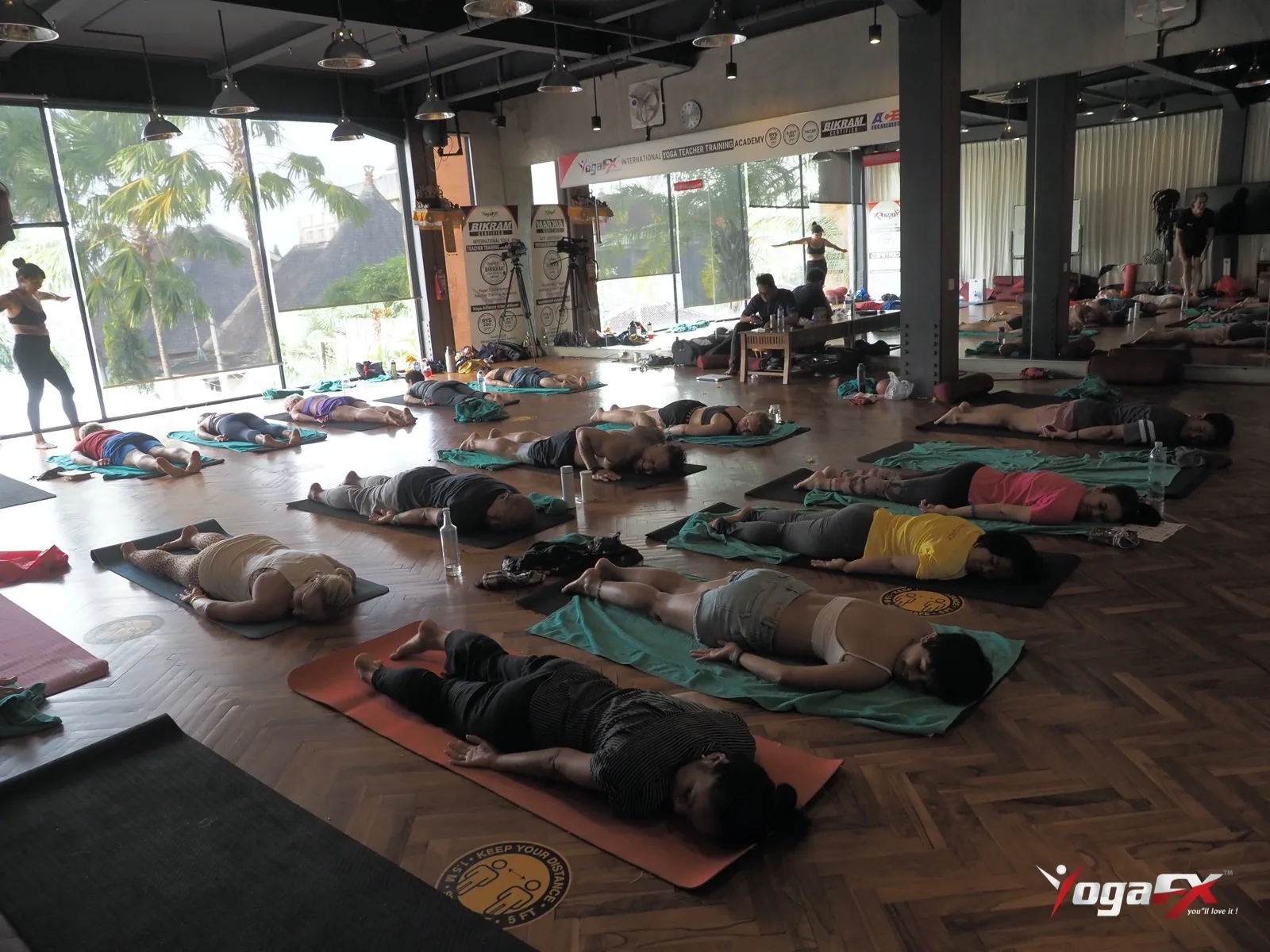
Blood markers tell one side of the story. Students tell the other. These two trainees did their teacher training in our hot room, and they describe the effort in their own words.
Scott got up every morning, put his yoga pants on and "sweated it out" until the course was done. He called the training hell and back, with a t-shirt to prove it.
Scott, YouTube review, 2025 (paraphrased; watch the video)
"It's been like a life transforming experience for me personally."
Mariana, YouTube review, 2023
Neither of them measured a blood marker, of course. Their words show what the numbers cannot: people choose the hot room because of how the practice feels over weeks, not because of one lab value.
Teach the Heat Research Honestly With Mr. Ian Terry
Future students will ask you, "is hot yoga good for inflammation?" A good teacher answers with the study, the dose and the limits. That is the habit we build in the 6-day Bikram Hot 26&2 Yoga Teacher Training MasterClass in Bali, which blends pre-course online study with an intensive week in the room.
Who leads the training
Mr. Ian Terry, E-RYT 500, leads the course. He has more than 12,000 teaching hours and trained for 5 years, from 2014 to 2019, with the founder of the method. Since 2017, YogaFX has trained more than 1,500 graduates from 80+ countries. Graduates leave with a Yoga Alliance RYT 200-Hour certification and a Bikram Hot 26&2 200-Hour International Yoga Certification.
Here is what the next step looks like:
- Next batch: check-in Sunday 24 January 2027, check-out Friday 29 January 2027, at Soham Wellness Center in Seminyak.
- Early Bird price: US$1,899 instead of US$1,999, with payment plans from US$250 a month.
- What you learn: the 26 postures, the dialogue, and the physiology behind heat, sweat and stress, so you can explain it clearly.
Read our full guide to yoga teacher training in Bali to compare formats, or message Mr. Ian on WhatsApp and ask about a spot.
FAQ
Does hot yoga cause inflammation?
It can raise one marker for a short time. In a 2020 study of 16 experienced practitioners, IL-6 rose about 15.5-fold 30 minutes after a hot Bikram hour and did not change at 74°F. The study did not track how long it stayed up, and it did not measure CRP.
Does hot yoga reduce inflammation?
Nobody can say yet. A 2021 trial found more heat shock protein 70 in hot yoga students after 12 classes, but it did not report CRP or IL-6. Reviews show heat shock proteins can raise or lower inflammatory signals. Treat it as an open question.
Is hot yoga anti-inflammatory?
The evidence is too thin to use that label. We found no hot yoga study that reported lower CRP, the marker doctors use most. Studies show heat changes the body's signals, but whether that calms inflammation over months has not been tested in a large trial.
Is hot yoga good for arthritis?
We could not open a hot yoga trial in arthritis, so we cannot recommend it. Heat and sweat do not treat joint disease. If you have arthritis or another inflammatory condition, ask your doctor before you try hot yoga, and keep taking any prescribed treatment.
What does CRP tell you about inflammation?
CRP is a protein your liver makes in response to inflammation. A high-sensitivity test picks up very small rises and helps estimate heart disease risk. It shows how much inflammation is present, but not what causes it or where it sits, so a doctor must read the result.
Still have questions? Message Mr. Ian and the YogaFX team on WhatsApp and we will answer them personally. Tell us about your practice, your goals and any health concerns, and we will point you to the right next step.