

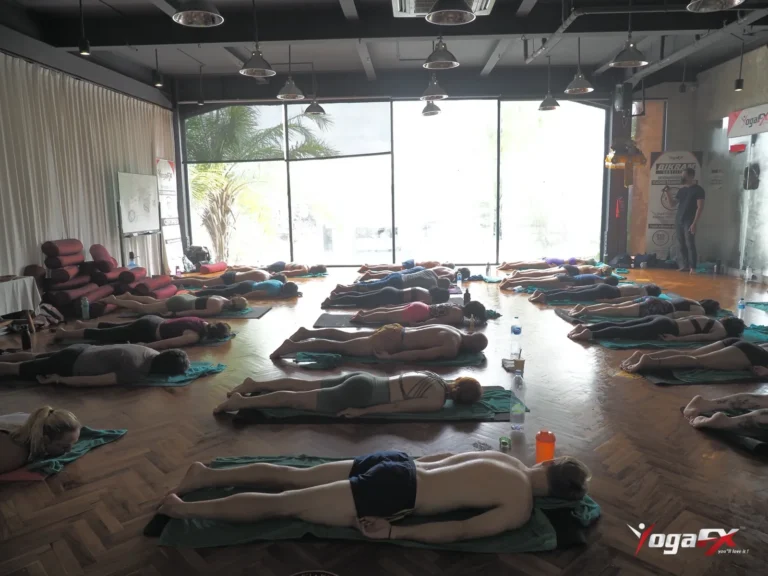

Cobra pose (Bhujangasana) is the first floor backbend in the Bikram Hot 26&2 class. You lie face down, place your hands under your shoulders, and lift your chest with your back muscles while your hips stay on the floor. Each set is held for 10 seconds, and you do two sets.

Mr. Ian Terry, E-RYT 500, has taught more than 12,000 hours of Bikram Hot 26&2 and trains teachers at YogaFX in Bali. This guide looks at cobra pose through the dialogue, the spoken words a teacher uses to talk you into the shape. You will see what each cue asks, where hands and elbows usually go wrong, and how trainees learn to hear a good cobra pose.
Where Cobra Pose Sits in the Bikram Floor Series
A Bikram class is 26 postures and 2 breathing exercises, in the same order, for 90 minutes at about 40°C and 40% humidity. Cobra pose is posture 16 in the order listed on our Bikram yoga asanas guide. It arrives right after Sit-Up, so your spine has just folded forward and now has to reverse.
That timing explains a lot. By posture 16 you have been moving for about 45 minutes, your hamstrings are warm, and your breath is already working hard. The teacher then asks you to lie down, which feels like relief. It isn't relief for long. The standing series before it includes Triangle pose and its cues.
- The hold: 10 seconds per set, with 2 sets in total.
- The position: face down, legs together, hands under the shoulders.
- The job: lift the chest with the back muscles, not by pushing with the arms.
- The rest: you lower down, turn your head to one side and breathe before the second set.
If you want a second walk-through of the same posture, our sister site has another take on Bhujangasana from the 26&2 side. This page stays with the spoken dialogue and the teacher's view of the room.
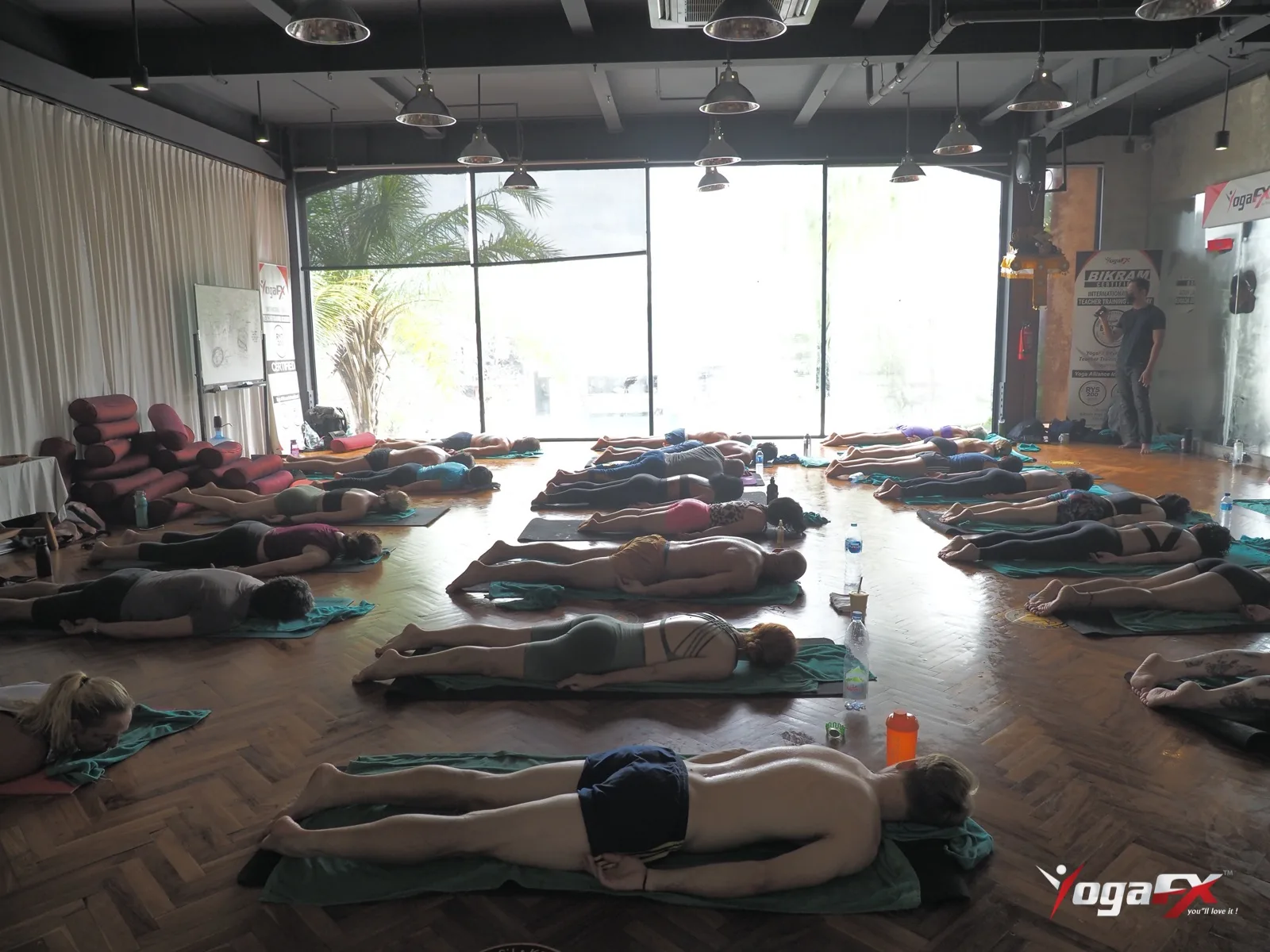
The Cobra Pose Dialogue: Seven Cues in the Order You Hear Them
Teachers deliver the exact words live, and trainees memorise them in the course. So this guide paraphrases the dialogue and does not reproduce it. What follows is the order of ideas, with the job each one does.
- Lie face down with the legs together. The first cue builds a base, so the lower body can push into the floor.
- Press the tops of the feet down. The feet and thighs stay active, which keeps the pelvis square.
- Set the hands under the shoulders. The palms go flat, fingers forward, and the arms act as a support, not an engine.
- Keep the elbows close to the ribs. Tucked elbows stop the shoulders from flaring and shrugging.
- Lift the chest with the back. The back muscles start the movement, and the hands only follow along.
- Open the chest and bring the shoulders down. The shoulder blades slide toward the hips, away from the ears.
- Lift the gaze a little, then come down. The head follows the spine, and the release is slow and in one line.
Notice how each cue guards the next one. The legs make the base, the base lets the back lift, and the elbows keep the shoulders from stealing the work. Take one cue out and the shape changes. That's why teachers repeat the early cues even when the room is tired.
Why the dialogue speaks in short commands
In a hot room, long explanations get lost. A short command such as "hips down" is easy to hear at minute 45, and it fixes one thing at a time. For that reason, trainees practise saying each cue clearly and without extra words. You can read how that practice works in our guide to learning the 26&2 dialogue word for word.
Hands, Elbows and Gaze: Where Cobra Pose Usually Goes Wrong
Most cobra pose problems start with the hands, because the hands decide how much the arms will do. A teacher scanning the room looks at three places first: the hands, the elbows and the head.
Hand placement
Hands that sit too far forward make the arms straighten early. Then the lower back takes the load, and the chest never really opens. Hands under the shoulders keep the elbows bent and the back muscles in charge. If you can see your fingertips past your nose, the hands have drifted forward.
Elbow placement
Elbows that wing out to the sides pull the shoulders up toward the ears. The neck then shortens, and the lift turns into a shrug. Tucked elbows do the opposite, because they let the shoulder blades slide down the back. As a result, the chest opens without any strain in the neck.
Head and gaze
The head is the heaviest part of the upper body, so it deserves a gentle cue. Throwing the head back crushes the back of the neck and tells the spine to stop short. Instead, lift the gaze a little and keep the chin soft. The spine does the curving, and the head simply goes along.
| Part of the body | What the cue asks | What a teacher listens or looks for | Quick fix |
|---|---|---|---|
| Hands | Under the shoulders, palms flat | Fingertips far past the face, arms straight early | Slide the hands back and bend the elbows |
| Elbows | Close to the ribs | Elbows flared wide, shoulders near the ears | Tuck the elbows and lengthen the neck |
| Hips | Heavy on the floor | Hip bones lifting away from the mat | Lower the chest an inch and start again |
| Head | Gaze up a little | Chin thrown back, neck creased | Keep the chin soft and look only slightly up |
The hips deserve one more sentence. If the hip bones lift, you have gone higher than your back can support today. Lower the chest and try again. Depth is not the goal in this posture. Control is.
Set One and Set Two: Using the Second Cobra Pose to Fix the First
Every posture in the 26&2 is done twice, and cobra pose is no exception. The second set is not a repeat for its own sake. It is a chance to change one thing you noticed in the first.
| Set 1 | Set 2 | |
|---|---|---|
| Your job | Find out where the shape collapses | Change one thing, not five |
| What to notice | Arms pushing, hips lifting, neck tight | Whether the fix made the lift lighter |
| Hold time | 10 seconds | 10 seconds |
| Good question to ask | Where did I use my arms? | Can the back lift a little more with the arms lighter? |
Students who treat set two as a second chance usually improve faster than students who try to go higher. A smaller, steadier lift teaches the back to work, while a bigger lift teaches the arms to take over. Over a few weeks, the steady lift tends to grow by itself.
The same logic carries into the next posture. Cobra pose hands you a warm, extended back, and the backbend that follows asks for more. When you are ready to see where that leads, read our guide to camel pose in the Bikram floor series.
Five Cobra Pose Slips a Teacher Fixes With One Short Cue
Here are the five slips that show up most in a Bali class, together with the style of cue a teacher uses to correct each one. The wording below is a paraphrase, not the script.
- Straight arms too early. The cue is about bending the elbows, so the back muscles get the first part of the lift.
- Hips leaving the floor. The cue is about pressing the front of the pelvis into the mat.
- Shoulders near the ears. The cue is about sliding the shoulder blades down the back.
- Neck thrown back. The cue is about keeping the chin soft and the gaze only a little higher.
- Held breath. The cue is about slow, steady breathing, because a held breath tightens the whole back.
For example, a student who always feels cobra pose in the lower back is usually pushing with the arms and lifting the hips at the same time. A lower lift with the elbows bent fixes both at once. If you feel sharp pain, pinching or tingling, come down and rest. Then tell your teacher.
What the Research Says About Cobra Pose, Back Strength and Safety
No study has measured cobra pose on its own. What exists is research on whole Bikram classes and on yoga for back pain, and it is worth reading with that limit in mind.
A small randomised trial of full Bikram classes
Tracy and Hart (2013) ran a randomised trial in the Journal of Strength and Conditioning Research. Twenty-one healthy young adults took part. The yoga group did 24 sessions in 8 weeks, each a 90-minute standardised class in a heated and humidified studio.
Compared with the control group, the yoga group showed more deadlift strength, much better lower back and hamstring flexibility, better shoulder flexibility and a modest drop in body fat. Handgrip strength, cardiovascular measures and maximal aerobic fitness did not change. Cobra pose was one posture among 26, so these results describe the whole class, not this pose.
A 2025 systematic review by Willmott and colleagues pooled 43 studies with 942 participants. It is named here without a link, because the full text could not be opened when this article was checked.
What the NIH says about yoga and low back pain
The US National Center for Complementary and Integrative Health summarises the evidence for chronic low back pain in its yoga and pain review. A 2022 Cochrane review of 21 trials with 2,223 participants found low-to-moderate certainty evidence that yoga gives small improvements in back-related function and pain compared with no exercise. In plain words, the benefit looks real but modest.
On safety, NCCIH says yoga is generally safe for healthy people when performed properly under a qualified instructor. It also warns that hot yoga carries special risks of overheating and dehydration. People with conditions such as lumbar spine disease should talk with their health care provider and the instructor first.
| Source | Who and how big | What it found | What it means for cobra pose |
|---|---|---|---|
| Tracy and Hart, 2013 | 21 healthy young adults, 24 classes over 8 weeks | More deadlift strength, better lower back and hamstring flexibility, modest fat loss | Regular classes may build the back and hip range the pose uses, but cobra was not tested alone. |
| NCCIH review of the Cochrane evidence, 2022 | 21 trials, 2,223 participants | Small improvements in back function and pain compared with no exercise | Yoga may help some people with back pain a little. It isn't a treatment for cobra pose or anything else. |
| NCCIH safety guidance | General yoga guidance | Safe for healthy people with a qualified instructor. Hot yoga adds overheating and dehydration risks | Hydrate, tell the teacher about any back problem, and follow tension, not pain. |
This is general information, not medical advice. If you have a back, neck or shoulder problem, a recent injury or surgery, or you are pregnant, speak to a healthcare professional before you practise, and tell your teacher before class. If pain, tingling or weakness shows up in the legs, stop and get medical help.
Our own guide to upper back pain from yoga explains what a teacher does when a posture feels wrong, and when to see a doctor.
How Trainees Learn to Teach Cobra Pose at YogaFX
Knowing the cues is the start. Teaching them means hearing what a student needed. A trainee who has the order in their head can look at a cobra pose with the hips lifted and name the fix in a few words. That is why the dialogue is memorised first and delivered second.
Mr. Ian Terry, E-RYT 500, has taught more than 12,000 hours. YogaFX, founded in 2017, has trained 1,500+ graduates from 80+ countries. The Bikram Hot 26&2 Yoga Teacher Training MasterClass is a hybrid course: an online pre-course, then a 6-day intensive in Bali. It leads to Yoga Alliance RYT 200 certification and a Bikram Hot 26&2 200-hour certification.
The next batch checks in on Sunday 24 January 2027 and checks out on Friday 29 January 2027, from US$1,899 at the Early Bird rate. You can compare formats in our guide to the 6-day Bikram teacher training in Bali.
In Their Words: Students on Learning From the Dialogue
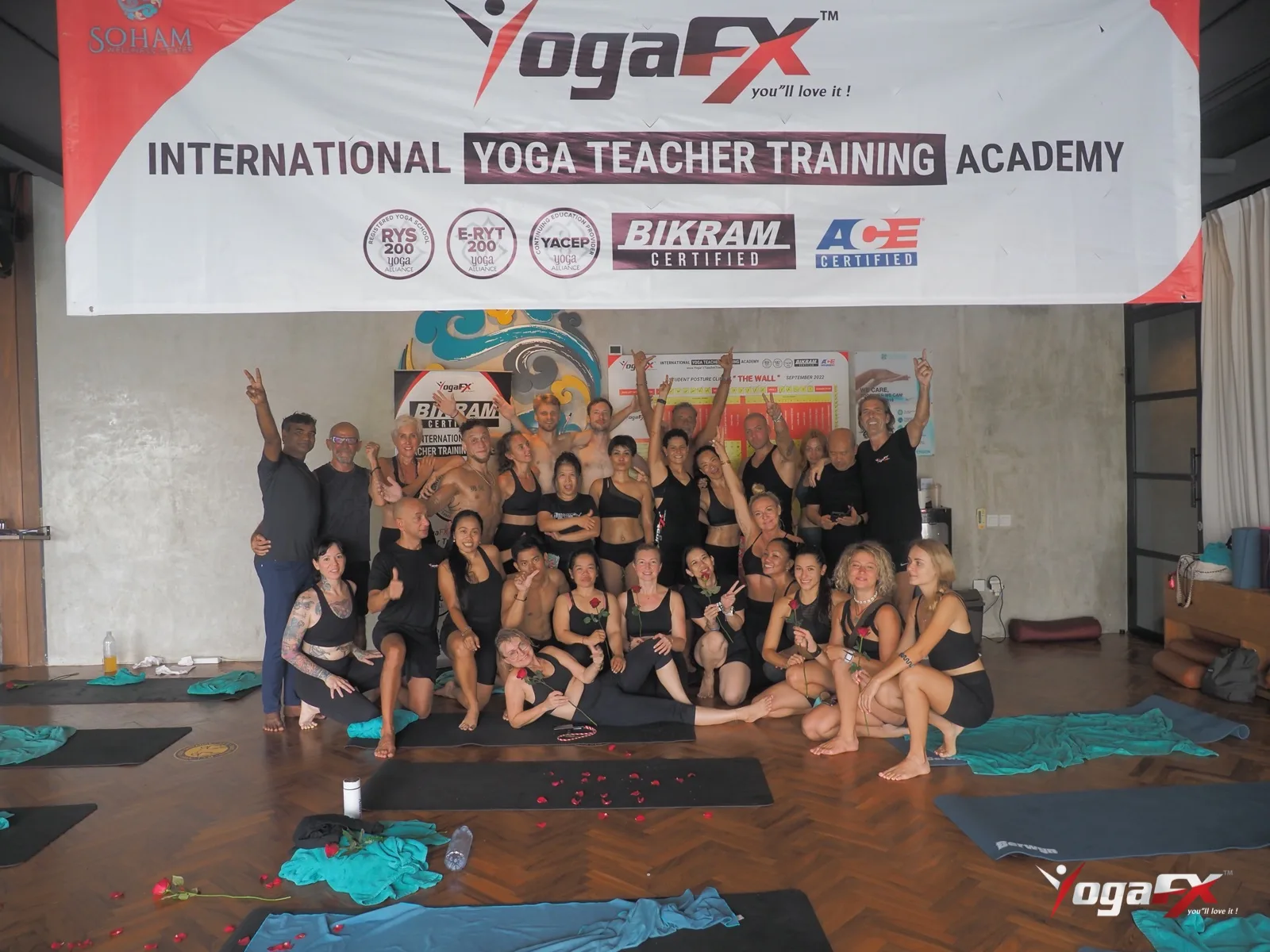
Students rarely talk about one posture when they look back. They'll talk about the teacher, the group and being talked through the hard parts. Here are three voices from YogaFX reviews, with first names only.
“Great inspiration, a great way to learn!!”
Jeanett, Google review, 2019
“Thank you everyone and thank you my team all of you for being very supportive during the dialogue.”
Maha, YouTube review, 2025
Maha's short video review is below. In 2019 Yannie also left a five-star video review for the training and thanked Mr. Ian and the team.
Both reviews sit among the 357 YouTube testimonials, 150 Google reviews and 50 Yoga Alliance reviews from YogaFX graduates.
FAQ
How long do you hold cobra pose in a Bikram class?
In the 26&2 class you hold cobra pose for 10 seconds, then lower down and rest. You then do the whole posture a second time. Your teacher talks you into the shape and back out of it, so the timing is set for you and you don't have to count.
How many times do you do cobra pose in a class?
Cobra pose is done twice in the Bikram class, with a short rest between the two sets. The first set shows you where the shape collapses, and the second set lets you change one thing. Most teachers suggest a smaller, steadier lift in set two instead of a higher one.
Can cobra pose cause lower back pain?
It can, usually when the arms push and the hips lift off the floor, which folds the lower back sharply. Lower the chest, bend the elbows and keep the hips heavy. If the pain is sharp, tingles or lingers, stop and speak to a healthcare professional before you practise again.
Who should take care with cobra pose?
The US National Center for Complementary and Integrative Health says people with conditions such as lumbar spine disease, pregnant women and older adults should talk with their health care provider and the instructor first. Tell your teacher about any back, neck or shoulder problem before class begins.
Does cobra pose reduce belly fat?
No study shows that one posture burns fat from one area. A small trial of full Bikram classes found a modest drop in body fat after 24 classes over 8 weeks, but that came from the whole program. Cobra pose is one of 26 postures, so treat it as part of the class.
Still have questions? Message Mr. Ian and the YogaFX team on WhatsApp and we will answer them personally.