
Upper back pain from yoga almost always comes from one of three sources: collapsing through the shoulders in plank or chaturanga, overextending the neck in upward-facing dog, or a rhomboid and mid-trapezius strain from repeated poses the muscles were not conditioned to hold.

It is a form problem far more often than an equipment problem or a "yoga is bad for you" problem, and the fix is almost always alignment correction plus targeted strengthening, not stopping practice altogether.
The Three Most Common Causes
Upper back pain that shows up specifically after yoga practice, rather than pain that yoga is being used to treat, points to a small set of recurring mechanical issues.
These three causes account for the large majority of cases, and they share a common thread: none of them is really about "yoga" as a whole. Each is about a specific movement pattern repeated without correction, and each has a straightforward fix once identified.
That distinction matters, because it reframes the question from "is yoga bad for my back" to "which specific movement in my practice needs adjusting," which is both more accurate and considerably more useful.
- Collapsed shoulders in plank and chaturanga. When the shoulder blades pinch together and the chest sinks toward the floor instead of staying stacked over the wrists, the rhomboids and mid-trapezius absorb load they are not built to carry repeatedly. This is the single most common cause in Vinyasa-style practices that move through chaturanga multiple times per class.
- Neck overextension in upward-facing dog or cobra. Cranking the head back to look at the ceiling, rather than keeping the gaze level or slightly upward with the neck in a neutral extension, transfers strain into the upper thoracic spine and the base of the skull. Repeated over a class, this shows up as tightness between the shoulder blades the next day.
- Underconditioned postural muscles meeting a new demand. Backbends, arm balances, and extended holds in postures like locust or bow ask the rhomboids, rear deltoids, and mid-back erectors to do sustained isometric work most students' desk-bound daily lives never require. The resulting soreness is real, but it is adaptation soreness, not damage, the first several times a new posture is introduced.
Is It Muscle Soreness or an Actual Injury?
This distinction matters more than which specific posture triggered the discomfort. Delayed-onset muscle soreness, or DOMS, is muscle pain that appears 12 to 24 hours after unaccustomed exercise, peaks around 24 to 72 hours, and resolves within about a week without treatment.
If your upper back feels tight and achy the day after a class that included new postures or more backbends than usual, and it improves steadily over several days, that is DOMS, and it is a normal, expected part of the body adapting to new demand.
A genuine injury looks different. Sharp pain during a specific movement rather than a general ache, pain that gets worse rather than better over several days, numbness or tingling radiating down an arm, or pain that changes how you breathe or turn your head are all signals that go beyond ordinary muscle soreness and warrant a conversation with a healthcare professional rather than a home remedy.
The distinction is not always obvious in the moment, which is exactly why "wait and see if it improves over 3 to 5 days" is a more reliable rule of thumb than trying to self-diagnose from a single data point.
A simple practical test: DOMS is usually symmetrical or closely tied to the specific muscles worked in that class, worsens slightly with the first movement of the day and then eases as you warm up, and responds to gentle activity.
An injury tends to be more localized to a single point, does not ease with movement the way muscle soreness does, and sometimes gets noticeably worse with specific motions like reaching overhead or turning the head to one side.
Keeping a rough mental note of which pattern a given episode follows, rather than assuming the worst or dismissing it outright, is the single most useful thing a student can do before deciding whether to rest, modify, or seek care.
How to Fix the Form Issues Behind It
Each of the three common causes above has a specific, learnable correction rather than a vague instruction to "be more careful."
For collapsed shoulders in plank and chaturanga, the fix is keeping the shoulder blades pulled slightly apart and down, away from the ears, rather than let them pinch together as the chest lowers. Many students find it easier to master this by holding a high plank with active shoulders for several breaths before ever attempting the lowering phase, since the collapse usually happens because the shoulders were never stable in the starting position to begin with.
For neck overextension in upward dog, keeping the gaze level or only slightly upward, rather than cranking the chin toward the ceiling, keeps the cervical spine in a neutral extension instead of a compressed one.
For general postural-muscle soreness following new postures, gentle movement, hydration, and time are the actual treatment; static stretching alone rarely resolves it faster than simply continuing to move normally.
Strengthening Work That Prevents It From Recurring
Form correction addresses the immediate mechanical error, but recurring upper back pain from yoga usually also reflects an underlying strength gap, most commonly in the muscles that hold the shoulder blades back and down against gravity for sustained periods. Building capacity in these muscles outside of class reduces how much any single session asks of them.
- Scapular retraction holds. Simple resistance-band pulls or prone Y-T-W raises, done two to three times a week, build endurance in the rhomboids and mid-trapezius specifically, the muscles most commonly overloaded by collapsing shoulders in plank.
- Prone back extensions. Gentle floor-based extension work builds the postural stamina that backbends and locust-type postures demand, so the muscles are conditioned before a class asks for a sustained hold rather than being conditioned by the class itself.
- Thoracic mobility drills. A stiff thoracic spine forces the lumbar spine or the shoulders to compensate for a rotation or extension the mid-back should be providing. Simple seated or quadruped thoracic rotations, done regularly, restore mobility that a single weekly class cannot build on its own.
None of this needs to be elaborate. Ten minutes of targeted work, two or three times a week, addresses the underlying conditioning gap far more directly than modifying every single class indefinitely, since modification manages the symptom while strengthening addresses the actual capacity shortfall causing it.
Consistency matters more than intensity here; a short routine done reliably outperforms an ambitious one that gets skipped after the first week.
Why Fixed-Sequence, Dialogue-Cued Practice Reduces This Risk
A meaningful share of upper back pain from yoga traces back to a structural feature of fast-paced Vinyasa classes: the instructor is cueing a room full of students moving through different points of a flow simultaneously, which makes individual alignment correction difficult in real time. A Bikram-format class removes that variable.
Every student in the room is in the same posture at the same moment, following the same scripted dialogue, which means an instructor correcting shoulder position or neck alignment is correcting the entire room at once rather than trying to catch individual errors mid-flow.
There is also no chaturanga in the standard 26-posture sequence, which removes the single most common mechanical cause of upper back strain in Vinyasa practice entirely.
Not sure which of the 26 postures might be contributing to your discomfort? Our 26 Poses Guide breaks down proper alignment for each one, cue by cue.
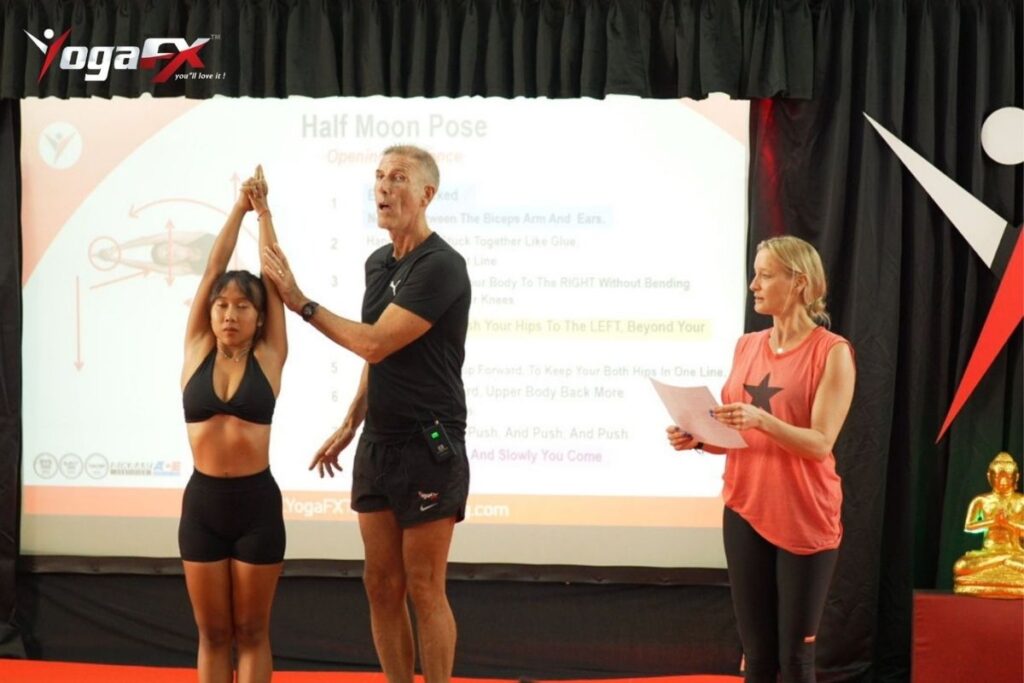
Mr. Ian Terry, E-RYT 500, who has taught more than 12,000 hours of Bikram-format classes, points to this structural difference specifically when students ask why they experience less upper back discomfort in a fixed-sequence class than in a Vinyasa class at the same intensity: the postures are still demanding, but the alignment is corrected verbally, posture by posture, every single class, rather than left to individual interpretation at speed.
A 2025 systematic review covering 43 studies and 942 participants (Willmott et al., PMC12488547) documented consistent improvements in range of motion and physical function from this heated, fixed-sequence format, findings that depend on the postures being performed with correct alignment in the first place, which is precisely what the dialogue is designed to enforce.
| Factor | Fast-paced Vinyasa | Fixed-sequence, dialogue-cued (Bikram) |
|---|---|---|
| Chaturanga repetitions per class | Often 10-20+ | None in the standard sequence |
| Alignment correction | Individual, as instructor circulates | Verbal, whole-room, every posture |
| Pace | Continuous flow, less time per cue | Held postures, full verbal cue before movement |
| Sequence variation | Changes class to class | Identical every class |
None of this means Vinyasa is unsafe or that upper back pain is inevitable in a flow-based practice. It means the mechanical risk factors are structurally different between the two formats, and a student who has repeatedly experienced upper back pain in a fast-paced flow class may find that a held, verbally-corrected sequence removes the specific triggers rather than simply masking them.
For students whose upper back pain specifically involves the shoulder rather than the mid-back, our dedicated guide to hot yoga for shoulder pain covers rotator cuff and frozen shoulder considerations in more depth. And if the pain sits lower, closer to the lumbar spine, our guide to Bikram yoga for lower back pain and sciatica addresses that separate region directly.
When to See a Doctor
Most upper back discomfort from yoga resolves on its own within a week with rest, hydration, and gentle continued movement. See a healthcare professional if pain is sharp rather than achy, if it has not improved after five to seven days, if you notice numbness or tingling radiating into an arm or hand, or if the pain changes your breathing pattern.
These are signals that something beyond ordinary muscle adaptation may be involved, and a proper diagnosis, rather than continued self-treatment, is the appropriate next step.
A physiotherapist or sports medicine doctor familiar with yoga-related movement patterns can also assess whether the underlying cause is a form issue, a strength deficit, or something structural, which is a more reliable path than guessing from online descriptions of symptoms.
FAQ
Why does my upper back hurt after yoga?
Most often from collapsing through the shoulders in plank or chaturanga, overextending the neck in upward-facing dog, or asking underconditioned rhomboids and mid-trapezius muscles to hold new postures. It is usually a form or conditioning issue rather than a sign yoga itself is harmful.
Is upper back pain after yoga normal?
Mild soreness that appears a day after class and improves steadily over several days is normal delayed-onset muscle soreness, especially after new postures. Sharp pain, worsening symptoms, or numbness are not normal and warrant checking with a healthcare professional.
Should I keep practicing yoga if my upper back hurts?
If the pain is mild soreness that fits the DOMS pattern, gentle continued movement is usually more helpful than complete rest. If the pain is sharp, worsening, or involves numbness or tingling, pause practice and consult a healthcare professional before continuing.
Does hot yoga reduce the risk of upper back pain compared to other styles?
A fixed-sequence, dialogue-cued format removes the chaturanga-related strain common in Vinyasa classes and allows an instructor to correct the entire room's alignment simultaneously, posture by posture. This structural difference can reduce the specific mechanical causes of upper back pain, though individual conditioning still matters.
This article is for general educational purposes and is not medical advice. Anyone experiencing persistent, worsening, or severe pain should consult a healthcare professional for proper diagnosis before continuing or modifying a physical practice.