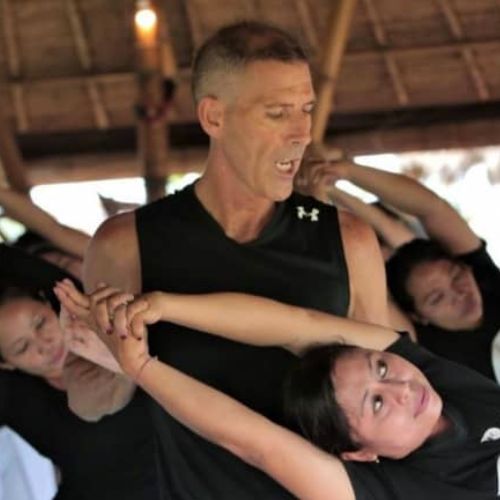
Hot yoga for shoulder pain is one of the most common musculoskeletal complaints brought into a Bikram yoga class. Over 12,000 or more teaching hours across studios globally, a consistent pattern is observable: practitioners with chronic shoulder tightness, impingement, and even frozen shoulder frequently report meaningful improvement with consistent Bikram practice when they approach specific postures correctly.

The hot yoga advantage for shoulder pain is not simply that yoga stretches the shoulder. It is that the 40-degree Celsius environment changes the mechanical properties of the shoulder's connective tissues before any movement begins, and that the Bikram sequence provides specific postures, most significantly Eagle Pose that address the shoulder joint in ways that room-temperature yoga cannot replicate at the same rate.
Hot yoga helps shoulder pain through two mechanisms that room-temperature yoga does not provide simultaneously: heat-enhanced connective tissue extensibility (40 degrees Celsius reduces muscle and fascial stiffness before any stretching begins) and synovial fluid mobilisation (Eagle Pose specifically opens all shoulder girdle joints in heat-enhanced conditions). The Bikram sequence addresses the shoulder in every class through Eagle Pose (joint lubrication), Half Moon (lateral shoulder capsule stretch), and the floor series backbends (posterior chain activation that addresses the forward-rounded posture driving most shoulder pain). Frozen shoulder, rotator cuff tendinopathy, and shoulder impingement each require specific modifications.
Why Hot Yoga Is Different for Shoulder Pain
Heat Changes Shoulder Mechanics Before You Start
The shoulder joint is surrounded by the joint capsule, rotator cuff tendons, the subacromial bursa, and the surrounding fascial sleeve. All of these structures are connective tissue and share the same temperature-dependent property: at 40 degrees Celsius, their viscosity decreases and extensibility increases. The shoulder becomes more mobile before the first stretch begins. Since shoulder imbalances often originate from structural alignment issues further down the spine, implementing Bikram yoga for scoliosis principles can offer systemic relief.
This is not the same as warming up with light movement. The thermal input from a 40-degree room penetrates the joint capsule and surrounding tissue over the first 15 to 20 minutes of class, reducing the passive resistance of the tissues to movement. The shoulder range of motion available at minute 45 of a Bikram class, when the body has been thoroughly heat-soaked, genuinely exceeds what is available through any room-temperature warm-up.
For practitioners with chronic shoulder restriction, this heat-enhanced tissue extensibility is often the difference between a posture being accessible and inaccessible. Practitioners with shoulder tightness that has not responded to room-temperature yoga often find Bikram practice produces progress where other approaches plateaued.
Synovial Fluid and Joint Lubrication
Synovial fluid lubricates the glenohumeral joint, the acromioclavicular joint, and the sternoclavicular joint. Like all joint fluid, synovial fluid has reduced viscosity at elevated temperatures, allowing freer distribution through the joint space in response to movement. Eagle Pose's compression-and-release mechanism drives synovial fluid through all shoulder girdle joints simultaneously in a heat-enhanced state, a mechanism that is physiologically more effective at 40 degrees than at room temperature.
Eagle Pose: The Primary Bikram Shoulder Posture
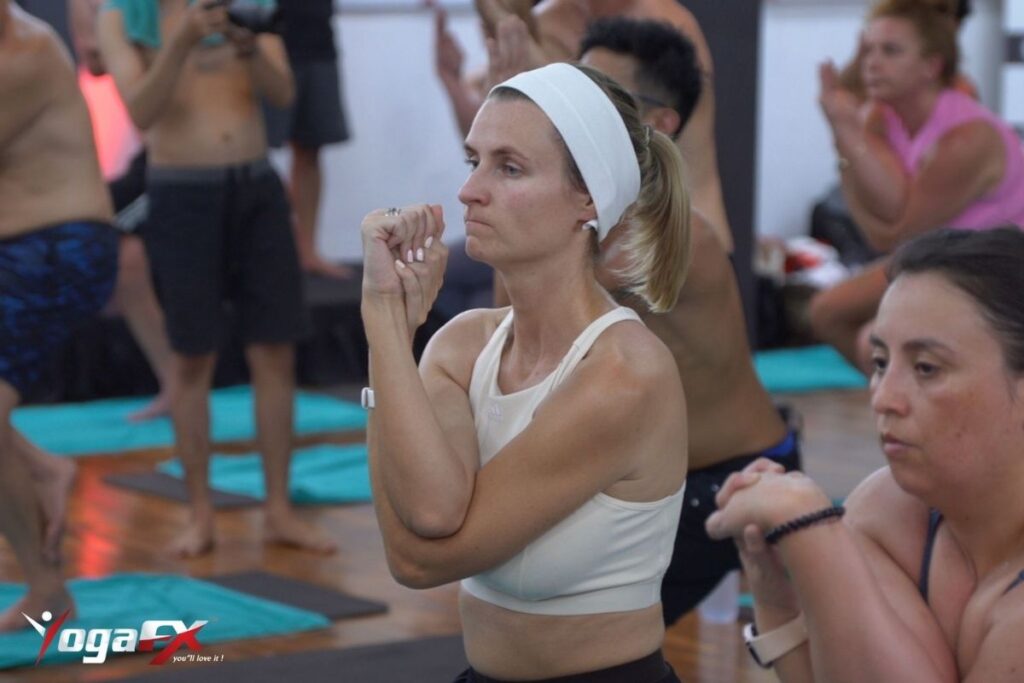
Eagle Pose is the most therapeutically relevant posture in the Bikram sequence for shoulder pain. Understanding why it works explains why practitioners with shoulder restrictions find consistent Bikram practice specifically helpful.
What Eagle Pose Does to the Shoulder
Eagle Pose requires wrapping both arms in front of the body with elbows at shoulder height, forearms perpendicular, and palms pressed together if range of motion allows. This position:
- Stretches the posterior shoulder capsule, the most commonly restricted area in shoulder impingement and swimmer's shoulder
- Opens the space between the scapulae, releasing the rhomboids and middle trapezius that chronically shorten in desk workers and forward-postured practitioners
- Compresses and releases the acromioclavicular and sternoclavicular joints through the wrapped-arm loading
- Tractors the glenohumeral joint into a distraction position that decompresses the inferior capsule
- Activates the lower trapezius and serratus anterior through the effort of maintaining elbow height, the muscles most commonly weak in shoulder impingement syndrome
Eagle Pose Modifications for Shoulder Pain
Full Eagle arm wrap (right arm under left, palms together) requires significant posterior shoulder capsule flexibility and adequate internal rotation range. Practitioners with restricted shoulders should progress through the modifications:
- Stage 1: arms crossed at the elbows only, no forearm wrap. Both elbows at shoulder height. This achieves the posterior capsule stretch without the full internal rotation demand.
- Stage 2: one arm wraps under, the other presses against the outside. Elbows at shoulder height. Gradually increases internal rotation demand.
- Stage 3: full wrap with palms together if available. Do not force the palms together, the therapeutic benefit is in the shoulder position, not the hand position.
The critical alignment point in Eagle Pose for shoulder health: elbows must remain at shoulder height throughout. Dropping the elbows eliminates the posterior capsule stretch and reduces the lower trapezius activation that makes the posture therapeutic rather than merely challenging.
Other Bikram Postures Relevant to Shoulder Pain
| Posture | Shoulder Region Addressed | Specific Mechanism |
|---|---|---|
| Eagle Pose (#4) | Posterior capsule, AC joint, SC joint, inferior glenohumeral | Compression-release of all shoulder girdle joints simultaneously in heat-enhanced synovial state |
| Half Moon Pose (#1) | Lateral shoulder capsule and upper trapezius | Lateral arm raise with overhead extension stretches the inferior capsule and lateral rotator cuff |
| Standing Bow Pulling (#6) | Anterior shoulder and pectoralis minor | The gripped-ankle arm position opens the anterior shoulder in a loaded position, most effective for forward-rounded shoulder posture |
| Full Locust Pose (#18) | Posterior rotator cuff and periscapular muscles | Full arm extension at shoulder height from prone activates the posterior rotator cuff and lower trapezius against gravity, directly addressing the weakness pattern of most shoulder impingement |
| Bow Pose (#19) | Anterior shoulder, biceps tendon, pectoralis | The ankle-grip position with shoulders externally rotated opens the anterior shoulder structures that contribute to forward shoulder posture |
| Camel Pose (#22) | Anterior chest and anterior shoulder capsule | Maximum thoracic extension directly addresses the forward thoracic kyphosis that is the primary driver of most non-traumatic shoulder pain |
| Pranayama (opening) | Upper trapezius and neck-shoulder junction | The arm rise on inhalation and compression under the chin on exhalation specifically addresses the upper trapezius tension that contributes to shoulder and neck pain |
Three Shoulder Conditions: Specific Guidance
Frozen Shoulder (Adhesive Capsulitis)
Frozen shoulder involves progressive thickening and scarring of the shoulder joint capsule, reducing range of motion in all directions. It typically progresses through three stages: freezing (pain, increasing restriction), frozen (reduced pain but maximum restriction), and thawing (gradual return of range).
The heat environment is specifically beneficial because the joint capsule that has become thickened and restricted responds more readily to stretching at 40 degrees than at room temperature. The thermal penetration of the Bikram room reduces the passive stiffness of the capsule before any movement begins.
- Freezing stage (acute, painful): attend class but reduce range in all shoulder-loading postures. Eagle Pose Stage 1 only (arms crossed, no wrap). Avoid Full Locust and positions that push the shoulder into end-range. The heat provides pain relief through circulatory effects without requiring loading.
- Frozen stage (restricted, less pain): this is when Bikram yoga is most actively therapeutic for frozen shoulder. Eagle Pose can be progressively taken deeper. The daily thermal treatment of the joint capsule combined with progressive loading produces consistent range gains. Practice 4 to 5 times per week during this stage for maximum benefit.
- Thawing stage: full practice at progressively increasing intensity. Range will be returning and the heat environment accelerates the connective tissue remodelling of the capsule.
Rotator Cuff Tendinopathy
Rotator cuff tendinopathy involves degeneration and pain in one or more of the four rotator cuff tendons (supraspinatus, infraspinatus, subscapularis, teres minor). It is typically caused by repetitive loading, age-related degeneration, or subacromial impingement compressing the tendons.
Full Locust Pose (both arms and legs lifted simultaneously from prone) is the most directly relevant posture, it loads the posterior rotator cuff and lower trapezius through a movement pattern that directly opposes the weakened pattern in most rotator cuff tendinopathy.
What to avoid with rotator cuff tendinopathy: reduce range in Standing Bow and Full Locust on painful days, these postures load the rotator cuff at end-range. If supraspinatus tendinopathy is the specific diagnosis, the overhead arm position in Half Moon can compress the tendon at the subacromial space, discuss with a physiotherapist before practicing overhead postures with active supraspinatus tendinopathy. Do not skip these postures entirely: controlled loading of tendinopathy within pain-free range is the evidence-based rehabilitation approach, and the Bikram sequence's gradual daily loading in a heat-enhanced state is consistent with this when performed within comfortable range.
Shoulder Impingement Syndrome
Shoulder impingement occurs when the rotator cuff tendons or subacromial bursa are compressed between the humeral head and the acromion process, typically during overhead movements. The most common contributing factors are weak lower trapezius and serratus anterior (allowing the scapula to tip forward), tight posterior shoulder capsule (causing the humeral head to migrate anteriorly), and forward thoracic posture.
Bikram yoga addresses all three contributing factors simultaneously:
- Weak lower trapezius and serratus anterior: Full Locust Pose activates both muscles through the prone arm extension against gravity. Eagle Pose activates lower trapezius through the effort of maintaining elbow height. Both postures directly address the muscular weakness pattern of impingement.
- Tight posterior shoulder capsule: Eagle Pose is the evidence-based stretch for posterior capsule tightness in shoulder impingement. The arm-wrap stretch of Eagle Pose is specifically the stretch that physiotherapists prescribe for glenohumeral internal rotation deficit (GIRD).
- Forward thoracic posture: Camel Pose (maximum thoracic extension) directly addresses the thoracic kyphosis that causes the scapula to tip forward and reduce subacromial space. This is the most proximal intervention for shoulder impingement available in the Bikram sequence.
The Thoracic Connection: Why Shoulder Pain Is Often a Posture Problem
Most non-traumatic shoulder pain in healthy adults has a proximal cause: forward thoracic posture (thoracic kyphosis) that shifts the scapulae forward, tilts them downward, and reduces the subacromial space beneath the acromion. Most shoulder pain is not primarily a shoulder problem, it is a thoracic spine problem that presents as shoulder pain.
The Bikram sequence addresses this connection through Camel Pose (posture 22), the deepest thoracic extension in the entire series. Practicing Camel Pose daily in a 40-degree environment produces progressive thoracic mobility improvement. As the thoracic spine extends, the scapulae reposition, the subacromial space opens, and the mechanical conditions that cause impingement and rotator cuff compression improve.
This is why practitioners with shoulder pain often report improvement faster than they expect from a practice that does not directly target the shoulder. Half Tortoise provides thoracic flexion. Spine Twist provides thoracic rotation. Camel and the prone backbend series provide extension. The complete thoracic conditioning of the Bikram sequence addresses the root mechanical cause of most shoulder pain, not just the symptomatic joint.
When Not to Practice Bikram Yoga with Shoulder Pain
- Acute rotator cuff tear: requires physiotherapy-directed rehabilitation before returning to loaded yoga practice. Full Locust and Bow Pose load the rotator cuff most directly and should be cleared by a physiotherapist before resuming.
- Shoulder labral tear: the glenohumeral distraction in Eagle Pose and end-range loading of several postures requires medical clearance. Not contraindicated for all labral tears, depends on severity and surgical status.
- Post-surgical shoulder: any yoga practice after shoulder surgery (SLAP repair, rotator cuff repair, shoulder replacement) requires specific physiotherapy clearance with awareness of post-surgical precautions.
- Acute bursitis (subacromial): during an acute bursitis flare, the inflamed bursa is sensitive to compression. Rest the acute phase and begin Bikram practice during the subacute recovery phase.
- Shoulder dislocation history: the shoulder distraction mechanism of Eagle Pose and end-range positions of Standing Bow require physiotherapy clearance in practitioners with a history of glenohumeral dislocation, particularly in hypermobile individuals.
Building a Shoulder-Focused Bikram Practice
- Frequency: 4 to 5 sessions per week. Shoulder connective tissue rehabilitation requires consistent thermal treatment and progressive loading.
- Eagle Pose priority: treat this posture as the primary therapeutic intervention. Use the full 10-second hold on both sides. Focus on elbows at shoulder height rather than arm wrap depth.
- Camel Pose second priority: approach as a thoracic intervention rather than a backbend. Focus on the push-hips-forward cue rather than how far back the hands reach.
- Full Locust progression: begin with Stage 1 single-leg Locust and Stage 2 double-leg Locust before pushing for maximum height in Full Locust. The posterior rotator cuff loading requires progressive development.
- Pain awareness: shoulder discomfort from stretching is expected. Sharp or acute pain in a specific position is a signal to reduce range, not push through.
FAQ
Does hot yoga help with shoulder pain?
Yes, for most chronic shoulder pain conditions, through two specific mechanisms: heat-enhanced connective tissue extensibility (40 degrees Celsius reduces the passive stiffness of the joint capsule and surrounding fascia before any movement begins) and synovial fluid mobilisation (Eagle Pose drives joint fluid through all shoulder girdle joints in a heat-enhanced state). Consistent Bikram practice has shown positive results in practitioners with frozen shoulder, impingement syndrome, and chronic shoulder tightness. Acute injuries and post-surgical shoulders require physiotherapy clearance before starting.
Is hot yoga good for frozen shoulder?
Yes, particularly in the frozen and thawing stages of adhesive capsulitis. The thermal penetration of a 40-degree room reduces the passive stiffness of the thickened joint capsule before movement, making progressive range restoration more accessible than at room temperature. Practice 4 to 5 times per week during the frozen stage for maximum benefit. In the freezing (acute, painful) stage, attend class but reduce range in all shoulder positions and focus on the heat environment's pain-relieving circulatory effects rather than pushing range of motion.
Which Bikram pose is best for shoulder pain?
Eagle Pose (Garurasana, posture 4) is the primary therapeutic posture for shoulder pain in the Bikram sequence. It stretches the posterior shoulder capsule (the most restricted area in impingement and frozen shoulder), activates the lower trapezius and serratus anterior (the muscles most commonly weak in impingement), and compresses-and-releases all shoulder girdle joints simultaneously in a heat-enhanced synovial state. Camel Pose is the second most relevant posture because it addresses the forward thoracic posture that is the root mechanical cause of most non-traumatic shoulder pain.
Can I do Bikram yoga with a rotator cuff injury?
Depends on severity and type. Rotator cuff tendinopathy (degeneration without tear) generally responds well to progressive tendon loading of the Bikram sequence within pain-free range. Partial or complete rotator cuff tear requires physiotherapy clearance and specific guidance on which postures to modify before returning to class. Full Locust and the prone backbend series load the rotator cuff most directly and should be assessed with a physiotherapist after a tear. During a physiotherapy-cleared return to practice, begin with Stage 1 (single-leg Locust only) and progress gradually.
Why does hot yoga make my shoulders worse?
If shoulder pain increases from hot yoga practice, the most common causes are: forcing end-range in Eagle Pose before adequate posterior capsule flexibility has developed (use Stage 1 modification), practicing Full Locust with arms at shoulder height with active supraspinatus impingement (overhead loading compresses the tendon), pushing Standing Bow range while an anterior shoulder structure is acutely inflamed, or practicing with an undiagnosed acute condition (partial tear, acute bursitis flare) that requires medical assessment rather than yoga modification. If shoulder pain specifically increases with Bikram practice, consult a physiotherapist before continuing.
How long until hot yoga improves shoulder pain?
Practitioners with chronic shoulder tightness and impingement typically report noticeable improvement within 4 to 6 weeks of consistent practice at 4 to 5 sessions per week. Frozen shoulder improvement is slower, meaningful range gains typically develop over 8 to 12 weeks of consistent practice, consistent with the slower connective tissue remodelling rate of the thickened joint capsule. Eagle Pose range specifically improves progressively over the first 10 to 20 classes for most practitioners starting from significant shoulder restriction.