






Hot yoga vs sauna comes down to who does the work. In a sauna, the room heats you while you sit still. In a hot 26&2 class, you heat yourself with 90 minutes of movement inside a warm room. Both raise your heart rate, but only one of them also trains your body.

Hot Yoga vs Sauna: 5 Differences That Matter
If you want fitness, flexibility and a steadier head, choose the class. If you want rest after a hard day, choose the sauna. That is the short verdict on hot yoga vs sauna, and the rest of this guide shows the physiology behind it.
Mr. Ian Terry, E-RYT 500, has taught more than 12,000 hours of Bikram Hot 26&2 yoga, and one question keeps coming up: is a class just a sauna with stretching? It is closer to a training session that happens to be hot. Here are the five differences that explain why.
- Effort. In a class you stand, balance, fold and hold. In a sauna you sit. That single gap drives almost everything below.
- Source of heat. A sauna warms you from the outside. A class adds heat your own muscles produce on top of the room.
- Time. A class runs 90 minutes. A sauna stay is usually 15 to 20 minutes at most.
- Training effect. Only movement changes strength, balance and range of motion. A sauna cannot do that.
- Mind. A scripted class asks for constant attention. A sauna offers a pause, which has its own value.
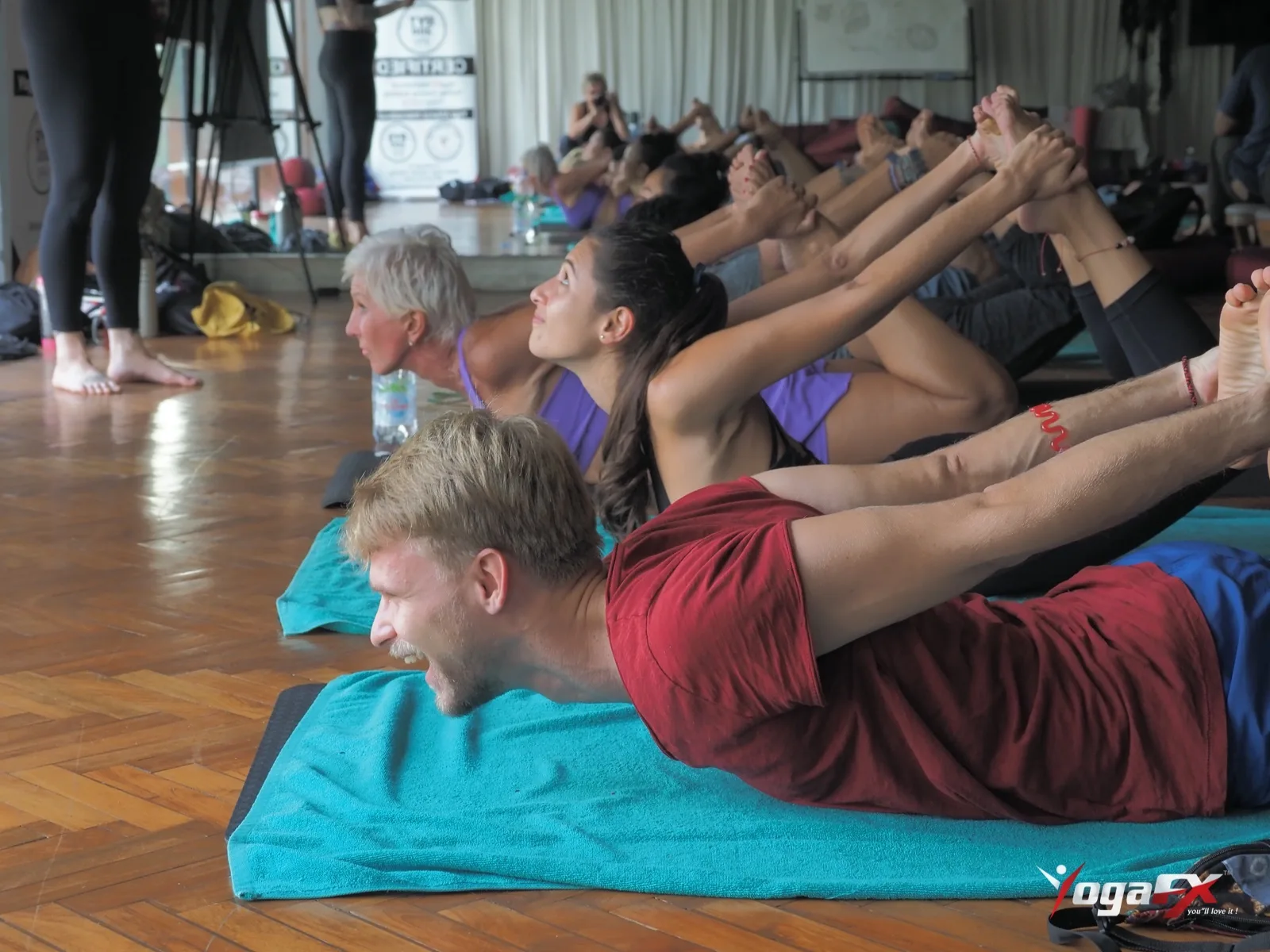
Hot Yoga vs Sauna: What Your Body Does in Active vs Passive Heat
Researchers call the sauna passive heat stress and the class active heat stress. The names sound technical, but the idea is simple. Passive heat comes only from the room. Active heat comes from the room and from the work you are doing in it.
What heat does when you sit still
Harvard Health Publishing notes that sauna heat can get as high as 185°F and that skin temperature soars to about 104°F within minutes. Your blood vessels widen, blood moves to the skin, and you sweat to cool down. Your heart works harder to keep up, yet your muscles do very little.
That's why a sauna feels like a gentle challenge and why stays are kept short. Harvard Health suggests no more than 15 to 20 minutes, and it advises people with uncontrolled high blood pressure or heart disease to check with their doctor first.
What changes when you add movement
Working muscle makes heat as a by-product. In a hot room, that extra heat has nowhere easy to go, so your body leans harder on sweating and circulation. The result is a bigger thermoregulation job than the room alone would create. For the details of the room itself, see why a Bikram room sits at 40°C and 40% humidity.
A class also controls the pace. You rest in Savasana, kneel for a set or sip water between postures. That built-in pacing is part of why a 90-minute session stays workable for healthy beginners who respect the heat.
| What your body deals with | Hot 26&2 class (active heat) | Sauna (passive heat) | Why it matters |
|---|---|---|---|
| Where the heat comes from | The room plus the heat your working muscles make | The room only | Active heat stacks two loads, so effort and heat rise together |
| Muscle work | Constant: standing balance, holds, floor series | Almost none | Only movement builds strength and range of motion |
| Heart and circulation | Pumps for heat and for muscle demand at once | Pumps mainly to move blood to the skin | The class behaves like cardio, the sauna like a gentle heat challenge |
| How you stop | Rest in Savasana or kneel for a set | Leave the room | Class rules keep you in the room and in control of your pace |
| Mind and focus | A scripted class asks for constant attention | Nothing is asked of you | The class trains focus, the sauna offers a pause |
| Typical session | 90 minutes | 15 to 20 minutes at most | The dose of heat is very different |
Hot Yoga vs Sauna by the Numbers
Numbers make the hot yoga vs sauna contrast easier to see. The cards below put class data next to sauna guidance, so you can compare the two without guessing.
40°C / 40%
The 26&2 room
Fixed heat and humidity for the whole 90 minutes of a class.
90 min
Heat plus work
26 postures and 2 breathing exercises, so your muscles keep working.
80% / 72%
Average heart rate
Share of predicted maximum for men and women during class.
103.2°F / 102.0°F
Average peak core temperature
Men and women in the same study. One man reached 104.1°F.
Up to 185°F
A dry sauna at its hottest
Skin temperature can reach about 104°F within minutes.
15 to 20 min
Longest sensible sauna stay
Heat only, with almost no muscular work during the stay.
Notice what the hot yoga vs sauna numbers show. A heart rate near 80% of predicted maximum for 90 minutes is real cardio work, and it happens while you also hold balance and flexibility postures. No sauna stay produces that mix.
What the Research Says About Hot Yoga vs Sauna
The best direct data for the hot yoga vs sauna question comes from the American Council on Exercise study, run by researchers at the University of Wisconsin-La Crosse in 2015. They tested 20 healthy volunteers aged 28 to 67 in a room at 105°F and 40% humidity.
Average heart rate reached 80% of predicted maximum in men and 72% in women. That is a steady, demanding load for 90 minutes.
Core temperature rose through the class too. The highest averages were 103.2°F for men and 102.0°F for women, and one man reached 104.1°F. Sports medicine guidance says exertion-related heat illness can occur at about 104°F.
None of the volunteers showed signs of heat intolerance, although the authors noted that these temperatures can carry some risk for some people.
Energy use is a second measure. Colorado State University researchers reported in 2014 that a 90-minute class burned about 460 calories for men and about 330 for women. That's solid exercise, though it's closer to brisk walking than to a hard run. A sauna stay adds little muscular work, so it doesn't belong in the same calorie conversation.
Where the sauna research is strong
The sauna side of hot yoga vs sauna has real evidence behind it too. A 2018 review in Mayo Clinic Proceedings by Laukkanen, Laukkanen and Kunutsor covered studies up to February 2018.
It said regular sauna bathing may be linked to lower risk of vascular disease, including high blood pressure and cardiovascular disease, with improved vessel function and lower blood pressure as proposed reasons. The wording is careful, because much of the evidence is observational. Don't read it as a promise.
Where the class research is strong
On the class side of hot yoga vs sauna, research reaches further into training and mood. A 2013 Colorado State University trial by Tracy and Hart on Bikram practice found gains in flexibility and strength.
In an 8-week randomised trial at Massachusetts General Hospital (Nyer et al., 2023, Journal of Clinical Psychiatry), 59% of people doing heated yoga cut their depression symptoms by half or more, against 6.3% on the waitlist. A 2022 study by Hui and colleagues also found that hot yoga lowered state anxiety.
These are encouraging results, not a treatment plan. If you manage anxiety, depression or a heart condition, talk to a healthcare professional before you change your routine.
Benefits of Hot Yoga vs Sauna: Where Each One Wins
The benefits of hot yoga vs sauna overlap a little, but they point in different directions. This is how we explain it to new students and trainees.
Where hot yoga wins
- Strength and flexibility. Holding postures under heat trains muscles and joints. A sauna cannot do this.
- Cardio load. A heart rate near 80% of maximum for 90 minutes counts as real aerobic work.
- Mood research. The Massachusetts General Hospital trial and the Hui study give the class a stronger mental health record.
- Skill. You leave knowing more about breath, balance and pacing. For a wider view, read the seven real gains of hot yoga.
Where the sauna wins
- Low effort. You can use it when your legs are too tired for a class.
- Short sessions. A sauna fits into 20 minutes, which suits a crowded day.
- Possible heart benefits. The Mayo review points to vessel function and blood pressure as likely reasons, with open questions.
- Pure rest. There is no sequence to follow and no teacher to listen to.
One myth deserves a plain answer. Neither habit changes the work your liver and kidneys already do. Sweat is mostly water and salt, and the liver and kidneys do the filtering. We explain the evidence in what the evidence says about sweat and toxins.
Bikram Yoga vs Sauna: The View From the Teaching Room
Teachers see the hot yoga vs sauna difference most clearly in week one. A first-time student in a sauna relaxes. A first-time student in class works, wobbles, rests and tries again. Both leave warm, but they do not leave the same.

Mr. Ian Terry has trained more than 1,500 graduates from over 80 countries. From his years in the room, the hot yoga vs sauna difference is plain: a sauna asks nothing of you, while a class asks for your attention, your breath and your effort. That demand trains focus and calm under pressure.
Graduates describe it in their own words. Katy, in a 2019 YouTube review, said the training gave her the space to develop herself and become even better. Stacey, in a 2024 video review below, talks about the group the same way. A sauna rarely produces that kind of language, because it does not ask you to work alongside other people.
I'm very grateful ... all of you are like family to me, and I think you all inspire me to do more and better.
Stacey, YouTube review, 2024
Why natural heat changes the comparison
Most hot yoga vs sauna comparisons assume a studio warmed by electric heaters. The YogaFX studios in Seminyak and Canggu use Bali's tropical climate instead, so no electric heaters run in the room. Humid air slows the evaporation of sweat, which is the opposite of a dry sauna. If you want the Bali visitor's view, read how the same question plays out for Bali visitors.

Hot Yoga vs Sauna for Weight Loss and Recovery
Two goals come up in almost every hot yoga vs sauna question: weight and recovery. For weight, the class has the edge because it burns calories through movement. A sauna can make you lose water through sweat, but that water usually returns when you drink, so the scale moves without any real fat loss.
For recovery, the picture flips. After a hard surf, a long run or a heavy training week, many people prefer a short sauna and an easy walk. A full 90-minute 26&2 class is a workout, not a rest. In the hot yoga vs sauna choice for sore muscles, listen to your body and pick the lighter option when you are exhausted.
A simple weekly pattern works for many healthy adults: take classes on training days and keep the sauna for rest days. The balance changes with your fitness, your climate and your doctor's advice, so treat it as a starting point, not a prescription.
Is Hot Yoga or Sauna Better? Choose by Goal
So, is hot yoga or sauna better? In any hot yoga vs sauna choice, the answer depends on what you want from that hour. This quick guide covers the usual goals.
- Get fitter or lose weight: choose the class, because it trains muscles and uses several hundred calories.
- Loosen tight hips and hamstrings: choose the class, because only movement changes range of motion.
- Rest sore legs: choose the sauna, or a walk and a long swim.
- Calm a busy mind: both can help, but the class has the stronger research record.
- Do both: yes, on the same day if you are healthy, with the class first. Our guide to sauna after hot yoga covers timing and cooling down.
Safety Notes for Hot Yoga vs Sauna
Heat is a stress, and stress needs respect. Drink water before and after either session, and add electrolytes after a long class. Leave the sauna or sit out a set if you feel dizzy, sick or lightheaded. Avoid alcohol before a sauna, as Harvard Health advises.
Check with a doctor first if you have heart disease, uncontrolled high blood pressure, are pregnant, or take medicines that affect sweating or heart rate. This article is education, not medical advice, so consult a healthcare professional about your own situation.
From Hot Yoga Student to Hot Yoga Teacher
If you choose hot yoga in the hot yoga vs sauna debate, you may wonder what it takes to teach it. The YogaFX 6-day Bikram Hot 26&2 teacher training MasterClass is a hybrid course with online pre-work and an intensive in Bali.
The next batch checks in on Sunday 24 January 2027 and checks out on Friday 29 January 2027. Graduates receive Yoga Alliance RYT 200-Hour and Bikram Hot 26&2 200-Hour International Yoga Certification.
Related reading
- Tired After Hot Yoga? 5 Real Reasons Trainees Differ
- Yoga for Men Over 40: 5 Safe Posture Changes
- Is Hot Yoga a Cardio Workout? Honest Answer and 3 Studies
- Men Only Hot Yoga: 5 Honest Reasons Mixed Rooms Win
FAQ
Is hot yoga the same as a sauna?
No. A sauna is passive heat: you sit in a very hot room and your body does little work. A hot yoga class is active heat: you move through 26 postures in a room near 40°C, so working muscles add their own heat. Both make you sweat, but only the class trains strength and flexibility.
Is hot yoga or sauna better?
Neither wins every time. Hot yoga is better for fitness, flexibility, strength and mood research, because you train while you are hot. A sauna is better for low-effort rest and recovery days. Pick by your goal for that hour, and use both on different days if you enjoy them.
Can you do hot yoga and sauna on the same day?
Most healthy adults can, but order and timing matter. Take the class first, drink water and electrolytes, then wait before any sauna and keep it short. Avoid a sauna right before class, because you would start already hot. Stop if you feel dizzy, and check with your doctor if you have a heart condition.
Is sweating the point of hot yoga?
No. Sweat is mostly water and salt, and it is how your body cools itself. Your liver and kidneys do the real filtering. Hot yoga is worth doing for flexibility, strength, heart rate work and mood, not for the sweat itself. The same is true of a sauna, so choose either one for what it actually does.
Can a sauna replace exercise?
A sauna cannot replace exercise. It raises heart rate through heat, but it adds almost no muscular work, so it builds little strength, flexibility or stamina. Reviewed studies suggest possible heart and blood pressure benefits from regular sauna use. Treat it as a rest-day habit, not a workout.
Still have questions? Message Mr. Ian and the YogaFX team on WhatsApp and we will answer them personally.