

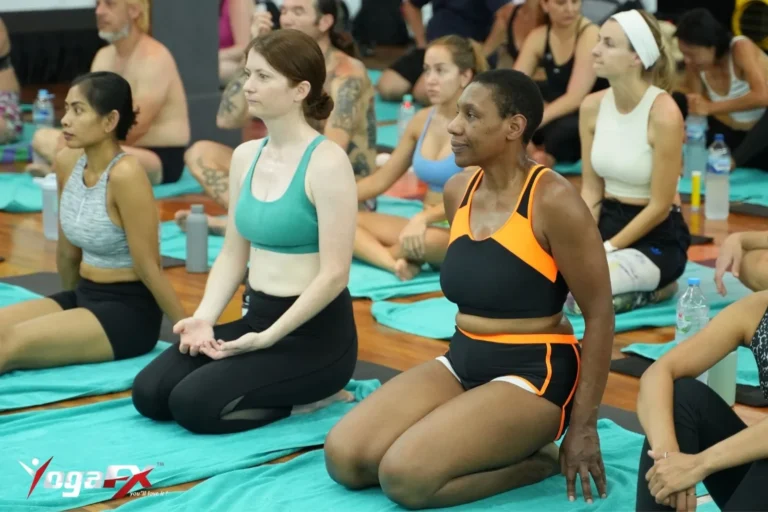
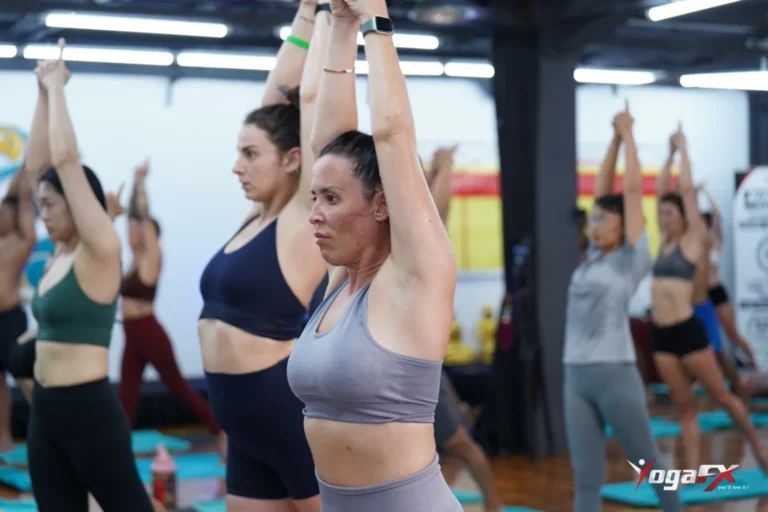
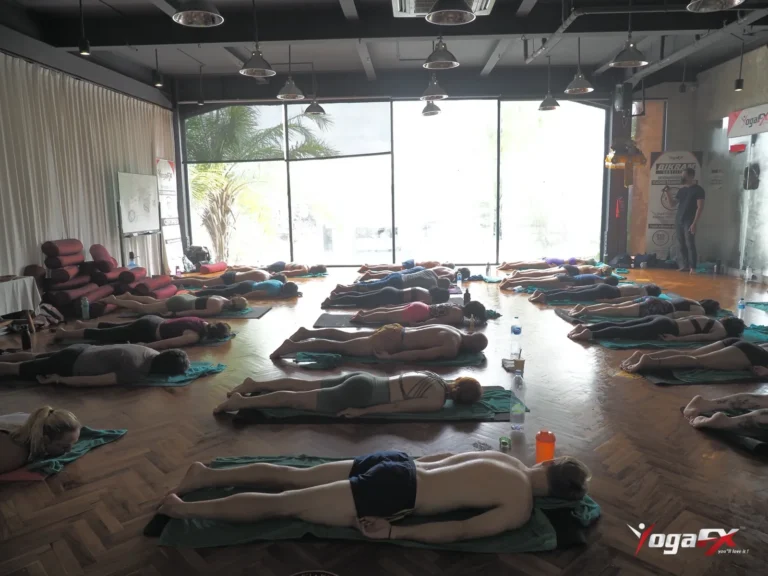

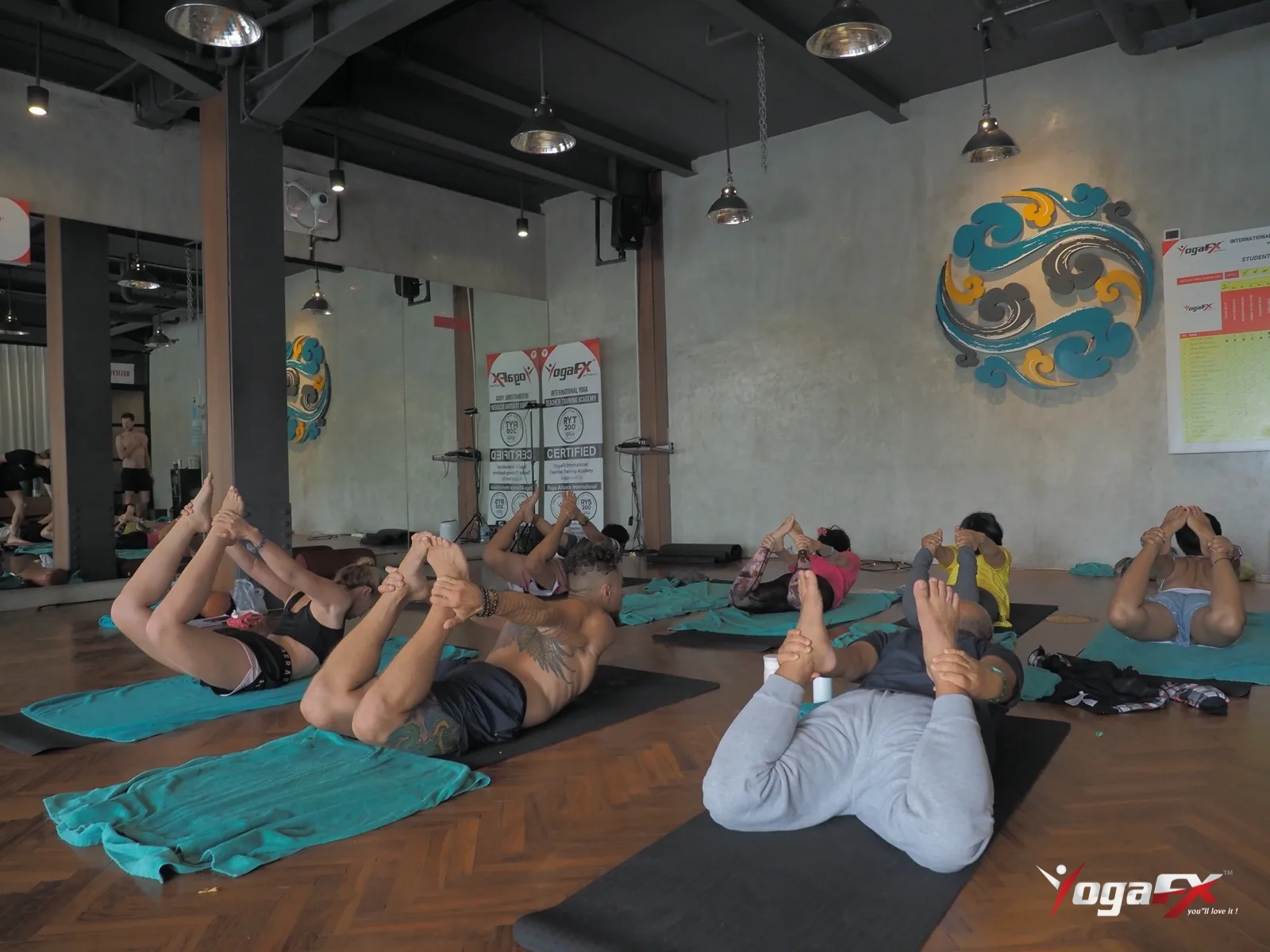
Hot 26 and 2 yoga is a fixed 90-minute class of 26 hatha postures and 2 breathing exercises, taught in a heated room at about 40°C with roughly 40% humidity. A teacher guides you with a scripted dialogue instead of demonstrating, so you listen, follow and repeat the same sequence every class.

This guide comes from the teaching side of the room. It covers where the method comes from, what a class actually feels like, and what the research can and can't say. It also shows how people go from practising to teaching.
Mr. Ian Terry, E-RYT 500 and founder of YogaFX, trained for five years (2014 to 2019) alongside the founder of the Bikram Hot 26&2 method. He has 12,000+ teaching hours behind the opinions below, so we'll say plainly what we know.
What hot 26 and 2 yoga is, in plain terms
Think of it as one lesson plan that never changes. The room is warm and humid. The postures run in a set order. The words the teacher uses are scripted. Because nothing else moves around, you can see your own progress from week to week.
- 26 postures taken in a fixed order, standing series first and floor series second.
- 2 breathing exercises, one at the start and one at the end of the class.
- 90 minutes, with short rests in Savasana between postures.
- A heated, humid room, about 40°C and 40% humidity, set by the studio.
- A guided dialogue with no music and no teacher demonstration.
Where hot 26 and 2 yoga comes from
The method traces back to Calcutta and the physical culture teacher Bishnu Charan Ghosh. His student Bikram Choudhury took the sequence to the West in the early 1970s and set it in a heated room. We cover that lineage in detail in our piece on Bishnu Charan Ghosh and the roots of the method.
The terms get mixed up, so here is how we use them:
- Hot yoga is the umbrella term for any yoga practised in a heated room.
- Bikram yoga is the specific style built on the fixed 26-posture, 2-breathing-exercise sequence.
- Hot 26&2 is the name we use for that same sequence and dialogue, kept as it was taught to Mr. Ian.
- Heated vinyasa and power flow are newer flowing styles that change from class to class.
If you want the wider picture of the heated-room family, our explainer on what is hot yoga sits alongside this guide.
How hot 26 and 2 yoga differs from other heated classes
Most people arrive from a flowing hot class or from a non-heated studio. The differences are easier to see side by side.
| Feature | Hot 26 and 2 yoga | Heated vinyasa or power flow | Non-heated yoga |
|---|---|---|---|
| Sequence | One fixed order of 26 postures and 2 breathing exercises | Changes with each teacher and class | Varies by style and teacher |
| Teacher guidance | Scripted dialogue, no demonstration | Often demonstrates and adjusts the flow | Usually demonstrates |
| Music | None, so you hear every cue | Common | Common |
| Room | About 40°C with about 40% humidity | Warm, often a lower or variable setting | Room temperature |
| Tracking progress | Easy, because the class repeats | Harder, because the class changes | Depends on the class |
That repetition matters more than people expect. For example, when the class is identical, a tight hamstring on Tuesday and a looser one on Friday means something. You're comparing like with like, which is why the fixed format helps.
What happens in a class, from standing series to Savasana
The 90 minutes split into three parts. The full walk-through is in our guide to what happens in a Bikram yoga class, but here is the short version.
| Part | What you do | What it asks of you | Typical effort |
|---|---|---|---|
| Standing series | Balancing and strength postures such as Awkward Pose, Eagle Pose and Triangle Pose | Balance, leg strength and focus in the heat | Highest heart-rate demand |
| Savasana breaks | Lie still on your back in Savasana between sets | Slow your breathing and let your heart rate settle | Recovery |
| Floor series | Backbends, forward folds and twists on the mat | Spinal flexibility and steady breathing | Mixed, with more recovery |
The standing series
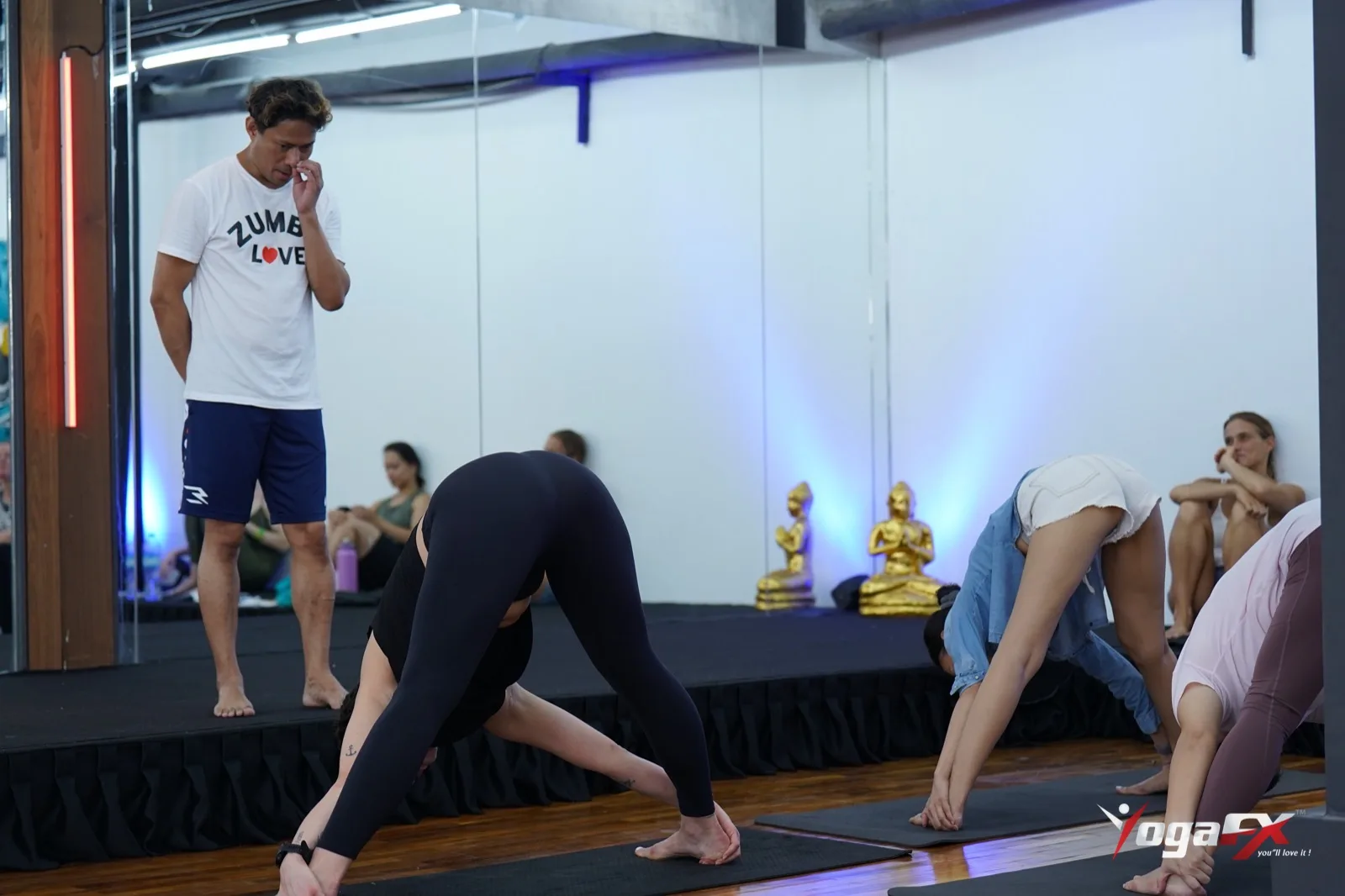
Standing postures come first, and they create most of the workload. You hold balance and lock your legs while the room keeps asking your body to cool itself. Heart rate usually runs highest here. Many students are surprised by how hard it works the heart.
The floor series
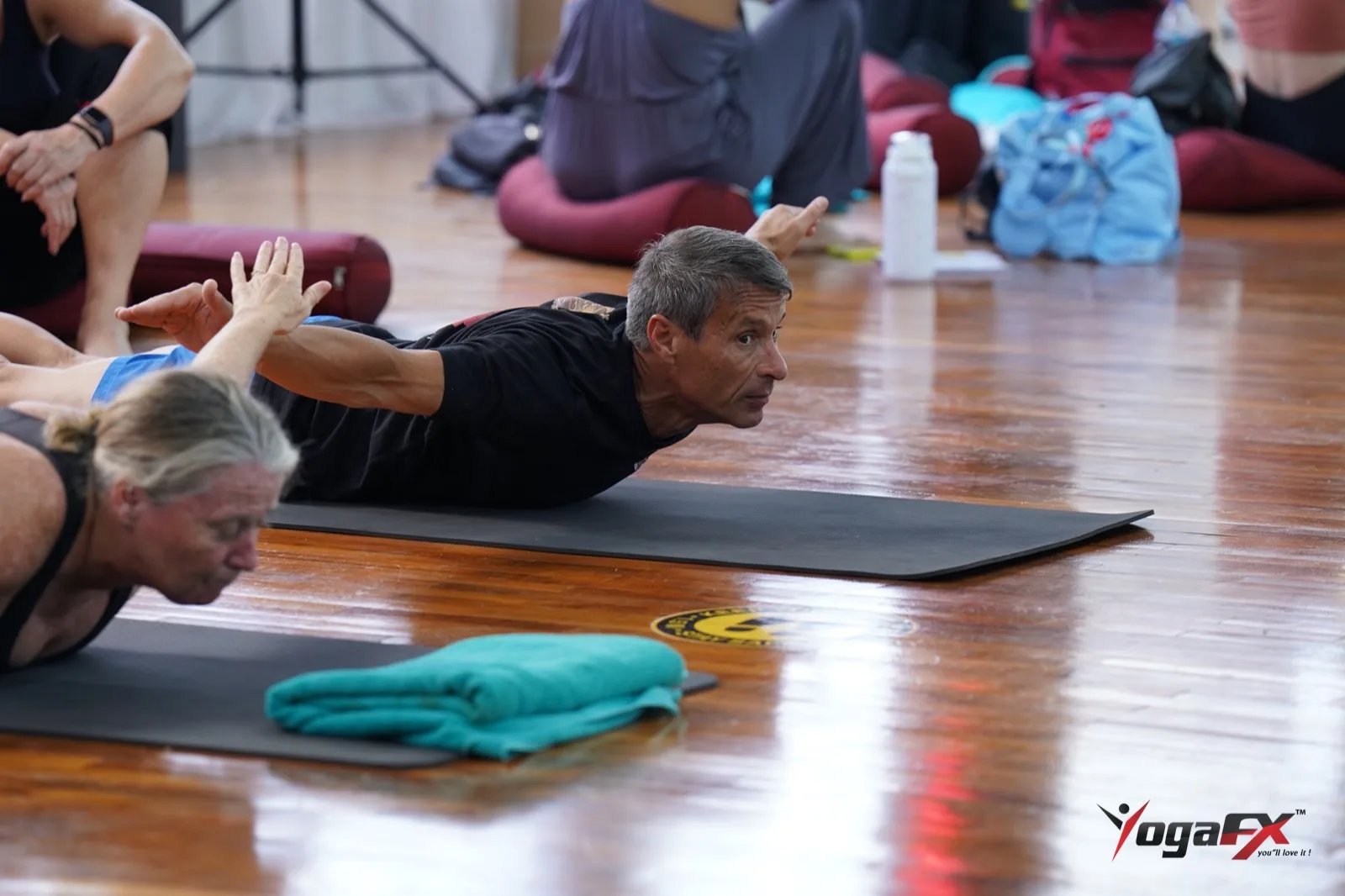
Once you're on the mat, the work shifts to the spine. Cobra, Locust, Bow and Camel all ask for strong backbends, followed by twists. Many people find the floor series lower in effort, although the backbends can still raise your breathing.
Why the dialogue matters
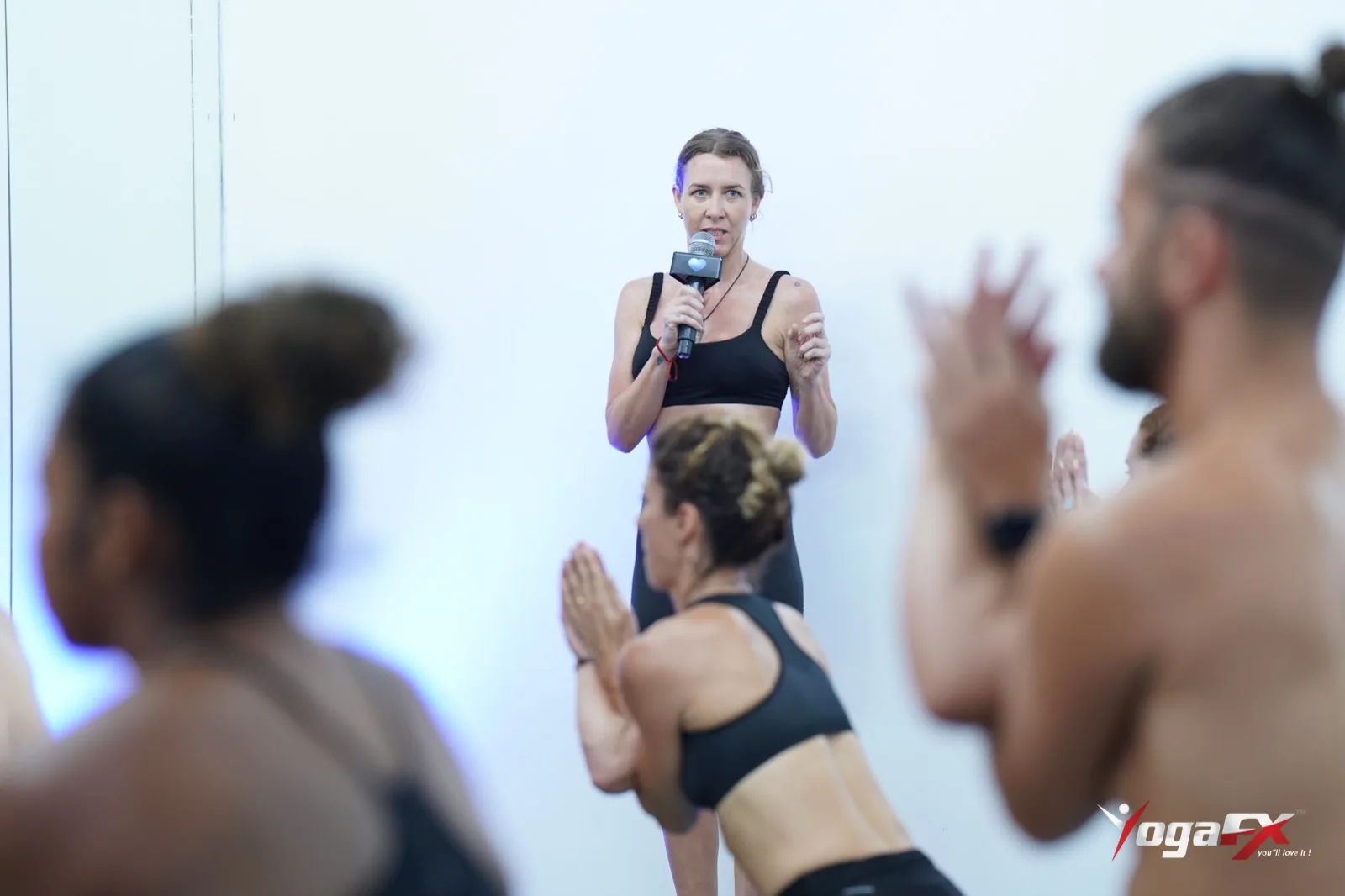
The teacher talks you through each posture with the same words every class. There is no demonstration and no music. You learn to translate a spoken cue straight into muscle action. That skill is the heart of teacher training, and we explain how to learn it in our guide to the 26&2 dialogue script.
What the heat does to your body and your focus
Heat changes how a class feels, and it helps to know why. When the room is warm, your blood vessels widen and more blood moves toward your skin to cool you down. Your muscles and connective tissue also feel looser, so many students move into deeper positions than they can in a cold room.
That is useful, but it is also a risk. A loose muscle can still be overstretched, and the heat can hide the warning signs. We teach students to work to a posture's correct shape, not to the deepest version they can force.
- Circulation: warm air widens blood vessels, so more blood reaches the muscles and skin.
- Flexibility: warm tissue feels more pliable, which makes the first stretches easier.
- Breathing: steady nose breathing keeps your heart rate manageable in the heat.
- Recovery: Savasana between postures gives your heart rate a chance to come down.
The mental side matters just as much. You face a mirror, hold a stare on one point and listen to the dialogue while your body complains. That is a lot to manage at once. Students often say the hardest part is not the posture but staying calm and starting the next one on time.
We teach this as the quiet skill of the class. Each posture has a start, a hold, a finish and a reset. Because you repeat that pattern 26 times in a row, it spills into daily life: you stay with a hard task a little longer, and you recover from a bad moment a little faster. Studies can't measure every part of that. Even so, trainees describe it again and again.
What the research says about hot 26 and 2 yoga
Research on heated yoga is growing, but it is still young. We'd rather tell you what is measured than what sounds exciting. Two points stand out, and a broader review adds context.
Mood and depression symptoms
A randomized trial from Massachusetts General Hospital and Harvard Medical School, led by Nyer and colleagues and published in 2023, tested heated hatha yoga in adults with moderate-to-severe depression. Over 8 weeks, 59.3% of the yoga group had a 50% or greater drop in symptom scores, compared with 6.3% of a waitlist group. Participants averaged about one class a week. You can read the record on Europe PMC.
Two cautions apply. The comparison group was a waitlist, not another treatment. And the trial studied heated hatha yoga, so we don't claim it proves anything about one brand of class. This is not medical advice, so speak to a healthcare professional about depression.
Fitness and heat adaptation
In a 2021 study by Bourbeau and colleagues, 22 adults did 12 sessions over 4 weeks, either in a heated room or at normal temperature, following a modified Bikram protocol. Maximal aerobic fitness rose in the hot yoga group only, and heat shock protein 70 looked higher in that group too. Read the full paper on PubMed Central.
The sample was small, so you should treat it as a promising signal about what heat adds, not a promise of results.
A wider look at the evidence
A 2025 systematic review, Hot Yoga: A Systematic Review of the Physiological, Functional and Psychological Responses and Adaptations (Willmott et al., on PubMed Central), brings together studies on how the body responds to practising in heat. We name it here for context. Look it up for the full findings.
Common claims about hot 26 and 2 yoga, sorted
Heated yoga attracts bold promises. Here is how we sort them.
| Claim | What we can say | Our view |
|---|---|---|
| Improves flexibility | Heat loosens muscles, and the fixed sequence trains range of motion | Reasonable, and students feel it quickly |
| Builds aerobic fitness | One small trial found gains in the hot group only | Promising, not settled |
| Lifts mood | A waitlist-controlled trial found larger symptom drops with heated yoga | Encouraging, but not a treatment |
| Heavy sweating shows how hard you worked | Sweat mainly cools the body, and the amount varies a lot between people | Not a measure of results |
| Burns a huge number of calories | Figures vary widely between studies and people | We give no number |
How often should you practise hot 26 and 2 yoga?
There is no single right answer, and anyone who gives you one is guessing. Beginners usually do well with two to three classes a week while the body adapts. Regular students often settle into three or four. Some people take on a 30-day challenge to build the habit, which is a good way to learn the sequence before teacher training.
Listen to your body, and take rest days. Hard heat on top of poor sleep or too little water is a fast route to feeling flat. If you feel unusually tired, scale back and drink more, and see a healthcare professional if it persists.
Who should be careful, and how to prepare
Heat raises your heart rate and your need for fluids. People with heart or blood pressure conditions, pregnant students, anyone sensitive to heat and anyone with a recent injury should speak to a healthcare professional before starting.
For everyone else, a few habits make the first classes much easier:
- Drink water through the whole day before class, rather than gulping a litre just beforehand.
- Skip heavy meals for two to three hours before you practise.
- Wear light, close-fitting clothes and bring a non-slip mat, a towel and a water bottle.
- Breathe through your nose and rest in Savasana whenever you need to.
- If you feel dizzy, lower yourself to the floor, lie on your back and stay in the room.
Expect your first three to five classes to feel intense. Your sweat rate, heart rate and comfort in the heat tend to settle as you adapt. Afterwards, replace fluids and minerals, eat a balanced meal, and let your body cool before a cold shower.
What students and trainees say
Numbers only go so far. These are words from people who practised the method and went on to train as teachers.
Fabulous location and professional teaching faculty.
Derrick, Yoga Alliance review, 2019
I never know I can teach in the class, but now I know I can do it, and this is because of your training.
Cherry, YouTube review, 2019 (watch the video)
It just changed my life internally and externally. And I have a new family.
A trainee in our YouTube review, 2023 (watch the video)
YogaFX has 150 Google reviews, 50 on Yoga Alliance and 357 YouTube testimonials from graduates, and we read them to find out what to teach better.
From practising to teaching hot 26 and 2 yoga
A lot of students ask the same question after a few months: could I teach this? The path is clearer than it looks.
- Build a steady practice, ideally three to four classes a week for several months.
- Get comfortable with the postures and how they should look and feel.
- Learn the dialogue, the scripted words that guide a class.
- Finish a practical teacher training where you teach real students and get feedback.
- Register your certificate with Yoga Alliance if you want the RYT 200 designation.
Mr. Ian teaches this path through the YogaFX Bikram Hot 26&2 Yoga Teacher Training MasterClass. It is a 6-day hybrid course with online pre-course study at home and an intensive in Bali.
The next batch runs Sunday 24 January to Friday 29 January 2027. Graduates leave with Yoga Alliance RYT 200-Hour eligibility and the Bikram Hot 26&2 200-Hour International Yoga Certification. You can see the full YogaFX teacher training programme for details. Our guide to 6-day Bikram yoga teacher training has dates and formats, and RYT 200 vs Bikram certification explains how the two credentials differ.
Mr. Ian has taught more than 1,500 graduates from over 80 countries.
FAQ
What is hot 26 and 2 yoga?
Hot 26 and 2 yoga is a fixed 90-minute class of 26 hatha postures and 2 breathing exercises, taught in a heated room at about 40°C with 40% humidity. The teacher guides everyone with a scripted dialogue and doesn't demonstrate, so you listen and follow along.
Is hot 26 and 2 yoga hard for beginners?
The heat makes the first classes tough, but the sequence is identical every time, so you learn it quickly. Expect around three to five classes to feel more comfortable. You can rest in Savasana whenever you need to. Drink water through the day and ease in at your own pace.
How is hot 26 and 2 different from hot vinyasa?
Hot vinyasa changes from class to class and links poses in flowing movement. Hot 26 and 2 follows one fixed sequence with a scripted dialogue and no music, and you hold each posture in a set order. That repetition makes progress easy to track from one class to the next.
Who should talk to a doctor before trying hot yoga?
Anyone with heart or blood pressure conditions, pregnancy, heat sensitivity or a recent injury should speak to a healthcare professional first. Heat raises your heart rate and fluid needs. If you feel dizzy in class, lower yourself to the floor, lie on your back and breathe through your nose.
Is YogaFX official Bikram Choudhury teacher training?
No. YogaFX is independent training, not official Bikram Choudhury teacher training. Mr. Ian Terry trained for five years, from 2014 to 2019, alongside the founder of the Bikram Hot 26&2 method, and teaches that method in a 6-day hybrid MasterClass in Bali with Yoga Alliance RYT 200-Hour eligibility.
What should I do after a hot yoga class?
Drink water and replace minerals lost in sweat, then eat a balanced meal with carbohydrates and protein within an hour or two. Let your body cool for 10 to 15 minutes before a cold shower, because very rapid cooling straight after class can shock your system.
Still have questions? Message Mr. Ian and the YogaFX team on WhatsApp through our contact page, and we will answer them personally.