Bow Posture, Dhanurasana in Sanskrit, is posture 19 in the Bikram yoga floor series. It is one of the most mechanically specific postures in the entire 26-posture sequence, and the one most commonly misunderstood by practitioners who approach it as a backbend. It is not primarily a backbend. It is primarily a kicking posture. The distinction changes everything about how it is practiced and what it produces.

This guide covers the mechanics of Bow Posture, why the kick drives the posture rather than the grip, what the 40-degree Celsius heat specifically changes about the experience, the complete alignment breakdown, the dialogue cues, and why Bali's natural humid heat produces a different result than the dry electric heat used in most hot yoga studios globally.
Bow Posture (Dhanurasana) is posture 19 in the Bikram yoga floor series. The practitioner lies face-down, grips both ankles, and lifts the body by kicking the feet away from the body while the arms hold the grip point.
The lift comes from the kick, not from pulling with the arms. Primary benefits: massages the entire digestive organ system through abdominal rocking, opens the full anterior body from thighs to throat, and provides spinal extension in a different mechanical pattern from the preceding Cobra, Locust, and Full Locust postures.
Hold time: 10 seconds, 2 sets. At 40 degrees Celsius, the hip flexors and anterior thorax are significantly more extensible than at room temperature.
Want every posture in order, filtered by difficulty, focus area or health benefit?
Where Bow Posture Sits in the Bikram Sequence
Bow Posture is the fourth posture in the Bikram floor backbend series, following Cobra (posture 16), Locust (posture 17), and Full Locust (posture 18). This sequential placement is not incidental. Each preceding posture builds the specific conditions that Bow Posture requires.
Cobra establishes the pattern of spinal extension from the prone position and activates the spinal erectors. Locust builds the posterior chain strength and lower back engagement that holds the torso elevated during Bow. Full Locust creates the full posterior chain activation from arms to legs simultaneously, preparing the body for the combined anterior stretch and posterior strength demand of Bow Posture.
By the time a practitioner enters Bow Posture in a properly conducted Bikram class, they have been in the 40-degree room for approximately 55 to 60 minutes. The hip flexors, quadriceps, and anterior thorax have been progressively warming through the standing series and the preceding floor postures.
This is the optimal physiological state for a posture that requires significant anterior body extensibility. Bow Posture at the beginning of a cold practice would be a fundamentally different, and less effective, experience.
The Core Mechanical Principle: The Kick Drives Everything
The single most important technical understanding for Bow Posture is this: the feet kick away from the body, and the body rises as a result of the kick. The arms do not pull. The arms hold a fixed grip point. The kicking force against this fixed grip is what elevates the thighs, opens the chest, and creates the arc of the posture.
Most practitioners who struggle with Bow Posture are attempting to pull themselves into the shape using their arms. This produces a strained, compressed version of the posture where the shoulders are tight, the chest is restricted, and the full anterior body opening that Dhanurasana is designed to create does not occur.
The dialogue at YogaFX makes this explicit: kick your feet up and back, away from your body. The kick instruction is the primary cue. Everything else follows from the kick. When the kick is strong and continuous, the thighs lift, the chest opens, and the spinal extension that gives the posture its therapeutic effect occurs naturally without any pulling from the arms.
Primary Benefits of Bow Posture
1. Digestive Organ Massage Through Abdominal Rocking
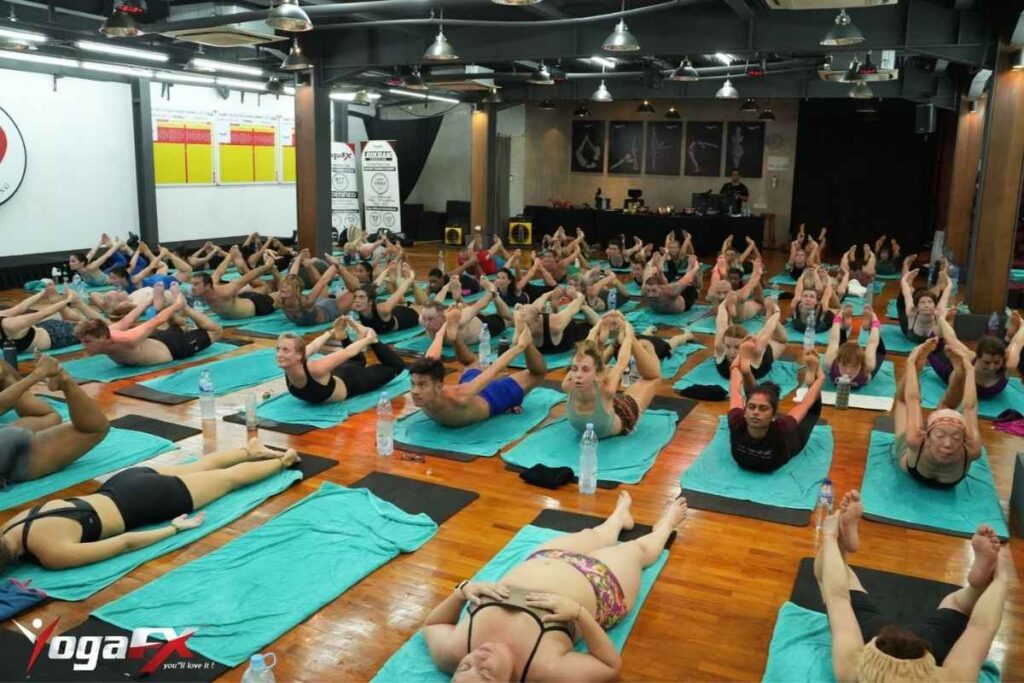
Bow Posture creates a rocking motion on the abdomen when the kick is sustained throughout the hold. The body weight concentrated on the abdominal region, combined with the rhythmic pressure of the rocking motion, massages the stomach, small intestine, large intestine, liver, pancreas, and gallbladder simultaneously. This is the most direct mechanical stimulation of the digestive organs available in the Bikram sequence.
Traditional Bikram instruction consistently attributes improved digestion, reduced constipation, and improved organ function to this mechanism. The rocking is not a performance error. It is the intended effect of a correctly executed Bow Posture with a strong, sustained kick.
2. Complete Anterior Body Opening
From the ankle grip to the full kick, Bow Posture stretches the complete anterior kinetic chain simultaneously: the anterior ankle and shin, the quadriceps and hip flexors, the abdominal muscles, the intercostals and chest, and the anterior shoulder and biceps. No other posture in the Bikram sequence stretches this full chain in a single movement.
For practitioners who carry chronic anterior tightness from desk work, driving, or any primarily seated lifestyle, the anterior body opening of Bow Posture addresses the accumulated tightness of that entire chain at once.
The 40-degree environment is particularly relevant here: the hip flexors and rectus femoris, which are consistently the tightest elements in this chain for sedentary practitioners, are measurably more extensible at heat than at room temperature.
3. Spinal Extension in a Different Mechanical Pattern
Bow Posture creates thoracic and lumbar spinal extension through a different mechanism than the preceding backbends. Cobra uses active spinal erector engagement with the lower body grounded. Locust adds posterior chain loading from the prone position. Full Locust combines arm and leg elevation simultaneously. Bow Posture achieves spinal extension through the tension between the ankle grip and the kicking force, creating a traction-based extension rather than the muscular-contraction-based extension of the preceding postures.
This variation in spinal extension mechanism means that Bow Posture produces spinal mobility in ranges that Cobra and Locust do not fully access, specifically the mid-thoracic region where the shoulder girdle attachment points limit the extension available in the purely prone backbends.
4. Posterior Chain Integration
While the primary perceived sensation of Bow Posture is in the anterior body (the stretch), the posterior chain, particularly the spinal erectors, glutes, and hamstrings, is working intensely throughout the hold to maintain the elevated position. The kick requires sustained hamstring and glute engagement. The torso elevation requires sustained spinal erector activation. This simultaneous anterior stretch and posterior chain engagement produces a full integration of the back and front body that neither a pure stretch nor a pure strength exercise achieves alone.
5. Cardiovascular Elevation in the Floor Series
Bow Posture is one of the few floor postures in the Bikram sequence that produces significant cardiovascular demand. The sustained muscular effort of the kick, the effort of maintaining the elevated position, and the respiratory challenge of the compressed abdominal position collectively elevate heart rate meaningfully above resting levels. In the context of the floor series, which is generally lower in cardiovascular demand than the standing series, Bow Posture represents one of the peaks of cardiovascular effort in the second half of the class.
What Changes at 40 Degrees Celsius: The Bali Natural Heat Difference
Hip Flexor Extensibility
The hip flexors, particularly the iliopsoas and rectus femoris, are the primary limiting factor in how far the thighs can lift in Bow Posture. These muscles are among the most temperature-sensitive in the body for extensibility because they are deep, heavily vascularised, and prone to chronic shortening in sedentary lifestyles. At 40 degrees Celsius, the extensibility of these muscles is measurably greater than at room temperature. The lift available in Bow Posture after 55 to 60 minutes in a properly heated Bikram room consistently exceeds what the same practitioner can achieve in the same posture at room temperature, even after extended warm-up.
Bali Natural Humid Heat vs Electric Dry Heat
Most hot yoga studios globally use electric heaters to reach 40 degrees Celsius. This produces a dry heat environment with humidity typically in the range of 15 to 25 percent. YogaFX Bali practices in natural tropical heat with no electric heaters at either the Seminyak or Canggu studios. Bali's ambient humidity consistently sits above 70 percent, and the studio environment reflects this.
For Bow Posture specifically, the difference between dry electric heat and natural humid heat is experienced most directly in the anterior thorax and chest opening. Dry heat causes rapid sweat evaporation that cools the skin surface faster than the core temperature rises, which creates a temperature gradient that reduces the deep fascial extensibility of the chest and intercostals.
Natural humid heat maintains consistent thermal penetration to the deep fascial layers, allowing the anterior thorax to reach its maximum extensibility more completely and more comfortably.
Practitioners who have attended both dry electric-heated studios and YogaFX Bali consistently report that the chest and anterior shoulder opening in Bow Posture is deeper and more sustainable in natural humid heat. This is the predictable outcome of the physics of heat transfer and fascial mechanics in different humidity conditions.
Dialogue Cues for Bow Posture
Entry
From Savasana after Full Locust: bend your knees, reach back, grab your ankles from the outside. Both hands grip both ankles from the outside of the foot, thumbs wrapped underneath. The outside grip creates the optimal leverage angle for the kick to lift the thighs rather than simply pulling the ankles toward the body.
The Kick Instruction
The central dialogue instruction: kick your feet up and back, away from your body. This is a continuous, active instruction, not a single initiation cue.
The kick is not a single effort that establishes a position and then stops. It is a sustained, continuous force throughout the entire 10-second hold.
Practitioners who initiate the kick strongly and then allow it to relax are holding a compromised version of the posture within the first 3 seconds.
Follow-Through Cues
As the kick elevates the body: try to look up at the ceiling, keep kicking. The upward gaze cue creates cervical extension that completes the full anterior body arc from ankles to throat. The repeated kicking instruction reminds practitioners that the effort must be maintained throughout. The phrasing does not say hold the position. It says keep kicking, which makes clear that the posture is dynamic effort, not static holding.
Breathing
Normal breath throughout. The abdominal compression in Bow Posture restricts breath depth, but breathing must continue. Holding the breath increases abdominal tension, which directly reduces the rocking motion that produces the digestive organ massage benefit. Practitioners who maintain normal breathing in Bow Posture consistently achieve a greater rocking motion and a more complete anterior body opening than those who hold their breath.
Complete Alignment Guide
| Body Part | Correct Position | Common Error and Consequence |
|---|---|---|
| Feet | Kick back and up, away from the body, continuous effort throughout | Feet static after initial kick - posture collapses into a static hold without the rocking benefit |
| Knees | Hip-width apart throughout, no wider | Knees splaying outward - reduces kick force transmission and shifts stretch from hip flexors to inner thigh |
| Grip | Both ankles from the outside, thumbs underneath, firm grip | Gripping tops of the feet or toes - reduces leverage and increases ankle strain risk under kicking force |
| Arms | Straight, functioning as fixed cables against which the kick works | Arms pulling or bending - converts kick mechanics to pulling mechanics, reducing anterior body opening |
| Chest | Opens upward as the kick lifts the thighs | Chest staying low - indicates insufficient kick force or hip flexor tightness preventing thigh lift |
| Gaze | Forward and up toward the ceiling in full expression | Gaze down or neutral - misses the cervical extension that completes the full anterior arc |
| Breath | Continuous normal breathing throughout | Breath holding - increases abdominal tension, reduces rocking motion, restricts anterior opening |
Common Mistakes in Bow Posture
Mistake 1: Pulling With the Arms Instead of Kicking
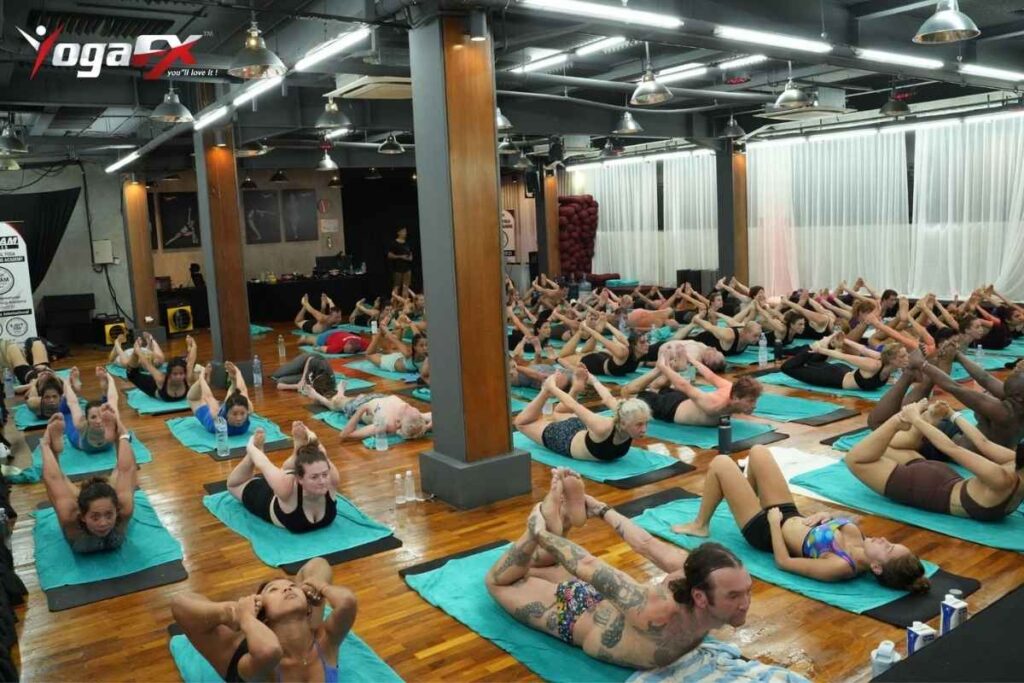
The most fundamental error in Bow Posture, and the one that most completely defeats the posture's purpose. When practitioners pull with their arms, the shoulders and upper back do most of the work, the chest is compressed rather than opened, and the anterior body opening that Dhanurasana is designed to produce does not occur. The arms become the prime movers instead of the legs.
Fix: consciously remove the pulling intention from the arms entirely. Think of the arms as ropes attached to two fixed points. The legs kick against these ropes. If the arms are not pulling, the kick becomes the only available mechanism for elevating the body, which is exactly the correct relationship.
Mistake 2: Static Hold After Initial Entry
Many practitioners kick into the posture, establish a position, and then stop kicking. The hold becomes static within 2 to 3 seconds. The rocking motion that produces the digestive massage benefit, and the progressive anterior body opening that the sustained kick produces, both cease when the kick stops.
Fix: treat the entire 10-second hold as an active kicking effort, not a position maintained after a single kick. A correctly held Bow Posture looks dynamic from the outside because the rocking motion is visible.
Mistake 3: Knees Wider Than Hip-Width
The knees splaying outward is a compensation for tight hip flexors or for insufficient kick strength. It reduces the mechanical efficiency of the kick by changing the angle of force application, and it shifts the stretch from the anterior hip and rectus femoris toward the inner groin and adductors, which are not the target tissue of Bow Posture.
Fix: actively squeeze the knees toward each other throughout the posture. If maintaining hip-width knee alignment prevents the thighs from lifting, work at reduced thigh height with correct knee alignment rather than achieving greater thigh lift with splayed knees.
Mistake 4: Releasing the Kick When Discomfort Increases
The abdominal compression and the anterior body stretch of Bow Posture create sensations that many practitioners interpret as reasons to exit the posture or reduce the kick. This is the most common reason practitioners remain in a shallow version of Bow Posture indefinitely without progressing.
Fix: differentiate between productive discomfort, which is the sensation of the anterior body opening and the abdominal compression, and pain that signals strain or injury. Productive discomfort is the sensation of the posture working correctly. Maintaining the kick through this sensation is what produces the posture's benefits.
Modifications by Level
Beginner: One Leg at a Time
For practitioners who cannot grip both ankles simultaneously, or who find the full bilateral version overwhelming in the first sessions, gripping one ankle and kicking that single leg while the other leg rests on the floor is a legitimate beginner modification. This version still produces the digestive rocking motion, the spinal extension, and the anterior body stretch on the working side. Alternate sides across the two sets.
Intermediate: Both Legs, Reduced Thigh Height
Both ankles gripped, continuous kick, thighs lifting to the currently available height with knees hip-width throughout. The focus at intermediate level is the quality of the kick and the maintenance of the rocking motion across the full 10 seconds rather than the absolute height of the thigh lift. A lower but actively kicked Bow Posture produces more benefit than a higher but statically held position.
Advanced: Full Expression with Cervical Extension
Full thigh lift, continuous kick producing visible rocking, arms straight, knees hip-width, gaze toward the ceiling completing the full anterior arc. At this level, the focus is the quality of the anterior body opening across the entire chain from ankles to throat, and the quality of the continuous breath maintained throughout the abdominal compression.
FAQ
What is the correct technique for Bow Posture in Bikram yoga?
Lie face-down, bend the knees, reach back and grip both ankles from the outside with both hands. From this position, kick the feet strongly away from the body and up toward the ceiling.
The arms hold the grip but do not pull. The kick force against the fixed arm grip is what lifts the thighs and opens the chest. Maintain the kick continuously for the full 10 seconds.
Keep knees hip-width throughout. Breathe normally. The posture should produce a visible rocking motion from the sustained kick.
Why do I rock back and forth in Bow Pose?
The rocking motion in Bow Posture is the intended effect of a correctly executed posture with a strong, sustained kick. It is not an error. The rocking concentrates the body weight rhythmically on the abdominal region, producing the mechanical massage of the digestive organs that is one of Bow Posture's primary therapeutic benefits. If you are not rocking, the kick is either not strong enough or not sustained throughout the hold.
What is the difference between Bow Pose in Bikram yoga and other yoga styles?
The Bikram version of Dhanurasana is mechanically identical to the Hatha yoga version in terms of the grip-and-kick structure.
The differences are contextual: it appears at posture 19 in a fixed sequence after three preceding prone backbends have specifically prepared the posterior chain and anterior body, it is practiced in a 40-degree environment that increases hip flexor and anterior thorax extensibility, and the dialogue emphasises the kick as the primary force rather than the grip.
The 10-second hold is shorter than many Vinyasa or Hatha versions.
Why is Bow Posture easier in Bali's natural heat compared to electric-heated studios?
Natural tropical humid heat at YogaFX Bali provides consistent deep thermal penetration to the hip flexors and anterior thorax that dry electric heat cannot replicate at the same temperature. Electric heaters produce dry heat at 15 to 25 percent humidity, causing rapid sweat evaporation that creates a temperature gradient reducing deep fascial extensibility.
Bali's natural humidity above 70 percent maintains consistent core thermal penetration. Practitioners who have experienced both consistently report greater anterior body opening and more comfortable sustained effort in Bow Posture in natural humid heat.
How long does it take to improve Bow Posture in Bikram yoga?
The kicking mechanics, specifically learning to drive the posture with the feet rather than the arms, typically stabilise within 10 to 20 classes as the neural pattern shifts. Thigh height increases progressively as hip flexor flexibility develops over 1 to 3 months of consistent practice.
The full anterior body opening from ankle to throat in one continuous arc with visible rocking and easy breathing may take 6 months to a year of regular practice at 3 or more sessions per week.
Is Bow Posture good for back pain?
For most practitioners with general lower back tightness or mild chronic back discomfort, Bow Posture practiced with correct technique, specifically the kick-driven mechanics rather than arm-pulling compression, produces a therapeutic spinal extension effect that complements the other floor backbends in the Bikram sequence.
Practitioners with diagnosed disc conditions, acute back injury, or structural spinal issues should consult a physician before practicing the full version. The beginner modification (one leg at a time, reduced lift) significantly reduces spinal loading while preserving some benefit.