

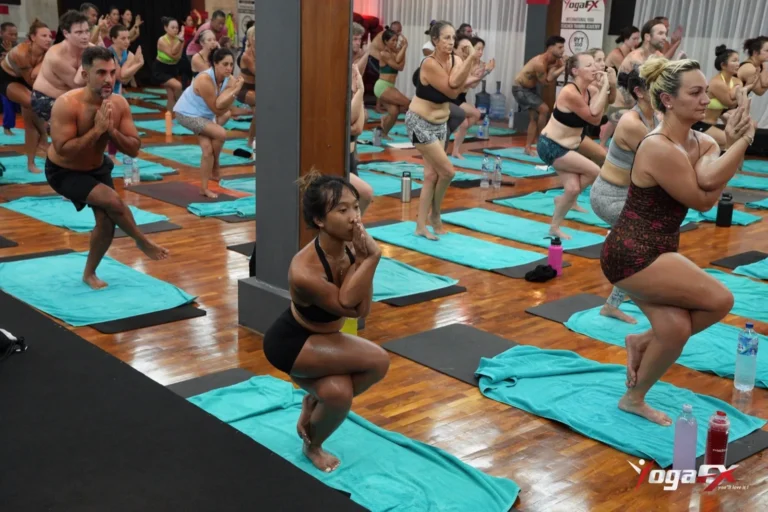
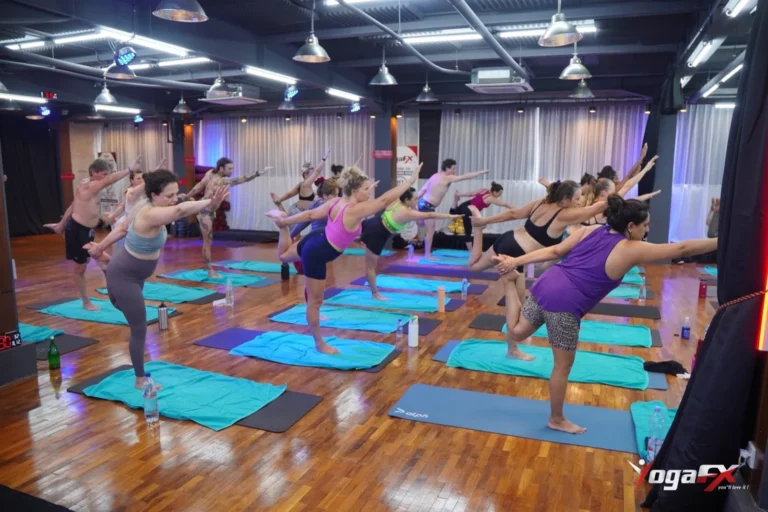

Balancing stick pose (Tuladandasana) is the seventh posture in the Bikram Hot 26&2 sequence. You stand on one leg, reach both arms forward and tip into one level line. You hold it for 10 seconds per side, twice. This guide covers the six cues, six common mistakes and what a teacher watches for.

By the time you reach it, your legs have already worked through Eagle Pose, Standing Head to Knee and Standing Bow. That order is not an accident. The earlier postures wake up the standing leg, so this one can ask for the hardest version of the same job. It is short, but it is rarely easy.
Mr. Ian Terry, E-RYT 500 with more than 12,000 teaching hours, trained for five years (2014 to 2019) with the founder of the Bikram Hot 26&2 method. He teaches this posture as a test of the base. If the standing foot is steady, the rest of the line follows.
Balancing Stick Pose in the Bikram Series: Six Cues
In class the dialogue gives the exact words and timing, so treat the list below as a map, not a script. It shows the order a teacher checks, from the floor up.
- Lock the standing knee. Press the whole foot into the floor and keep the leg straight and strong.
- Bring the hands together overhead. Keep the arms long, beside the ears, with the shoulders away from them.
- Pick one point and stay on it. Your eyes give your balance a fixed reference.
- Tip forward from the hip. The chest and arms travel as one piece, so the waist does not fold.
- Kick the back leg straight behind you. Push the foot back, not up, until arms, torso and leg make one level line.
- Hold, then come up slowly. Stay for 10 seconds, rise with control, then repeat on the other side and again for the second set.
That is six cues, and each one prepares the next. Because the back leg sits out of sight, a student cannot check it in the mirror. So the cues describe what you feel (a locked knee, a long spine) instead of what you see.
Where Balancing Stick Pose Sits in the Balance Series
The standing series has three postures in a row that all rest on one leg. A teacher reads them as a staircase. Each one removes a little more help from the body.
| Posture | Position in the sequence | Shape of the body | What usually fails first |
|---|---|---|---|
| Standing Head to Knee | 5th | Standing leg locked, other leg lifted forward and held | Standing knee softens as the lifted leg pulls on it |
| Standing Bow Pulling | 6th | Leg kicked back into the hand, torso tips forward | Standing hip drifts as the kick rises |
| Balancing Stick | 7th | Arms reach forward, back leg reaches behind, body level | Chest rounds, or the back leg climbs too high |
Notice the pattern. In the first posture the lifted leg is in front, where you can see it. In the second it moves behind you. In balancing stick pose both the leg and the arms leave your view. For example, a student who wobbles here has often skipped a lesson one posture earlier.
If you want the full running order, our guide to all 26 postures with Sanskrit names lists every step. For how the body senses these shifts, see our article on proprioception exercises in the balance series.
Why Balancing Stick Pose Feels Harder Than It Looks
The name helps. Tuladandasana joins tula, usually read as a balance or scale, with danda, a staff or stick. Picture a seesaw. The back leg goes one way, the chest goes the other, and the standing hip is the pivot. If the pivot moves, the whole seesaw tips.
From the back of the room, the pose looks calm. Inside, it's busy. The standing ankle makes tiny corrections, the hips fight to stay square and both hamstrings work in different ways. Because the student can't see the lifted leg, they have to feel a straight line from fingertips to toes.
That's why a teacher trains the room to listen. A good cue names one feeling the student can act on right now. "Press the whole foot down" works. "Be more stable" doesn't. So the best balancing stick pose teaching is mostly about choosing the right six words at the right moment.
Three checks before the kick
- Check the foot. Is the weight spread across the ball and the heel, not dumped into the toes?
- Check the knee. Is it locked and still, before the back leg moves at all?
- Check the gaze. Are the eyes resting on one fixed point?
If all three are true, the kick usually goes well. If one fails, fix it first. A teacher who skips this step ends up correcting the chest, the arms and the leg when the real fault sits in the foot.
The 10-Second Hold: Why Balancing Stick Pose Stays Short
The hold is brief on purpose. Ten seconds per side, then a second set, is long enough to feel the line and short enough to keep the form clean. A long, shaky hold teaches the body to wobble. A short, tidy one teaches it to balance.
Outside yoga, health services recommend similar short holds. The NHS balance exercises page describes a one-leg lift with the hips level and a slight bend in the opposite leg. It says to hold the lift for 5 to 10 seconds and repeat 3 times on each side. The class hold sits in that same range, with a harder shape.
The Cleveland Clinic balance guide adds a useful point. It says standing on one leg can be more difficult than it sounds, and that it is a good way to judge where your balance is today. So treat a wobble as information, not failure.
10 sec
Hold per side
Long enough to feel the line, short enough to keep form.
2 sets
Each side
The second set shows what the first set taught you.
7th
Posture in the class
It follows Standing Bow and ends the single-leg work.
3 in a row
One-leg postures
Head to Knee, Standing Bow, then Balancing Stick.
5 to 10 sec
NHS one-leg hold
Repeated 3 times on each side in its home routine.
Six Balancing Stick Pose Mistakes and How a Teacher Fixes Them
A teacher stands at the front or side of the room and sees the same faults again and again. Here are six, with the cue that usually fixes each one.
1. The back rounds
The student folds at the waist, the chest drops and the line bends. The fix is to hinge from the hip. Think of a door swinging on its hinge, so the whole upper body moves as one piece.
2. The back leg climbs too high
The foot rises while the torso stays upright, so the body forms a V instead of a T. Push the foot back, not up. Then let the chest come forward to match the leg.
3. The hip opens
The lifted leg turns out and the hip rolls to the side. Point the toes down and aim both hip bones at the floor. This is a small turn, but it takes the line from sloppy to clean.
4. The standing knee goes soft
The leg shakes, because the small muscles around the ankle are doing the work of the knee. Lock the knee and press the whole foot down. In a hot room, sweat makes this harder, so a wide, active foot gives more grip.
5. The breath stops
Many students hold their breath without noticing. The jaw tightens, the shoulders rise and the wobble grows. Breathe slowly through the nose and soften the face. A calm face usually means a calm base.
6. The exit is rushed
Some students drop out of the pose the moment it gets hard, or snap upright when the 10 seconds end. Come up slowly and with control. The way out is part of the posture, and it protects the lower back.
What Research Says About One-Leg Balance and Leg Strength
We do not claim that balancing stick pose treats any condition. We use outside research to explain why the cues make sense. Each linked source comes from a health service or hospital, not from a yoga website, and we opened it to check what it says.
The Cleveland Clinic balance guide says balance exercises can help reduce the chance of falling. It also notes that as people age they lose muscle mass and strength, so they become more prone to trips and falls. One-leg standing is one of the simplest ways to train this skill.
On the strength side, a 2013 study of Bikram yoga (Tracy and Hart) reported about a 20% increase in posterior chain strength, alongside changes in flexibility and body composition. That study looked at the whole class, not this posture alone. Still, balancing stick pose leans on the same muscles at the back of the legs and hips.
A 2025 systematic review (Willmott et al.) of 43 studies with 942 participants gathered the research on Bikram yoga as a whole. It points to general benefits such as flexibility and well-being, but it does not test this single posture. So read it as context, not proof.
This article is education, not medical advice. If you have a knee, ankle, hip or back injury, or you feel dizzy on one leg, please consult a healthcare professional before you practise.
Easier Versions and When to Stop
A good teacher always offers a way down. The NHS balance exercises page suggests doing balance work near a wall or a stable chair in case you lose your balance. That advice fits this posture too. Here are options a beginner can use:
- Lower leg, higher chest. Shorten the lever so the standing leg can stay steady.
- Soft standing knee. A slight bend can help while the hamstrings learn to lengthen.
- Fingertips near a wall. Touch only if you need it, then take the hand away.
- Shorter hold. Clean form for five seconds beats a shaky ten.
Stop and come down if you feel sharp pain, dizziness or a pinch in the knee, hip or lower back. The heat adds load, so drink water before class and rest between sets when you need to.
What Trainees Say After Learning the Postures
Students rarely talk about one posture when they look back. They talk about the whole week and what it did to them. Here are three YouTube reviews from YogaFX trainees, taken from their video transcripts and lightly edited.
This is one of the best moments I have experienced for so long time. I'm so grateful, thank you.
A trainee in our YouTube review, 2023
Truly life-changing amazing experience, one of the most amazing things I've ever done.
A trainee in our YouTube review, 2023
This is not like physical practice, but our emotion, our mental, our heart, our love, and I love you guys. Thank you.
Arkan, YouTube review, 2023 (translated)
Arkan filmed his review at his graduation ceremony. Watch it below, then see a second graduate's video.
Learn to Teach Balancing Stick Pose at YogaFX in Bali
If you want to coach postures like this with confidence, the YogaFX Bali MasterClass is built for it. It is a 6-day hybrid course. You study online first, then join an in-person intensive in Seminyak, Bali. The next intensive runs from check-in on Sunday 24 January 2027 to check-out on Friday 29 January 2027.
Graduates earn the Yoga Alliance RYT 200-Hour credential and the Bikram Hot 26&2 200-Hour International Yoga Certification. More than 1,500 graduates from over 80 countries have trained with YogaFX since 2017. Mr. Ian Terry leads the training and gives live feedback in the posture clinics.
For the wider picture, the YogaFX teacher training hub shows how the full programme fits together. If you only want the student side of this posture, read the plain-language Tuladandasana walkthrough on our sister site. And if you are ready to ask a question, message us on WhatsApp.
FAQ
What are the variations of balancing stick pose?
The common variations keep the same line but shorten the lever. Lower the back leg, keep the chest a little higher, soften the standing knee slightly, or rest your fingertips near a wall. Each version trains the same base. Tell your teacher about any injury before class so they can suggest the safest option.
Is balancing stick pose part of Bikram yoga?
Yes. Balancing stick pose is the seventh posture in the Bikram Hot 26 and 2 sequence. It follows Standing Bow Pulling and comes before Standing Separate Leg Stretching. Each posture is done twice, and the dialogue sets the timing, so the order and the words stay the same in every class.
How long do you hold balancing stick pose?
In the Bikram sequence you hold it for 10 seconds per side, then repeat for a second set. That is short on purpose, because clean form matters more than time. If you cannot hold the full line yet, keep the back leg lower and build the hold over several weeks.
Is balancing stick pose hard for beginners?
It is one of the harder standing postures, because the back leg and arms sit out of sight. Most beginners wobble at first, and that is normal. Start with a lower leg, a soft standing knee or fingertips near a wall. Then raise the difficulty slowly as your balance improves.
Does Bikram teacher training teach balancing stick pose?
Yes. Trainees practise all 26 postures and 2 breathing exercises every day, and they coach each other in posture clinics. YogaFX is independent training, not official Bikram Choudhury teacher training. Mr. Ian Terry gives live feedback, so trainees learn which cue helps which student.
Still have questions? Message Mr. Ian and the YogaFX team on WhatsApp and we will answer them personally.