


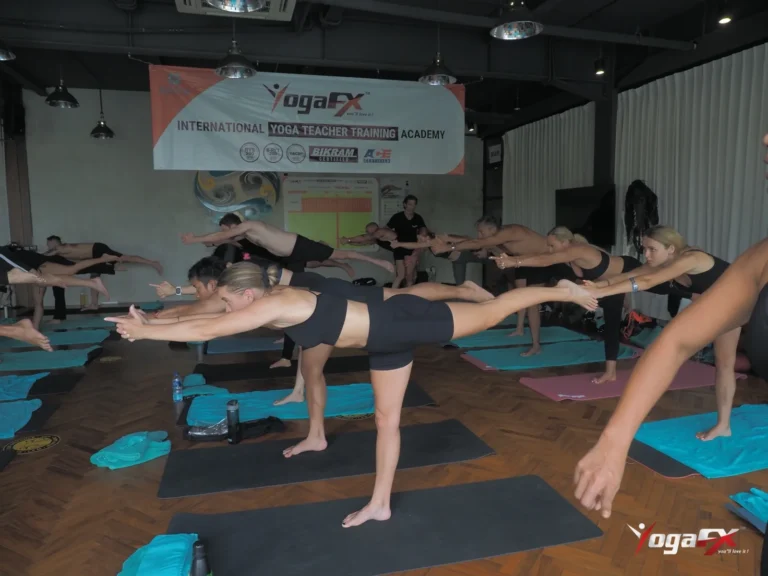
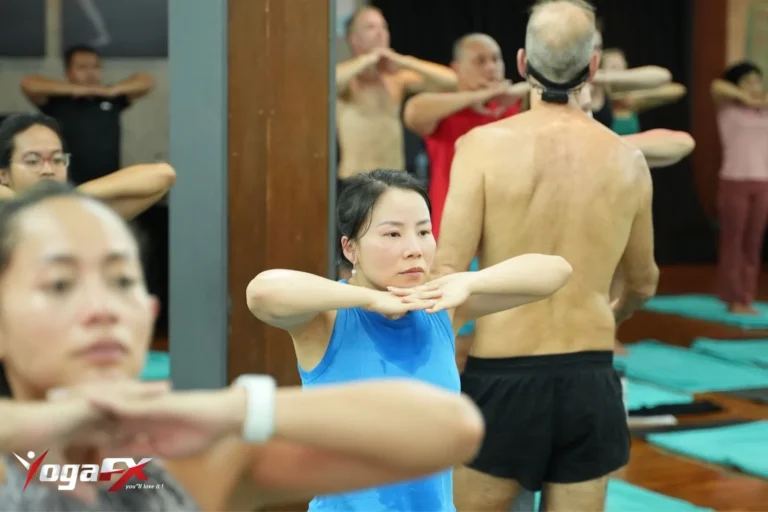

Tree pose in Bikram yoga is a one-leg balance that trains attention as much as it trains the legs. You stand on one strong leg, rest the other foot high on the thigh, bring your hands together and keep your eyes on one fixed spot in the mirror. The wobble is usually a concentration problem first.

This guide comes from a 26&2 teacher's side of the room. It covers the concentration cues, the mirror, what research says about gaze and fatigue, and how trainees learn the posture in Bali. For the step-by-step shape, the 26 and 2 teacher's guide to tree pose sits on our sister site.
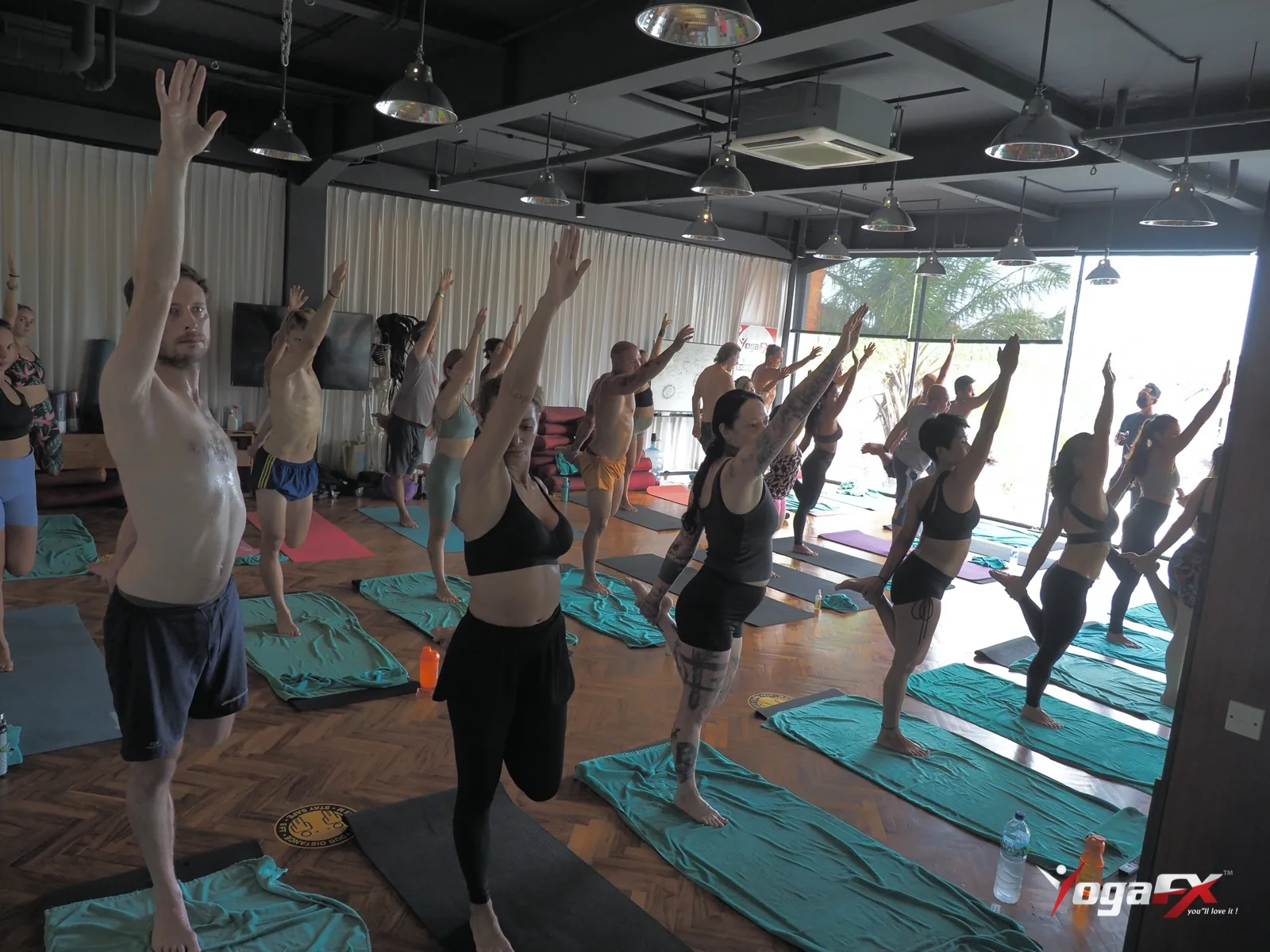
Tree Pose in the Bikram Series: Where the Mind Takes Over
Tree pose comes late in the standing series. It follows Standing Separate Leg Head to Knee and arrives just before Toe Stand. By then you have worked through most of a 90-minute class in a room heated to about 40°C, so your legs are warm and tired.
That placement matters. The heavy folds and bends are behind you, so the posture asks for something quieter. You balance, you breathe and you keep your attention in one place. The Bikram list calls it Tadasana, although many other styles use that word for mountain pose and call the one-leg shape Vrksasana.
From the back of the room, nothing much seems to happen. Inside the posture, your standing foot makes small corrections all the time. Meanwhile your mind offers a dozen reasons to quit. That gap between how it looks and how it feels is why teachers treat tree pose as a concentration posture.
The posture gives your attention three jobs:
- Hold a target. Your eyes stay on one spot, so your brain has a steady reference point.
- Check the base. You notice the standing foot, the knee and the hips before a lean turns into a fall.
- Ignore the noise. Sweat, fatigue and the thought that you are done all pass through, and you let them.
None of this requires flexibility. Hip range changes the shape of the posture, but the attention work is the same for a stiff beginner and a long-time practitioner.
How Attention Moves Through One Round of Tree Pose
Think of one round as six short phases. Your attention has a different job in each one, and each one has a typical slip. The table below maps them in plain words. It is a teaching note, not the dialogue script, so always follow your teacher in the room.
| Phase | What your attention is doing | The reset cue | Typical slip |
|---|---|---|---|
| 1. Setting up | Choosing a target in the mirror | Pick one spot at eye level | Eyes scanning the room |
| 2. Lifting the foot | Tracking weight onto the standing leg | Strong standing leg, foot lifted by hand | Hopping or grabbing for the foot |
| 3. Placing the foot | Feeling the hip open | Foot high on the thigh, knee out to the side | Foot pressed on the knee joint |
| 4. Hands together | Balancing the upper body over the base | Spine tall, shoulders down | Hunched shoulders and a held breath |
| 5. Holding | Returning to the spot again and again | Look back at the spot, slow the exhale | Staring at the foot instead of the spot |
| 6. Releasing | Staying careful when the mind says you are done | Lower the foot slowly | Dropping the foot early |
Notice that four of the six slips are attention problems, not strength problems. The eyes leave the spot, the breath stops or the mind rushes the exit. Fix those and the leg often steadies by itself.
The Fixed Gaze and the Mirror: Using Both on Purpose
The Bikram room has a full mirror across the front wall. Tree pose is where it earns its place. The mirror shows your spine, your hips and your standing knee, so you can correct a lean before it grows. It also gives your eyes a target that never moves.
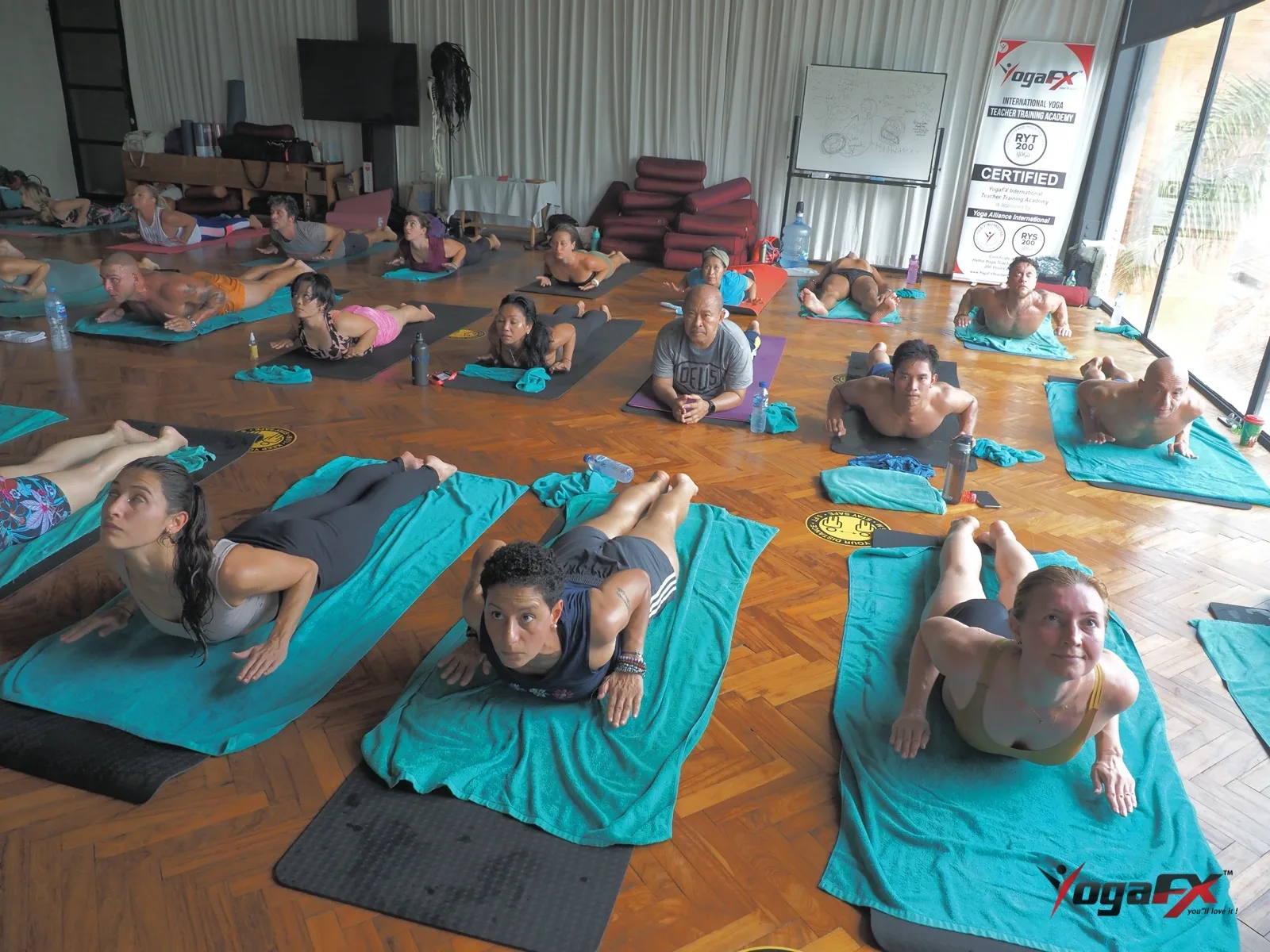
Gaze works best as a tool, not a stare. Pick a spot at eye level, often your own eyes. When your mind drifts, look back at the spot. Every return counts as one repetition of attention training, and you get many of them in a single round.
What the research says about vision and one-leg balance
Vision does real work in single-leg balance. In a 2024 PLOS ONE study, Buckley and colleagues asked 18 adults to move into a single-limb stance with and without vision. When vision was blocked, people were less stable while holding the position (Buckley et al., 2024).
The limits matter. The participants were healthy adults tested in a lab, not yoga students in a hot room. The study supports a role for your eyes in staying steady. It does not show that tree pose improves balance, and we do not claim that it does.
Three ways to use the mirror
- Check the standing leg. Is the knee straight and strong, or locked back hard?
- Check the pelvis. Both hip bones should face the mirror instead of tilting to one side.
- Check your face. A clenched jaw or a frozen breath usually shows before the wobble does.
No mirror in your line of sight? Choose a fixed mark on the wall at eye level. The principle is the same: one target that does not move.
5 Concentration Cues for Tree Pose, in Plain Words
The exact dialogue is taught live, and we do not reproduce the script here. These five cues are plain-language reminders of what each part of the posture asks of your attention.
- Find your spot. Choose one point at eye level before you lift anything. Decide once, then keep it.
- Own the standing leg. Press evenly through the whole foot and keep the leg strong. A shaky base makes everything above it harder.
- Lift the foot with your hands. Slow movement keeps your attention on the base, whereas hopping scatters it.
- Open the hip, not the knee. The foot rests high on the thigh and the knee opens to the side. Pressing the foot into the knee joint is the slip to avoid.
- Stay when it gets dull. The first few breaths feel exciting and the next few feel long. That stretch is the training, so keep your eyes on the spot.
If your hip does not allow the foot on the thigh yet, rest it lower on the calf or ankle. Keep it off the side of the knee. Tell your teacher about any knee, hip or ankle injury before class.
When Attention Slips: Fatigue, Heat and the Wobble
Every student wobbles, so the useful question is why. A 2016 PLoS ONE study by Beurskens and colleagues tested 20 young adults after an all-out treadmill protocol. Sway and sway velocity increased when people were fatigued and when they did a second task at the same time (Beurskens et al., 2016). The authors found no extra penalty from combining the two, but each one alone made balance worse.
That was a treadmill, not a hot room, so it cannot describe a Bikram class directly. It does match what teachers see. Tired legs and a busy mind both make a one-leg hold harder, and in a long class a wandering mind acts as a second task.
Quick fixes when the wobble starts
Heat adds its own wrinkle. Sweat makes the lifted foot slide, and a warm room can make the effort feel bigger than it is. A few first fixes help:
- Foot slipping? Lift it with your hands and place it again, slightly lower on the thigh or on the calf.
- Mind racing? Count slow breaths and return to your spot.
- Falling toward the lifted knee? Draw the standing hip in under you and level the pelvis.
- Feeling dizzy or unwell? Come out of the posture, sit down and tell your teacher.
The evidence side by side
The table below puts the three sources side by side, so you can see what each one tells us and what it does not.
| Source | Who or what | What it found or says | What it means for tree pose |
|---|---|---|---|
| Buckley et al., PLOS ONE 2024 | 18 adults in a lab | Less stable single-limb holding when vision was blocked | Your eyes and the mirror do real work. It says nothing about yoga benefits. |
| Beurskens et al., PLoS ONE 2016 | 20 young adults after a treadmill test | Sway rose with fatigue and with a second task | Tired legs and a busy mind both hurt balance. The test was not in a hot room. |
| Mayo Clinic, Balance exercises, 2024 | Guidance page | Balance exercises help at any age; fall risk rises after 65; try a single-leg hold up to 30 seconds with good form | A sensible home practice, with something stable nearby if you need it. |
Tree Pose Compared With Eagle and Standing Head to Knee
Several standing postures train the same skill in different shapes. Tree pose strips away most of the extra effort cues, so attention has fewer places to hide.
- Eagle pose asks you to wrap the arms and legs while staying low on one leg. Attention goes to holding the wrap.
- Standing Head to Knee asks you to hold a lifted leg and fold forward. Attention goes to the work of the standing leg.
- Tree pose has no wrap and no fold. Attention goes to the target, the base and the breath.
Balancing Stick, earlier in the series, uses a long horizontal line instead. Our guide to Balancing Stick pose shows how that shape loads the standing leg differently.
For the body-position side of all this, our guide to proprioception exercises in the Bikram balance series explains why small ankle and hip signals matter so much on one leg.
Learning Tree Pose at YogaFX in Seminyak
Mr. Ian Terry, E-RYT 500 with more than 12,000 teaching hours, leads the YogaFX teacher training in Bali. He trained for five years, from 2014 to 2019, with the founder of the Bikram Hot 26&2 method. The studio is at Jl. Pangkungsari Gg Jepun No.888, Kuta Utara, Seminyak, Badung, Bali 80361, and it is open daily from 06:00 to 22:00.
If you are new to the heat, the Free 1-Day Guest Pass gives you your first class at no cost. You can ask about it on WhatsApp.
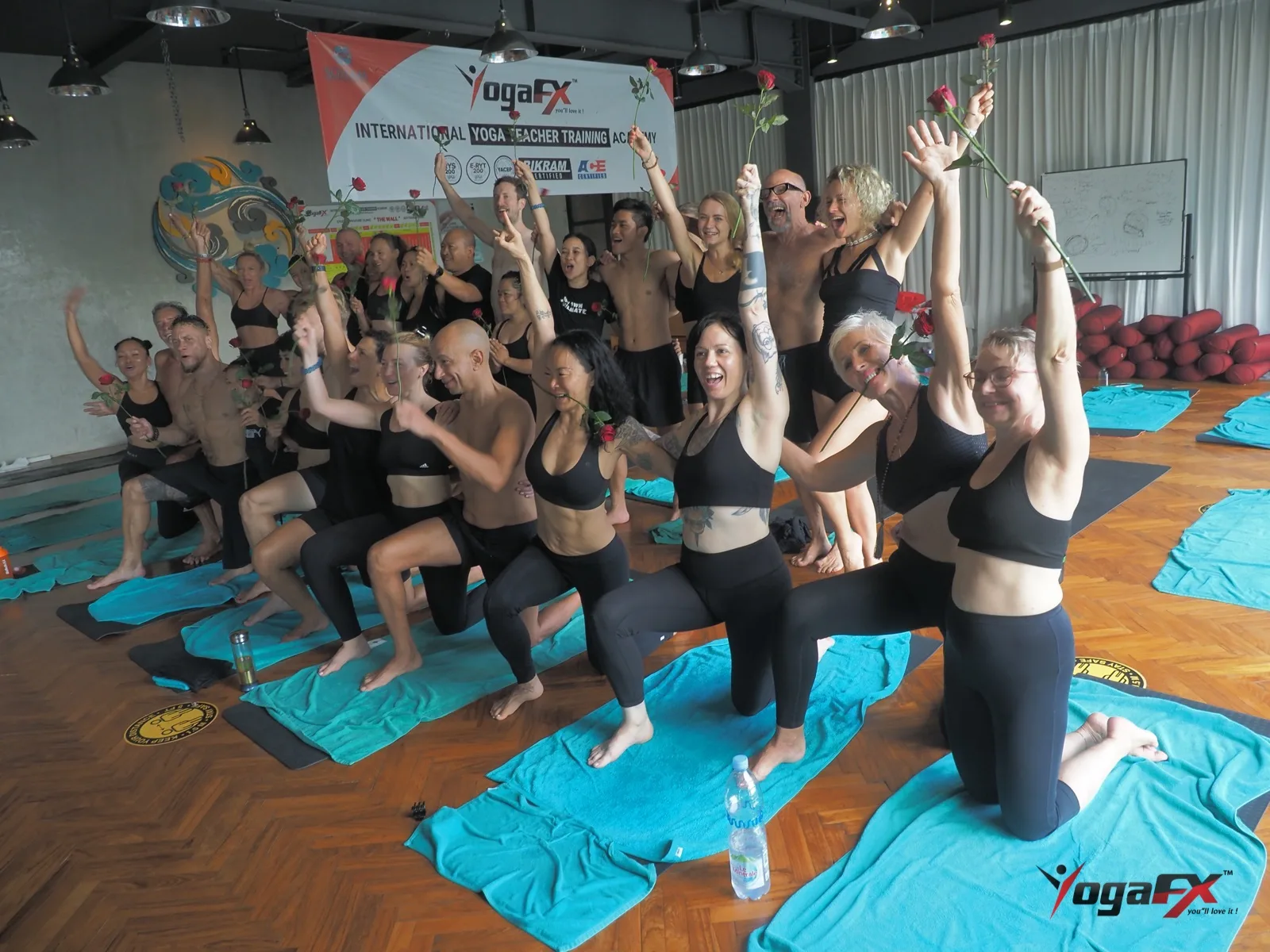
If you want to teach, the 6-day hybrid MasterClass combines pre-course online study with an intensive in Bali. It leads to Yoga Alliance RYT 200-Hour certification plus a Bikram Hot 26&2 200-Hour International Yoga Certification. The next batch runs from check-in on Sunday 24 January 2027 to check-out on Friday 29 January 2027. Our guide to Bikram yoga teacher training in 6 days has the dates and formats.
What Trainees Say About Learning With Mr. Ian
Reviews rarely describe one posture. They describe the teacher, the room and the group. Here are three, with first names only where we have them. They are about the training experience in general, not about tree pose.
Ian is a good yoga instructor. He gave a clear instructions and make sure that we do the pose correctly.
Tuti, Google review, 2020
Moscow is waiting for you. I love yoga.
A trainee in our YouTube review, 2018 (transcript)
It was brilliant, thank you very very much.
A trainee in our YouTube review, 2018 (transcript, lightly edited)
The video below is one of those reviews, titled "Moscow Please Come Back" on the YogaFX YouTube channel.
How to Practise Tree Pose Before Your Next Class
You do not need a special routine. A few habits make the posture steadier when it arrives in class.
- Practise near a wall. Rest a fingertip on it so a wobble never becomes a fall.
- Start with the foot low. Rest it on the calf, then move it up as your hip opens over the weeks.
- Choose one spot. Return to it every time your eyes drift.
- Build the hold slowly. Hold only as long as your form stays good, then switch sides.
- Compare your sides. Most people have a steadier leg, and noticing it is half the work.
Mayo Clinic notes that balance exercises can help you keep your balance at any age, and that the risk of falling goes up after age 65. Its single-leg stand asks you to hold the position as long as you keep good form, up to 30 seconds, and it says you can hold onto something stable at first (Mayo Clinic, Balance exercises).
This is general information, not medical advice. Consult a healthcare professional before you practise balance postures if you have balance problems, dizziness or a condition that affects your bones, joints or muscles, and tell your teacher before class.
Expect the first weeks to feel clumsy. Your ankles and hips are learning a new job, and the second side often shows you what you changed on the first.
FAQ
Is tree pose good for balance?
Tree pose is a one-leg balance, so it gives your ankle, hip and attention regular practice. Research on single-leg balance, such as a 2024 PLOS ONE study of 18 adults, shows that vision matters for stability. No study here tests tree pose itself, so treat it as practice, not a promised fix.
Why can't I do tree pose?
Most stalls come from three places: a tired standing foot, a foot pressed on the knee, or eyes that keep drifting. Rest the foot lower on the calf, choose one fixed spot and breathe slowly. Practise near a wall, and tell your teacher about any knee, hip or ankle pain.
Should you close your eyes in tree pose?
In a Bikram class you keep your eyes open on one fixed spot, because the gaze is the concentration tool. Research also suggests vision helps single-leg stability: in a 2024 study, 18 adults were less stable without it. Closing your eyes is a harder test, not a better one.
How long should you hold tree pose?
In a Bikram class your teacher sets the timing, so follow the dialogue. At home, Mayo Clinic suggests holding a single-leg stand as long as you keep good form, up to 30 seconds, then switching sides. Build slowly, and stop if your alignment goes or anything hurts.
How can I improve my tree pose?
Start with the foot low on the calf, stay near a wall and pick one spot at eye level. Return to the spot whenever your mind drifts. Add time only while your form stays good, practise a few minutes most days, and compare both sides to see which leg needs more work.
Still have questions? Message Mr. Ian and the YogaFX team on WhatsApp and we will answer them personally.