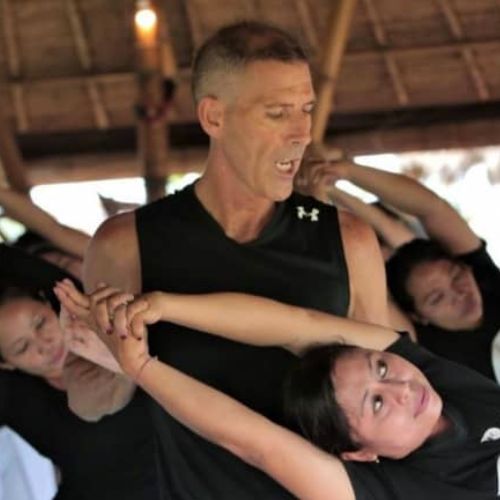
This page is the quick-reference resource for all 26 Poses of Bikram Yoga and 2 breathing exercises: English name, Sanskrit name, sets, hold time per set, and primary benefit in sequence order. Every posture links to its dedicated guide where alignment cues, common mistakes, and beginner modifications are covered in full detail. The complete 90-minute class begins with Pranayama opening breathing and ends with Kapalbhati closing breathing, with the 26 Poses of Bikram Yoga between them divided into the standing series (postures 1 to 12) and the floor series (postures 14 to 26).

Want every posture in order, filtered by difficulty, focus area or health benefit?
Opening: Pranayama Series
| No | English Name | Sanskrit Name | Sets | Hold | Primary Benefit |
|---|---|---|---|---|---|
| 0 | Standing Deep Breathing | Pranayama Kriya | 1 | 6 breath cycles | Maximum respiratory preparation. Parasympathetic activation through complete forced exhalation. Opens the class. |
Standing Series: Postures 1 to 12
| No | English Name | Sanskrit Name | Sets | Hold per Set | Primary Benefit |
|---|---|---|---|---|---|
| 1 | Half Moon Pose (with Hands to Feet) | Ardha Chandrasana with Pada Hasthasana | 2 | 10 seconds lateral + 20 seconds forward fold | Lateral spinal decompression. Posterior chain stretch. Opens intercostals for full respiratory capacity through the class. |
| 2 | Awkward Pose | Utkatasana (3 parts) | 2 per part | 10 seconds each part | Systematic lower body strengthening. Quadriceps, adductors, and calves targeted sequentially. Prepares joints for the balance series. |
| 3 | Eagle Pose | Garurasana | 2 | 20 seconds | Simultaneous opening of 14 major joints. Joint lubrication in heat-enhanced synovial conditions. Posterior shoulder capsule stretch. |
| 4 | Standing Head to Knee | Dandayamana Janushirasana | 2 | 60 seconds | Hamstring flexibility. Single-leg balance and concentration. The most sustained focus demand in the standing series. |
| 5 | Standing Bow Pulling Pose | Dandayamana Dhanurasana | 2 | 60 seconds | Cardiovascular peak. Full anterior body opening. Tourniquet effect producing circulatory stimulation on side change. |
| 6 | Balancing Stick | Tuladandasana | 2 | 10 seconds | Maximum cardiovascular demand per second. Full posterior chain engagement. Peak heart rate in the shortest hold. |
| 7 | Standing Separate Leg Stretching | Dandayamana Bibhaktapada Paschimotthanasana | 2 | 20 seconds | Bilateral hamstring and inner thigh stretch. Active cardiovascular recovery after the standing series peak. |
| 8 | Triangle Pose | Trikanasana | 2 | 20 seconds | The most complex coordination demand in the sequence, 12 simultaneous alignment points. Full lateral stretch, deep hip opening, cardiovascular re-elevation. |
| 9 | Standing Separate Leg Head to Knee | Dandayamana Bibhaktapada Janushirasana | 2 | 10 seconds | Thyroid and parathyroid compression via chin-to-knee contact. Hamstring stretch. Forward fold with spinal rounding. |
| 10 | Tree Pose | Tadasana | 1 per side | 20 seconds | Single-leg balance and hip mobility. Relative cardiovascular recovery before the final balance challenge. |
| 11 | Toe Stand | Padangustasana | 1 per side | 10 seconds | Deepest single-leg balance in the standing series. Ankle strength, arch stability, intrinsic foot musculature development. |
Mandatory Savasana transition (Dead Body Pose) between standing and floor series: 2 minutes minimum. Cardiovascular redistribution from peripheral vasculature to core organs. Not optional rest a prescribed physiological transition.
Floor Series: Postures 12 to 26
| No | English Name | Sanskrit Name | Sets | Hold per Set | Primary Benefit |
|---|---|---|---|---|---|
| 12 | Dead Body Pose | Savasana | Between postures | 20 seconds between each floor posture | Active cardiovascular recovery. Nervous system reset between floor postures. The prescribed rest within the floor series. |
| 13 | Wind-Removing Pose | Pavanamuktasana | 3 positions | 20 seconds each | Ascending and descending colon massage. Hip joint traction. Lower back release from standing series accumulation. |
| 14 | Sit Up | - | Between postures | Transition only | Abdominal engagement in transition. Core activation between floor postures. |
| 15 | Cobra Pose | Bhujangasana | 2 | 20 seconds | Spinal erector strengthening in extension. First prone backbend. Counteracts the forward flexion compression of daily sitting. |
| 16 | Locust Pose | Salabhasana (2 parts) | 2 per part | 10 seconds each part | Asymmetric then bilateral posterior chain loading. Isolates then integrates lower back and glute activation. |
| 17 | Full Locust Pose | Poorna Salabhasana | 2 | 10 seconds | Full posterior chain integration arms, spine, and legs simultaneously. Peak posterior chain loading before the final backbend series. |
| 18 | Bow Pose | Dhanurasana | 2 | 20 seconds | Digestive organ massage through abdominal rocking. Full anterior body opening from ankles through chest. The rocking is the therapeutic mechanism. |
| 19 | Fixed Firm Pose | Supta Vajrasana | 2 | 20 seconds | Knee, ankle, and hip flexor opening in kneeling backbend. The deepest available rectus femoris stretch in the sequence. |
| 20 | Half Tortoise Pose | Ardha Kurmasana | 2 | 20 seconds | Maximum lumbar decompression. Heart rate measurably drops. Deepest lower back release in the entire sequence. Parasympathetic activation. |
| 21 | Camel Pose | Ustrasana | 2 | 20 seconds | Maximum spinal extension. Strongest adrenal stimulation. Full anterior body opening from knees through throat. The sequence's most demanding backbend. |
| 22 | Rabbit Pose | Sasangasana | 2 | 20 seconds | Maximum spinal flexion the direct physiological counterpose to Camel. Traction-based spinal decompression. The only consecutive counterpose pair in the sequence. |
| 23 | Head to Knee with Stretching Pose | Janushirasana with Paschimotthanasana | 3 positions (R, L, both) | 20 seconds each | Seated hamstring and lower back flexibility. Abdominal organ compression. Deeper hamstring access than standing versions for many practitioners. |
| 24 | Spine Twist | Ardha Matsyendrasana | 1 per side | 20 seconds | The only true spinal rotation in the sequence. Completes multi-plane spinal conditioning, the rotation plane not addressed by any other posture. |
| 25 | Blowing in Firm | Kapalbhati in Vajrasana | 1 | 60 rapid exhales | Nervous system reset. Digestive organ stimulation. Carbon dioxide clearing. Mirrors Pranayama completes the respiratory arc of the class. |
Closing: Kapalbhati Series
| No | English Name | Sanskrit Name | Sets | Hold | Primary Benefit |
|---|---|---|---|---|---|
| 26 | Blowing in Firm Pose | Kapalbhati in Vajrasana | 1 | 60 rapid exhales, approximately 1 to 2 minutes | Nervous system reset through rhythmic abdominal engagement. Mirrors Pranayama opening. The class began and ends with breath. |
The Complete Sequence: Key Facts
- Total postures: 26 plus Pranayama opening and Kapalbhati closing
- Total class duration: 90 minutes fixed
- Temperature specification: 40 degrees Celsius with 40 percent relative humidity
- Standing series: postures 1 to 11, approximately 45 minutes
- Floor series: postures 12 to 25, approximately 35 minutes
- Sets per posture: all postures performed twice (two sets) except Spine Twist, which is performed once per side
- Savasana: between every floor series posture (20 seconds) and a mandatory 2-minute minimum between standing and floor series
- Instruction method: scripted verbal dialogue only no physical demonstration by the instructor
- Sequence consistency: identical in every authentic Bikram or 26 and 2 class globally
The Sequence Logic: Why This Order
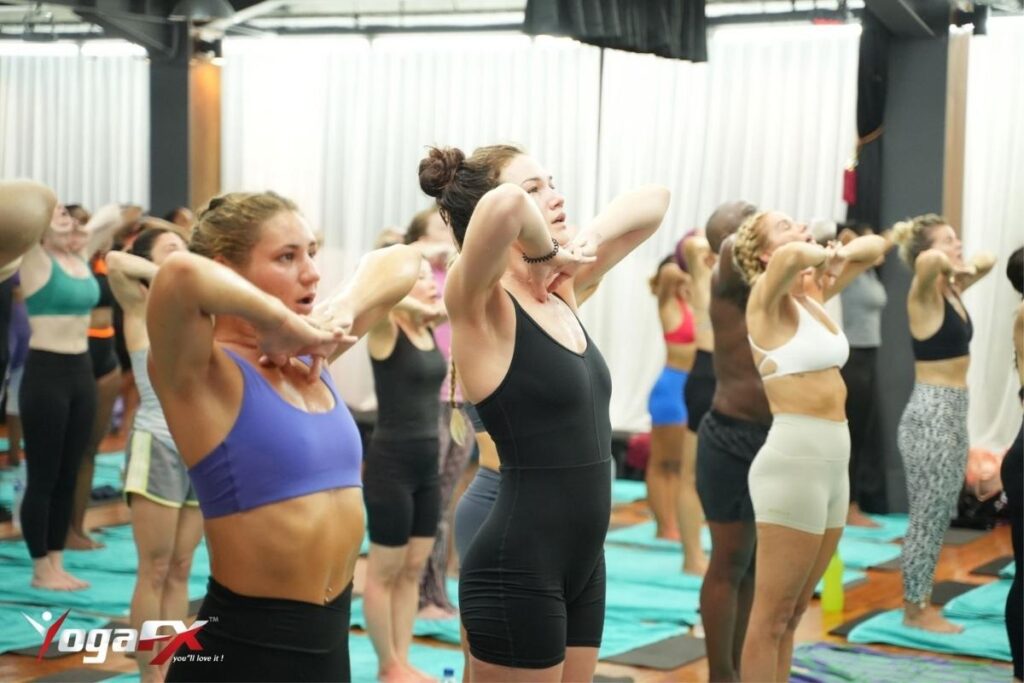
The 26 Poses of Bikram Yoga are not a random collection each section prepares the body for the next:
- Postures 1 to 2 (warm-up): spinal preparation (Half Moon) and lower body activation (Awkward Pose) before any balance or cardiovascular demand
- Posture 3 (joint preparation): Eagle Pose lubricates 14 major joints before the single-leg balance series loads them
- Postures 4 to 6 (cardiovascular peak): the three highest-demand postures arrive after the body is fully prepared peak heart rate at 80 to 90 percent of maximum
- Postures 7 to 11 (closing standing series): active recovery transitioning toward Savasana, heart rate descending from peak
- Postures 13 to 18 (floor backbends): progressive posterior chain loading in prone positions, building toward the maximum extension of Camel Pose
- Postures 19 to 21 (Camel and Rabbit): the only consecutive physiological counterpose pair maximum extension immediately followed by maximum flexion
- Postures 22 to 24 (closing floor series): seated and twisting work completing multi-plane spinal conditioning
- Kapalbhati closing: mirrors Pranayama opening the class begins and ends with controlled breath
The Research Behind the Sequence
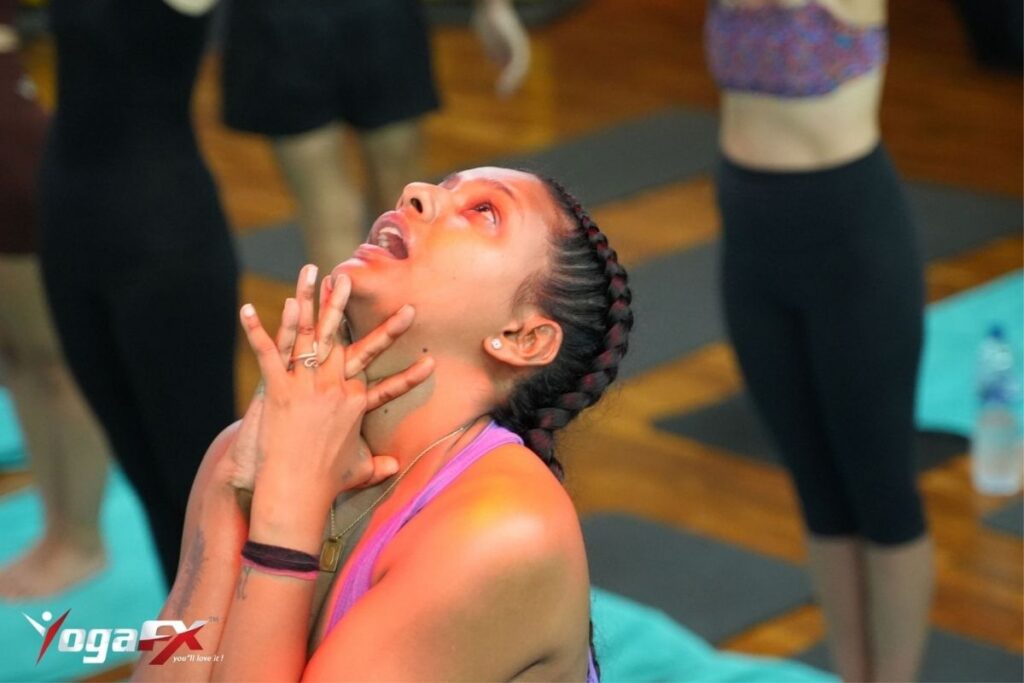
The 26 Poses of Bikram Yoga sequence is the most peer-reviewed single yoga format in the research literature. The 2025 Willmott systematic review (PMC12488547) analysed 43 studies covering 942 participants, confirming improvements in flexibility, balance, bone mineral density, body composition, and psychological well-being. Key specific findings:
- Tracy and Hart 2013 (PubMed: 23438366): 20 percent posterior chain strength increase, significant lower back and hamstring flexibility gains, body fat reduction with lean muscle gain at 8 weeks
- Porcari et al. 2014 (PubMed: 24700459): 333 kcal (women) to 460 kcal (men) per 90-minute session, heart rate at 80 percent of maximum throughout
- Nyer et al. 2023 Harvard MGH (PubMed: 37883245): 59 percent of participants with moderate to severe depression cut their symptoms by half or more after 8 weeks of heated yoga, versus 6 percent on the waitlist
Where to Go Deeper
This page is the quick-reference table. For practitioners and instructors who want more depth on any posture, the following guides cover alignment cues, common mistakes, and beginner modifications:
- All 26 Bikram yoga postures: alignment cues, common mistakes, and modifications the practitioner-level guide to every posture in the sequence
- Eagle Pose: the 14-joint posture
- Camel Pose: alignment and the hip-forward safety cue
- Rabbit Pose: maximum spinal decompression
- Half Moon Pose: lateral spinal decompression
- Standing Head to Knee: the focus posture
- Bow Pose: the digestive series
- Awkward Pose: lower body activation
The reference table on this page covers every posture in the sequence. What it cannot convey is the experiential dimension that practitioners consistently describe as the practice's most significant feature the way the fixed sequence, encountered repeatedly over months and years, becomes something other than a list of postures. One practitioner who described herself as having no expectation of ever enjoying yoga found, after consistent practice, that the familiar sequence had become a framework she practiced within rather than a series of instructions to decode.
Another, a complete beginner, described leaving the intensive able to execute every posture fully a transformation the fixed sequence and consistent instruction made measurable precisely because nothing in the format changed except his own depth within it.
While a quick summary sheet is helpful, studying the specific Bikram yoga poses with alignment cues will significantly elevate your posture execution.
FAQ
What are the 26 Poses of Bikram Yoga?
The 26 postures in sequence order: Half Moon Pose (Ardha Chandrasana), Awkward Pose (Utkatasana, 3 parts), Eagle Pose (Garurasana), Standing Head to Knee (Dandayamana Janushirasana), Standing Bow Pulling Pose (Dandayamana Dhanurasana), Balancing Stick (Tuladandasana), Standing Separate Leg Stretching (Dandayamana Bibhaktapada Paschimotthanasana), Triangle Pose (Trikanasana), Standing Separate Leg Head to Knee (Dandayamana Bibhaktapada Janushirasana), Tree Pose (Tadasana), Toe Stand (Padangustasana), Dead Body Pose/Savasana (transition)
Wind-Removing Pose (Pavanamuktasana), Cobra Pose (Bhujangasana), Locust Pose (Salabhasana), Full Locust Pose (Poorna Salabhasana), Bow Pose (Dhanurasana), Fixed Firm Pose (Supta Vajrasana), Half Tortoise Pose (Ardha Kurmasana), Camel Pose (Ustrasana), Rabbit Pose (Sasangasana), Head to Knee with Stretching (Janushirasana with Paschimotthanasana), Spine Twist (Ardha Matsyendrasana), and Blowing in Firm Pose/Kapalbhati. The full class opens with Pranayama standing deep breathing and closes with Kapalbhati in Vajrasana.
How many poses are there in Bikram yoga?
26 Poses of Bikram Yoga plus 2 breathing exercises (Pranayama opening and Kapalbhati closing). The sequence is divided into a standing series (postures 1 to 11, approximately 45 minutes) and a floor series (postures 12 to 25, approximately 35 minutes), with a mandatory Savasana transition between them. Every posture is performed twice (two sets) except Spine Twist, which is performed once per side. Every posture on the sheet is driven by precise verbal commands, keeping you safe and properly aligned with the scripted yoga dialogue explained step by step.
What is the hardest pose in Bikram yoga?
Different practitioners find different postures hardest depending on their specific physical restrictions. The most commonly cited: Standing Head to Knee (requires hamstring flexibility, single-leg balance, and sustained concentration simultaneously), Toe Stand (the deepest balance challenge in the sequence), and Camel Pose (the most intensity-producing backbend, particularly for practitioners with thoracic restriction). For new practitioners, the heat itself is often more challenging than any specific posture in the first 5 to 10 classes. To ensure your alignment is correct when practicing at home without a live instructor, consider practicing the 26 poses online with guided video breakdowns.
Is there a printable PDF of the 26 Poses of Bikram Yoga?
Several printable references circulate publicly: lakshminarayanlenasia.com hosts a PDF document from 2005, Scribd hosts "Printable Bikram Yoga Postures," and Pinterest has pinned posture charts. This page provides the same information in a more complete and updated web format including Sanskrit names, sets, hold times, benefits, and links to per-posture detailed guides which is more useful for most practitioners than a static PDF.
While a downloadable sheet is excellent for quick reference, you can explore the anatomy and alignment deeper by checking books covering the 26-posture sequence in depth.
What is the difference between Bikram yoga and 26 and 2 yoga?
The sequence is identical. "Bikram yoga" and "26 and 2 yoga" describe the same 26 Poses of Bikram Yoga fixed sequence with 2 breathing exercises, practiced at 40 degrees Celsius. The naming difference reflects a post-2019 rebranding by the studio community following controversy around founder Bikram Choudhury most studios now use "26 and 2 yoga" or "original hot yoga." The postures, their order, their hold times, and the scripted verbal dialogue used to teach them are unchanged. Every posture listed requires exact commands for entry, hold, and exit, which is why the scripted teaching language for each posture is strictly maintained worldwide.