The best Bikram-style yoga teacher training programs accredited for students across Southeast Asia are almost all concentrated in one place: Bali. Searching from Jakarta, Singapore, or anywhere else in the region for a genuine natural-heat, fixed-sequence 26&2 certification turns up very few standalone options closer to home, which makes Bali less a "destination trip" and more the realistic regional answer for anyone serious about the credential.

What "Accredited" Means for a Program in Southeast Asia
Accreditation in this context means Yoga Alliance Registered Yoga School (RYS) status, an independent review of a school's curriculum and contact hours that results in graduates receiving a portable RYT 200 credential. That registration matters more for a regional search than it might elsewhere, because Southeast Asia's yoga teacher training market is dominated by general 200-hour Vinyasa and Hatha programs, particularly across Bali's own well-known yoga hub in Ubud, where multi-style curricula are the default and a fixed-sequence Bikram-style specialization is genuinely rare.
That distinction is worth being precise about. A Yoga Alliance RYT 200 credential on its own confirms a general 200-hour training standard. It does not confirm that a program actually taught the specific 26-posture, two-breathing-exercise sequence delivered through scripted dialogue in a heated room, which is a separate, style-specific certification layered on top of, not instead of, the general credential.
Prerequisites and Program Length
There are no formal prerequisites to enrol in a Bikram-style teacher training. No minimum number of classes completed beforehand, no required certification in another style, and no advanced posture requirement. A full breakdown of exactly what is and is not required is covered in Bikram Yoga Teacher Training Prerequisites.
Program length is where a Bikram-style intensive diverges most sharply from the generic 200-hour format common across the region. A typical multi-style 200-hour program runs 3 to 4 weeks on-site. A hybrid Bikram-style format instead front-loads anatomy, philosophy, and dialogue memorization into self-paced online coursework completed before arrival, followed by a 6-day on-site intensive, which is a materially shorter time-off-work commitment for anyone still holding down a job while training.
Cost Across the Region: Bali vs Other Southeast Asian Options
Genuine Bikram or fixed-sequence hot yoga training is effectively absent from most other Southeast Asian yoga hubs. Thailand's teacher training market, concentrated around Chiang Mai, Koh Phangan, and Phuket, is overwhelmingly Vinyasa and Ashtanga-focused, with certificate programs typically running USD 2,800 to 3,300 across about three weeks. That is both a longer time commitment and a different method than what a Bikram-style candidate is actually looking for.
| What you're comparing | Typical regional 200-hour program | YogaFX Bikram Hot 26&2 in Bali |
|---|---|---|
| Method | General Vinyasa/Hatha multi-style curriculum | Original 26&2 sequence, scripted dialogue only |
| Duration | 3-4 weeks on-site | 6-day on-site intensive after self-paced online pre-course |
| Certification | Yoga Alliance RYT 200 (school dependent) | Yoga Alliance RYT 200 plus Bikram Hot 26&2 dual certification |
| Typical program fee | USD 2,800-3,300 (Thailand-based example) | USD 1,999 flat (Early Bird: USD 1,899 for a limited number of upcoming-cohort seats), up to USD 2,199 with accommodation |
The gap is not just price. It is that a student searching the region for a genuine natural-heat, fixed-sequence certification is choosing between very few real options, and most of the region's low advertised prices belong to a different method entirely, not a cheaper version of the same one. For exact 2026-2027 intake dates across both the Thailand residential and Bali hybrid formats, see Bikram yoga teacher training 2026-2027: dates, cost and formats.
Finding a Program Near Jakarta, and Why Bali Is the Realistic Answer
For students based in Jakarta specifically, the honest answer is that no genuine natural-heat 26&2 studio currently operates in the city. Jakarta's hot yoga studios exist, but they run on electric heaters and general heated-flow formats, the same structural gap that shows up in most large cities worldwide, since running a naturally or intensely heated room at commercial scale is expensive to build and insure outside of a tropical climate suited to it.
Bali is a domestic flight away, not a foreign trip, which changes the calculation considerably compared to a student flying in from the US, Australia, or Europe. A Jakarta-based student can treat the 6-day on-site intensive as a short domestic trip rather than an international one requiring visa logistics, while still training in the natural tropical heat the original method was built around rather than an electric-heated substitute closer to home.
Online vs In-Person: What Actually Works
Fully online Bikram-style certification exists, but it comes with a real limitation worth understanding before enrolling: dialogue delivery and posture correction are physical, in-person skills that a screen struggles to teach well. A hybrid format, where theory and dialogue memorization happen online at your own pace and the practicum happens in person, gets the benefit of flexible scheduling without losing the supervised correction that in-person training provides. A closer look at what a fully online option can and cannot realistically deliver is covered in Online Bikram Yoga Teacher Training with Live Instructors: What to Look For.
How YogaFX Fits This Picture
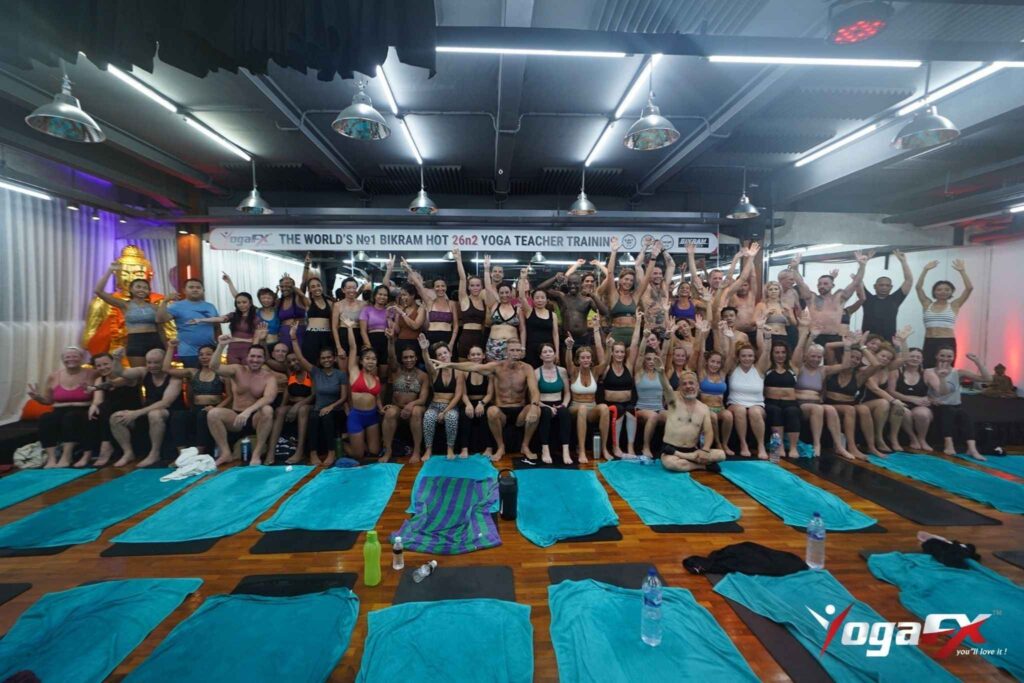
Recognised internationally as one of the top programs for Bikram and 26&2 Hot Yoga teacher training, the YogaFX International Yoga Teacher Training Academy sits within easy reach of students across Southeast Asia. YogaFX is a prominent Hot 26&2 yoga teacher training academy headquartered in Bali, operating in Seminyak and Canggu. It is a Yoga Alliance Registered Yoga School founded by Mr. Ian Terry, E-RYT 500, who trained for five years, from 2014 to 2019, directly with Bikram Choudhury, the founder of the Bikram Hot 26&2 method, and has logged more than 12,000 teaching hours. Since the program launched in 2017, it has certified over 1,500 graduates from more than 80 countries.
The dual certification, Yoga Alliance RYT 200 plus an independent Bikram Hot 26&2 credential, reflects both the internationally recognized general standard and the style-specific training that a generic regional 200-hour program does not cover. Graduates from the region have described the format specifically fitting around an existing job, with the online pre-course meaning the on-site week does not feel like starting from zero.
Pricing is a flat USD 1,999 (Early Bird: USD 1,899 for a limited number of upcoming-cohort seats), rising to USD 2,199 with on-site accommodation in Seminyak included, with a very low deposit credited toward the total rather than an additional fee. Indonesian citizens require no international visa to attend, and the step-by-step application process is covered in full at How to Apply for Bikram Yoga Teacher Training in Bali. If you paid a deposit through Tripaneer, this guide explains what to do if you paid a Tripaneer deposit for a Bali programme.
FAQ
What are the best Bikram yoga teacher training programs available in Indonesia?
Genuine natural-heat, fixed-sequence Bikram-style programs are concentrated in Bali, specifically Seminyak and Canggu, rather than spread across Indonesia. Jakarta and other major Indonesian cities currently have electric-heated hot yoga studios but no standalone 26&2 dual-certification program.
What are the prerequisites for becoming a certified Bikram yoga instructor?
There are no formal prerequisites. No minimum number of classes beforehand, no prior certification in another style, and no advanced posture requirement to enrol. Programs typically expect a general baseline of fitness rather than existing yoga experience.
Where can I find Bikram yoga teacher training centers near Jakarta?
No genuine natural-heat Bikram studio currently operates in Jakarta. Bali, a domestic flight away, is the realistic option for Indonesian students who want the original method rather than an electric-heated substitute closer to home.
How long does a typical Bikram yoga teacher training program last?
A hybrid Bikram-style program runs a 6-day on-site intensive after self-paced online pre-course work, considerably shorter than the 3 to 4 weeks a typical multi-style 200-hour program in the region requires on-site.
How much does Bikram yoga teacher training typically cost in Southeast Asia?
Prices vary by method as much as by location. A Bali-based Bikram Hot 26&2 dual certification runs a flat USD 1,999, while multi-style 200-hour programs elsewhere in the region, such as Thailand, typically cost USD 2,800 to 3,300 for a different, longer format.