
Bikram yoga is a specific yoga method: 26 postures and 2 breathing exercises, practiced in the same fixed order in every class worldwide, in a room heated to 40 degrees Celsius (105 degrees Fahrenheit) with 40 percent relative humidity, for exactly 90 minutes. It is not a general category of hot yoga. It is not interchangeable with Vinyasa practiced in a warm room. It is a method with a specific physiological rationale, a peer-reviewed research base, and a history that any prospective practitioner should understand.
Bikram yoga is a 90-minute sequence of 26 postures and 2 breathing exercises practiced at 40 degrees Celsius with 40 percent humidity. The sequence never changes between classes or studios. Peer-reviewed research documents 333 to 460 kcal calorie burn per session (University of Wisconsin, 2014), 20 percent strength increase after 8 weeks (Tracy and Hart, 2013), and significant depression reduction in a Harvard Medical School RCT (2023). At YogaFX Bali, the practice is conducted in natural tropical heat without electric heaters.
What Is Bikram Yoga: The Exact Specification
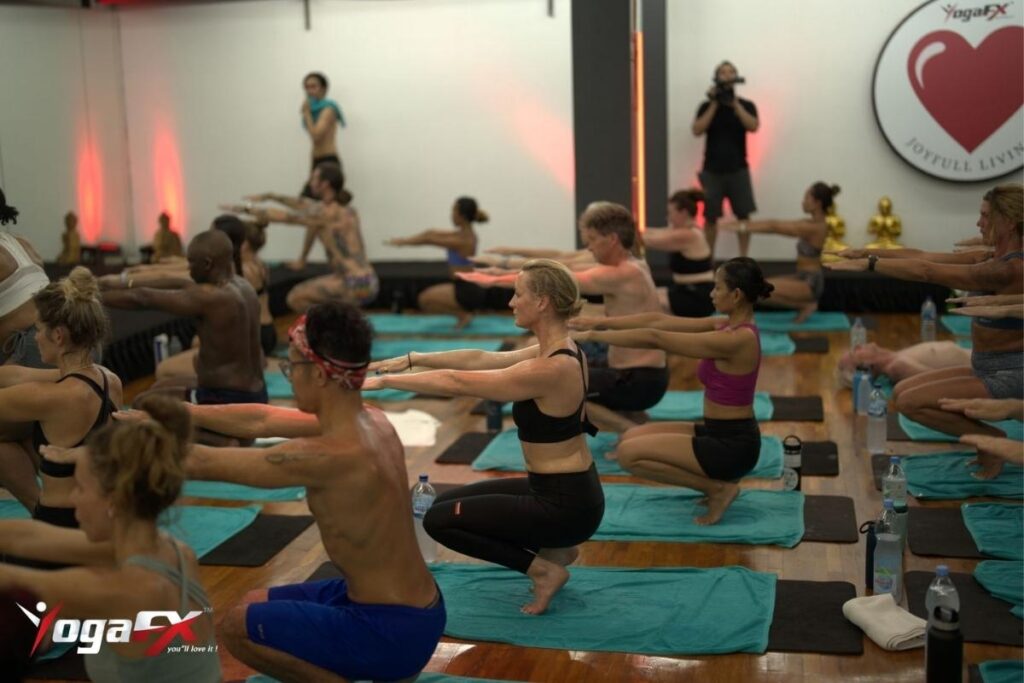
Bikram yoga has four non-negotiable defining characteristics that distinguish it from other hot yoga formats.
1. The 26 Postures and 2 Breathing Exercises
The Bikram sequence consists of exactly 26 postures drawn from Hatha yoga tradition, plus Pranayama Series (standing deep breathing at the opening) and Kapalbhati breathing in Vajrasana (at the close). Every class everywhere begins and ends the same way. The 26 postures run in the same order every time. The sequence does not change based on instructor preference, student level, or studio style. At its core, the practice relies on static, non-vinyasa holds, which is why having hot Hatha yoga explained clarifies the system's focus on alignment and breath.
This fixed structure is one of Bikram yoga's most significant features. Because the sequence is identical in every class, progress is directly measurable. A practitioner can compare their Standing Head to Knee depth in class 1 against class 100 against the same pose in a class attended two years later. No other yoga format provides this level of controlled progress measurement.
2. The Temperature: 40 Degrees Celsius with 40 Percent Humidity
The room specification is 40 degrees Celsius (105 degrees Fahrenheit) with 40 percent relative humidity. Both parameters are functional. The temperature reduces muscle viscosity and increases connective tissue extensibility, allowing the postures to be performed at greater depth with lower injury risk than at room temperature. The 40 percent humidity prevents sweat from evaporating too quickly, maintaining core temperature in the therapeutic range throughout the 90-minute session.
The heat is not decorative. It is a functional component that enables the physiological outcomes the sequence was designed to produce. At YogaFX Bali, this temperature and humidity is provided by Bali's natural tropical climate without any electric heating infrastructure at either the Seminyak or Canggu studios.
3. The 90-Minute Duration
The Bikram sequence is designed as an integrated physiological system that requires 90 minutes to complete. The standing series (postures 1 to 13) heats the core and creates the muscular demand that the floor series (postures 14 to 26) requires to be effective. Compressed formats (60 minutes) cover approximately the first 18 postures. The floor series, which addresses the spine in maximum extension and flexion and provides the compression-decompression cycle for the abdominal organs, requires the pre-heated state that only the complete standing series produces.
4. The Verbal Dialogue
Bikram yoga classes are taught from a scripted verbal dialogue that delivers identical instruction across all certified instructors. Practitioners follow verbal cues rather than watching demonstrations. This makes Bikram yoga unusually accessible for beginners because no prior posture knowledge is required. It also means every class feels consistent regardless of which certified instructor is teaching.
What Is Bikram Yoga Called Now?
Many studios and practitioners now use alternative names for the practice to separate the method from Bikram Choudhury, who left the United States in 2016 following multiple sexual assault lawsuits and was convicted in absentia in California in 2023. The practice itself is unchanged. The names in common use:
- 26 and 2 yoga: the most widely adopted alternative name, describing the method by its content — 26 postures plus 2 breathing exercises
- Original Hot Yoga: used by several independent studio networks to emphasise lineage authenticity without referencing Choudhury
- Hot 26 and 2: a hybrid name that combines the heat description with the posture count
- Bikram yoga: still used by some studios and practitioners, particularly where brand recognition matters
At YogaFX, the method is taught as Original 26 and 2 Hot Yoga. Mr. Ian Terry's connection to the practice comes through 5 direct training events with Bikram Choudhury between 2012 and 2019 — in Bangkok, China, Spain, India, and Los Angeles — and his position as assistant teacher on Choudhury's staff during those events. This is the most direct lineage connection available from an instructor operating independently of Choudhury's current activities.
The History of the Method: The Practice and the Founder
Bikram yoga was developed by Bikram Choudhury, who trained under Bishnu Ghosh in Calcutta beginning in the 1960s. Ghosh was a physical culture teacher and the brother of Paramahansa Yogananda, and had developed a therapeutic approach to Hatha yoga postures that Choudhury systematised into the 26-posture sequence. Choudhury brought the method to the United States in the early 1970s, establishing studios and teacher training programmes that spread globally over the following decades.
The method and the founder are separable, and this distinction matters for anyone engaging with Bikram yoga in 2026. Following a 2019 Netflix documentary and multiple serious legal proceedings, most studios teaching the 26-posture sequence have rebranded: the terms 26 and 2 yoga, original hot yoga, and 26 plus 2 yoga are now widely used to describe the same method without referencing Choudhury. The postures, sequence, temperature specification, and teaching dialogue are unchanged. YogaFX teaches the method as Original 26 and 2 Hot Yoga, and Mr. Ian Terry's connection to the method comes through 5 direct training events with Choudhury between 2012 and 2019 and 12,000 or more hours of instruction.
The 26 Postures: Structure of the Sequence
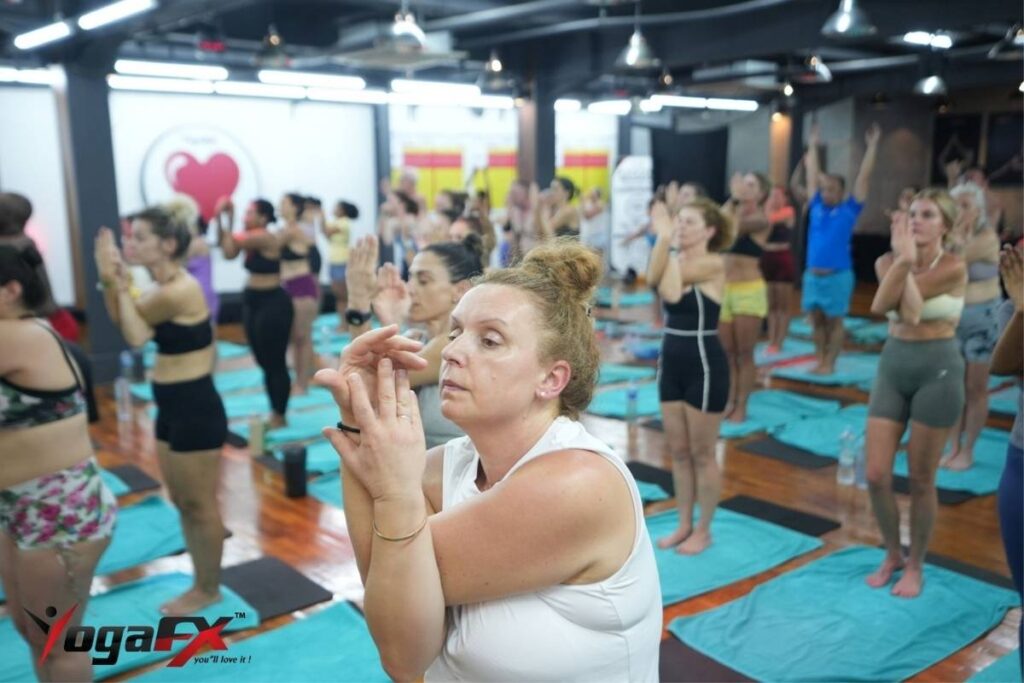
The sequence divides into two series. The standing series (postures 1 to 12, followed by a Savasana transition) builds cardiovascular demand progressively through lateral stretches, squats, and single-leg balance postures. The floor series (postures 14 to 26) addresses the spine in every plane of movement and provides the therapeutic organ compression and nervous system work that the standing series prepares the body for.
| Sequence | Posture (English) | Sanskrit Name | Primary Function |
|---|---|---|---|
| Opening | Standing Deep Breathing | Pranayama | Respiratory warm-up, mental preparation |
| 1 | Half Moon Pose | Ardha Chandrasana | Lateral spine stretch and backbend |
| 2 | Hands to Feet Pose | Pada Hasthasana | Posterior chain stretch |
| 3 | Awkward Pose | Utkatasana | Lower body strength, ankle stability |
| 4 | Eagle Pose | Garurasana | 14 major joints simultaneously |
| 5 | Standing Head to Knee | Dandayamana Janushirasana | Balance, hamstring, concentration |
| 6 | Standing Bow Pulling Pose | Dandayamana Dhanurasana | Peak cardiovascular posture |
| 7 | Balancing Stick | Tuladandasana | Maximum cardiovascular demand per second |
| 8 | Standing Separate Leg Stretching | Dandayamana Bibhaktapada Paschimotthanasana | Hamstring and inner thigh |
| 9 | Triangle Pose | Trikanasana | Full lateral body, 12 simultaneous alignments |
| 10 | Standing Separate Leg Head to Knee | Dandayamana Bibhaktapada Janushirasana | Thyroid compression, hamstring |
| 11 | Tree Pose | Tadasana | Hip mobility, balance |
| 12 | Toe Stand | Padangustasana | Ankle strength, deep balance |
| Trans. | Savasana | Dead Body Pose | Cardiovascular redistribution |
| 14 | Wind-Removing Pose | Pavanamuktasana | Colon massage, hip opening |
| 16 | Cobra Pose | Bhujangasana | Spinal extension, adrenal stimulation |
| 17 | Locust Pose | Salabhasana | Lower back strength |
| 18 | Full Locust Pose | Poorna Salabhasana | Full posterior chain |
| 19 | Bow Pose | Dhanurasana | Digestive organ massage, full anterior opening |
| 20 | Fixed Firm Pose | Supta Vajrasana | Knee and hip flexor opening |
| 21 | Half Tortoise Pose | Ardha Kurmasana | Maximum lumbar decompression |
| 22 | Camel Pose | Ustrasana | Maximum spinal extension |
| 23 | Rabbit Pose | Sasangasana | Maximum spinal flexion, counterpose to Camel |
| 24 | Head to Knee with Stretching | Janushirasana and Paschimotthanasana | Hamstring, spinal flexion |
| 25 | Spine Twist | Ardha Matsyendrasana | Only spinal rotation in the sequence |
| Closing | Blowing in Firm Pose | Kapalbhati in Vajrasana | Nervous system reset |
What the Research Shows
Bikram yoga is the most extensively studied yoga format in peer-reviewed literature. The fixed sequence and controlled environmental conditions make it unusually measurable for clinical research.
| Study | Design | Key Findings |
|---|---|---|
| Porcari et al. 2014, University of Wisconsin (PubMed: 24700459) | Direct metabolic measurement during actual 90-minute Bikram classes | 333 kcal women / 460 kcal men per session. Heart rate averaged 80 percent of maximum. Active participants reached 600+ kcal. |
| Tracy and Hart 2013 (PubMed: 23438366) | 8-week controlled study, 3 to 4 sessions per week, standardised pre and post testing | 20 percent deadlift strength increase. 9 percent balance improvement. Reduced body fat percentage. Hamstring and lower back flexibility gains. |
| Nyer et al. 2023, Harvard MGH (PubMed: 37883245) | Randomised controlled trial, 80 adults with moderate to severe depression, 8-week Bikram intervention | ~60 percent of yoga group reduced depression symptoms by 50 percent or more. 44 percent achieved full remission. Only 6.3 percent of control group saw comparable improvement. |
The research base for Bikram yoga is more specific and better controlled than for any other yoga style. The fixed sequence and standardised environmental conditions enable reproducible measurement that variable-sequence room-temperature yoga research cannot match.
To understand this style within the broader yoga ecosystem, it helps to analyze the structural differences in a head-to-head breakdown of Bikram versus Ashtanga yoga.
What Bikram Yoga Is Good For: Benefits by Category
Physical Benefits
- Calorie burn: 333 to 460 kcal per 90-minute session at moderate intensity, with active practitioners reaching 600+ kcal
- Strength: 20 percent increase in deadlift strength after 8 weeks of consistent practice at 3 to 4 sessions per week
- Flexibility: accelerated by heat — connective tissue extensibility is greater at 40 degrees Celsius than at room temperature, producing faster early flexibility gains
- Cardiovascular conditioning: average heart rate of 80 percent of maximum throughout a 90-minute session, equivalent to moderate cycling
- Body composition: reduced body fat percentage alongside lean muscle gain from consistent practice
- Balance: 9 percent improvement in standing balance after 8 weeks (Tracy and Hart, 2013)
- Joint health: Eagle Pose opens 14 major joints through compression-and-release with heat-enhanced synovial fluid mobility
- Spinal mobility: the sequence addresses the spine in every plane — flexion, extension, rotation, and lateral flexion — in every class
Mental and Psychological Benefits
- Depression reduction: approximately 60 percent of participants in the Harvard MGH 2023 RCT reduced depression symptoms by 50 percent or more. 44 percent achieved full remission.
- Mental focus and concentration: the sustained balance postures in a 40-degree room at elevated heart rate develop focused attention under physical stress
- Stress reduction and cortisol regulation: the sustained meditative focus of the sequence activates the parasympathetic nervous system
- Sleep quality: consistently reported as one of the first benefits practitioners notice, typically appearing within 1 to 2 weeks
Bikram Yoga vs Hot Yoga: What Is the Difference
Bikram yoga and hot yoga are frequently used interchangeably in studio marketing, but they are not the same thing.
| Feature | Bikram Yoga (26 and 2) | Hot Yoga (generic) |
|---|---|---|
| Sequence | Fixed: 26 postures, identical globally | Variable: instructor-designed, changes each class |
| Temperature | 40°C, 40% humidity (standardised) | Variable: 32 to 40°C, humidity rarely controlled |
| Heat source | Natural heat at YogaFX Bali (no electric heaters) | Electric heaters, typically dry heat |
| Research base | Directly studied by three major research institutions | Research applies to Bikram conditions, not generic hot yoga |
| Duration | 90 minutes, fixed | Variable: 45, 60, or 75 minutes commonly |
| Lineage | Bikram Choudhury method, now taught as 26 and 2 | No specific lineage, studio-defined format |
What to Expect in Your First Bikram Yoga Class
Before Class
- Pre-hydrate throughout the day. Drink 500ml to 1 litre in the 2 hours before class. Dehydration in the first classes is the most avoidable performance-limiting factor.
- Eat lightly or not at all in the 2 to 3 hours before class.
- Bring: a large non-slip mat towel (essential from class 1), a yoga mat, 1 litre of water minimum, and moisture-wicking clothing. Cotton becomes very uncomfortable within minutes.
- Arrive 15 minutes early to begin acclimatising before class starts.
During Class
- The first 10 to 15 minutes will feel overwhelming. This is universal. It passes as heat adaptation begins. Stay in the room.
- Follow the verbal instruction. The instructor tells you exactly what to do. You do not need to know the postures in advance.
- Lying flat in Savasana when overwhelmed is the correct response to heat distress, not leaving the room.
- Breathe continuously and normally throughout. Breath holding increases muscular tension and reduces the effectiveness of every posture.
After Class
- Rehydrate immediately. Water and electrolytes (sodium and potassium) replace what sweating removed.
- Heat adaptation develops across 5 to 10 sessions. The class that felt overwhelming in session 1 becomes manageable by session 5.
- Rest on the day of your first class. The thermoregulatory demand of the first session is genuinely significant.
New students often confuse these terms, so a side-by-side breakdown of Bikram vs Hatha, Bikram vs Vinyasa, Bikram vs Hot Yoga clarifies what to expect in your first class.
Bikram Yoga and Teacher Training
For practitioners considering teaching, Bikram yoga has a specific advantage that most yoga styles lack: the scripted dialogue means a certified instructor can deliver a complete, competent 90-minute class from their first teaching session after certification. There is no sequencing to develop, no creative planning between classes, and no risk of losing track mid-class. The dialogue provides the complete instructional framework.
The YogaFX teacher training programme awards three credentials simultaneously: Yoga Alliance RYT 200 and Bikram Hot Yoga Certification. The programme combines an online self-paced pre-course with a 6-day intensive in Bali's natural tropical heat under Mr. Ian Terry's direct instruction. Programme cost: USD 1,699. Graduates can teach from day one of certification.
FAQ
What is special about Bikram yoga?
Three features distinguish Bikram yoga from all other yoga formats: the fixed 26-posture sequence (identical in every class globally), the precise environmental specification (40 degrees Celsius with 40 percent humidity), and the scripted verbal dialogue (identical instruction from all certified teachers). The combination of these three features makes Bikram yoga uniquely measurable for research, uniquely accessible for beginners, and uniquely progressive for long-term practitioners tracking specific posture improvements.
Why is it no longer called Bikram yoga?
Many studios that previously used the Bikram name rebranded following the 2019 Netflix documentary and the multiple legal proceedings against Bikram Choudhury. The practice itself is unchanged. The terms 26 and 2 yoga, original hot yoga, and 26 plus 2 yoga describe the same 26-posture, 40-degree, 90-minute sequence. YogaFX refers to the method as Original 26 and 2 Hot Yoga. The postures, sequence, temperature, and teaching dialogue are not affected by the rebranding.
What is Bikram yoga now called?
The most widely adopted alternative names are 26 and 2 yoga, original hot yoga, and 26 plus 2 yoga. Some studios retain the Bikram name. All refer to the same fixed 26-posture sequence practiced at 40 degrees Celsius for 90 minutes. The content of the practice is identical regardless of the name used.
Is Bikram yoga harder than regular yoga?
Bikram yoga is more physically demanding than most room-temperature yoga formats due to the cardiovascular demand of the heat and the 90-minute sustained intensity of the standing series. It is most challenging in the first 5 to 10 sessions before heat adaptation occurs. After adaptation, the challenge shifts to posture depth and cardiovascular endurance within the fixed sequence. Compared to high-intensity Vinyasa or power yoga, Bikram yoga produces more calorie burn than room-temperature Hatha but less than advanced power yoga. It is more demanding than any gentle or restorative yoga.
Is Bikram yoga good for beginners?
Yes. The verbal dialogue means a complete beginner can attend their first class with no prior knowledge and follow the instruction throughout. Every posture has built-in modifications that the dialogue covers. The same class accommodates all levels because the sequence never changes and progress is measured by posture depth within the fixed sequence, not by advancement to more complex postures. The primary beginner challenge is heat adaptation in the first 5 to 10 sessions, not the postures themselves.
How many calories does Bikram yoga burn?
A 90-minute Bikram yoga session burns 333 kcal for the average woman (68kg) and 460 kcal for the average man (82kg) based on the University of Wisconsin 2014 study using direct metabolic measurement. Active participants consistently reached 600 or more kcal. A 70kg practitioner at moderate effort burns approximately 413 kcal per 90-minute session. The heat adds approximately 10 to 15 percent to calorie burn above what the same sequence at room temperature would produce.
What is Bikram yoga good for?
Bikram yoga is documented to produce calorie burn equivalent to moderate cycling, 20 percent strength increase over 8 weeks, significant depression reduction (Harvard MGH 2023 RCT with 44 percent full remission), accelerated flexibility gains from heat, joint health improvement through Eagle Pose compression-release, and complete spinal conditioning in every class. The most consistently reported benefit outside formal research is improved sleep quality, which most practitioners notice within the first 1 to 2 weeks of consistent practice.