
Hot yoga vs regular yoga comes down to one variable: room temperature. In controlled studies, a 40°C room did not raise calorie burn and changed little else. Heat added a small gain in hip flexibility and a few cellular markers. The practice itself drives most of the benefit, so pick the room you will actually attend.

Mr. Ian Terry, E-RYT 500, has taught the original Bikram Hot 26&2 method for more than 12,000 hours and trained 1,500+ graduates from 80+ countries. This guide comes from that teaching floor. Every claim below is checked against published research. If you're weighing a studio membership or your first class, hot yoga vs regular yoga is the question to settle first, and this guide will save you the guesswork.
Hot Yoga vs Regular Yoga: The Short Answer
A hot class and a regular class share the same bones: standing, balancing, stretching and resting. The one designed difference is heat, and that is the whole story of hot yoga vs regular yoga. A Bikram-style hot class runs around 40°C with 40% humidity, while regular yoga sits at normal room temperature. In the studies below, that was about 18 to 23°C.
So what does the extra 20 degrees buy you? Here's the research summary for hot yoga vs normal yoga in plain terms:
- Calories: no meaningful difference in a one-hour controlled trial.
- Flexibility: hip abduction improved more in the heat, but 12 of 13 range-of-motion measures matched.
- Fitness: aerobic capacity rose after 12 hot sessions, and the paper found no significant gap between hot and room-temperature groups.
- Heart and mood: both temperatures helped, so heat was not required.
- Risk: heat adds strain, which is the real cost of the choice.
That does not make hot yoga pointless. Many students love the focus the heat forces and the deep, warm stretch. It simply means the marketing claims are bigger than the evidence. You can read how this fits the wider picture in our guide to how Bikram compares with vinyasa, ashtanga, hatha and other styles.
How a Hot Class Differs From a Regular Class
People say "regular yoga" to mean almost anything at room temperature: hatha, vinyasa, yin or a gym stretch class. "Hot yoga" is just as loose. It can mean a heated flow class or the fixed Bikram Hot 26&2 sequence. Before you compare hot yoga vs regular yoga, decide which pair you mean. The difference between hot yoga and normal yoga is smaller than the labels suggest.
| Factor | Hot yoga (Bikram-style) | Regular yoga | What the research found |
|---|---|---|---|
| Room | About 40°C, 40% humidity | Room temperature, roughly 18 to 23°C in studies | Heat is the main designed difference |
| Calories, 1 hour | 151 kcal measured | 156 kcal measured | No significant difference (Lambert 2020) |
| Hip flexibility | +6.6° hip abduction | +2.3° hip abduction | Small edge for heat; 12 of 13 measures equal |
| Aerobic fitness, 12 sessions | VO2 max 3.22 to 3.46 L/min | VO2 max 3.00 to 3.05 L/min | Gain only in hot group, but no significant gap between groups (Bourbeau 2021) |
| Blood vessel health, 12 weeks | Improved | Improved | Heat not needed (Hunter 2018) |
| Main risk | Heat strain, dizziness, dehydration | Lower heat risk | Build up slowly and see a doctor first if unsure |
The format differs too. A traditional 26&2 class lasts 90 minutes, follows a scripted dialogue, uses no demonstration and plays no music. Every class runs the same 26 postures and 2 breathing exercises. A regular class changes by teacher, so you get variety, but you cannot compare one week with the next as cleanly.

What the Lab Studies Found
Three studies give the clearest view of the heat question. Each put people into a hot room or a cooler room and measured what changed. Read them as small but careful tests, not final answers. They're the best direct evidence on hot yoga vs regular yoga that we have.
Hot vs room-temperature Bikram sequence. No significant difference.
The one range-of-motion measure where heat clearly helped.
Hot and cool rooms matched on almost every joint tested.
Hot group after 12 sessions. No significant gap versus the cool group.
Twelve hot sessions did not train the body to handle heat better.
Hot yoga vs regular yoga: calories, fat use and flexibility
In 2020, Lambert and colleagues set up a hot yoga vs regular yoga test with 16 experienced practitioners on two separate days. Each did the same one-hour Bikram sequence, once at 105°F and once at 74°F. Mean oxygen use and total calories matched, at 151 versus 156 kcal. You can read the full paper in the International Journal of Exercise Science.
Two things did differ. The respiratory exchange ratio was lower in the heat (0.89 versus 0.95), which points to a bit more fat used as fuel during class. Hip abduction also improved more, by 6.6° against 2.3°. The authors still judged the session too light to meet fitness or weight-loss guidelines on its own.
Hot yoga vs regular yoga: fitness and cellular stress
For example, Bourbeau and team gave 22 beginners 12 sessions over four weeks, hot in one group and cooler in the other.
Aerobic capacity rose in the hot group only, and levels of a protective heat-shock protein (HSP70) were higher there. However, the paper reported no significant difference between groups for VO2 max. Neither group changed in perceived stress. See the full trial in the International Journal of Yoga.
The group also saw no sign of heat acclimation after 12 hot classes. That surprised many people, because "getting used to the heat" is a common claim. A rise in BDNF, a brain-growth protein, appeared when both groups were pooled, so it came from yoga, not temperature.
Hot yoga vs regular yoga: heart health and mood
A 12-week study by Hunter and colleagues (Experimental Physiology, 2018) put 52 sedentary adults into hot yoga, room-temperature yoga or no yoga. Both yoga groups improved blood vessel function compared with the control group. The hot group also showed a small drop in body fat. The researchers concluded the heat was not necessary for the vascular gains.
A larger 2025 systematic review (Willmott and colleagues, 43 studies, 942 participants) found hot yoga linked with better flexibility, bone density and well-being. It compared hot yoga against many controls, not just a cool room, so it shows hot yoga works rather than that heat is the reason. For more on this topic, see our article on what Bikram studies measured for the heart.
Mood research follows the same pattern. A 2023 Massachusetts General Hospital trial (Nyer and colleagues) found that 59.3% of people in an eight-week heated hatha yoga course cut their depression symptoms by half or more, versus 6.3% on a waitlist. It tested heated yoga against waiting, not against a cool room. This is information, not medical advice, so talk to a healthcare professional about depression.

Hot Yoga vs Regular Yoga for Beginners
Is hot yoga better than normal yoga for a first-timer? Usually not. A beginner is learning balance, breath and basic alignment, and heat makes each of those harder to feel. You don't need the extra load while you're still finding the postures.
That said, some beginners do well in a hot room from day one. They tend to be students who already tolerate heat, who like structure and who book a class they can repeat. If that's you, start with the lightest schedule you can, two classes a week, and add more only when recovery feels easy.
- Week 1 to 2: go for the full 90 minutes but rest freely and sip water.
- Week 3 to 4: aim for steadier breathing and fewer rests.
- Week 5 onward: compare how you feel against a regular class and decide.
Treat the first month as a trial, not a verdict. Your body will keep adjusting to hot yoga vs regular yoga for weeks, even though the lab found no formal heat acclimation in 12 sessions.
Hot Yoga vs Regular Yoga for Calories and Weight Loss
The most common reason people choose hot yoga vs regular yoga is weight loss. The sweat feels like proof. It is not. Sweat is your body cooling itself, and the weight you lose on the scale after class is water you will drink back.
A 2014 University of Wisconsin study (Porcari and colleagues) measured real Bikram classes. They found about 333 calories for women and 460 for men across 90 minutes, at roughly 80% of maximum heart rate. That is a decent workout, similar to a brisk walk or easy jog, so it counts as real exercise. Because the Lambert trial showed that taking the heat away did not change the energy cost, the heat can't claim the credit.
So the calories come from the class, not the room. Practise three or four times a week, eat normally and the numbers add up over months. Our guide to Bikram yoga for weight loss breaks down what the research supports. For what the heat really is doing, think of it as a training challenge, not a health trick.
Is Hot Yoga Harder Than Regular Yoga?
In the hot yoga vs regular yoga debate, hot feels harder, and the reason is physiological. Your body has to cool itself while you balance, hold and stretch. Heart rate climbs earlier. You may feel dizzy or tired in the first weeks. Many first-timers say the heat, not the postures, is the hardest part.
The data splits two ideas. Energy cost, the amount of work your muscles do, was the same in hot and cool rooms. Perceived effort and heat strain are different, and those are higher in the heat. As a result, hot yoga is not more work, but it is more demanding on your system.
That is why beginners should start slowly. Arrive hydrated, stay on the mat to rest when you need to, and leave the room if you feel unwell. A good teacher will tell you the same thing in the first class.
Hot Yoga vs Regular Yoga: Four Common Myths
A lot of what people repeat about heat is stronger than the research. These four claims come up most often.
- "A drenched shirt proves it worked." Sweat is mostly water and salt for cooling. How much you sweat says little about how well you trained.
- "Hot yoga burns far more." The 2020 trial found 151 versus 156 calories. The heat didn't change the energy cost.
- "Heat makes you more flexible for good." Heat gives a short-term stretch advantage in some joints, and the lab found no lasting gap on 12 of 13 measures.
- "You'll get used to it fast." Twelve hot sessions produced no measurable heat acclimation.
None of this means hot yoga is bad. It means the honest reason to choose it is that you enjoy it. If the heat keeps you coming back, it's working for you.
Who Should Choose Hot Yoga, and Who Should Not
Choose between hot yoga vs regular yoga by your goal, your health and your schedule, not by the heat itself. Here is a simple way to decide.
Hot yoga suits you if you:
- Like a fixed, repeatable sequence you can measure progress against.
- Want a deep warm stretch and find cool rooms leave you tight.
- Enjoy a demanding, focused 90 minutes with no music or distraction.
- Have cleared the heat with a doctor and feel well.
Regular yoga suits you if you:
- Are pregnant, have heart or blood pressure problems, or react badly to heat.
- Prefer variety, flow, slower pacing or longer holds.
- Want to practise at home or in a gym without a heated studio.
- Are building a base before you try heat.
If you have a medical condition, consult a healthcare professional before any heated class. Nothing here replaces personal medical advice. The cleaner point is that you do not need the heat to get most of yoga's benefits, so a cooler class is a fine choice, not a downgrade.
A Teacher's View on Hot Yoga vs Regular Yoga
Mr. Ian Terry has run original hot 26&2 classes for years, and he treats the heat as a teaching tool. Warm muscles let students go deeper into stretches with less resistance, and fixed room conditions make each class comparable. That is useful to a student and essential to a teacher in training.
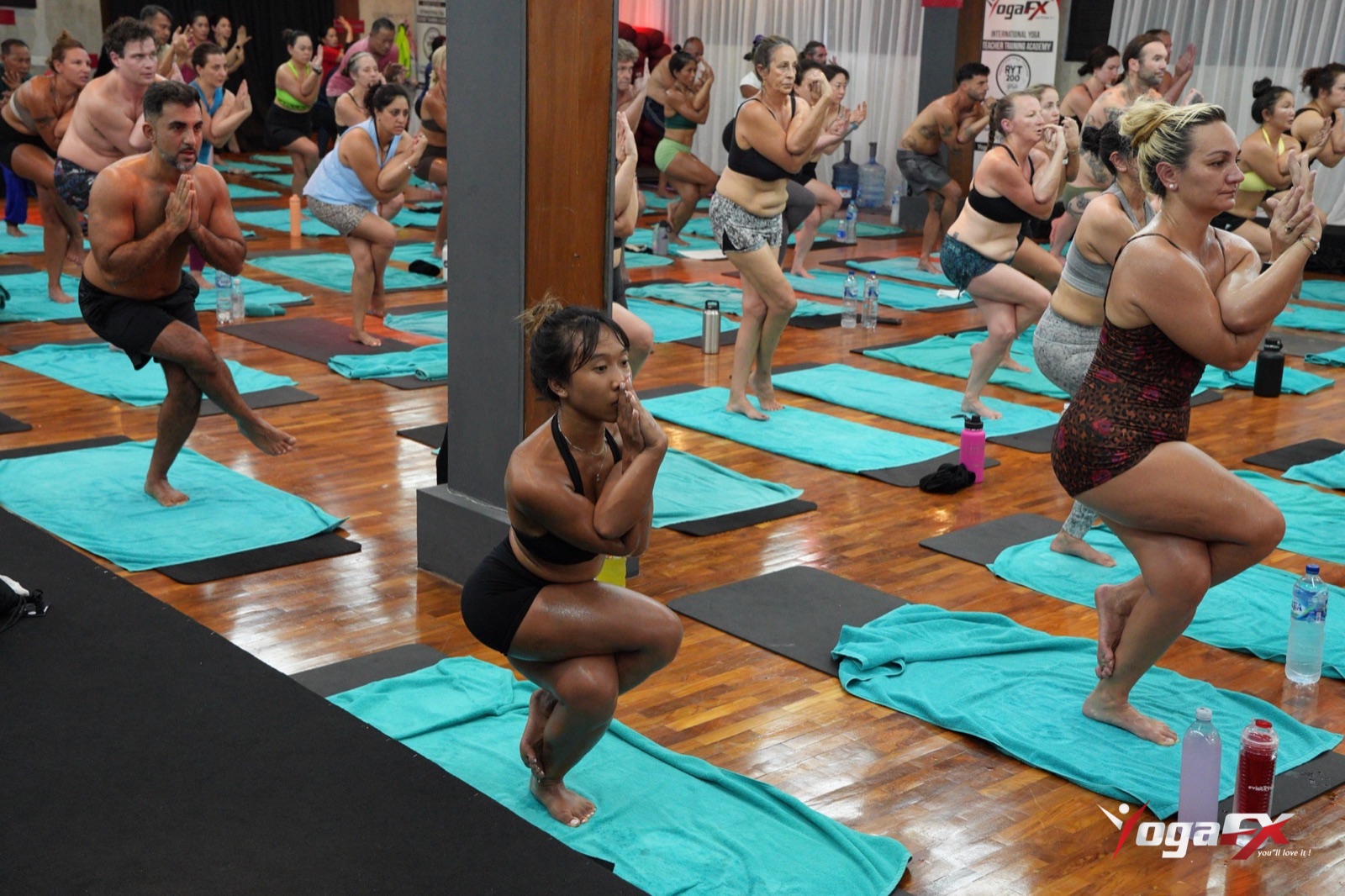
At YogaFX, classes use natural tropical heat in Bali, not electric heaters. The studio runs at about 40°C and 40% humidity for a 90-minute class, and the schedule runs 06:00 to 22:00 every day at both the Seminyak and Canggu locations. If you want a deeper look at how that environment works, read our guide to the Bikram hot yoga room and its temperature.
What YogaFX Students Say
These are real reviews from people who trained with Mr. Ian. They are about the teacher training, not the heat question, but they show what the teaching floor is like.
"The Teacher Training totally exceeded my expectations. The best choice I've made in a long time."
Mariana, Google review, 2022
"The great professionalism and human skills of our instructor Mr Ian made everything so simple and fun."
Mario, Google review, 2022
"Thank you so much for creating this space for us to grow."
Samantha, YouTube review, 2019
How to Test Hot vs Regular Yoga Yourself
The best answer to hot yoga vs regular yoga is your own. Run a fair test over a few weeks so heat is the only thing that changes.
- Pick one hot class and one regular class with similar length and level.
- Book each at least three times, because the first class is always the hardest.
- Note how you feel the next morning: stiffness, sleep, energy and mood.
- Track one number, such as how far you can reach or hold a balance.
- Keep the one you look forward to, and add the other when you want variety.
Drink water through the day, not only before class. Eat a light meal two to three hours before a hot session. Pack a large towel and a water bottle. If you feel faint, nauseated or confused, stop and rest in a cooler spot.

From Student to Teacher: Where to Go Next
If hot yoga becomes your daily practice, you may start thinking about teaching it. The YogaFX Bikram Hot 26&2 Yoga Teacher Training MasterClass is a six-day hybrid course: online pre-course study plus an intensive in Bali. Graduates earn Yoga Alliance RYT 200 and the Bikram Hot 26&2 200-Hour International Yoga Certification.
The next batch checks in on Sunday 24 January 2027 and checks out on Friday 29 January 2027. Read the dates, formats and what the week looks like in our full 2026-2027 Bikram yoga teacher training guide.
FAQ
Is hot yoga better than regular yoga?
Not for most goals. In the controlled studies, hot and room-temperature classes gave similar calorie burn, heart-health gains and stress scores. Heat added a little hip flexibility and some cellular markers. The better class is the one you will attend three times a week, so choose by comfort, schedule and teacher.
Does hot yoga burn more calories than regular yoga?
No, not by the study evidence. A 2020 lab trial found 151 calories in a hot hour and 156 in a room-temperature hour. Sweating more loses water, not extra fat. Class length, pace and your body size set calorie burn far more than the thermostat does.
Is hot yoga harder than regular yoga?
It feels harder, but the lab data says the work is not larger. Energy cost matched room-temperature yoga in the 2020 trial. The heat adds strain on your cooling system, so you tire sooner and your heart rate can run higher. Build up slowly and drink water before class.
What is the difference between regular yoga and hot yoga?
The room. Regular yoga runs at ordinary room temperature, while a Bikram-style hot class is held around 40°C and 40% humidity for 90 minutes. Both terms cover many styles, so the sequence, pace and teaching method matter as much as the temperature does.
Is hot yoga or regular yoga better for weight loss?
Neither wins on its own. One hour of Bikram-style yoga cost about 150 calories in the lab, which is too low to drive weight loss alone. Either style helps when you practise often and pair it with sensible eating and other activity. Consistency beats temperature.
Still have questions? Message Mr. Ian and the YogaFX team on WhatsApp and we will answer them personally. This article is for information only and is not medical advice, so consult a healthcare professional before starting any heated exercise, especially if you have a heart condition or are pregnant.