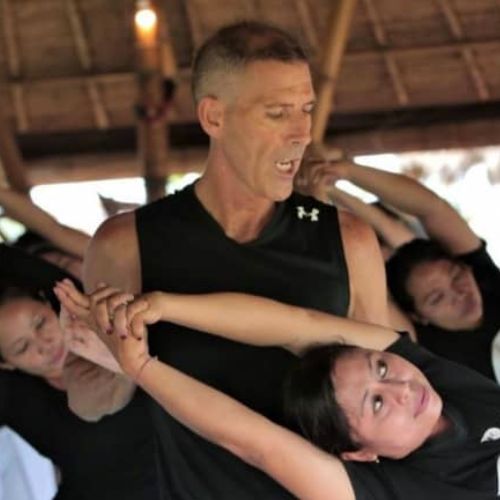
Bikram Yoga vs Pilates attract similar audiences. Both appeal to practitioners who want a structured, disciplined practice with measurable outcomes. Both develop core strength, body awareness, and flexibility. Both are practiced by people who take their physical training seriously.

The differences between them are specific and consequential. Understanding which practice is better for which goal - weight loss, core depth, back pain relief, body shape, or beginner accessibility - requires a comparison that goes deeper than the surface-level distinctions most articles provide.
Bikram yoga is a 90-minute fixed sequence of 26 postures at 40 degrees Celsius, producing 333 to 460 kcal calorie burn per session (University of Wisconsin 2014), 20 percent strength increase in 8 weeks, and significant cardiovascular conditioning. Pilates is a controlled movement system targeting the core through precise, low-impact exercises at room temperature.
Bikram wins on calorie burn, cardiovascular conditioning, heat-enhanced flexibility, and documented mental health outcomes. Pilates wins on deep core isolation, injury rehabilitation, and accessibility for people with specific movement limitations. Both are effective. The right choice depends on your primary goal.
What Each Practice Is
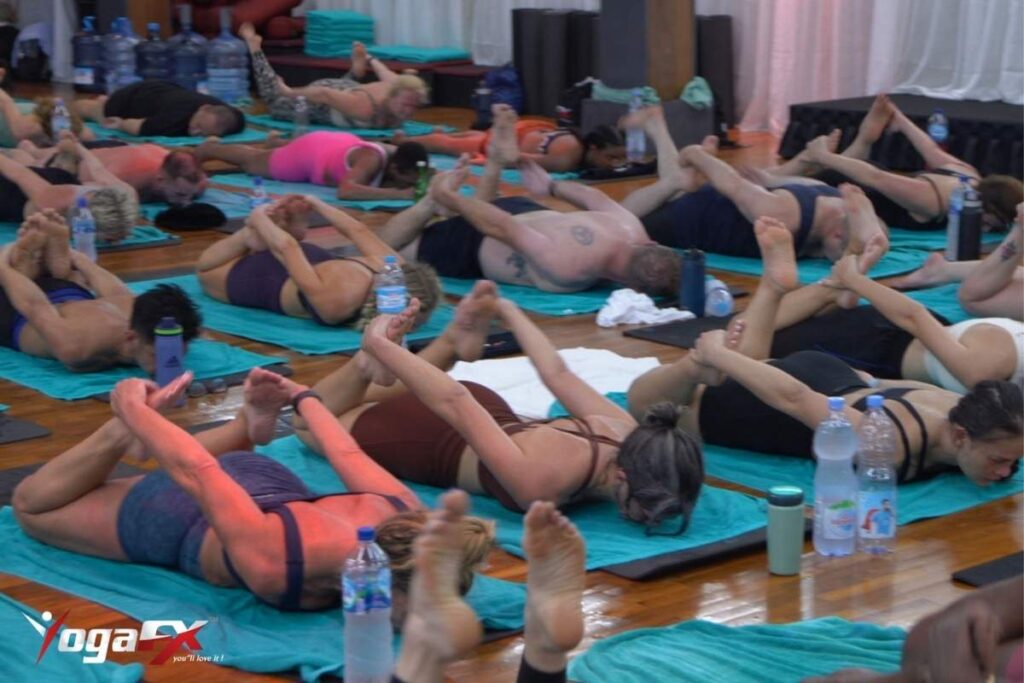
Bikram Yoga (26 and 2)
Bikram yoga is a fixed sequence of 26 postures and 2 breathing exercises practiced in a room heated to 40 degrees Celsius with 40 percent relative humidity for 90 minutes. The sequence never changes. Every class everywhere teaches the same postures in the same order.
The instructor delivers a scripted verbal dialogue. The heat is a functional component of the method, not a stylistic choice: it reduces muscle viscosity, increases connective tissue extensibility, and creates a cardiovascular thermoregulatory demand that produces documented health outcomes.
At YogaFX Bali, the heat is provided by Bali's natural tropical climate without electric heaters at both the Seminyak and Canggu studios - the original humid-heat environment the sequence was designed for.
Pilates
Pilates is a movement system developed by Joseph Pilates in the early 20th century, originally designed as rehabilitation training for injured dancers and athletes. The method emphasises precise, controlled movements that target deep core muscles including the transverse abdominus, multifidus, and pelvic floor - the stabilising muscles that most other exercise systems do not isolate effectively.
Pilates is practiced either on a mat (mat Pilates) or using a reformer machine that provides resistance through springs. It is generally room-temperature, low-impact, and lower cardiovascular intensity than Bikram yoga. The precision of movement required in Pilates is high - small deviations from correct form significantly reduce the effectiveness of the exercises.
Head-to-Head Comparison
| Dimension | Bikram Yoga (26 and 2) | Pilates |
|---|---|---|
| Temperature | 40°C, 40% humidity - mandatory | Room temperature |
| Duration | 90 minutes fixed | 45 to 60 minutes typically |
| Calorie burn (60 min, 70kg) | Approximately 276 kcal (moderate) | 175 to 254 kcal (mat), 250 to 360 kcal (reformer) |
| Cardiovascular demand | 80% max heart rate sustained (UW 2014) | Low to moderate - not primarily cardiovascular |
| Core strength | Significant - standing series and balance demands | Superior - deep core isolation is the defining feature |
| Flexibility | Accelerated by heat - faster gains than room temperature | Moderate - improves with practice but no heat advantage |
| Spinal health | Systematic: all planes of movement every class | Strong - spine articulation is central to the method |
| Injury rehabilitation | Moderate - contraindicated for acute injuries | High - originally designed as rehabilitation system |
| Beginner accessibility | High - verbal dialogue, no prior knowledge needed | High - low-impact, adaptable to limitations |
| Research base | 3 major peer-reviewed studies with direct measurement | Methodologically weaker research base overall |
| Mental health (documented) | Harvard MGH 2023 RCT: 59% cut depression symptoms by half or more, versus 6% on the waitlist | Some stress reduction research - less rigorous design |
Calorie Burn and Weight Loss
For weight loss specifically, Bikram yoga has a clear advantage in documented calorie burn. The University of Wisconsin 2014 study (Porcari et al., PubMed: 24700459) directly measured metabolic expenditure during actual Bikram classes: 333 kcal for women (average 68kg) and 460 kcal for men (average 82kg) per 90-minute session, with heart rate averaging 80 percent of maximum throughout.
Pilates calorie burn is lower per session. Mat Pilates typically produces 175 to 254 kcal per 60-minute session for a 70kg practitioner. Reformer Pilates produces more - estimated at 250 to 360 kcal per session - because the resistance loading is greater. Neither format produces a cardiovascular demand comparable to Bikram yoga.
The Tracy and Hart (2013) study (PubMed: 23438366) documented that 8 weeks of Bikram yoga at 3 to 4 sessions per week produced significant body fat reduction alongside a 20 percent lean muscle increase. The lean muscle gained increases resting metabolic rate, producing calorie burning between sessions rather than only during them. Pilates also builds lean muscle - particularly in the deep core - but the total muscle mass developed is lower than from the Bikram standing series.
| Weight Loss Metric | Bikram Yoga | Pilates |
|---|---|---|
| Calorie burn per 90-min session | 333 to 460 kcal (direct measurement) | Estimated 260 to 540 kcal depending on format and intensity |
| Cardiovascular demand | 80% max HR throughout | Low to moderate |
| Body fat reduction (8 weeks) | Documented - Tracy and Hart 2013 | Possible - less rigorous research |
| Lean muscle gain | 20% strength increase - Tracy and Hart 2013 | Core and stabiliser development, smaller total mass |
| Resting metabolic rate effect | Increased from lean muscle gain | Modest increase from deep core development |
| Weight loss verdict | Stronger documented outcome | Supportive but lower total calorie expenditure |
Core Strength
Pilates is the superior practice for deep core development. This is not a close comparison. The Pilates method was specifically designed to isolate and strengthen the deep stabilising muscles of the trunk - the transverse abdominus, multifidus, internal obliques, and pelvic floor - that most other exercise systems fail to target specifically.
Bikram yoga develops significant core strength through the standing balance series: the abdominal engagement required to hold Standing Head to Knee, the core demand of Balancing Stick, and the sustained isometric core engagement of the entire standing series. This core development is real and functional. It is not the deep stabiliser isolation that Pilates produces.
For practitioners with core weakness as a primary concern, for those recovering from core-related injuries, or for those who need pelvic floor rehabilitation: Pilates provides what Bikram yoga does not. For practitioners who want general core strength alongside comprehensive cardiovascular conditioning, flexibility, and full-body strength: Bikram yoga provides the more complete stimulus.
Back Pain and Spinal Health
Both practices address back pain but through different mechanisms. Understanding the distinction helps practitioners choose the right one for their specific spinal issue.
Pilates for Back Pain
Pilates was originally developed for rehabilitation, and spinal rehabilitation specifically remains one of its strongest applications. The deep core muscles that Pilates targets - transverse abdominus and multifidus - are the primary stabilisers of the lumbar spine. Weakness in these muscles is a documented contributor to chronic lower back pain. Building these muscles through Pilates directly addresses the mechanical cause of most non-specific lower back pain. Pilates is also low-impact, which makes it appropriate for practitioners who cannot tolerate the cardiovascular and thermoregulatory demands of Bikram yoga during acute or subacute back pain episodes.
Bikram Yoga for Back Pain
Bikram yoga addresses back pain through spinal mobility rather than deep stabiliser strength. The sequence works every plane of spinal movement in every class: lateral flexion (Half Moon), forward flexion (Hands to Feet), extension (Cobra, Camel), rotation (Spine Twist), and traction (Half Tortoise, Rabbit). This comprehensive spinal mobility conditioning is not available in any single other practice format.
The heat of the Bikram environment increases spinal disc hydration and reduces the muscle spasm contribution to back pain by relaxing the paraspinal musculature before any spinal movement is performed. This means the spinal mobility work in Bikram yoga is performed in a more favourable mechanical environment than the same movements at room temperature. Half Tortoise specifically provides maximum lumbar traction - the most direct lumbar decompression available in any yoga format.
For practitioners with chronic back pain from poor posture, sedentary lifestyle, or accumulated compression: Bikram's systematic spinal decompression and mobility work addresses the restriction that drives the pain. For practitioners with acute disc issues, spinal stenosis, or post-surgical rehabilitation: Pilates is safer and more appropriate.
Body Shape and Flexibility
Which Changes Body Shape More?
Both practices change body shape but through different mechanisms. Bikram yoga changes body shape primarily through fat reduction (documented calorie burn creating caloric deficit) and lean muscle development through the standing series (20 percent strength increase). The body shape changes from consistent Bikram practice are leaner overall with stronger lower body and core.
Pilates changes body shape primarily through deep core development, postural improvement, and the lengthening effect of controlled eccentric muscle contractions. The characteristic Pilates body shape change is improved posture, a longer appearance from better spinal alignment, and deep core definition that is different from the surface muscle development of other exercise systems. The two changes are complementary: Bikram's fat reduction and lower body strength alongside Pilates' deep core definition produces a more comprehensive body composition change than either alone.
Flexibility
Bikram yoga produces faster flexibility gains than Pilates for most practitioners. The heat-enhanced connective tissue extensibility of the 40-degree environment reduces collagen viscosity and allows ranges of motion at heat that room-temperature practice cannot achieve at the same rate. The Tracy and Hart (2013) study documented significant lower back and hamstring flexibility gains after 8 weeks of Bikram practice.
Pilates improves flexibility through controlled eccentric loading and active lengthening of muscles. The gains are real but slower-developing than in the Bikram environment, because room temperature connective tissue requires more sustained loading to produce the same extensibility changes.
Hot Yoga vs Hot Pilates
An increasingly available comparison in major cities is hot yoga versus hot mat Pilates - both practiced in heated studios. Hot Pilates studios typically heat their rooms to 32 to 38 degrees Celsius, not the Bikram specification of 40 degrees Celsius with 40 percent humidity. The heat in hot Pilates increases sweat output and makes muscles more pliable, but the Pilates movement system does not require heat to be effective and was not designed for a heated environment. The heat is an addition, not a functional component.
Bikram yoga's heat is functional: the temperature and humidity specifications are specifically calibrated to the physiological demands of the 26-posture sequence. The University of Wisconsin research, the Tracy and Hart study, and the Harvard depression RCT were all conducted at Bikram-specific conditions. The documented outcomes are specific to those conditions.
For practitioners choosing between the two formats in a heated context: Bikram yoga has the documented research base, the specific temperature rationale, and the original humid-heat environment at YogaFX Bali that hot Pilates does not replicate.
Mental Health
The Harvard MGH 2023 randomised controlled trial (Nyer et al., PubMed: 37883245) is the most significant mental health study conducted on any yoga format. In 80 adults with moderate to severe depression, 59% of participants cut their depression symptoms by half or more after 8 weeks of heated yoga, versus 6% on the waitlist.
No equivalent randomised controlled trial exists for Pilates and depression. Pilates research on stress reduction and anxiety shows positive results but uses observational designs and self-report measures rather than the rigorous RCT design of the Harvard study. For practitioners whose primary wellness concern includes mental health, mood, or stress management: Bikram yoga has the more rigorous documented evidence base.
For Beginners
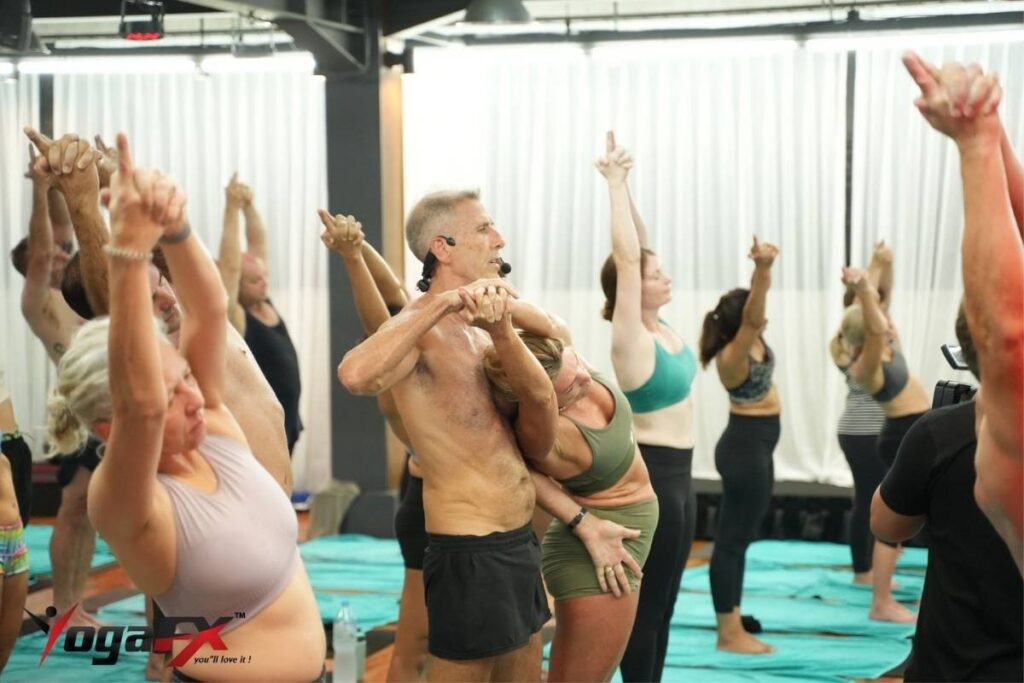
Both practices are genuinely accessible for beginners, for different reasons. Bikram yoga is accessible because the scripted verbal dialogue provides complete instruction for every posture - a complete beginner can attend their first class with no prior knowledge and follow the instruction throughout. The fixed sequence means every class is the same, so there is no new material to catch up to. The primary beginner challenge is heat adaptation in the first 5 to 10 sessions, not the postures themselves.
Pilates is accessible because it is low-impact, adaptable to current limitations, and does not produce the thermoregulatory stress of a 40-degree room. For beginners with existing injuries, mobility limitations, or cardiovascular concerns: Pilates is the more immediately appropriate starting point. The precision of form required in Pilates means that a good teacher is more important for beginners than in Bikram, where the dialogue guides form.
Decision Framework: Which One for Which Goal
| Your Primary Goal | Better Choice | Reason |
|---|---|---|
| Weight loss and calorie burn | Bikram yoga | 333 to 460 kcal per session documented, 80% max HR, 20% strength increase |
| Deep core isolation and pelvic floor | Pilates | Specifically designed to isolate transverse abdominus and deep stabilisers |
| Flexibility gains fastest | Bikram yoga | Heat-enhanced connective tissue extensibility accelerates gains beyond room temperature |
| Back pain - chronic compression and mobility | Bikram yoga | Systematic spinal decompression and all-plane mobility in every class |
| Back pain - acute, rehabilitation, post-surgical | Pilates | Low-impact, adaptable, original rehabilitation application |
| Cardiovascular conditioning | Bikram yoga | No comparison - Pilates is not primarily cardiovascular |
| Postural improvement | Pilates (slight edge) | Deep stabiliser development directly addresses postural muscle weakness |
| Mental health and depression | Bikram yoga | Harvard MGH 2023 RCT - no equivalent Pilates study exists |
| Injury rehabilitation | Pilates | Specifically designed for this. Bikram contraindicated for acute injuries. |
| Comprehensive body conditioning | Combine both | Bikram for cardiovascular, flexibility, lower body; Pilates for deep core isolation |
Combining Bikram Yoga and Pilates
The two practices are highly compatible and address different aspects of physical conditioning that the other does not fully cover. Many practitioners who practice both consistently describe the combination as producing better overall results than either alone.
Bikram yoga provides what Pilates does not: cardiovascular conditioning at 80 percent of maximum heart rate, heat-enhanced flexibility gains, comprehensive spinal mobility in all planes, documented mental health benefits from the whole-body hyperthermia mechanism, and full-body strength from the standing series. Pilates provides what Bikram yoga does not: deep transverse abdominus isolation, pelvic floor activation, injury rehabilitation application, and the slow precision movement work that develops movement quality in ways that the 10-second Bikram hold format does not.
A practical combination schedule: Bikram yoga 3 times per week for primary conditioning, Pilates once or twice per week for deep core and postural work. Allow rest days between sessions. Most practitioners who try this combination for 8 weeks report that their Bikram postures improve measurably from the improved core stability, and their Pilates control improves from the flexibility gains of the heat practice.
FAQ
Is hot yoga better than Pilates?
For cardiovascular conditioning and calorie burn: yes, by a significant margin. For deep core isolation and injury rehabilitation: Pilates is better. For overall flexibility gains: Bikram yoga is faster due to heat-enhanced connective tissue extensibility. For documented mental health outcomes: Bikram yoga has the Harvard MGH 2023 RCT which Pilates lacks. Neither is universally better - the right choice depends on your primary goal.
Which is better for weight loss, yoga or Pilates?
Bikram yoga produces more calorie burn per session (333 to 460 kcal per 90 minutes from direct measurement versus approximately 175 to 360 kcal for Pilates depending on format). Bikram also produces documented lean muscle gain that increases resting metabolic rate. For weight loss specifically, Bikram yoga has the stronger documented evidence base. Both practices contribute to weight loss as part of a consistent exercise programme.
Is Pilates good for spine issues?
Yes, particularly for non-specific lower back pain caused by weak deep core stabilisers. Pilates specifically targets the transverse abdominus and multifidus, the two primary muscles responsible for lumbar spine stability. Building these muscles through Pilates addresses the mechanical cause of most chronic lower back pain. For acute disc injuries, spinal stenosis, or post-surgical rehabilitation: consult a physiotherapist or physician before starting either practice.
Does Pilates or yoga change body shape more?
Different changes rather than more or less. Bikram yoga changes body shape through documented fat reduction and lean muscle development in the lower body and core, producing a leaner overall appearance. Pilates changes body shape through deep core development and postural improvement, producing improved alignment and definition in the stabilising muscles. Both changes are real. Combining both produces a more comprehensive body shape change than either alone.
Can I do Bikram yoga and Pilates in the same week?
Yes. The two practices are highly compatible and do not duplicate each other's stimulus. A practical schedule: Bikram yoga 3 times per week for cardiovascular conditioning, flexibility, and strength; Pilates once or twice per week for deep core and postural work. Most practitioners find their performance in both practices improves when they combine them - the flexibility from Bikram enhances Pilates range of motion and the core stability from Pilates improves Bikram balance posture quality.
Which is harder, Bikram yoga or Pilates?
Bikram yoga is harder cardiovascularly and thermally - the heat and 80 percent of maximum heart rate throughout a 90-minute session is genuinely demanding. Pilates is harder in terms of neuromuscular precision - the level of conscious control and deep muscle activation required is greater than in the Bikram standing series. They are hard in different ways. Most practitioners who try both describe Bikram yoga as harder on their first session; after heat adaptation, the difficulty in Bikram is posture-specific while Pilates remains consistently precise.