Bikram Yoga vs Power Yoga is not a standardised practice. This is the most important thing to understand before comparing it to Bikram yoga. "Power yoga" describes an athletic, intensity-focused style of yoga typically Vinyasa-based with challenging sequences, often (but not always) heated but the exact postures, sequence, temperature, and instruction method vary entirely by studio and instructor. Two power yoga classes at different studios may have almost nothing in common.

Bikram yoga is a standardised practice. The 26 postures, the 2 breathing exercises, the fixed sequence, the 40-degree Celsius temperature with 40 percent humidity, the 90-minute duration, and the scripted verbal dialogue are identical in every authentic Bikram class globally. This fundamental difference in standardisation shapes every other aspect of the comparison.
Bikram yoga is a fixed, researched, heat-specific practice: 26 postures in the same sequence at 40 degrees Celsius for 90 minutes, with three peer-reviewed studies documenting specific outcomes. Power yoga is an umbrella term for athletic, intensity-focused yoga typically dynamic flow with instructor-designed sequences, variable heat, and upper-body-demanding push patterns.
Bikram wins on documented outcomes, heat-enhanced flexibility, lower body strength, progress tracking, and teacher training speed. Power yoga wins on upper body strength, class variety, and accessible cost. The best approach combines both.
What Is Power Yoga?
Power yoga emerged in the 1990s as an Americanised, fitness-focused version of Ashtanga yoga. The two instructors most credited with its development Bryan Kest on the West Coast and Beryl Bender Birch on the East Coast independently developed athletic yoga formats that emphasised physical challenge over spiritual practice.
In 2026, "power yoga" has evolved to mean almost any athletic, dynamic yoga class. Common characteristics: dynamic flow with postures linked by breath-driven movement and often including chaturanga (low push-up) transitions; instructor-designed sequences with no fixed format; upper body emphasis from push and pull patterns; often heated to 32 to 38 degrees Celsius (though room temperature is also common); and variable duration of 45 to 75 minutes.
The absence of standardisation is the defining characteristic. A "power yoga" label guarantees athletic intensity but not any specific postures, sequence, temperature, or instructional approach.
Side-by-Side Bikram Yoga vs Power Yoga Comparison
| Feature | Bikram Yoga (26 and 2) | Power Yoga |
|---|---|---|
| Sequence | Fixed: 26 postures identical globally | Variable: instructor-designed every class |
| Temperature | 40°C, 40% humidity specified | Variable: room temp to 38°C, humidity uncontrolled |
| Duration | 90 minutes fixed | 45 to 75 minutes typically |
| Movement style | Static holds: 10 to 20 seconds per posture | Dynamic flow: continuous breath-linked movement |
| Upper body strength | Limited, no push/pull patterns | High, chaturanga transitions load chest, shoulders, triceps |
| Lower body strength | High, Awkward Pose series, standing balance | Moderate, from flow transitions and standing sequences |
| Posterior chain | High, prone floor series specifically targets this | Moderate, depends on sequence choice |
| Cardiovascular demand | 80 percent max HR sustained throughout (UW 2014) | Variable, depends on pace and class intensity |
| Calorie burn (90 min) | 333 to 460 kcal, direct measurement (UW 2014) | Estimated 350 to 500 kcal, no equivalent direct study |
| Progress tracking | Direct, same sequence every class, measurable | Difficult, variable sequence prevents direct comparison |
| Research base | 3 major peer-reviewed studies | No equivalent specific research |
| Beginner accessibility | High, verbal dialogue, no prior knowledge needed | Variable, depends heavily on instructor pace and style |
| Cost (typical) | USD 25 to 45 per class | USD 20 to 40 per class, often slightly lower |
| Music | No music, silence except verbal dialogue | Usually music, instructor's choice |
| Teacher training speed | Teachable from certification day one, scripted dialogue | Sequencing skill develops over 1 to 2 years of teaching |
The Heat Question: Does Power Yoga Compare?
Many power yoga studios market themselves as "hot power yoga" or "heated power yoga." This creates an apparent overlap with Bikram yoga that is worth examining closely.
The Bikram temperature specification is 40 degrees Celsius with 40 percent relative humidity. This humidity level is functional, it slows sweat evaporation, maintains sustained deep tissue thermal penetration, and produces the connective tissue extensibility changes that the Tracy and Hart (2013) research documented.
Hot power yoga studios typically heat their rooms to 32 to 38 degrees Celsius with humidity at 15 to 25 percent dry electric heat. The research outcomes documented for Bikram yoga (strength gains, flexibility improvements, cardiovascular data, the Harvard 2023 depression RCT) were collected under the full Bikram specification. Applying those outcomes to hot power yoga at lower temperatures and humidity is extrapolation, not measurement.
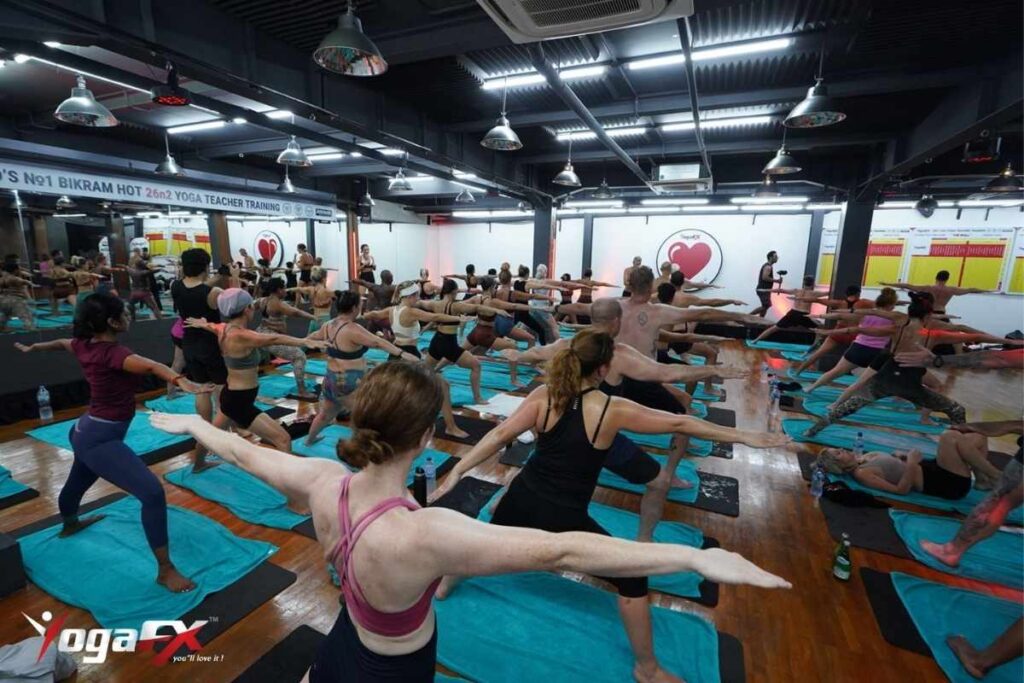
At YogaFX Bali, natural tropical heat provides 40 degrees Celsius with ambient humidity above 70 percent without electric heaters. This is the original humid-heat environment the Bikram sequence was designed for producing the full documented outcomes that neither dry electric Bikram studios nor hot power yoga studios fully replicate.
Which Is Harder: Bikram or Power Yoga?
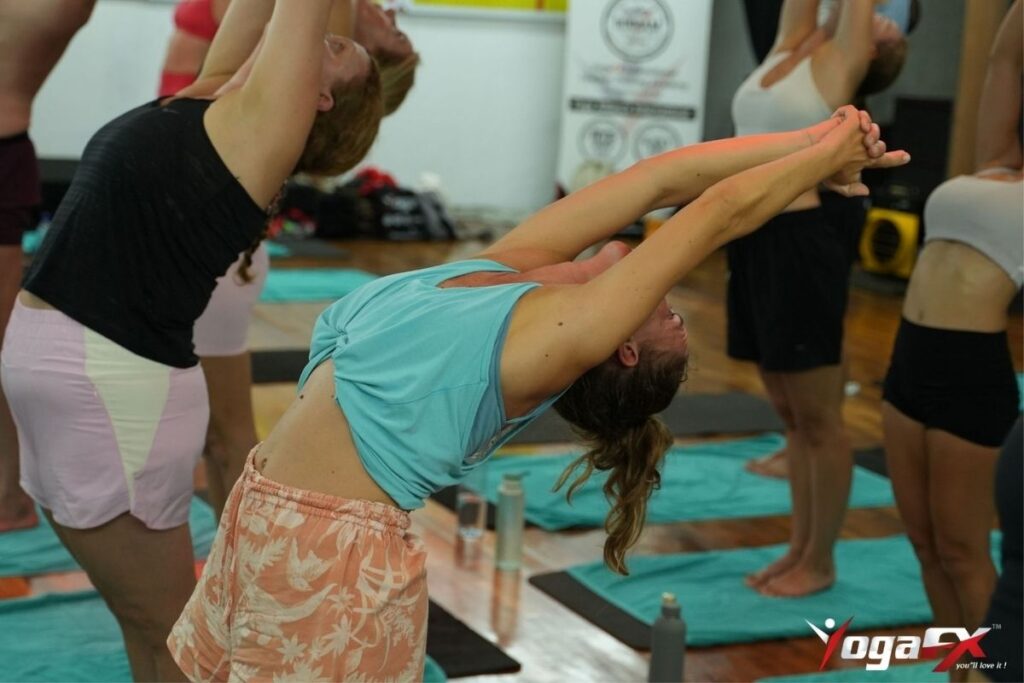
Bikram yoga is harder thermally. The full 40-degree Celsius with 40 percent humidity specification sustained for 90 minutes produces a thermoregulatory challenge that no amount of athletic fitness prepares a new practitioner for. Experienced marathon runners, CrossFit athletes, and professional footballers routinely find their first Bikram class significantly harder than expected. Heat tolerance is a specific physiological adaptation that develops independently of cardiovascular fitness.
Power yoga is harder athletically for practitioners who have already heat-adapted to Bikram. The chaturanga transitions of power yoga require upper body pushing strength that the Bikram sequence does not develop. Advanced power yoga arm balances and inversions require strength-to-weight ratio and body control that the Bikram standing balance series does not specifically train.
For a new practitioner with no background in either: Bikram is harder in the first 10 sessions because of heat adaptation. After heat adaptation completes (sessions 5 to 10), a challenging power yoga class and a Bikram class are comparable in total physical demand, through different mechanisms.
For Weight Loss: Which Is More Effective?
- Bikram yoga: 333 kcal for women (average 68kg) and 460 kcal for men (average 82kg) per 90-minute session, directly measured via indirect calorimetry by the University of Wisconsin 2014 study (PubMed: 24700459)
- Power yoga: estimated 350 to 500 kcal per 60 to 75 minutes for an active class, no direct measurement study exists at the same methodological quality
The calorie data is broadly comparable per session. Bikram additionally produces documented lean muscle gain from the posterior chain loading of the floor series (Tracy and Hart 2013, PubMed: 23438366) lean muscle increases resting metabolic rate for between-session calorie burning. Power yoga produces upper body lean muscle from chaturanga loading, with a different metabolic rate effect on different muscle groups.
For weight loss specifically: the practice you will attend most consistently is the more effective one. For practitioners who find the fixed Bikram sequence more sustainable, Bikram is more effective. For practitioners who need variety to maintain motivation, power yoga is more effective.
The Research Gap: Why Bikram Has an Advantage
Power yoga has no dedicated peer-reviewed research base comparable to Bikram's three major studies. This is not because power yoga is ineffective, it is because the variability of power yoga makes controlled research extremely difficult. You cannot replicate a "power yoga" intervention across two groups because no two power yoga classes are the same.
Bikram's fixed sequence and standardised conditions make it one of the most researchable yoga formats. The Harvard MGH 2023 randomised controlled trial (Nyer et al., PubMed: 37883245) is the most significant mental health study ever conducted on any yoga format, specifically because Bikram's standardisation made a rigorous RCT design possible.
When a studio's marketing uses Bikram research data to support their hot power yoga claims, they are applying research conducted under different conditions to a different format. The documented outcomes belong to the Bikram format specifically.
Teacher Training: The Career Difference
| Dimension | Bikram Teaching | Power Yoga Teaching |
|---|---|---|
| Core skill | Scripted dialogue mastery, 45 min of memorised verbal instruction | Creative sequencing, designing new class content, often spontaneously |
| Ready to teach day one? | Yes, dialogue provides complete instructional framework | Partial, effective sequencing develops over 1 to 2 years |
| Training required | RYT 200 plus Bikram/26 and 2 style certification and dialogue coaching | RYT 200, some studios require additional power yoga modules |
| Salary positioning | Hot yoga specialist: 15 to 25% premium over general RYT 200 rates | General RYT 200 rates at most studios |
Who Should Choose Bikram?
- You want documented, research-backed outcomes validated by peer-reviewed studies
- You want to measure progress directly, the fixed sequence makes improvement observable session to session
- You are a complete beginner who wants complete verbal instruction without needing prior knowledge
- You want heat-enhanced flexibility gains at a rate that room-temperature practice cannot match
- You are considering teacher training and want to teach a complete 90-minute class from your first certified session
- You want the mental health benefits documented in the Harvard 2023 RCT, whole-body hyperthermia requires the full thermal specification that Bikram specifically provides
Who Should Choose Power Yoga?
- Upper body strength development is a primary goal chaturanga transitions develop chest, shoulder, and tricep musculature that Bikram does not
- You need variety to sustain motivation the changing sequence of power yoga provides fresh content every class
- You prefer a social, energetic class environment with music most Bikram classes are practiced in silence
- Cost is a primary constraint power yoga classes are often somewhat less expensive than dedicated Bikram studios
- You want to explore arm balances and inversions power yoga classes regularly include these; Bikram does not
Combining Both: The Most Comprehensive Approach
Bikram Yoga vs Power Yoga are physiologically complementary. They develop different capacities with minimal overlap.
Bikram provides: heat-enhanced flexibility, posterior chain strength, documented cardiovascular conditioning, joint lubrication across 14 major joints simultaneously, systematic all-plane spinal mobility, and the documented mental health effects of whole-body hyperthermia. Power yoga provides: upper body pushing and pulling strength from chaturanga patterns, arm balance and inversion skill, variety and creative expression, and a different form of cardiovascular challenge from high-paced dynamic flow.
Practical combination: Bikram yoga 3 times per week for the documented health outcomes and posterior chain development; power yoga once per week for upper body strength and variety. This schedule produces more comprehensive body conditioning than either practice alone and aligns with the research-validated Bikram frequency (Tracy and Hart 2013 used 3 to 4 sessions per week).
FAQ
What is the difference between Bikram yoga and Power yoga?
Bikram yoga is a fixed 26-posture sequence practiced at 40 degrees Celsius with 40 percent humidity for 90 minutes, taught through a scripted verbal dialogue. Power yoga is an umbrella term for athletic, dynamic yoga typically instructor-designed, varying by class, often heated but without a specific temperature requirement. Bikram is standardised and researched; power yoga is variable and unstandardised. The two develop different physical capacities: Bikram builds posterior chain strength and heat-enhanced flexibility; power yoga builds upper body pushing strength through chaturanga transitions.
Which is harder, Bikram or Power yoga?
Different kinds of harder. Bikram is harder thermally 40 degrees Celsius with 40 percent humidity for 90 minutes challenges the thermoregulatory system in ways that no amount of athletic fitness prepares you for. New practitioners with high fitness levels routinely find their first Bikram class harder than expected.
Power yoga is harder athletically for practitioners who have heat-adapted the upper body demands of chaturanga transitions and arm balance sequences require specific strength that Bikram does not develop. After heat adaptation (sessions 5 to 10), both practices produce comparable total physical challenge through different mechanisms.
Is Bikram yoga or Power yoga better for weight loss?
Comparable calorie burn per session. Bikram: 333 to 460 kcal per 90 minutes, directly measured (UW 2014). Power yoga: estimated 350 to 500 kcal per active session, without equivalent direct measurement. Bikram additionally produces documented posterior chain lean muscle gain that elevates resting metabolic rate. For weight loss, the practice you will attend most consistently is more effective than the practice with marginally higher calorie burn.
Can I do both Bikram and Power yoga?
Yes, and the combination produces more comprehensive results than either alone. Bikram covers posterior chain strength, heat-enhanced flexibility, documented cardiovascular conditioning, and mental health. Power yoga covers upper body strength and variety. Schedule Bikram on Monday, Wednesday, Friday; power yoga on Tuesday or Thursday. Allow one rest day per week. The flexibility gains from Bikram improve power yoga range of motion; the upper body stability from power yoga improves Bikram balance posture quality.
Is Power yoga the same as hot yoga?
Not necessarily. Power yoga can be practiced at room temperature or in a heated studio. Hot power yoga uses a heated room, typically 32 to 38 degrees Celsius, but without the specific temperature and humidity specification of Bikram yoga. Some studios use "hot power yoga" and "Bikram yoga" almost interchangeably in marketing, which is inaccurate Bikram yoga has a fixed sequence and specific environmental conditions that heated power yoga does not replicate.
Which is more beginner-friendly, Bikram or Power yoga?
Bikram is more beginner-friendly from an instructional standpoint. The scripted verbal dialogue provides complete instruction for every posture no prior knowledge required. The fixed sequence means the class never changes, so there is no new content to catch up to each session. The heat is more challenging for beginners than power yoga. Power yoga's difficulty for beginners depends entirely on the instructor's pacing and class level some beginner power yoga classes are very accessible; others are not. A mismatch in power yoga class level can leave a beginner confused in ways that Bikram's consistent instruction prevents.