






The best-supported heat therapy benefits come from observational sauna studies, mainly a link with heart outcomes, while evidence for yoga is thinner. A Bikram hot room adds movement to heat, so it sits between passive sauna and exercise. Here is where it fits, and where the evidence stops.

I am writing this from the teaching side. Mr. Ian Terry, our Founder and Lead Instructor (E-RYT 500, 12,000+ teaching hours), has run hot rooms for years. He often tells trainees to separate what heat does from what the postures do. This guide follows that rule, so every claim below is tied to a source or marked as unproven.
Medical note: this article is education, not medical advice. Heat is a real physical stress. Please consult a healthcare professional before using any heat practice if you have a heart, blood pressure or kidney condition, or if you are pregnant.
What Heat Therapy Benefits Actually Mean
The benefits of heat exposure depend on how the heat is delivered, so it helps to define terms first. Heat therapy is the planned use of warmth to change how the body feels or functions. It covers hot packs on a sore back, a soak in a hot bath, a visit to a sauna and a class in a heated room. The common thread is that core and skin temperature rise for a set period.
People search for heat therapy benefits for very different reasons. Some want pain relief. Others want a recovery habit after training, or a way to unwind. Each goal needs a different type of heat, and that is why a single "heat is good for you" claim never holds up.
- Local heat (a hot pack or heat wrap) warms one area and is mostly used for muscle and joint comfort.
- Whole-body passive heat (sauna, hot bath) raises body temperature while you sit still.
- Active heat (exercise in a warm room) raises temperature because you move, sweat and work your heart.
The third group is where a Bikram class lives. In practice, active heat is harder to study. You cannot easily tell whether a result came from the warmth or from the effort. That caveat appears again below, because the reviewers themselves raise it.
Heat Therapy Benefits According to Research
The most useful recent overview is a 2026 narrative review in Comprehensive Physiology, written by researchers at the University of Oregon and colleagues. It looks at sauna, hot water immersion and other forms of passive heat. Richey and colleagues, "Heat Therapy: Targeting Health, Disease, and Disability" is open access, so you can check every statement yourself.
Three points from that review matter for anyone weighing heat therapy benefits:
- Sauna and the heart. The review draws on a Finnish study that followed 2,315 middle-aged men for a median of nearly 30 years. Sudden cardiac death risk was lowest in men who used a Finnish sauna 4-7 times a week for more than 19 minutes per session.
- The catch. The authors note the cohort was Finnish, which limits how far the result travels to other people and other habits.
- Hot water. Studies of hot water immersion used temperatures of 37-41 degrees C and sessions of 30-90 minutes, mostly in laboratories. Real-world data on hot tubs are thin.
A second source is a 2018 review in Mayo Clinic Proceedings. Laukkanen, Laukkanen and Kunutsor reviewed epidemiological, experimental and interventional studies and concluded that sauna bathing may be linked to several health benefits. Note the careful wording: "may be linked", not "causes".
Put simply, the best-supported heat therapy benefits belong to regular sauna use in observational data. Randomised proof is thinner, and nobody should treat heat as a drug. That honest framing is the starting point for the rest of this guide.
Matching Heat to Your Goal: Sauna Day or Class Day
Most readers do not need a lab comparison. They need to know which kind of heat suits the week they are having. The table below puts passive heat (sauna) and active heat (a hot 26&2 class) next to common goals, with a teacher's note for each.
| Your goal | Passive heat (sauna) | Active heat (hot 26&2 class) | Teacher's note |
|---|---|---|---|
| Wind down after a long day | Sit still, no effort needed | Needs 90 minutes of focus | Choose the sauna on a drained evening, and keep it short |
| Build fitness | Little workload, you are seated | About 333 kcal (women) or 460 kcal (men) at about 80% of max heart rate (Porcari et al., 2014) | The class does the work, not the heat |
| Loosen stiff muscles | Warms tissue passively | Warms tissue while you move through 26 postures | Warm muscles feel looser, so move with care |
| Learn to read heat as a teacher | Rarely taught | Daily practice in a monitored room | Reading a student who overheats is a core skill |
Notice that only one cell carries a research number. The rest is teaching experience, and I label it that way on purpose. The 2026 review also warns that exercise and heat cannot easily be separated in hot yoga studies, so any result from a class belongs to both together.
Sauna vs hot yoga: the short version
On the sauna vs hot yoga question, sauna gives passive heat with the strongest observational data, while a class gives active heat with a real workload. Neither replaces the other, and both depend on safe pacing. Most heat therapy benefits claims should be read with that split in mind.
Where the Bikram Hot Room Sits Beside Passive Sauna
A sauna session asks nothing of you except patience. A Bikram class asks for 90 minutes of standing, balancing, folding and breathing in a room near 40 degrees C. Both raise body temperature, but they stress the body in different ways.
Two studies help here:
- A 2014 University of Wisconsin study (Porcari et al.) measured the energy cost of a 90-minute class at roughly 333 kcal for women and 460 kcal for men, at about 80% of maximum heart rate.
- A 2025 systematic review (Willmott et al.) pulled together 43 studies and 942 participants on Bikram yoga, with outcomes that include flexibility and well-being.
Those numbers show a real workload, and that workload is why heat therapy benefits from a class cannot be compared with a sauna one for one. A sauna does not ask for it. So when someone says "hot yoga is just a sauna with stretching", the data say otherwise: the heart is working at a steady, high effort the whole time.
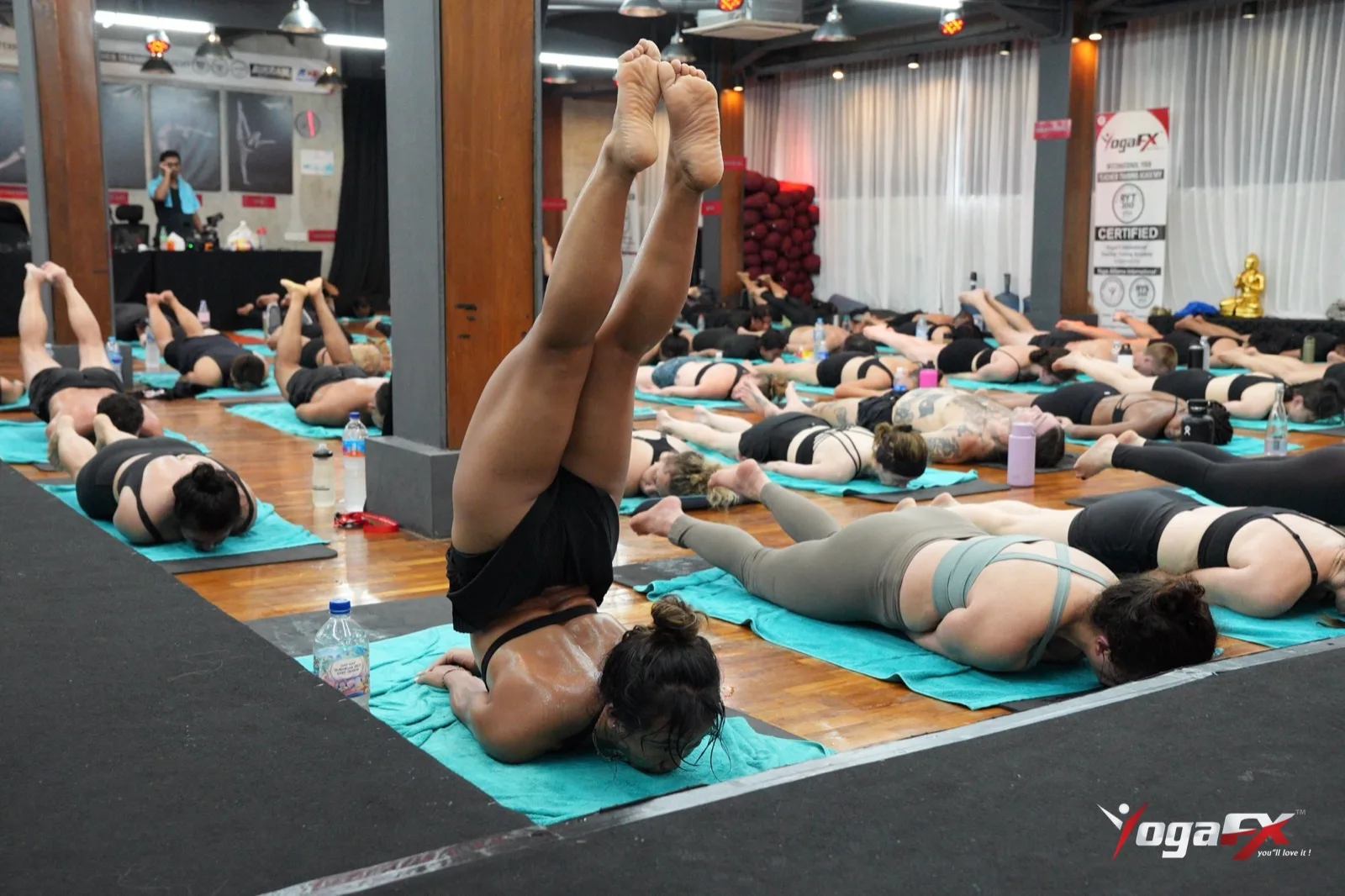
If you want the head-to-head view, our comparison hot yoga vs sauna: active and passive heat stress goes deeper. For the heart-rate side, ask your teacher what zones to expect in a Bikram class.
Why the Bikram Lineage Uses Heat at All
The heat in a 26&2 room is not a wellness trend. It is part of the method, and the method has a lineage. The lineage runs through Bishnu Charan Ghosh, a story told in our article on the roots of Bikram yoga.
Mr. Ian Terry spent 5 years, from 2014 to 2019, training with the founder of the Bikram Hot 26&2 method. That is where he learned the rule most teachers repeat: the room is a tool for the postures, never the goal. Warm muscles move further, and the scripted dialogue keeps everyone working at a steady pace.
Teachers also point to a practical reason. A heated room makes stretching feel easier, which can tempt students to push too far. Part of a teacher's job is to slow people down. That is a safety lesson, and it shows up in every training day.
If you want the full background, read our guide to Hot 26 and 2 yoga: lineage, science and teaching.
Natural Tropical Heat Versus Electric Heat
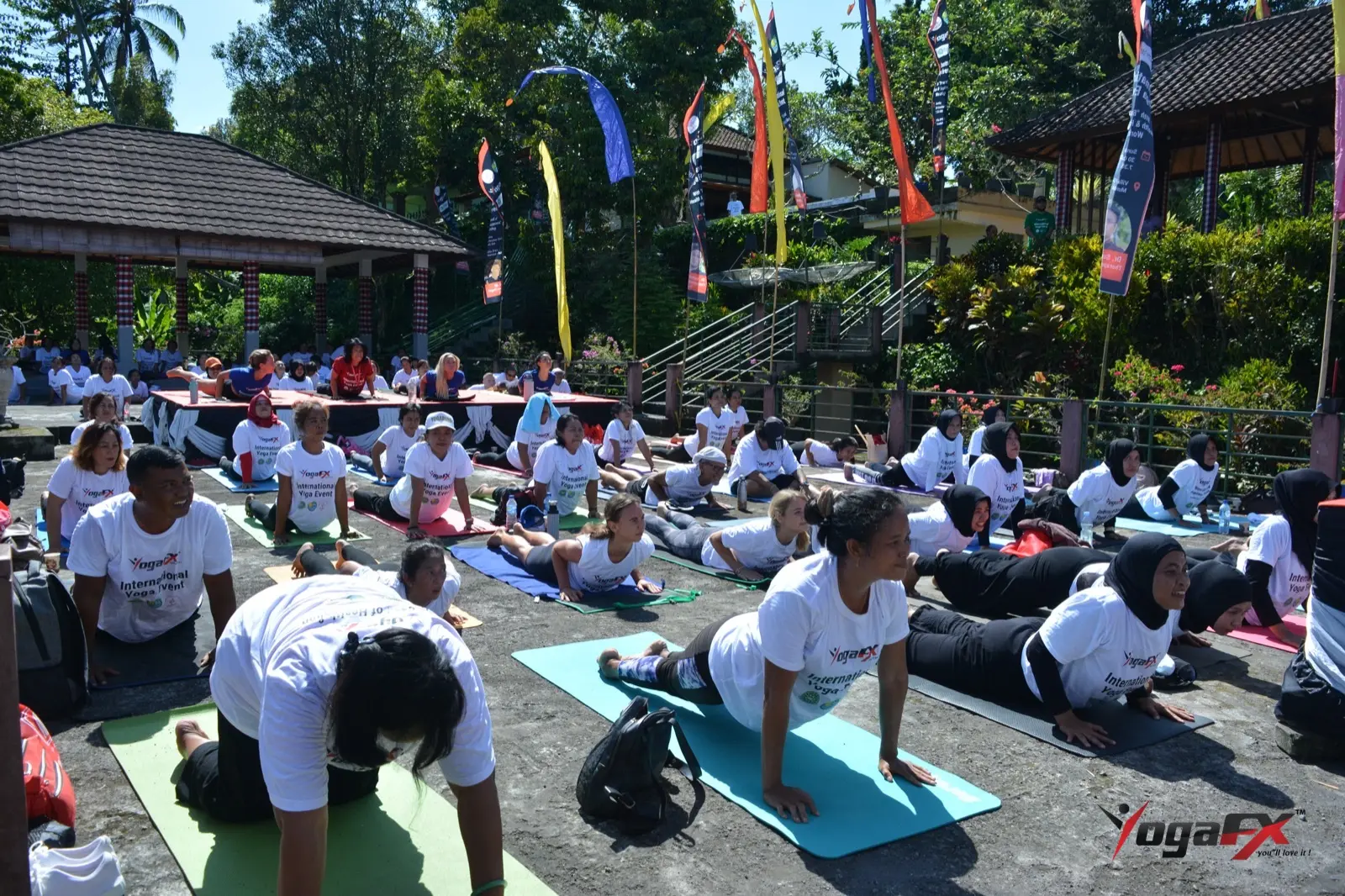
At YogaFX in Bali, the heat is largely natural and tropical. That is a different setup from a studio running panels or heaters. The room stays near 40 degrees C and 40% humidity, and the class lasts 90 minutes with a scripted dialogue and no music or demonstration.
Why does the source of heat matter? Humid air and dry air feel different, and humidity changes how sweat evaporates. We explain the humidity side in our steam room comparison. No study has proven that tropical heat gives extra benefits, so I will not claim it. I will say it is what our students train in, and it is why we teach pacing and hydration so carefully.
Mood, Stress and the Mind: What Students and Studies Say
What trainees and studies say about mood
Many people try heat for how it makes them feel, not for blood vessels. Mood-related heat therapy benefits are still early science. A 2023 trial at Massachusetts General Hospital (Nyer et al.) tested 8 weeks of heated hatha yoga in adults with depression. About 59% of the yoga group cut their symptoms by half or more, against about 6% on a waitlist.
That is encouraging, but it is not a treatment claim. The trial was small, and it cannot tell us whether heat, movement, or the weekly routine did the work. A 2022 study (Hui et al.) also reported that hot yoga reduced state anxiety. Again, the design cannot separate heat from exercise.
So what do trainees actually say? We pulled three real reviews from the YogaFX review store. Names are first names only.
"We then had unlimited access to the Wellness Centres facilities such as the ice bath, steam room and Sauna."
Adam, Google review, 2024
Adam describes the venue of an earlier batch, where a morning class was followed by sauna, steam room and ice bath. That pairing is the closest thing we have to a real-life test of active heat plus passive heat. It is also a personal account, not evidence.
"Coming here was solely for like my personal benefit and my personal growth."
Bronte, YouTube review, 2025 (watch the video)
"It was more than just a certification. This was a true quest to find a little bit about myself and I loved every bit."
Angela, YouTube review, 2024 (watch the video)
Both trainees talk about growth, not temperature, and that doesn't surprise me. That fits what I see in the room: the lasting effect people describe is rarely about heat on its own. It is about showing up daily for something hard.
What Is Still Unproven About Heat Therapy
Honest teaching means saying where the evidence stops for heat therapy benefits. Here is what I tell trainees when they ask whether heat will fix a specific problem.
- Detail on dose is missing. Nobody has shown the ideal temperature, length or weekly count for most goals. The Finnish figure of 4-7 sessions a week is an observation, not a prescription.
- Cause is hard to prove. People who use saunas often may differ in lifestyle, income or health from people who do not. Observational studies cannot remove every difference.
- Yoga adds confounders. A hot class changes your breathing, mood, sleep routine and fitness, all at once. Any benefit could come from any of those parts.
- Small trials dominate. Many hot yoga trials are short and use few people.
None of this makes heat useless. It's a reminder that heat therapy benefits are real but modest and uneven. It means you should treat each claim as a hypothesis worth testing on yourself, carefully, with your doctor in the loop if you have any health condition.
A sensible way to try heat therapy
You don't need a lab to be careful. Use the same approach whichever of the heat therapy benefits you want.
If you are new to heat, start small and keep notes. A simple plan beats a heroic one, because consistency matters more than intensity.
- Begin with short exposures and increase slowly over several weeks.
- Drink water before and after, and eat lightly before a hot class.
- Track how you feel the next day, including sleep, energy and soreness.
- Take a rest day whenever you feel run down or unwell.
Combining Sauna With a Hot 26&2 Class
Can you stack passive heat on top of active heat? Some people do, and some training venues make it easy. The question is whether it is wise on a given day.
Our full guide, sauna after hot yoga and core temperature rules, covers timing in detail. The short version, from Mr. Ian Terry's teaching experience, runs like this:
- Hydrate first. After 90 minutes of sweating, your body needs fluid and rest, not more heat.
- Keep the sauna short. A brief, gentle session is safer than a long one.
- Stop if you feel dizzy. Lightheadedness means leave the heat and cool down slowly.
- Skip it on hard days. If you are already drained, passive heat adds stress without adding comfort.
These are teaching guidelines, not research findings. If you have heart or blood pressure issues, ask your doctor before you combine heat sources.
Heat Therapy Safety: Who Should Be Careful
Heat therapy benefits come with a cost: heat changes blood flow, fluid balance and heart rate. For most healthy adults, short sessions are tolerated well. But a hot room is not neutral, and this is why good teachers talk about safety before they talk about benefits.
- Heart or blood pressure conditions: talk to your doctor first.
- Pregnancy: ask your healthcare professional before any heat practice.
- Alcohol: never combine it with sauna or a hot class.
- Dehydration: drink before, during and after. Heavy sweating drains fluid.
Mr. Ian Terry teaches every trainee to read these warning signs in other people too. Spotting a student who is overheating is a skill, and it is part of what a Bikram teacher learns in training.
Heat Therapy Benefits and Teacher Training With Mr. Ian Terry
If heat therapy benefits interest you because you teach or want to teach, the YogaFX 6-day hybrid MasterClass is where we teach the full picture: the 26 postures, the dialogue, and how to manage a hot room safely. Mr. Ian Terry has trained 1,500+ graduates from 80+ countries since 2017.
The next batch checks in on Sunday 24 January 2027 and checks out on Friday 29 January 2027, at Soham Wellness Center in Seminyak. The course gives you Yoga Alliance RYT 200-Hour and Bikram Hot 26&2 200-Hour International Yoga Certification. You can see the format on our 6-day Bikram teacher training page.
For a broader overview that looks at heat therapy across hot yoga generally, see this guide to how hot yoga fits into heat therapy. You can also browse the YogaFX teacher training hub for the full programme.

FAQ
Why does the Bikram method use a heated room?
In the Bikram lineage the heat is a teaching tool. Warm muscles move further, and the scripted 90-minute dialogue keeps everyone working at a steady pace. Teachers also learn that easier stretching can tempt students to overreach, so slowing people down is part of the job.
Can a hot yoga class replace a sauna session?
Not exactly. A sauna gives passive heat while you sit still, and a class gives active heat plus a real workload. They can serve different goals. If you want fitness, the class does more work. If you want to unwind, a short sauna may fit better.
Is the evidence for sauna benefits strong?
It is promising but limited. A Finnish study of 2,315 men links frequent sauna use with fewer sudden cardiac deaths, yet it is observational, so it shows a link, not a cause. A 2018 review says sauna bathing may be linked to several health benefits.
Do teachers learn about heat safety in Bikram training?
Yes. Trainees learn to spot warning signs such as dizziness or heavy fatigue, to pace a class, and to explain hydration. Mr. Ian Terry teaches this in the YogaFX 6-day hybrid MasterClass, because reading a student who is overheating is a core teaching skill.
Can I do sauna after a Bikram class?
Some people do, but caution is wise. After 90 minutes of sweating you need fluid and rest first. Keep any sauna short and gentle, and stop at once if you feel dizzy. If you have heart or blood pressure issues, ask your doctor before stacking heat.
Still have questions? Message Mr. Ian and the YogaFX team on WhatsApp and we will answer them personally.