





Hot yoga dizzy? Ease off, lie down in Savasana, and stay in the room unless you have signs of heat exhaustion. Bikram teachers give a faint student the same four instructions: slow down, rest flat, sip water slowly, and get up slowly. Most dizzy spells in a 40 degree Celsius room settle with rest.

Nobody wants a hot yoga dizzy spell in the middle of a 90-minute class. The worry is common, and it is worse for people who plan to teach, because a teacher has to know what to say to the next faint student. This guide gives you the words, the reasons behind them, and the signs that mean a doctor, not a mat.
Mr. Ian Terry, an E-RYT 500 teacher with more than 12,000 teaching hours, trains teachers in the Hot 26&2 method in Bali. The steps below follow the habits of that classroom tradition and are checked against public health pages from the NHS, Mayo Clinic and MedlinePlus. They are general information, not medical advice.
Hot Yoga Dizzy: 4 Instructions Bikram Teachers Give
The 26&2 class is a scripted dialogue, so a teacher does not pause the class to improvise. Teachers still keep a short list of instructions for a hot yoga dizzy student who feels faint. The list is simple because a dizzy person cannot follow a long one.
1. Ease off at the first wobble
The first instruction is to stop, not to push through. A student who keeps going to save face often turns a light-headed moment into a faint. Coming out of the posture early costs you a few seconds. Fainting mid-posture can cost you a fall. A hot yoga dizzy moment is a signal, so answer it early.
Mayo Clinic lists both dizziness and faintness among the symptoms of heat exhaustion, and its first advice is to stop all activity and rest. That matches what a Bikram teacher says from the front of the room.
2. Lie down in Savasana
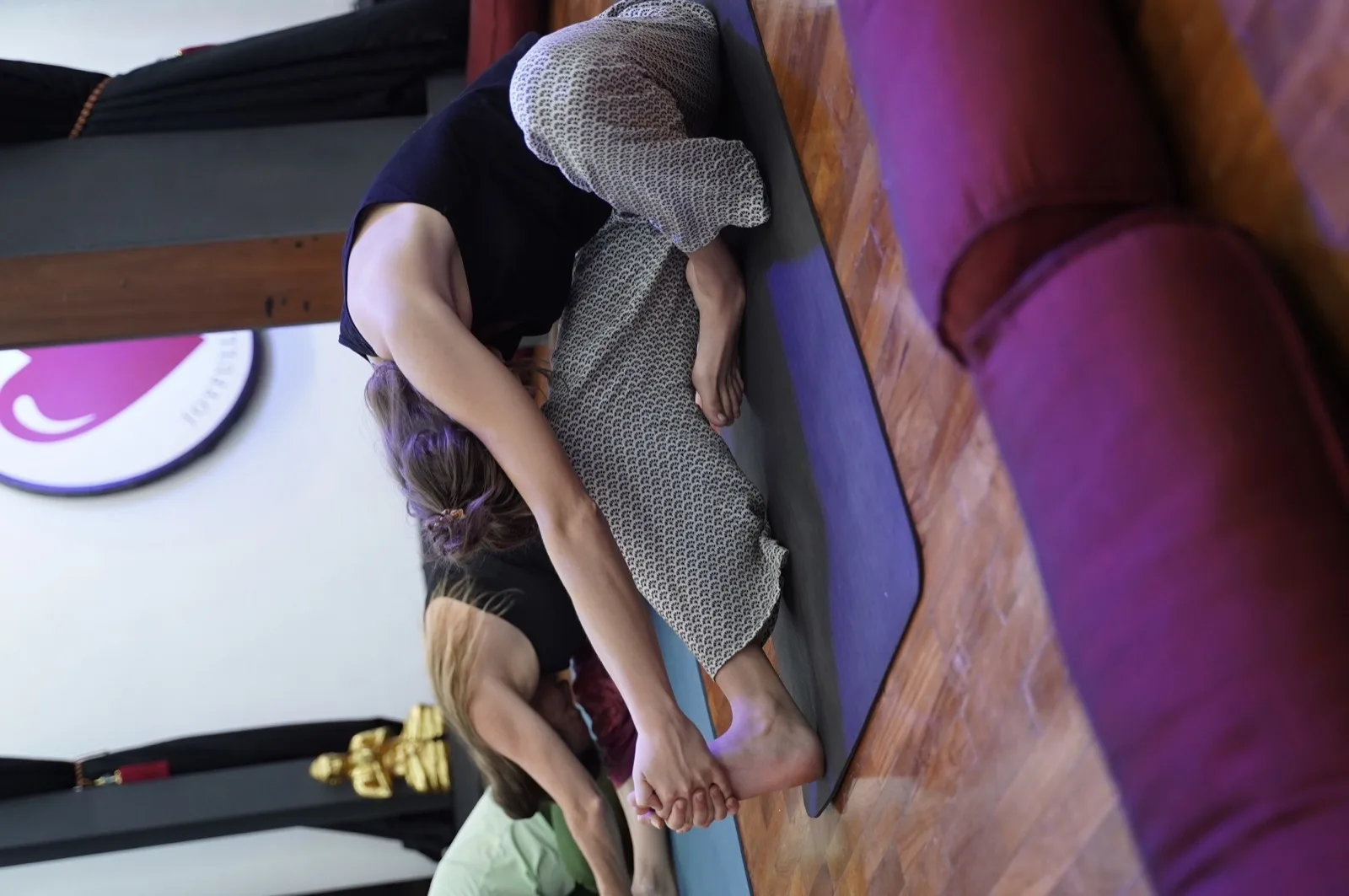
Savasana, the corpse pose, is the rest posture of the class. Lying flat takes the load off your legs and lets blood reach your head more easily. A seated forward fold or a kneeling rest also works if lying flat feels wrong for you today.
Choose the lowest position you can hold. The closer your head sits to the mat, the less distance blood has to travel upward.
3. Stay in the room
Teachers in the Bikram tradition usually ask a dizzy student to rest on the mat instead of walking out. A staggering walk to the door is riskier than lying down where you are. The next section explains when this rule stops applying.
4. Sip water, then rise slowly
Take small sips, not a long gulp. Then sit up, wait a few breaths, and stand only when the room is steady. We come back to the standing moment further down, because it causes more dizziness than most students expect.
Why a Hot Yoga Dizzy Spell Happens in a 40 Degree Room
A class at 40 degrees Celsius with 40 percent humidity asks your body to cool itself for 90 minutes. Your blood vessels widen, your skin takes more blood, and you sweat. All three changes can leave less blood for your brain when you move quickly.
A 2014 University of Wisconsin study (Porcari et al.) measured the effort of a 90-minute class and found that participants worked at about 80 percent of their maximum heart rate. That is real cardiovascular work in real heat. Our guide to heart rate zones in a Bikram class shows what that looks like from the mat.
Mayo Clinic explains that a hot environment can cause heavy sweating and possibly dehydration, which can lower blood pressure and trigger dizziness on standing. So the heat, the sweat and the standing postures all stack up.
- Heat. Your body sends blood to the skin to lose heat, so less stays in the core.
- Fluid loss. Sweat removes water and salt, which lowers blood volume.
- Position changes. Standing up fast after lying or sitting briefly drops blood pressure.
- Breath holding. Tense postures with a held breath can also make you feel light-headed.
Not every hot yoga dizzy student has done something wrong. A well-prepared student can still feel unsteady on a humid day, in a new room, or after a poor night of sleep. That is why teachers treat it as a signal to respond to, not a failure to apologise for.
Which Kind of Hot Yoga Dizzy Is It? A Teacher's Table
Teachers sort dizziness by when it arrives. The timing points to the likely cause and the right first move. The table below is a teaching aid, so it cannot replace a doctor's advice for your own health.
| When it hits | What it feels like | Likely trigger | What a teacher tells you |
|---|---|---|---|
| Rising from a floor posture | A brief tilt that passes in seconds | Blood pressure drop on standing | Sit for a few breaths, then stand slowly |
| Mid-class, standing postures | Light-headed, a feeling of fading | Heat plus fluid loss | Come down, lie in Savasana, sip water |
| Late in class | Dizziness with heavy sweating and a pounding pulse | Possible heat exhaustion | Stop, move to cooler air, tell the teacher |
| Right after class | Wobbly when you stand or walk | Standing up fast, low fluids | Sit, drink slowly, rise in stages |
| Hours later or the next day | Tired, foggy, light-headed | Under-drinking or low sleep | Rest, drink, eat a light meal |
The first two rows are the most common. The third row is the one to watch, because it matches the heat exhaustion symptoms listed by the NHS, which include dizziness, excessive sweating and being very thirsty. If you also feel tired or sick for hours afterwards, read why some trainees feel wiped out after class.
Stay in the Room: What It Means and When to Leave
Staying in the room is a tradition in the Bikram class, and it has a practical reason. A hot yoga dizzy student who rests on the mat stays under the teacher's eye. A student who stumbles out alone might faint in a corridor with nobody nearby.
But the rule has an exception, and a good teacher knows it. Mild light-headedness usually settles with rest on the mat. Signs of heat exhaustion call for a cooler place. Mayo Clinic's first-aid steps are to rest, move to a cooler place, and drink cool water or sports drinks. The NHS adds that someone helping should stay with the person until they feel better.
So the working rule is this: rest first, and leave the heat if the signs build. Ask a staff member or fellow student to walk with you instead of going alone. Our page on studio rules about leaving the room explains how to step out without disturbing the class.
Signs that mean leave the heat now
- Heavy sweating together with a rapid pulse.
- Nausea, a headache, or a feeling of weakness that is getting worse.
- Cool, pale, clammy skin.
- Confusion, or you cannot answer a simple question.
If you faint, hit your head, feel chest pain, or become confused, treat it as an emergency and get medical help. Those signs are not a reason to rest on the mat and wait.
Hydration Timing for Students Who Get Dizzy
Water helps with a hot yoga dizzy spell, but timing matters. Mayo Clinic's prevention advice is to drink plenty of fluids because staying hydrated helps your body sweat and keep its temperature from rising too high. A big drink in the last ten minutes before class does not fix a day of under-drinking.
Here is the timing teachers suggest, in plain terms:
- Through the day. Drink steadily so you arrive with fluid already in reserve.
- Before class. Have a light meal and a small drink, not a full bottle that sloshes in your stomach.
- During class. Take small sips in the pauses the dialogue gives you, instead of one long gulp.
- After class. Drink again, and add salt through food or an electrolyte drink if you sweated heavily.
The NHS notes that an isotonic sports drink or oral rehydration powder can help replace salt lost through sweating. That is useful after a heavy sweat, though it is advice for recovery and not a licence to skip plain water.
There is also a fair warning here. Drinking far too much plain water in a short time is not a fix for dizziness either. Steady, small amounts work better, and a doctor can advise you if you take medicine that changes how your body handles fluid.
Rising Slowly: The Floor-to-Standing Moment
Many students have a hot yoga dizzy moment only when they stand up. Mayo Clinic describes orthostatic hypotension as low blood pressure that happens when standing after sitting or lying down. It can cause dizziness, lightheadedness and possibly fainting.
MedlinePlus gives simple home advice for the same problem: get up from a lying position slowly, and stay seated for a few moments before standing. A hot room makes the effect stronger because the body is already working to cool down.
In class, that means three small habits. Sit up before you stand. Hold the mat edge or a wall as you rise. Take two or three breaths before the next posture. A teacher cannot do this for you, but a teacher can remind you.
How a Scripted Class Helps With Hot Yoga Dizzy Moments
The Hot 26&2 class runs for 90 minutes at 40 degrees Celsius and 40 percent humidity, with a scripted dialogue, no music and no demonstration. The heat comes from the natural tropical climate, not from an electric heater. That setting shapes how a hot yoga dizzy student is handled.
Because the teacher speaks every instruction, a student who lies down can still follow the class by ear. Nobody has to watch a demonstration to stay with the sequence. You rest, listen, and rejoin when you are ready. That is why the guidance on this site calls resting part of the practice, and not a break from it.
If you want to know how hard the class is before you try it, read how hard the 90-minute class really is. The honest answer is that it is demanding, and that is exactly why the rest instructions exist.
What Students Say About the Room
None of the reviews below describe a hot yoga dizzy moment, so we are not pretending they do. They show what students report about the room, the teaching and the support, which is the context a nervous newcomer should hear.
This is the most incredible experience.
Amanda, YouTube review, 2019
Amanda's full video review is above. She says she was unsure about teaching before and is positive about it now.
If you really really want to be a great yoga teacher that understand how to be a teacher and to be a student at the same time, choose YogaFX.
A trainee in our YouTube review, 2023
It's amazing, we are having the oxygen of the beach, we are having an amazing teacher and friends.
A trainee in our YouTube review, 2018
Those words come from students who trained with YogaFX in Bali. They are short, and they are the students' own.
Hot Yoga Dizzy After Class: The Next Few Hours
A hot yoga dizzy feeling does not always end when the class does. Many students feel it when they walk out into brighter, cooler air, collect their bag, and stand in a queue. The body is still working to cool down, and standing still is hard for a body that just lost fluid.
Treat the first half hour as part of the class. Sit down somewhere shaded, drink slowly, and eat something light when your stomach feels settled. Wait until you feel steady before you drive or ride a bike. If the dizziness comes back as you stand, sit again and repeat the slow rise.
Another hot yoga dizzy spell on the same evening is worth noting. Write down what you ate, how much you drank, and how you slept. That small record helps a doctor, and it helps you spot a pattern such as skipped meals or a hard week.
When Hot Yoga Dizzy Means See a Doctor
A single dizzy moment that clears within a few minutes of rest is rarely a cause for alarm. Dizziness that keeps returning is different. See a doctor before your next class if the spells repeat, if they come with chest pain or a racing heart, or if you black out.
Tell your doctor that you practise in a heated room. Mention any heart, blood pressure or diabetes condition, and any medicine that changes fluid or blood pressure. Your doctor can tell you whether the heat suits you. This article gives general information only, so please consult a healthcare professional about your own health.
For Future Teachers: What to Say to a Faint Student
If you are heading toward teacher training, this topic is part of the job. A teacher has to notice the student who goes quiet, grey or glassy, and has to speak calmly. Use short sentences, one instruction at a time: come down, lie flat, small sips, I am here.
Never diagnose. Say what you see and what to do, and call for help when the signs are serious. You can see the dates and formats on the 6-day teacher training page.
Mr. Ian Terry and the YogaFX team answer questions about the training on WhatsApp, including how classroom safety is taught.
FAQ
How to not get dizzy in hot yoga?
Drink steadily through the day, eat a light meal before class, and arrive early to settle. In class, sip water in the pauses and rise slowly from the floor. If the room tilts, come down and rest. Tell your teacher about any heart, blood pressure or diabetes condition beforehand.
Is it normal to feel dizzy after hot yoga?
A brief wobble when you stand is common, because heat and sweat can lower blood pressure. It should pass within seconds if you sit and rise slowly. Dizziness that lingers, repeats, or comes with chest pain, confusion or fainting is not normal, and you should see a doctor.
Can hot yoga make you faint?
Yes, it can. Heat, fluid loss and standing up fast can each lower blood pressure enough to cause fainting. That is why teachers tell students to rest early. If you do faint or hit your head, get medical help straight away, even if you feel fine afterwards.
Why do I feel sick after hot yoga?
Nausea can come from heat, a heavy meal before class, or too little fluid. It can also be an early sign of heat exhaustion. Move to a cooler place, rest, and sip water or an electrolyte drink. Seek medical help if vomiting continues or you feel worse.
Why do I get a headache after hot yoga?
Headaches after a hot class often follow fluid loss or a long gap without food. Drink water through the day and have a light snack afterwards. A severe headache, or one with confusion or vomiting, can signal something serious, so stop practising and see a healthcare professional.
Still have questions? Message Mr. Ian and the YogaFX team on WhatsApp and we will answer them personally, whether you are worried about a dizzy spell in class or want to know how teacher training handles student safety in class.