


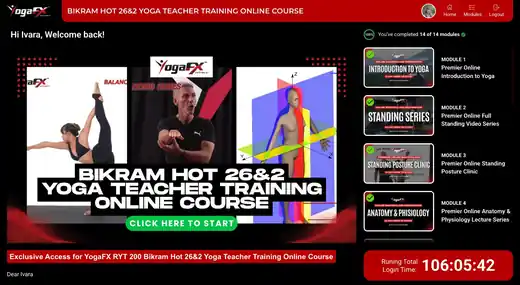



Yoga alliance certification and Bikram certification are two different credentials with two different histories. Yoga Alliance built a voluntary registry from 1997 to 1999 to set common school standards across many styles. Bikram ran its own single-method teacher training. Both still matter to a teacher today, and a good yoga alliance certification is only half the picture.

This guide is written inside the Bikram tradition, under Mr. Ian Terry, E-RYT 500, so it tells the story from that side of the room. It explains how the two systems began, why they never merged, and what that means if you want a hot yoga teaching career. It's general information, and we checked the dates below against public sources in November 2026.
Yoga Alliance Certification and Bikram Certification: What Each One Recorded
Start with the plain difference. Yoga Alliance certification is a listing on a registry. A school registers as an RYS, and its graduates apply to be listed as an RYT. The registry says its teacher listing is not a certification program, so the common phrase is shorthand. It records that you trained at a registered school. It does not test your method.
Bikram certification worked the other way round. It was tied to one method, taught by one founder. The training handed you a fixed script, a fixed sequence and a fixed room. Teachers learned a standardized dialogue, and the class ran as 26 postures and 2 breathing exercises for 90 minutes at about 40°C and 40% humidity.
What is Yoga Alliance, and is it accreditation?
People often ask what is Yoga Alliance and whether yoga alliance accreditation exists. The registry calls its work credentialing, not accreditation. It is a nonprofit trade body, not a government inspector. So yoga alliance certification is best read as a public record that a registered school trained you. For how that record fits Bikram-lineage graduates, see our guide to accredited yoga teacher training today.
The basic yoga alliance certification requirements are simple. You finish a programme at a registered school, then apply for your listing with your training certificate. Fees and renewal rules sit on the registry's own site, and they change, so check them before you apply.
So one credential answers the question, "Did you finish a recognised amount of training?" The other answers, "Can you teach this exact class?" Neither question replaces the other. That's why the two systems ran in parallel for so long, and it's why yoga alliance certification never replaced the method course.
- Registry credential. Records your school, your hours and your listing. It covers many styles at once.
- Method credential. Records that you learned one sequence, one script and one way of running a hot room.
- Audition. Studios still judge the result by watching you teach a real class.
How Yoga Alliance Certification Began, From 1997 to 2023
The registry story starts with a conference. According to the history pages of Yoga Alliance that we read, about two dozen practitioners met after a Yoga Journal conference in San Francisco in 1997. They asked whether there should be a national standard for training yoga teachers. That fall they called themselves the Ad Hoc Yoga Alliance and met at the Kripalu Center in Massachusetts.
In 1999 the group became an organisation and launched a voluntary registry for schools and teachers. The word "voluntary" matters. Nobody was licensed, and nobody was banned. The Yoga Alliance entry on Wikipedia describes it as a US-based nonprofit trade and professional organization, and the registry still works that way.
Later milestones show how yoga alliance certification grew from a standards idea into a worldwide listing. In 2013 the trade body took separate 501(c)(6) status. In 2016 it created the YACEP designation for continuing education providers. Then the pandemic changed delivery. In March 2020 it let registered schools teach online, and the 2023 digital standards made that option permanent.
| Year | Yoga Alliance track | Bikram track | What it meant for a new teacher |
|---|---|---|---|
| 1997 | Practitioners meet after a Yoga Journal conference to discuss a national standard | No registry link described in the sources we read | Training quality varied widely from school to school |
| 1999 | Organisation formed and voluntary registry launched | Founder's own nine-week trainings run through the 1990s | Two separate routes to a teaching credential |
| 2013 | Trade body takes 501(c)(6) status | Method taught through a standardized dialogue | A listing becomes a common hiring check |
| October 2015 | Registry keeps growing across many styles | Ninth Circuit rules the sequence is not copyrightable | The postures become free for any school to teach |
| November 2017 | Registry continues to grow across many styles | Founder's companies file for bankruptcy | Independent schools carry the method forward |
| 2020 to 2023 | Online delivery allowed, then made permanent | Studios rename classes as hot yoga or 26&2 | Teachers can mix online study with in-person practice |
Notice what the left-hand column never says. It names no yoga style. Yoga Alliance celebrates the diversity of styles, so it sets a floor for them all and leaves the method to each school.
Where Bikram Teacher Training Came From
The other story is a founder story. Bikram Choudhury began offering nine-week teacher certification courses in the 1990s, according to the Bikram Yoga entry on Wikipedia. His college trained its own teachers and taught them a standardized dialogue. That script is why a Bikram class sounds the same in any city.
The model was powerful. A student could walk into a studio on another continent and get the same 90 minutes. For example, a teacher could trust the room because the training had drilled the sequence, the timing and the heat. For a student of the method, that consistency was the product.
As a result, the training sat outside the general registry system. Neither the yoga alliance certification history pages nor the Bikram histories we read describe a formal link between the two. They ran on separate tracks, with different aims and different gatekeepers.
The 2015 ruling and what changed after it
The next turning point was legal. In October 2015 the Ninth Circuit unanimously affirmed a lower court and held that copyright protects only the expression of an idea, not the sequence itself. In plain terms, the 26 postures became open for any teacher or school to use. You can read our full account of the copyright, trademark and lineage history in our Bikram yoga history guide.
After that came a period of upheaval. The founder's companies filed for bankruptcy in November 2017. After the 2019 documentary Bikram: Yogi, Guru, Predator, many studios dropped the Bikram name and used "hot yoga" instead. Today the method often appears as Hot 26&2, and independent schools carry it forward.
Why the Two Systems Ran Apart: Five Real Differences
The split was not an accident or a quarrel. It came from five practical differences in what each system tried to do.
- Purpose. The registry set a minimum standard for many styles. The method course aimed to reproduce one class exactly.
- Gatekeeper. A trade body listed schools that met its standards. A single founder decided who could teach his sequence.
- Content. The registry describes categories of study, such as techniques, anatomy, philosophy and practicum. The method course taught a script word for word.
- Delivery. The registry now allows online study. The method course lived in a heated room, because the heat changes pacing and safety.
- Proof. A listing proves you finished training. An audition proves you can teach the room.
Each difference is reasonable on its own terms, because each system had a different job. A registry that tried to teach one sequence would stop serving the many styles it lists. A method course that tried to serve every style would lose the consistency that made it valuable. So the two systems solved different problems, and they didn't need to merge.
That also explains the market today. A general registry listing, such as yoga alliance certification, is easy for a studio to check. A method certificate is harder to check but tells the studio far more about the class you will teach. Smart studios want both, and smart teachers collect both.
What Yoga Alliance Certification Means for a Hot Yoga Teacher Today
So what should you do with this history of yoga alliance certification? Treat the two credentials as two layers. The first layer is yoga alliance certification, which gives you a searchable listing and a common language with employers. The second layer is a method certificate, which shows you can run a 26&2 class with the script, the timing and the heat.
Studios hiring for a hot room tend to check four things:
- Your listing. A studio can look up yoga alliance certification in a minute.
- Your method training. They want proof you learned the 26&2 script.
- Your teaching hours. More hours usually means a calmer room.
- Your audition. A short class shows pacing and voice quickly.
A teacher with only the first layer often needs extra training before a hot studio will hire them. A teacher with only the second layer may struggle to show a recognised record of hours. That's why holding both is the safest plan.
For the practical details of fees and renewal, read the practical side of the registry for UK hot yoga teachers, including fees and renewal. This guide stays on the history so you can see why the layers exist. For a wider look at your options, see our guide to types of hot yoga certification.
Why the trainer's background matters
A listing records hours, so it is worth asking who is leading your training and how long they have taught. Mr. Ian Terry holds E-RYT 500 and has more than 12,000 teaching hours. He spent five years, from 2014 to 2019, training alongside the founder of the Bikram Hot 26&2 method. If you want the credential explained, read what E-RYT 500 means.
Lineage matters here because a registry cannot show it. Instead, a yoga alliance certification listing says you finished training. Your trainer's own training history tells you where the method came from.
What the Research Says About Heated Yoga and Teacher Training
Yoga alliance certification says nothing about health outcomes, so a teacher should know the research. Therefore we keep these claims modest, because study quality varies and results differ between people.
Willmott and colleagues published a 2025 review of Bikram yoga research. Across 43 studies, it reported better flexibility, bone density and well-being. Mood data come from a Massachusetts General Hospital trial (Nyer et al., 2023, Journal of Clinical Psychiatry). After eight weeks, roughly 59% of heated yoga participants had halved their depression symptoms, compared with 6.3% on the waitlist.
We name each study instead of linking it, because the research sites blocked our link checker on 10 November 2026. Search the authors and year to read them yourself. None of this promises a result for you. This is general information, not medical advice, so consult a healthcare professional before any heated class if you have a heart condition, are pregnant or take regular medication.
Why does it matter for teachers? A heated room raises the stakes. The teacher paces the class, watches for distress and calls rest at the right moment. Because of that, the skill comes from practice in a real hot room, not from a registry listing.
What Graduates Say About Yoga Alliance Certification Plus a Method Certificate
Numbers describe a registry, but people describe a course, and yoga alliance certification is only one part of what they remember. Across platforms, YogaFX students have left 150 Google reviews, 50 Yoga Alliance reviews and 357 YouTube testimonials. Reviews are one person's experience, not proof of a result for you. Three of them touch on the point of this guide.
"Feeling like we've grown together as a family."
Chris, YouTube review, 2025
Chris describes the training as a shared experience, which no registry listing can record. You can watch the full video review below.
"Two of the most important mentors in my life."
Katy, Google review, 2019
Katy points to the mentors rather than the paperwork. That's the same lesson the history teaches: the credential opens the door, and the teaching earns the trust.
Yanti, in a 2019 YouTube review, thanked Mr. Ian and the YogaFX family after receiving her 200-hour teacher training certificate (paraphrased).
How YogaFX Brings the Two Systems Together
One course, two certificates
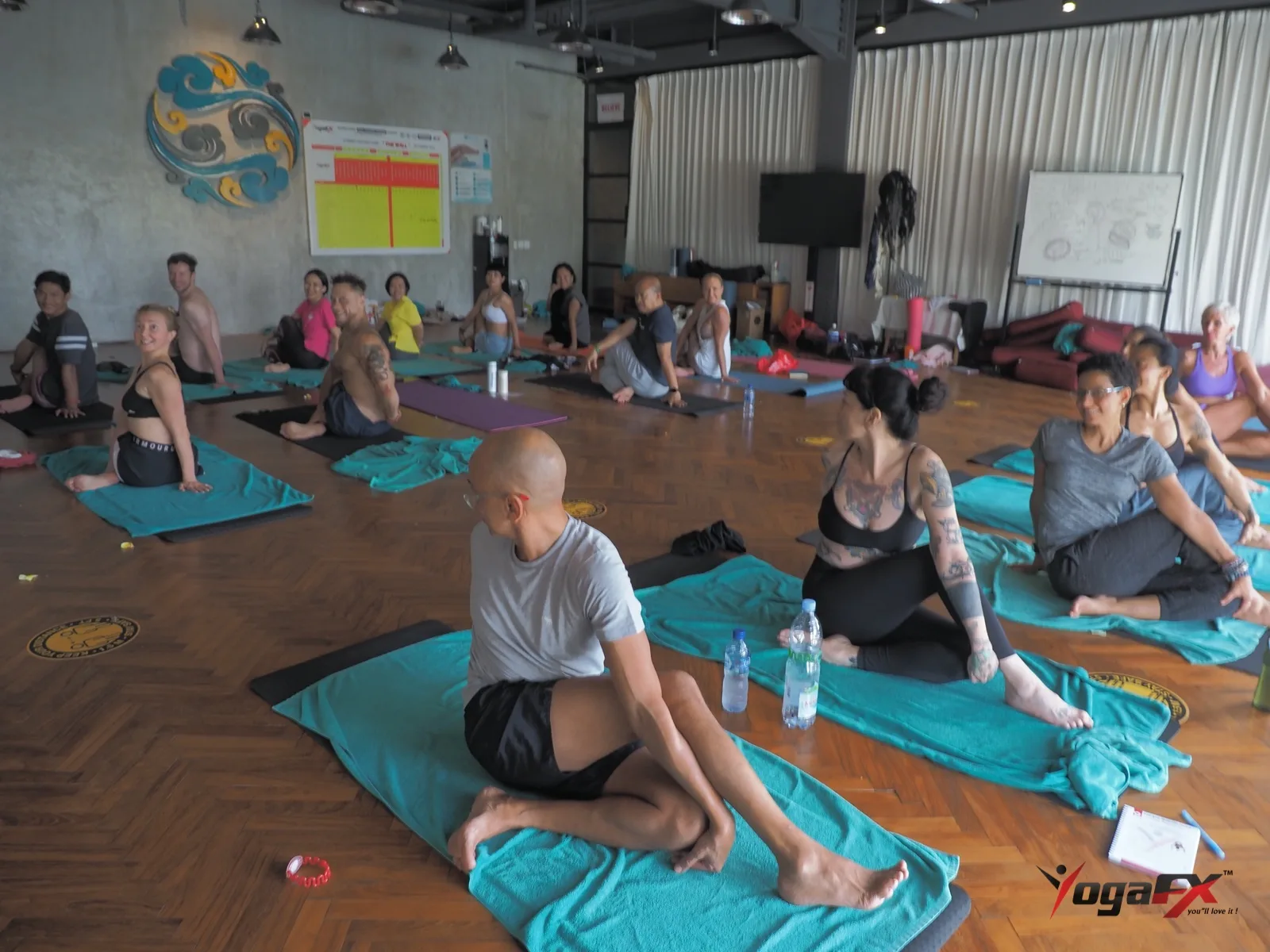
YogaFX is built to give graduates both layers in one course. The Bikram Hot 26&2 Yoga Teacher Training MasterClass is a hybrid: you study online first, then train in person in Bali. Graduates earn yoga alliance certification through the Yoga Alliance RYT 200-Hour certificate and the Bikram Hot 26&2 200-Hour International Yoga Certification.
Dates, venue and price
The in-person part runs from a Sunday check-in to a Friday check-out, so you take about five days off work. The next batch checks in on Sunday 24 January 2027 and checks out on Friday 29 January 2027, at the Soham Wellness Center in Seminyak. Dates and venues can shift, so confirm with the team before you book flights.
Budget for US$1,899 on the Early Bird rate, against US$1,999 at the standard rate. A twin-share room costs US$1,999 and a premium single is US$2,199. You can also pay in instalments from about US$250 a month, with no interest.
Since 2017, Mr. Ian has taught more than 1,500 graduates from over 80 countries. See dates, cost and formats for the six-day training for every intake, and read continuing education in the Bikram tradition for what comes after you graduate.
FAQ: Yoga Alliance Certification and Bikram
Is yoga alliance certification the same as Bikram certification?
No. Yoga Alliance certification is a listing on a voluntary registry that records your school and your training hours across many styles. Bikram certification was a method credential tied to one sequence and one script. The two answer different questions, so many hot yoga teachers hold both.
When did yoga alliance certification begin?
The idea began in 1997, when practitioners met to discuss a national standard for teacher training. Yoga Alliance was founded in 1999 and launched a voluntary registry for schools and teachers. It has never been a government licence, and it names no single yoga style.
Why did the Bikram system run separately from the registry?
They had different aims. The registry set a minimum standard for many styles, while the Bikram course reproduced one fixed class. The histories we read describe no formal link between them. Each system kept its own gatekeeper, its own content and its own way of judging a teacher.
Can a hot yoga teacher hold both credentials?
Yes. A teacher can register through a registered school for the listing and also complete method training for the 26&2 script and heated room. YogaFX graduates earn the Yoga Alliance RYT 200-Hour certificate and the Bikram Hot 26&2 200-Hour International Yoga Certification in one course.
Is this training the official Bikram Choudhury teacher training?
No. This is independent training, not official Bikram Choudhury Teacher Training. It teaches the Original Hot 26&2 method under Mr. Ian Terry, who trained alongside the method founder from 2014 to 2019. Always ask any school to explain its lineage and credentials in writing.
Still have questions? Message Mr. Ian and the YogaFX team on WhatsApp and we will answer them personally. WhatsApp Mr. Ian: +628113888330
About the author. This article was prepared under the guidance of Mr. Ian Terry, E-RYT 500, with 12,000+ teaching hours and five years (2014 to 2019) of training alongside the founder of the Bikram Hot 26&2 method. Since 2017 he has trained 1,500+ teachers from 80+ countries at YogaFX in Bali.
Disclaimer: this article is general information, not medical or legal advice. Registry rules change, so confirm credentials and fees with Yoga Alliance directly.